

What you'll learn
- How to write vectors using i\mathbf{i}i and j\mathbf{j}j components.
- How to find a vector between two points and calculate its length.
- How to add vectors to find resultants, especially forces.
- How to find speed and bearing from a velocity vector.
1. What is a vector?
A scalar has size only, such as mass, time or temperature. A vector has size and direction, such as displacement, force or velocity.
In AS Maths, two-dimensional vectors are often written using i\mathbf{i}i and j\mathbf{j}j.
- i\mathbf{i}i means one unit in the positive horizontal direction.
- j\mathbf{j}j means one unit in the positive vertical direction.
So the vector 4i−3j4\mathbf{i}-3\mathbf{j}4i−3j means “4 units right and 3 units down”.
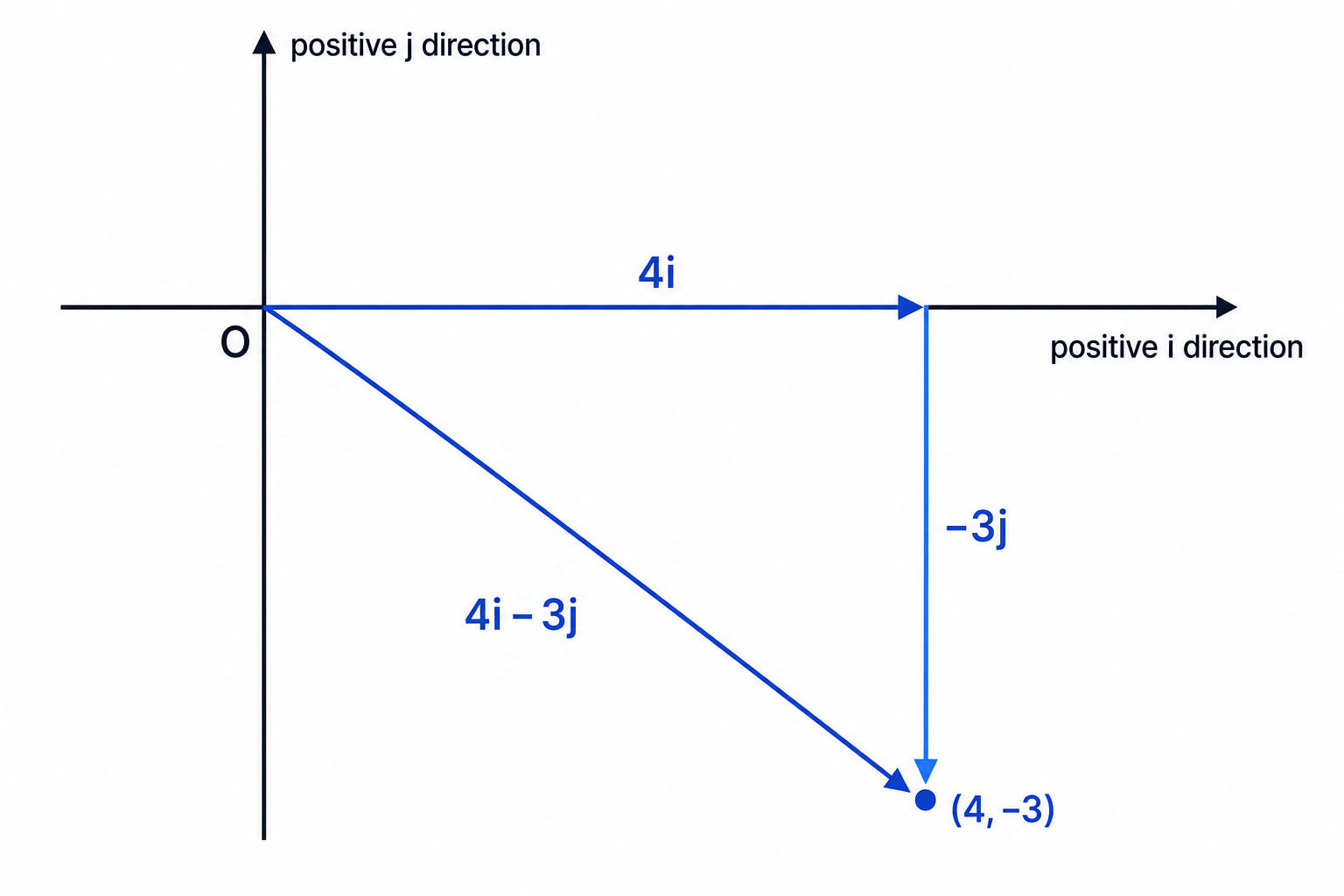
Vector in component form
A vector written as ai+bja\mathbf{i}+b\mathbf{j}ai+bj has horizontal component aaa and vertical component bbb.
Components are instructions
Read ai+bja\mathbf{i}+b\mathbf{j}ai+bj as a movement: first aaa units horizontally, then bbb units vertically. A negative component means move in the opposite direction.
Interpreting a vector
A particle starts at the point with position vector 2i+5j2\mathbf{i}+5\mathbf{j}2i+5j. It moves through the vector 3i−7j3\mathbf{i}-7\mathbf{j}3i−7j. Find its new position vector.
-
Start with the original position vector and add the movement vector:
(2i+5j)+(3i−7j)(2\mathbf{i}+5\mathbf{j})+(3\mathbf{i}-7\mathbf{j})(2i+5j)+(3i−7j) -
Add the i\mathbf{i}i components and the j\mathbf{j}j components separately:
(2+3)i+(5−7)j=5i−2j\begin{aligned} (2+3)\mathbf{i}+(5-7)\mathbf{j} &=5\mathbf{i}-2\mathbf{j} \end{aligned}(2+3)i+(5−7)j=5i−2j -
The new position vector is 5i−2j5\mathbf{i}-2\mathbf{j}5i−2j.
Mixing the components
Only combine like components: i\mathbf{i}i with i\mathbf{i}i, and j\mathbf{j}j with j\mathbf{j}j. Do not add the horizontal part to the vertical part.
2. Position vectors and vectors between points
A position vector tells you where a point is relative to the origin, usually called OOO.
For example, if point AAA has position vector 3i+4j3\mathbf{i}+4\mathbf{j}3i+4j, then AAA is 3 units right and 4 units up from the origin.
Position vector
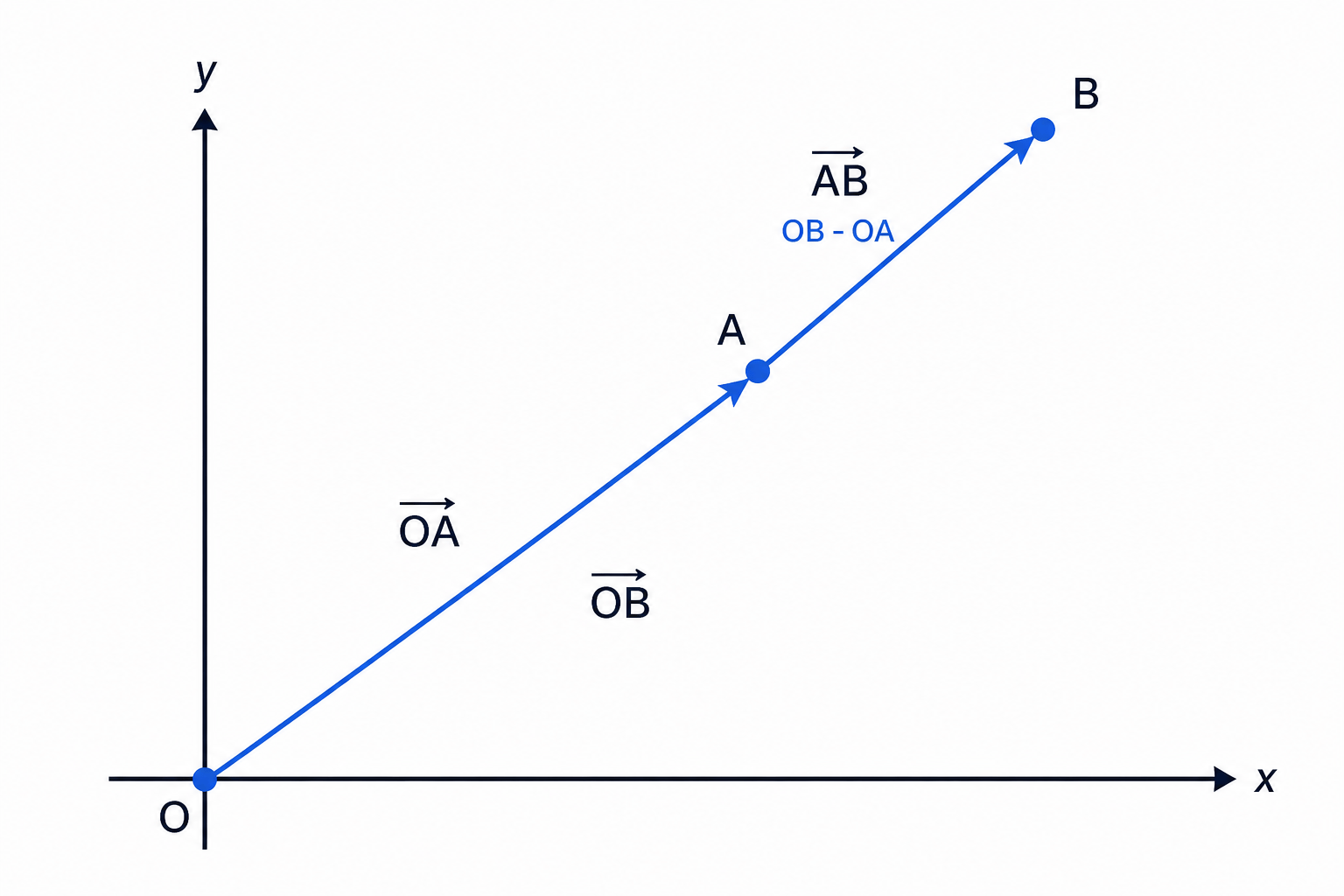
The position vector of a point AAA is the vector OA⃗\vec{OA}OA, from the origin OOO to the point AAA.
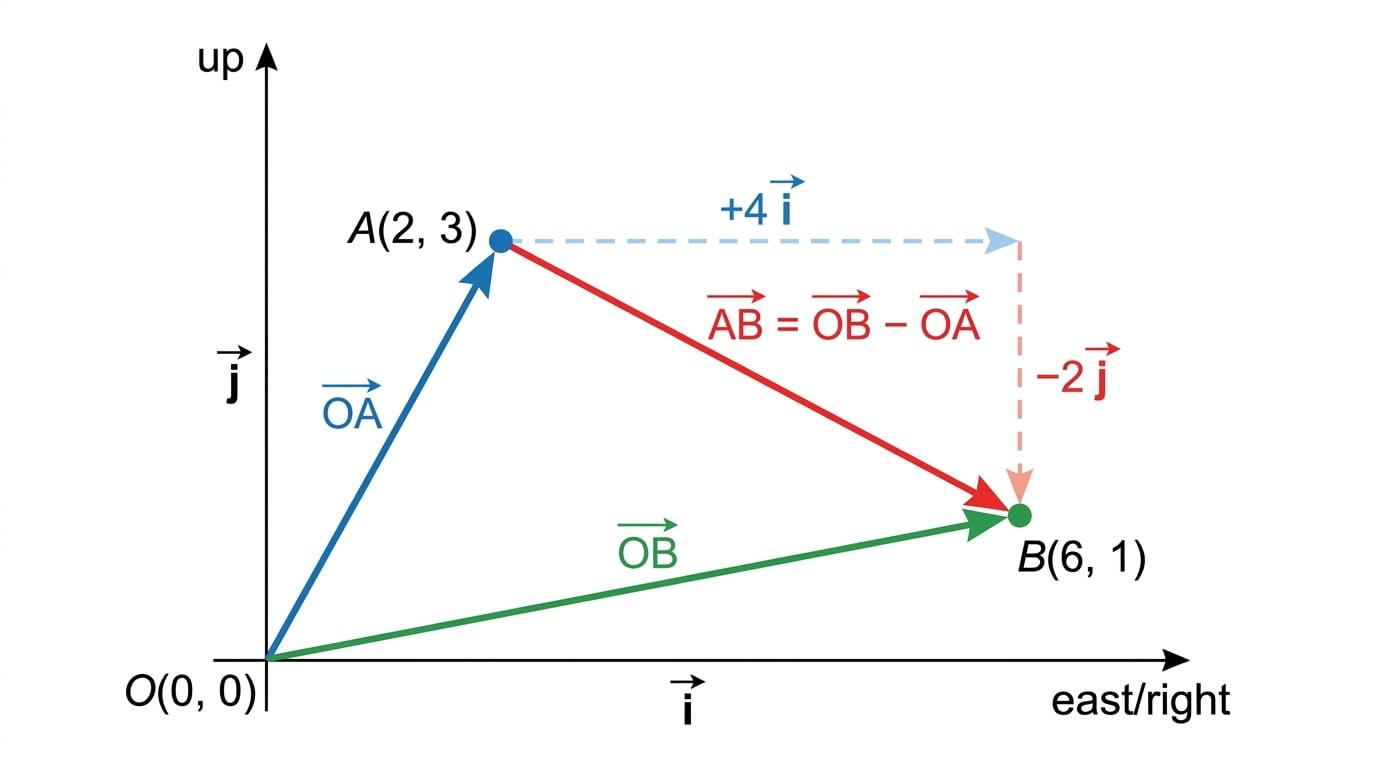
To find the vector from AAA to BBB, subtract the position vector of AAA from the position vector of BBB:
AB⃗=OB⃗−OA⃗\vec{AB}=\vec{OB}-\vec{OA}AB=OB−OAThe diagram shows why: to travel from AAA to BBB, compare where BBB is with where AAA is.
Finding a vector between two points
Point AAA has position vector 4i−2j4\mathbf{i}-2\mathbf{j}4i−2j and point BBB has position vector −3i+6j-3\mathbf{i}+6\mathbf{j}−3i+6j. Find AB⃗\vec{AB}AB.
-
Write down the formula:
AB⃗=OB⃗−OA⃗\vec{AB}=\vec{OB}-\vec{OA}AB=OB−OA -
Substitute the two position vectors:
AB⃗=(−3i+6j)−(4i−2j)\vec{AB}=(-3\mathbf{i}+6\mathbf{j})-(4\mathbf{i}-2\mathbf{j})AB=(−3i+6j)−(4i−2j) -
Subtract the components carefully:
AB⃗=(−3−4)i+(6−(−2))j=−7i+8j\begin{aligned} \vec{AB} &=(-3-4)\mathbf{i}+(6-(-2))\mathbf{j}\\ &=-7\mathbf{i}+8\mathbf{j} \end{aligned}AB=(−3−4)i+(6−(−2))j=−7i+8j -
Therefore, AB⃗=−7i+8j\vec{AB}=-7\mathbf{i}+8\mathbf{j}AB=−7i+8j.
Order matters
AB⃗\vec{AB}AB means “from AAA to BBB”, so it is always final position minus starting position. Reversing the order gives BA⃗\vec{BA}BA, which points the other way.
3. Magnitude: the length of a vector
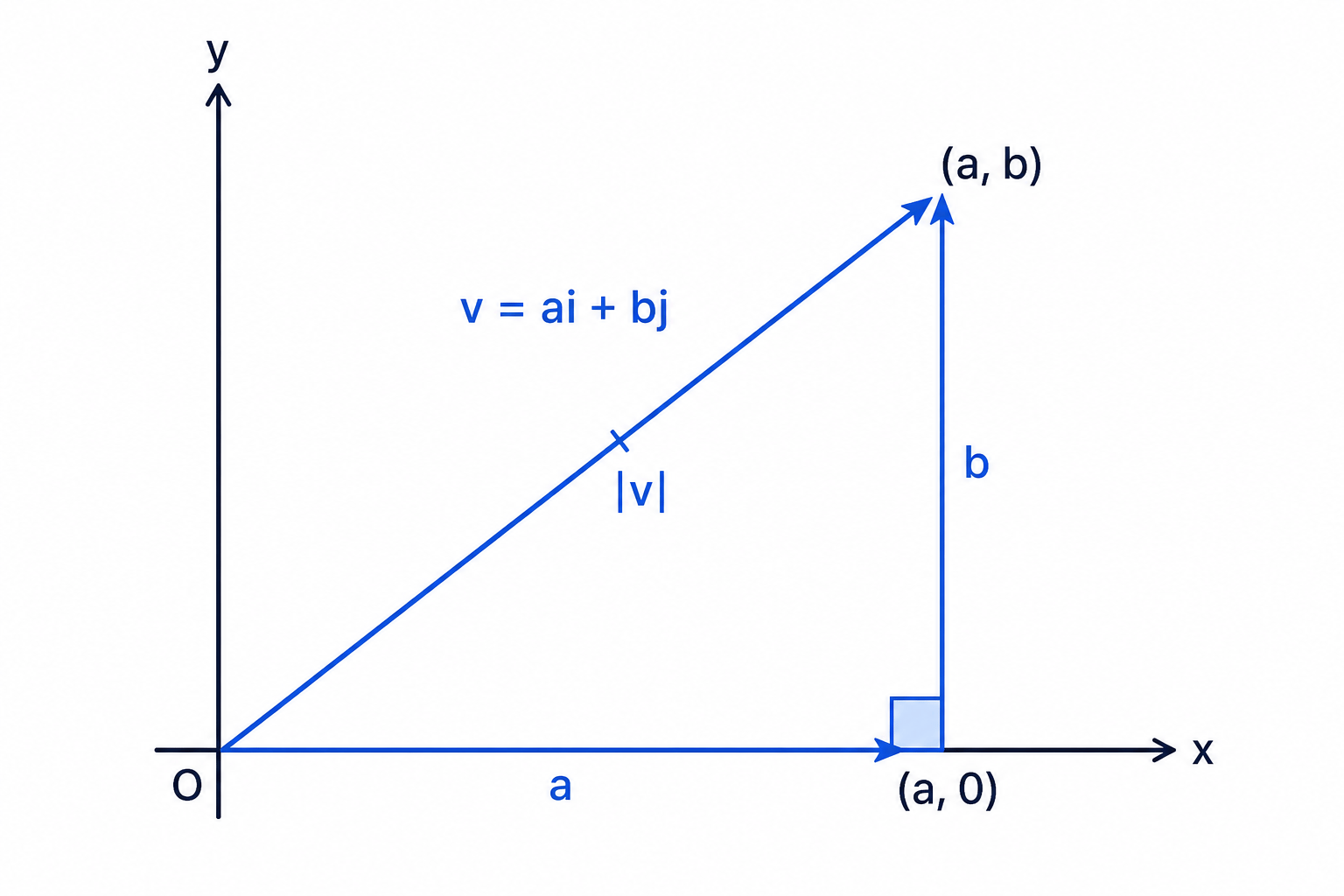
The magnitude of a vector is its length. It is written using vertical bars, such as ∣v∣|\mathbf{v}|∣v∣.
If v=ai+bj\mathbf{v}=a\mathbf{i}+b\mathbf{j}v=ai+bj, then its magnitude comes from Pythagoras:
Magnitude
The magnitude of a vector is its length or size, ignoring direction.
Finding the length of a vector
Find the length of the vector −7i+8j-7\mathbf{i}+8\mathbf{j}−7i+8j.
-
Identify the horizontal and vertical components:
a=−7,b=8a=-7,\qquad b=8a=−7,b=8 -
Substitute into the magnitude formula:
∣v∣=(−7)2+82|\mathbf{v}|=\sqrt{(-7)^2+8^2}∣v∣=(−7)2+82 -
Simplify:
∣v∣=49+64=113\begin{aligned} |\mathbf{v}| &=\sqrt{49+64}\\ &=\sqrt{113} \end{aligned}∣v∣=49+64=113 -
So the length is 113\sqrt{113}113, or about 10.6 to 3 significant figures.
Using magnitude to find an unknown component
Given that ∣5i+kj∣=13|5\mathbf{i}+k\mathbf{j}|=13∣5i+kj∣=13, find the possible values of kkk.
-
Use the magnitude formula:
∣5i+kj∣=52+k2|5\mathbf{i}+k\mathbf{j}|=\sqrt{5^2+k^2}∣5i+kj∣=52+k2 -
Set it equal to 13:
25+k2=13\sqrt{25+k^2}=1325+k2=13 -
Square both sides:
25+k2=16925+k^2=16925+k2=169 -
Solve for kkk:
k2=144k=±12\begin{aligned} k^2&=144\\ k&=\pm 12 \end{aligned}k2k=144=±12 -
The possible values are k=12k=12k=12 or k=−12k=-12k=−12.
Magnitude does not show direction
If you solve k2=144k^2=144k2=144, there are two possible values unless the question gives extra information, such as k>0k>0k>0.
4. Adding vectors and resultant forces
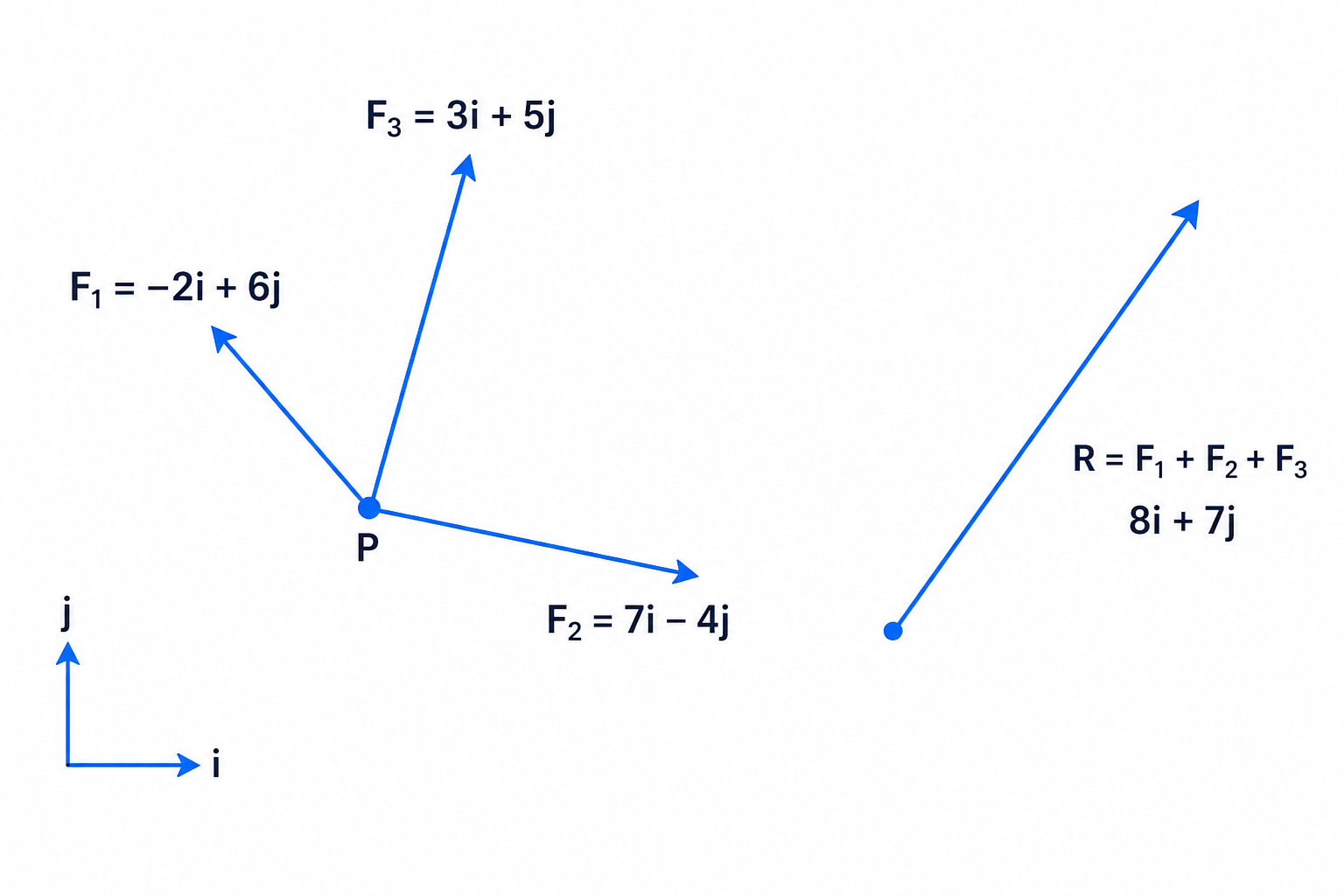
When several vectors act together, you add their components. This is common with forces.
Resultant vector
The resultant vector is the single vector that has the same overall effect as two or more vectors acting together.
For example:
(2i+3j)+(5i−j)=7i+2j(2\mathbf{i}+3\mathbf{j})+(5\mathbf{i}-\mathbf{j})=7\mathbf{i}+2\mathbf{j}(2i+3j)+(5i−j)=7i+2jFinding a resultant force
Three forces act on a particle:
F1=−2i+6j,F2=7i−4j,F3=3i+5j\mathbf{F}_1=-2\mathbf{i}+6\mathbf{j},\qquad \mathbf{F}_2=7\mathbf{i}-4\mathbf{j},\qquad \mathbf{F}_3=3\mathbf{i}+5\mathbf{j}F1=−2i+6j,F2=7i−4j,F3=3i+5jFind the resultant force.
-
Add the three force vectors:
R=F1+F2+F3\mathbf{R}=\mathbf{F}_1+\mathbf{F}_2+\mathbf{F}_3R=F1+F2+F3 -
Substitute the vectors:
R=(−2i+6j)+(7i−4j)+(3i+5j)\mathbf{R}=(-2\mathbf{i}+6\mathbf{j})+(7\mathbf{i}-4\mathbf{j})+(3\mathbf{i}+5\mathbf{j})R=(−2i+6j)+(7i−4j)+(3i+5j) -
Add the i\mathbf{i}i components and j\mathbf{j}j components separately:
R=(−2+7+3)i+(6−4+5)j=8i+7j\begin{aligned} \mathbf{R} &=(-2+7+3)\mathbf{i}+(6-4+5)\mathbf{j}\\ &=8\mathbf{i}+7\mathbf{j} \end{aligned}R=(−2+7+3)i+(6−4+5)j=8i+7j -
The resultant force is 8i+7j8\mathbf{i}+7\mathbf{j}8i+7j.
Finding an unknown vector from a resultant
Vectors a=−4i+9j\mathbf{a}=-4\mathbf{i}+9\mathbf{j}a=−4i+9j and b=xi+yj\mathbf{b}=x\mathbf{i}+y\mathbf{j}b=xi+yj have resultant 2i−5j2\mathbf{i}-5\mathbf{j}2i−5j. Find xxx and yyy.
-
Write the vector equation:
a+b=2i−5j\mathbf{a}+\mathbf{b}=2\mathbf{i}-5\mathbf{j}a+b=2i−5j -
Substitute a\mathbf{a}a and b\mathbf{b}b:
(−4i+9j)+(xi+yj)=2i−5j(-4\mathbf{i}+9\mathbf{j})+(x\mathbf{i}+y\mathbf{j})=2\mathbf{i}-5\mathbf{j}(−4i+9j)+(xi+yj)=2i−5j -
Compare the i\mathbf{i}i components:
−4+x=2-4+x=2−4+x=2 -
Solve for xxx:
x=6x=6x=6 -
Compare the j\mathbf{j}j components:
9+y=−59+y=-59+y=−5 -
Solve for yyy:
y=−14y=-14y=−14
5. Vectors in triangles
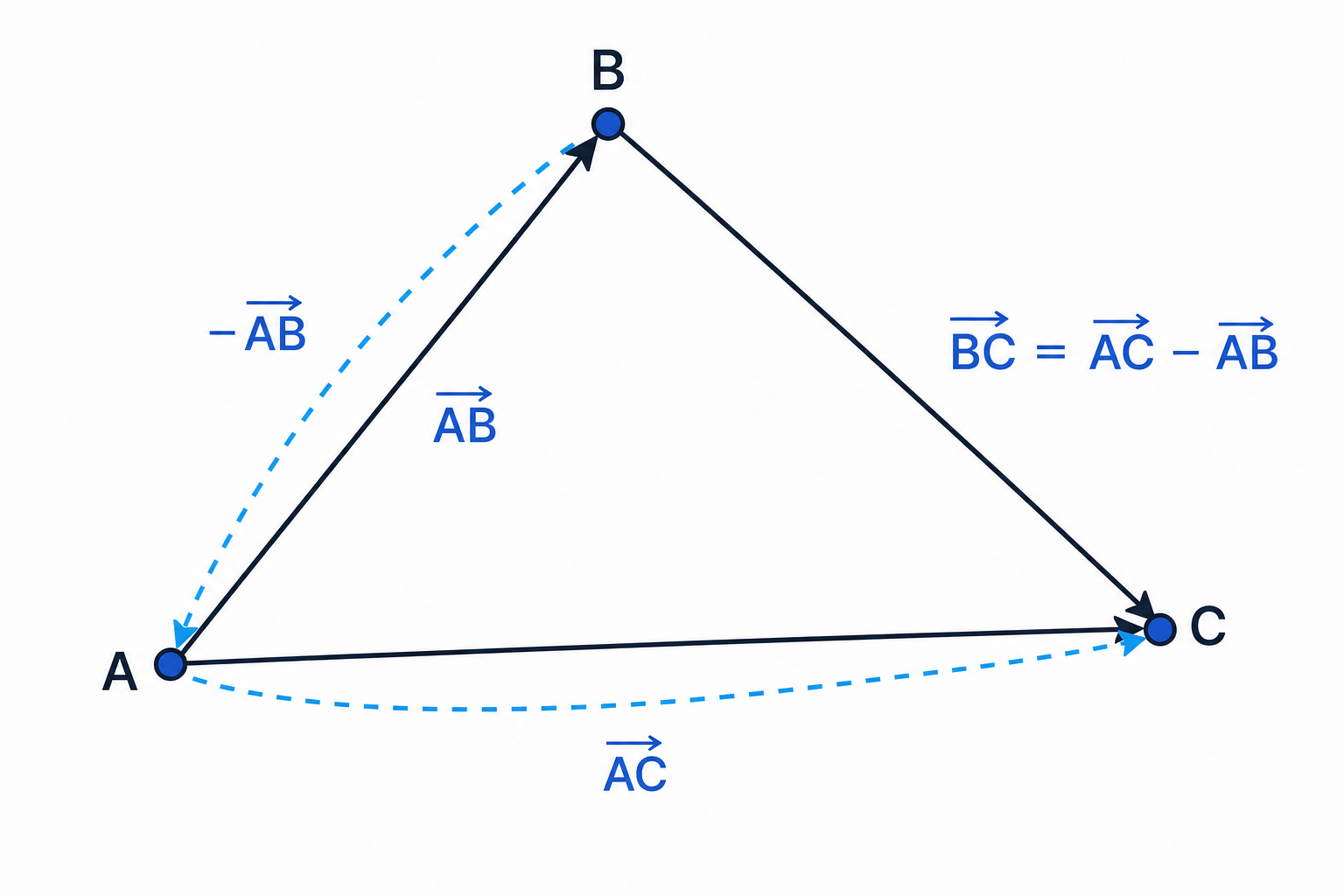
In a triangle, vectors are often described using the vertices, such as AB⃗\vec{AB}AB and AC⃗\vec{AC}AC.
If you know two vectors starting from the same point, you can find the vector between their endpoints by subtracting.
For example:
BC⃗=AC⃗−AB⃗\vec{BC}=\vec{AC}-\vec{AB}BC=AC−ABThis works because travelling from BBB to CCC is the same as going from BBB back to AAA, then from AAA to CCC.
Finding a side vector in a triangle
In triangle ABCABCABC,
AB⃗=6i−2j,AC⃗=9i+4j\vec{AB}=6\mathbf{i}-2\mathbf{j},\qquad \vec{AC}=9\mathbf{i}+4\mathbf{j}AB=6i−2j,AC=9i+4jFind BC⃗\vec{BC}BC and the length of ABABAB.
-
Use the relationship:
BC⃗=AC⃗−AB⃗\vec{BC}=\vec{AC}-\vec{AB}BC=AC−AB -
Substitute the two known vectors:
BC⃗=(9i+4j)−(6i−2j)\vec{BC}=(9\mathbf{i}+4\mathbf{j})-(6\mathbf{i}-2\mathbf{j})BC=(9i+4j)−(6i−2j) -
Subtract the components:
BC⃗=(9−6)i+(4−(−2))j=3i+6j\begin{aligned} \vec{BC} &=(9-6)\mathbf{i}+(4-(-2))\mathbf{j}\\ &=3\mathbf{i}+6\mathbf{j} \end{aligned}BC=(9−6)i+(4−(−2))j=3i+6j -
To find the length of ABABAB, use the magnitude of AB⃗=6i−2j\vec{AB}=6\mathbf{i}-2\mathbf{j}AB=6i−2j:
∣AB⃗∣=62+(−2)2|\vec{AB}|=\sqrt{6^2+(-2)^2}∣AB∣=62+(−2)2 -
Simplify:
∣AB⃗∣=36+4=40=210\begin{aligned} |\vec{AB}| &=\sqrt{36+4}\\ &=\sqrt{40}\\ &=2\sqrt{10} \end{aligned}∣AB∣=36+4=40=210
Using the wrong direction in triangles
BC⃗\vec{BC}BC is not usually AB⃗−AC⃗\vec{AB}-\vec{AC}AB−AC. Check the direction: from BBB to CCC means “position of CCC minus position of BBB”.
6. Velocity vectors, speed and bearings
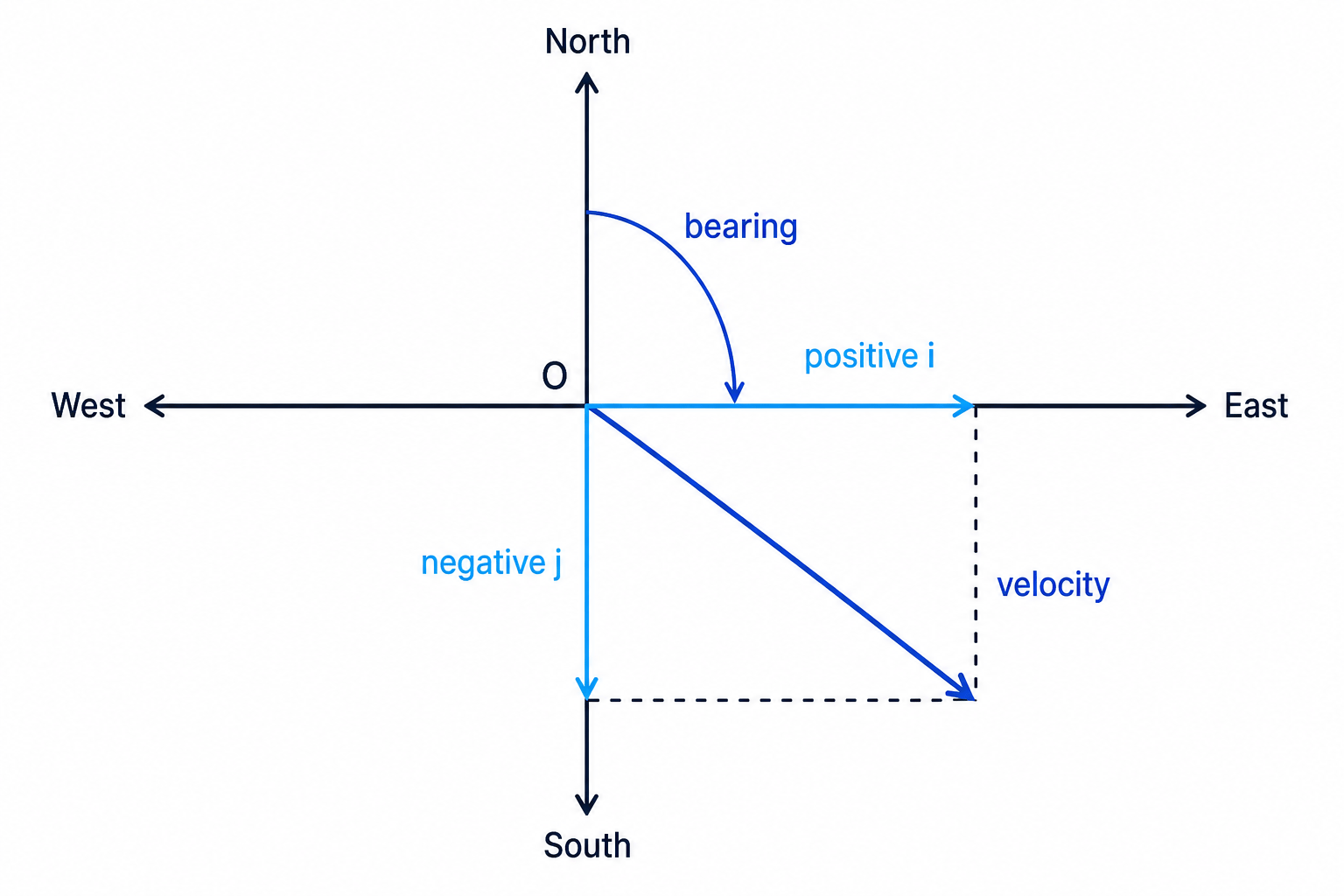
A velocity is a vector: it tells you both speed and direction. If i\mathbf{i}i is east and j\mathbf{j}j is north, then:
- positive i\mathbf{i}i means east,
- negative i\mathbf{i}i means west,
- positive j\mathbf{j}j means north,
- negative j\mathbf{j}j means south.
The speed is the magnitude of the velocity vector.
Bearing
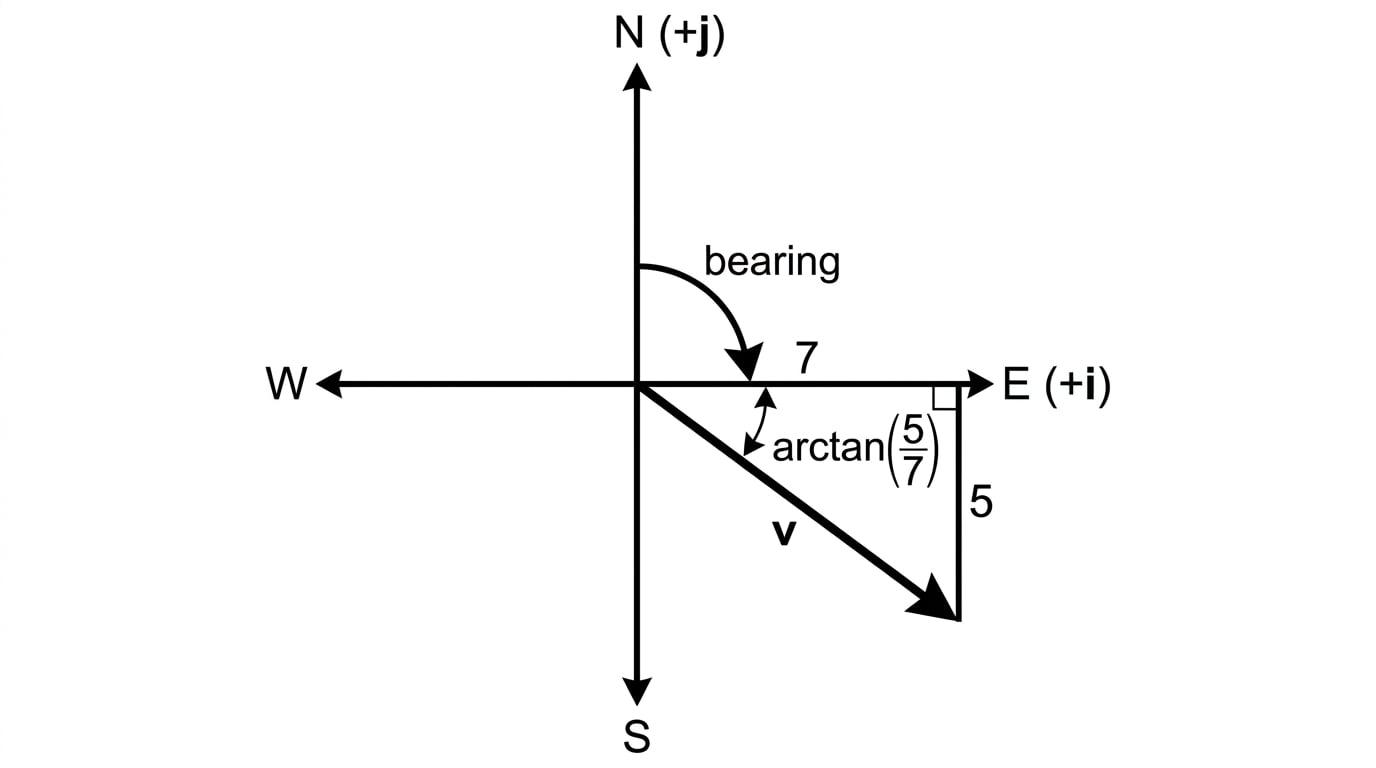
A bearing is an angle measured clockwise from north. It is usually written as a three-figure angle, such as 037° or 126°.
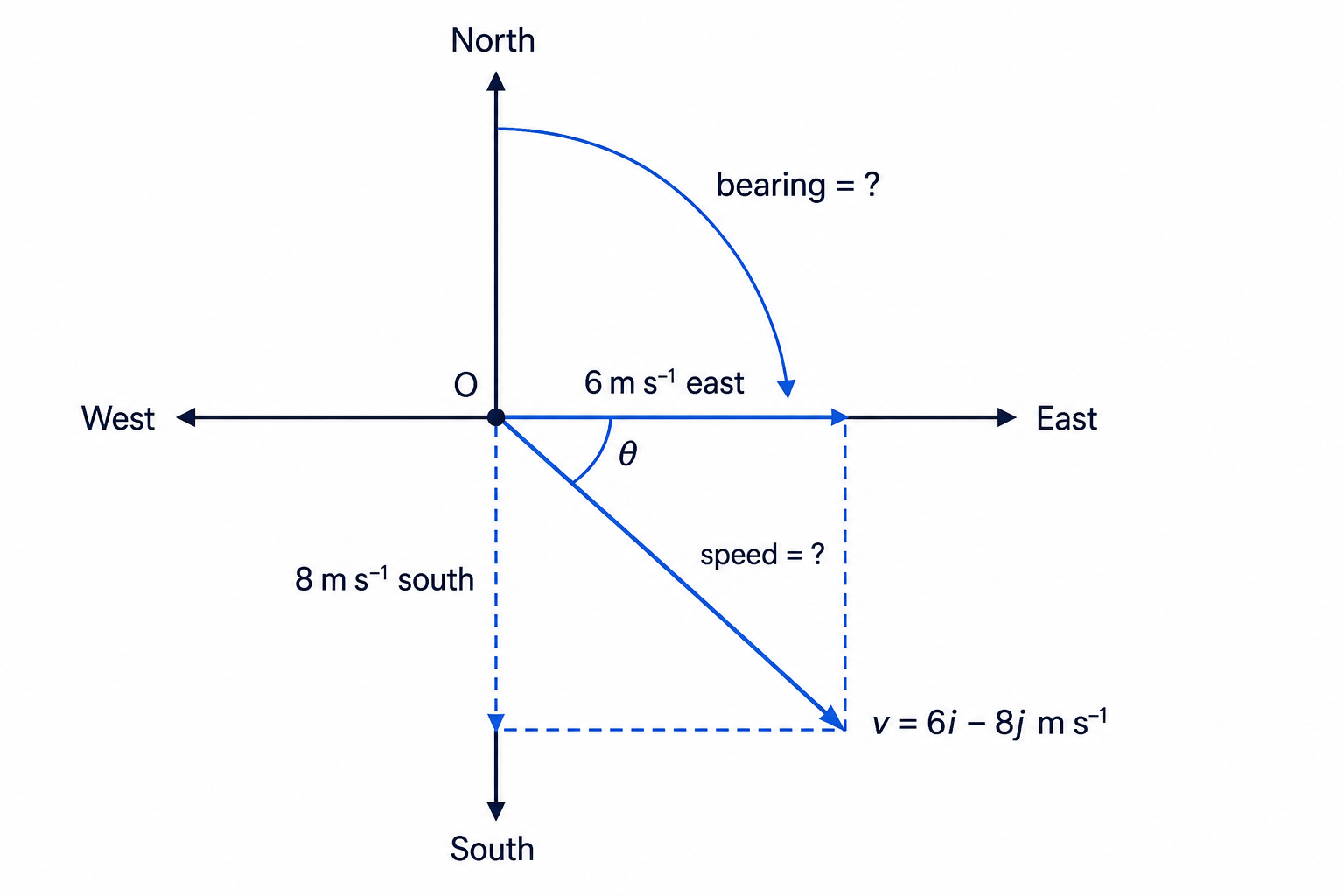
This diagram shows a velocity vector pointing south-east, with the bearing measured clockwise from north.
Finding speed and bearing from velocity
A boat has velocity (6i−8j) m s−1(6\mathbf{i}-8\mathbf{j})\text{ m s}^{-1}(6i−8j) m s−1, where i\mathbf{i}i points east and j\mathbf{j}j points north. Find its speed and bearing.
-
The speed is the magnitude of the velocity vector:
speed=62+(−8)2\text{speed}=\sqrt{6^2+(-8)^2}speed=62+(−8)2 -
Calculate the speed:
speed=36+64=10\begin{aligned} \text{speed} &=\sqrt{36+64}\\ &=10 \end{aligned}speed=36+64=10 -
The vector points 6 units east and 8 units south, so it is in the south-east quadrant.
-
Find the angle below east:
θ=tan−1(86)≈53.1∘\theta=\tan^{-1}\left(\frac{8}{6}\right)\approx 53.1^\circθ=tan−1(68)≈53.1∘ -
Bearings are measured clockwise from north. East is 090°, so add the angle below east:
90∘+53.1∘=143.1∘90^\circ+53.1^\circ=143.1^\circ90∘+53.1∘=143.1∘ -
The bearing is approximately 143° to the nearest degree.
Bearing sanity check
Before calculating, decide the quadrant. A vector with positive i\mathbf{i}i and negative j\mathbf{j}j points south-east, so its bearing must be between 090° and 180°.
In the exam
-
Write vectors in component form and keep the i\mathbf{i}i and j\mathbf{j}j parts separate throughout.
-
For AB⃗\vec{AB}AB, always use final minus initial: OB⃗−OA⃗\vec{OB}-\vec{OA}OB−OA.
-
For lengths, use Pythagoras: square both components, add, then square root.
-
For bearings, sketch a quick compass diagram first so you know whether to add or subtract your angle.
Check yourself
-
If AAA has position vector 2i−3j2\mathbf{i}-3\mathbf{j}2i−3j and BBB has position vector 7i+4j7\mathbf{i}+4\mathbf{j}7i+4j, how would you find AB⃗\vec{AB}AB?
-
Why can k2=25k^2=25k2=25 give two possible values of kkk?
-
A velocity vector has positive i\mathbf{i}i component and negative j\mathbf{j}j component. Which quadrant is it travelling in?
