

What you'll learn
- How to find all angles that satisfy a trigonometric equation in a given interval.
- How to use the key identities sin2x+cos2x≡1\sin^2 x+\cos^2 x\equiv 1sin2x+cos2x≡1 and tanx≡sinxcosx\tan x\equiv \frac{\sin x}{\cos x}tanx≡cosxsinx.
- How to turn trig equations into quadratics in sinx\sin xsinx or cosx\cos xcosx.
- How to avoid losing solutions when rearranging equations involving tanx\tan xtanx.
1. The basics: angles, periods and quadrants
In AS Maths, trigonometric equations are usually in degrees. Before doing anything else, make sure your calculator is in degree mode.
Period and reference angle
- The period of a trig function is the angle after which its values repeat. Sine and cosine have period 360°, while tangent has period 180°.
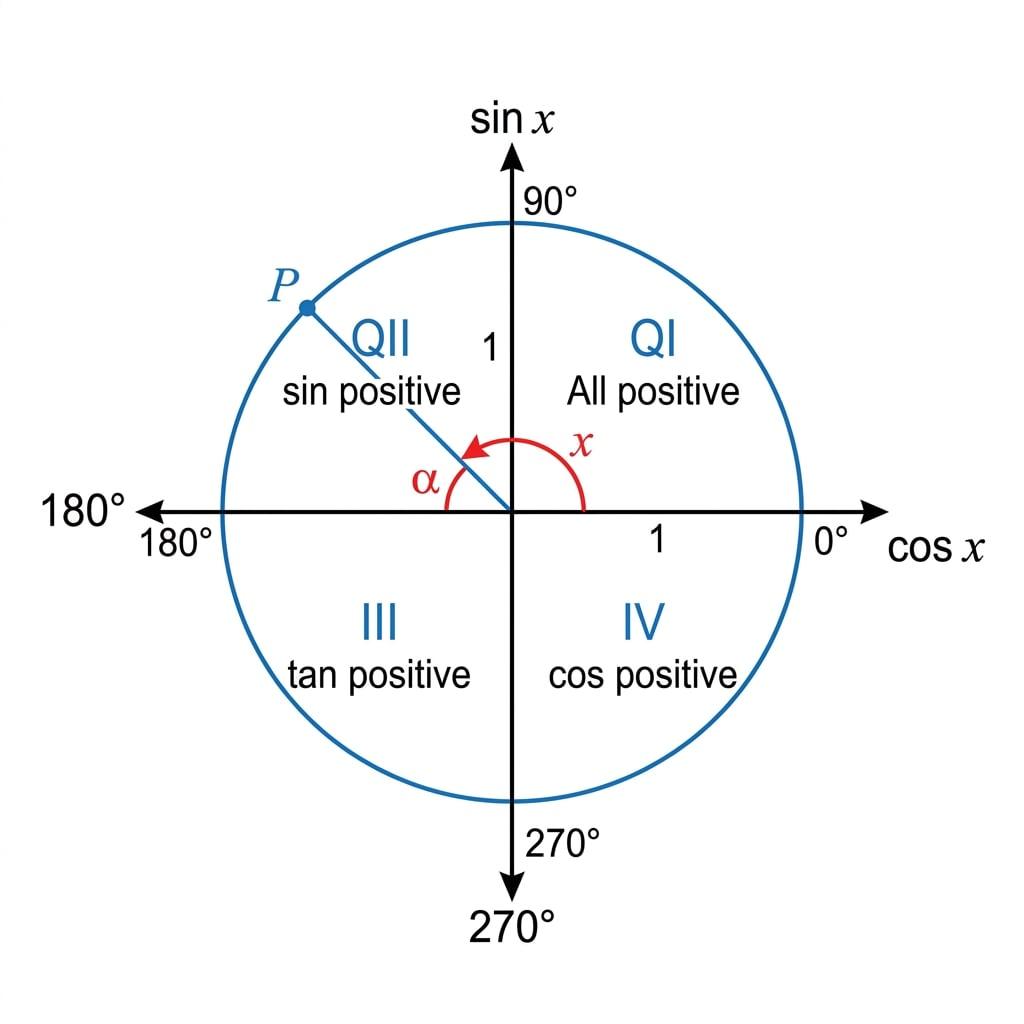
- A reference angle is the acute angle made with the x-axis. It helps you find the matching angle in another quadrant.
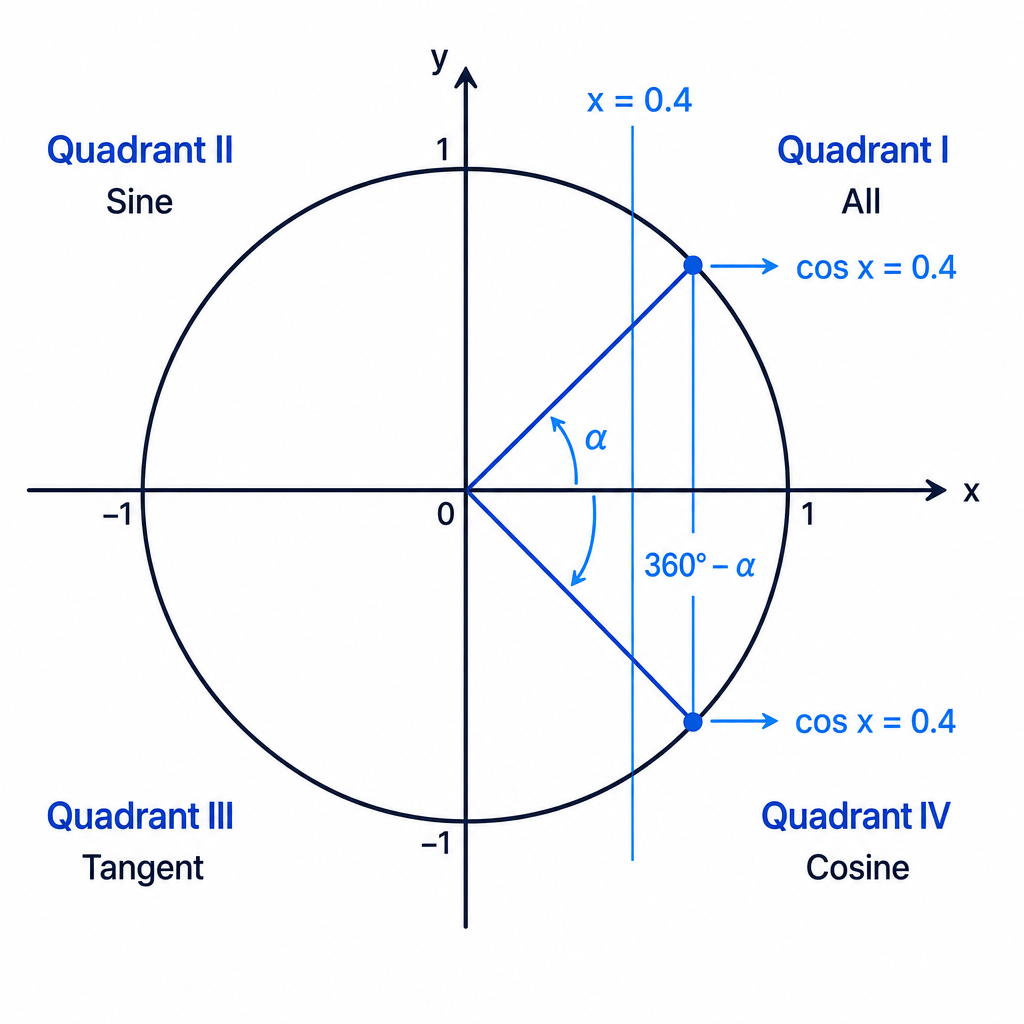
The unit circle explains why one trig value often gives more than one answer. For example, cosx=0.4\cos x=0.4cosx=0.4 has two solutions between 0° and 360° because cosine is positive in Quadrants I and IV.
CAST rule
Use CAST to remember signs: All positive in Quadrant I, Sine positive in Quadrant II, Tangent positive in Quadrant III, Cosine positive in Quadrant IV.
Solving a shifted cosine equation
Solve 5cos(x−35)=25\cos(x-35)=25cos(x−35)=2 for 0∘≤x<360∘0^\circ \leq x < 360^\circ0∘≤x<360∘, giving your answers to two decimal places.
-
Divide both sides by 5:
cos(x−35)=0.4\cos(x-35)=0.4cos(x−35)=0.4 -
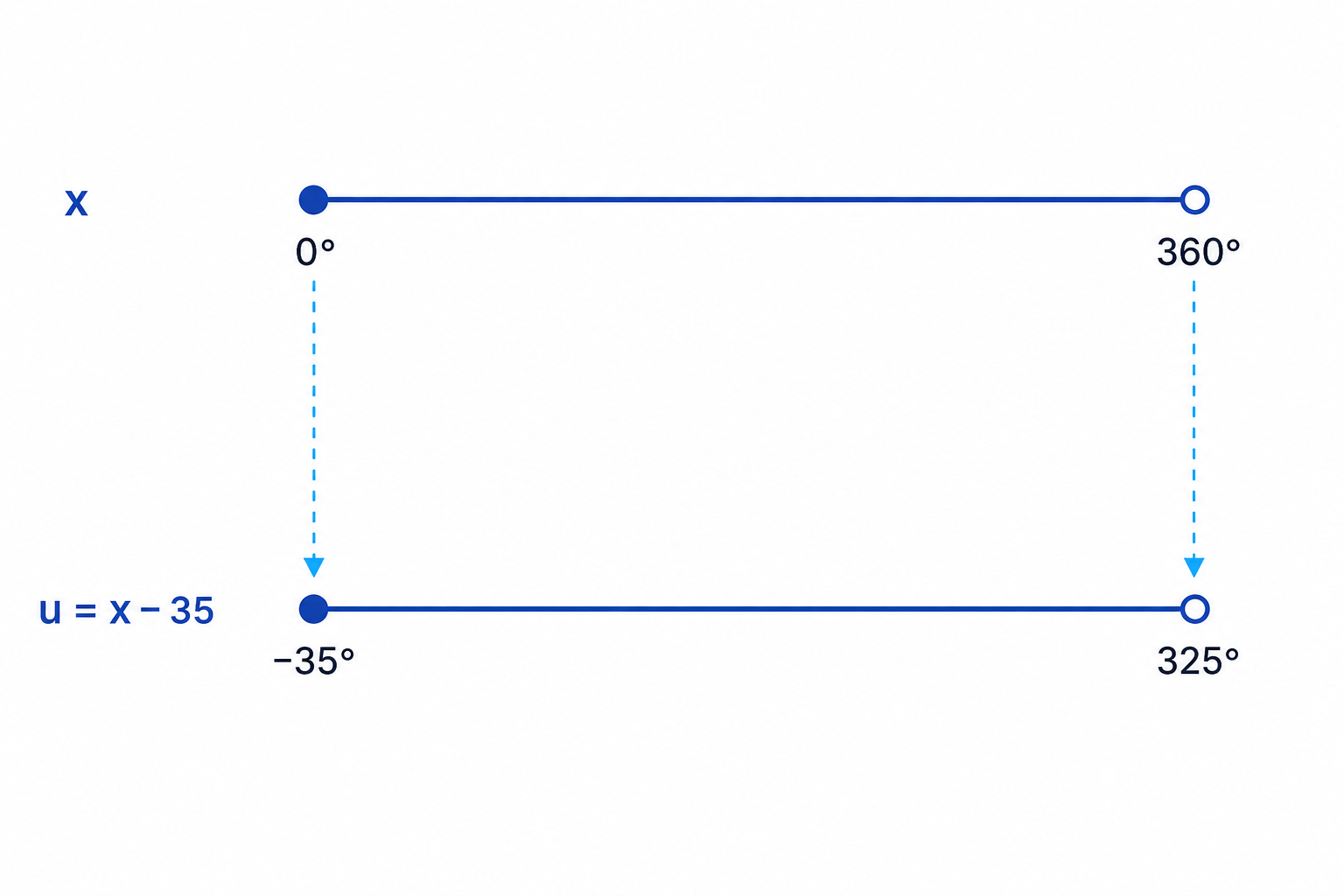
Let u=x−35u=x-35u=x−35. Since 0∘≤x<360∘0^\circ \leq x < 360^\circ0∘≤x<360∘, the new interval is:
$$
-35^\circ \leq u < 325^\circ
$$
3. Find the reference angle using inverse cosine:
$$
\alpha=\cos^{-1}(0.4)=66.4218\ldots^\circ
$$
4. Cosine is positive in Quadrants I and IV, so within the interval for uuu:
$$
u=66.4218\ldots^\circ,\quad u=360^\circ-66.4218\ldots^\circ=293.5781\ldots^\circ
$$
5. Add 35° to return to xxx:
$$
x=101.42^\circ,\quad x=328.58^\circ
$$
Calculator warning
If you use sin−1\sin^{-1}sin−1, cos−1\cos^{-1}cos−1 or tan−1\tan^{-1}tan−1, your calculator gives only one angle. Your job is to use quadrants and the interval to find the rest.
2. Composite angles: change the interval carefully
The argument of a trig function is the expression inside it. In sin(3θ−20)\sin(3\theta-20)sin(3θ−20), the argument is 3θ−203\theta-203θ−20.
When the argument is not just the variable, solve using a substitution such as u=3θ−20u=3\theta-20u=3θ−20. The most important step is to transform the interval.
Solving a sine equation with a composite angle
Solve sin(3θ−20)=0.7\sin(3\theta-20)=0.7sin(3θ−20)=0.7 for 0∘≤θ<180∘0^\circ \leq \theta < 180^\circ0∘≤θ<180∘, giving your answers to two decimal places.
-
Let u=3θ−20u=3\theta-20u=3θ−20.
-
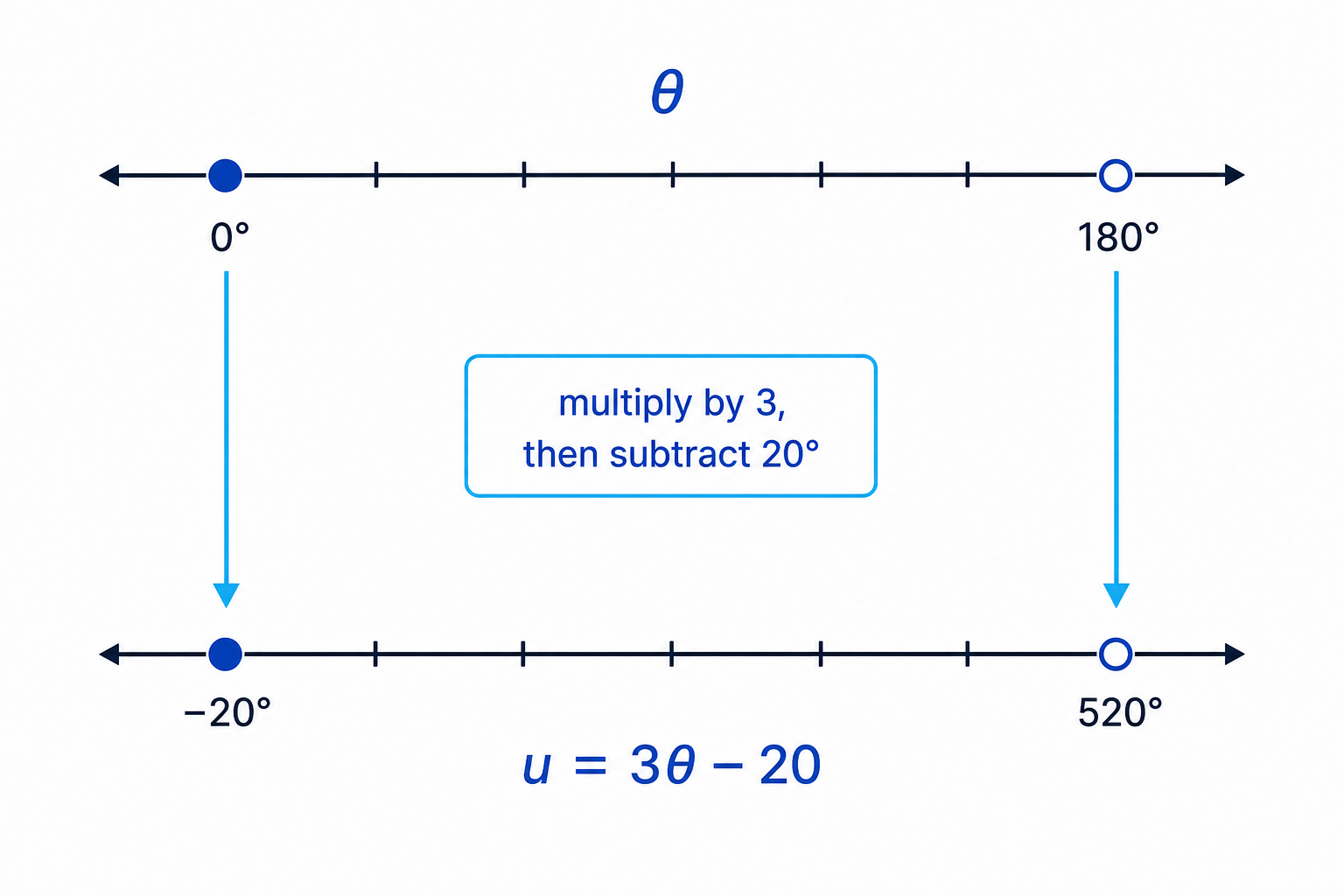
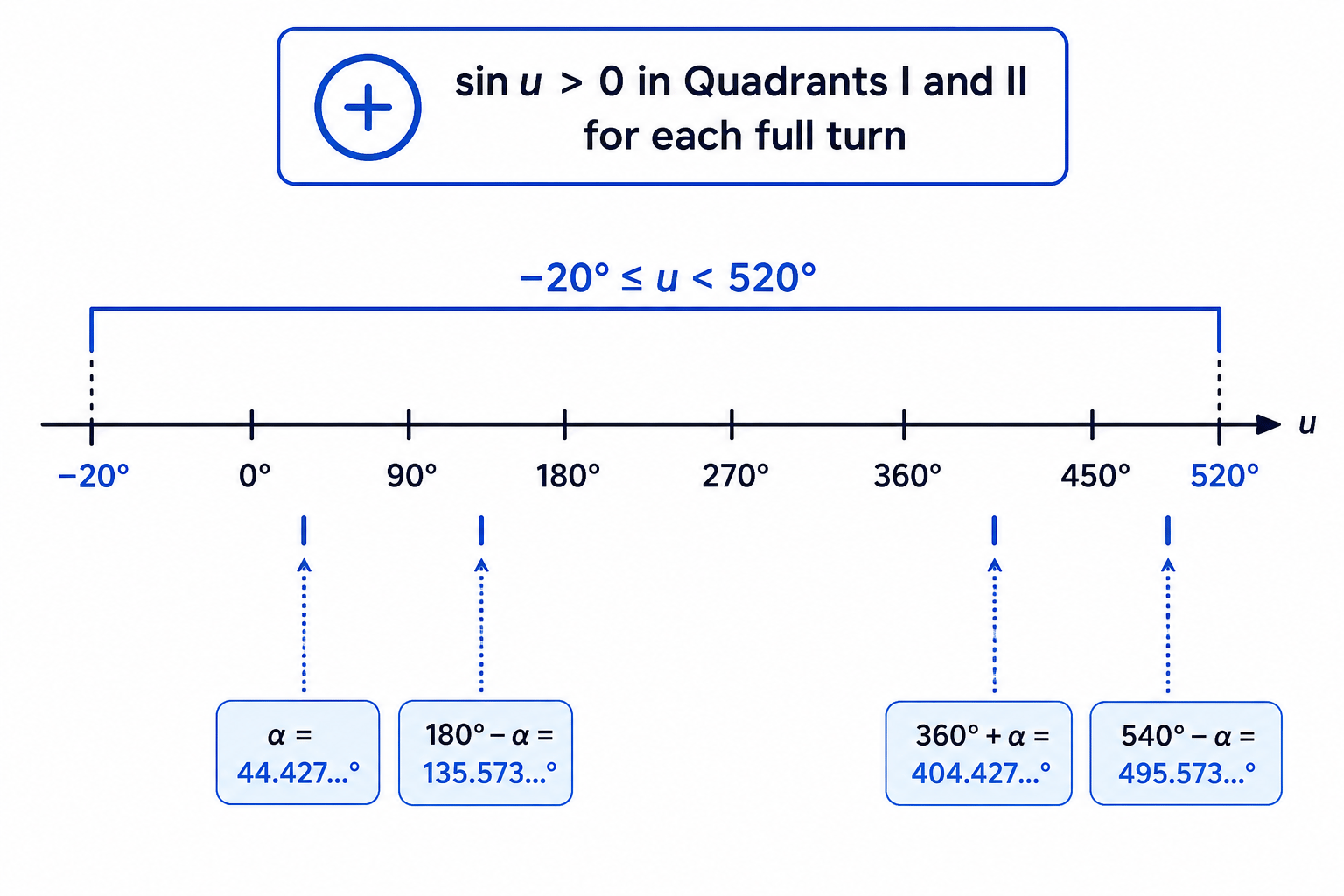
Convert the interval. When θ=0∘\theta=0^\circθ=0∘, u=−20∘u=-20^\circu=−20∘. When θ\thetaθ approaches 180°, uuu approaches 520°:
$$
-20^\circ \leq u < 520^\circ
$$
3. Find the reference angle:
$$
\alpha=\sin^{-1}(0.7)=44.4270\ldots^\circ
$$
4. Sine is positive in Quadrants I and II, so the possible values of uuu are:
$$
u=44.4270\ldots^\circ,\quad 135.5729\ldots^\circ,\quad 404.4270\ldots^\circ,\quad 495.5729\ldots^\circ
$$
5. Use u=3θ−20u=3\theta-20u=3θ−20, so θ=u+203\theta=\frac{u+20}{3}θ=3u+20:
$$
\theta=21.48^\circ,\quad 51.86^\circ,\quad 141.48^\circ,\quad 171.86^\circ
$$
3. Core identities
Trigonometric identity
A trigonometric identity is an equation that is true for all allowed values of the variable. The symbol ≡\equiv≡ means “identically equal to”.
The two identities you use most in this topic are:
sin2x+cos2x≡1\sin^2 x+\cos^2 x\equiv 1sin2x+cos2x≡1and
tanx≡sinxcosx,cosx≠0\tan x\equiv \frac{\sin x}{\cos x},\quad \cos x\neq 0tanx≡cosxsinx,cosx=0You can rearrange the first one as:
sin2x≡1−cos2x\sin^2 x\equiv 1-\cos^2 xsin2x≡1−cos2xor
cos2x≡1−sin2x\cos^2 x\equiv 1-\sin^2 xcos2x≡1−sin2xThese are especially useful when an equation contains both sin2x\sin^2 xsin2x and cosx\cos xcosx, or both cos2x\cos^2 xcos2x and sinx\sin xsinx.
Turning a trig equation into a quadratic
Show that 3sin2x=4cosx+23\sin^2 x=4\cos x+23sin2x=4cosx+2 can be written as 3cos2x+4cosx−1=03\cos^2 x+4\cos x-1=03cos2x+4cosx−1=0, then solve it for 0∘≤x<360∘0^\circ \leq x < 360^\circ0∘≤x<360∘.
-
Replace sin2x\sin^2 xsin2x with 1−cos2x1-\cos^2 x1−cos2x:
3(1−cos2x)=4cosx+23(1-\cos^2 x)=4\cos x+23(1−cos2x)=4cosx+2 -
Expand and rearrange into a quadratic:
3−3cos2x=4cosx+23cos2x+4cosx−1=0\begin{aligned} 3-3\cos^2 x&=4\cos x+2\\ 3\cos^2 x+4\cos x-1&=0 \end{aligned}3−3cos2x3cos2x+4cosx−1=4cosx+2=0 -
Factorise:
(3cosx−1)(cosx+1)=0(3\cos x-1)(\cos x+1)=0(3cosx−1)(cosx+1)=0 -
Solve each part:
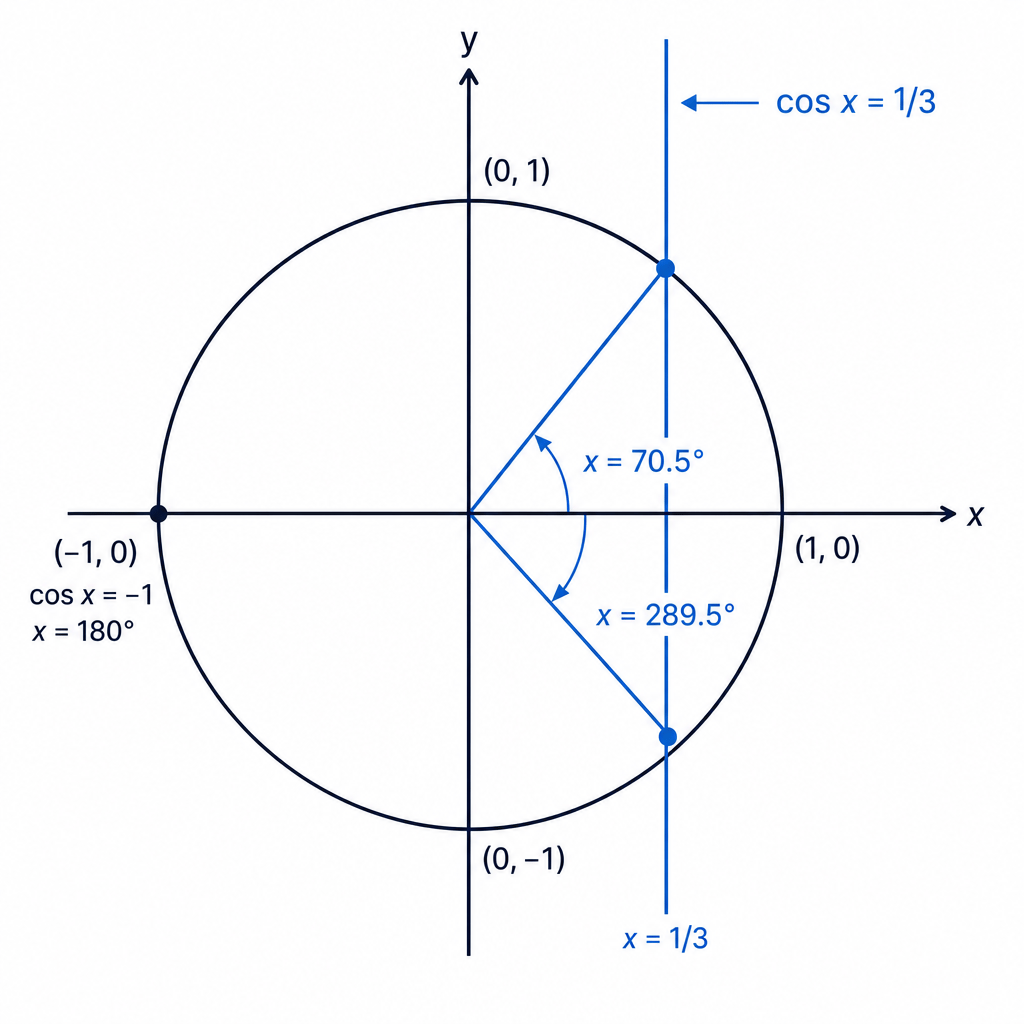
cosx=13orcosx=−1\cos x=\frac{1}{3}\quad \text{or}\quad \cos x=-1cosx=31orcosx=−1 -
For cosx=13\cos x=\frac{1}{3}cosx=31, cosine is positive in Quadrants I and IV. Also, cosx=−1\cos x=-1cosx=−1 gives x=180∘x=180^\circx=180∘:
$$
x=70.5^\circ,\quad 180^\circ,\quad 289.5^\circ
$$
Accepting impossible trig values
If a quadratic gives sinx=1.4\sin x=1.4sinx=1.4 or cosx=−2\cos x=-2cosx=−2, reject it immediately. Sine and cosine values must lie between -1 and 1.
4. Equations involving tangent
Tangent often appears with sine and cosine because:
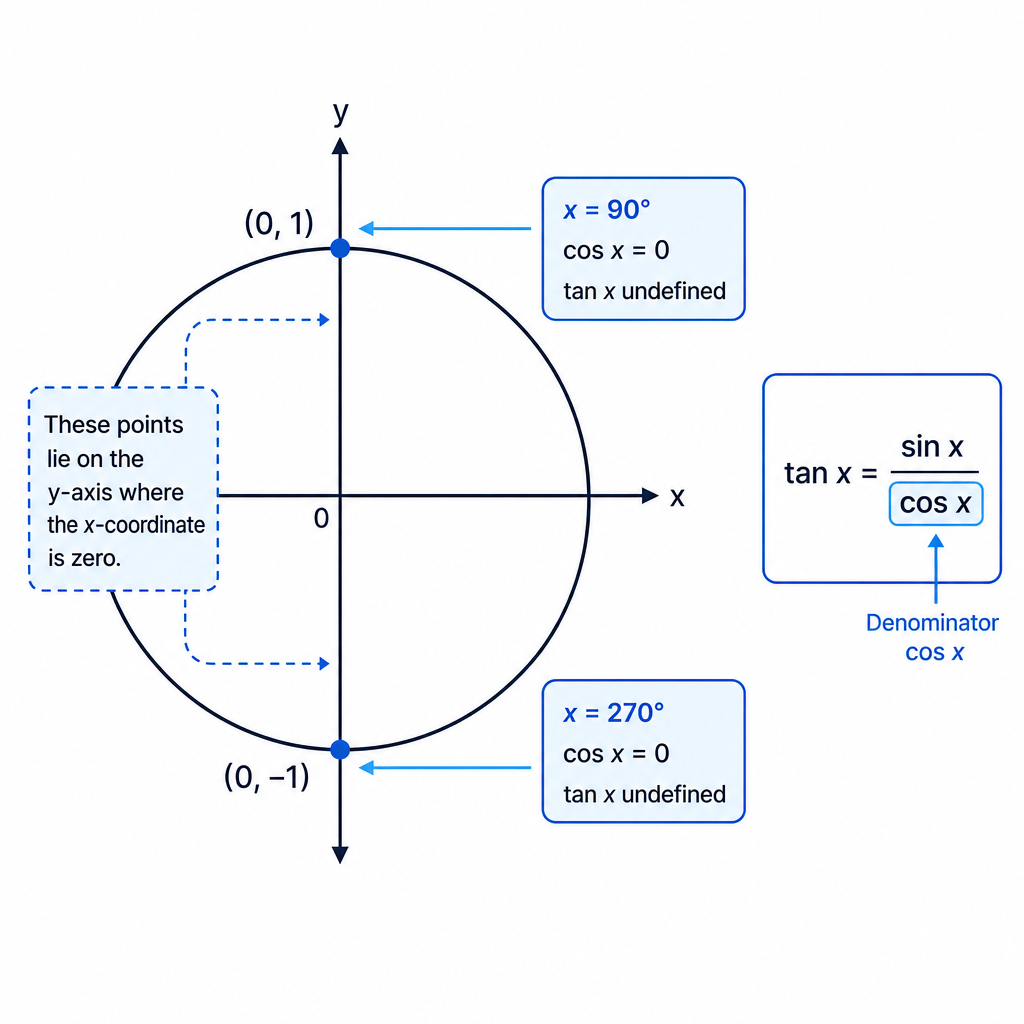
tanx=sinxcosx\tan x=\frac{\sin x}{\cos x}tanx=cosxsinxBut be careful: tanx\tan xtanx is undefined when cosx=0\cos x=0cosx=0.
Do not divide by a possible zero factor
Solve 3tanx=5sinx3\tan x=5\sin x3tanx=5sinx for 0∘≤x<360∘0^\circ \leq x < 360^\circ0∘≤x<360∘, giving answers to one decimal place where appropriate.
-
Replace tanx\tan xtanx with sinxcosx\frac{\sin x}{\cos x}cosxsinx:
3⋅sinxcosx=5sinx3\cdot \frac{\sin x}{\cos x}=5\sin x3⋅cosxsinx=5sinx -
Multiply by cosx\cos xcosx. Values with cosx=0\cos x=0cosx=0 are not valid anyway because tanx\tan xtanx would be undefined:
3sinx=5sinxcosx3\sin x=5\sin x\cos x3sinx=5sinxcosx -
Bring everything to one side and factorise:
$$
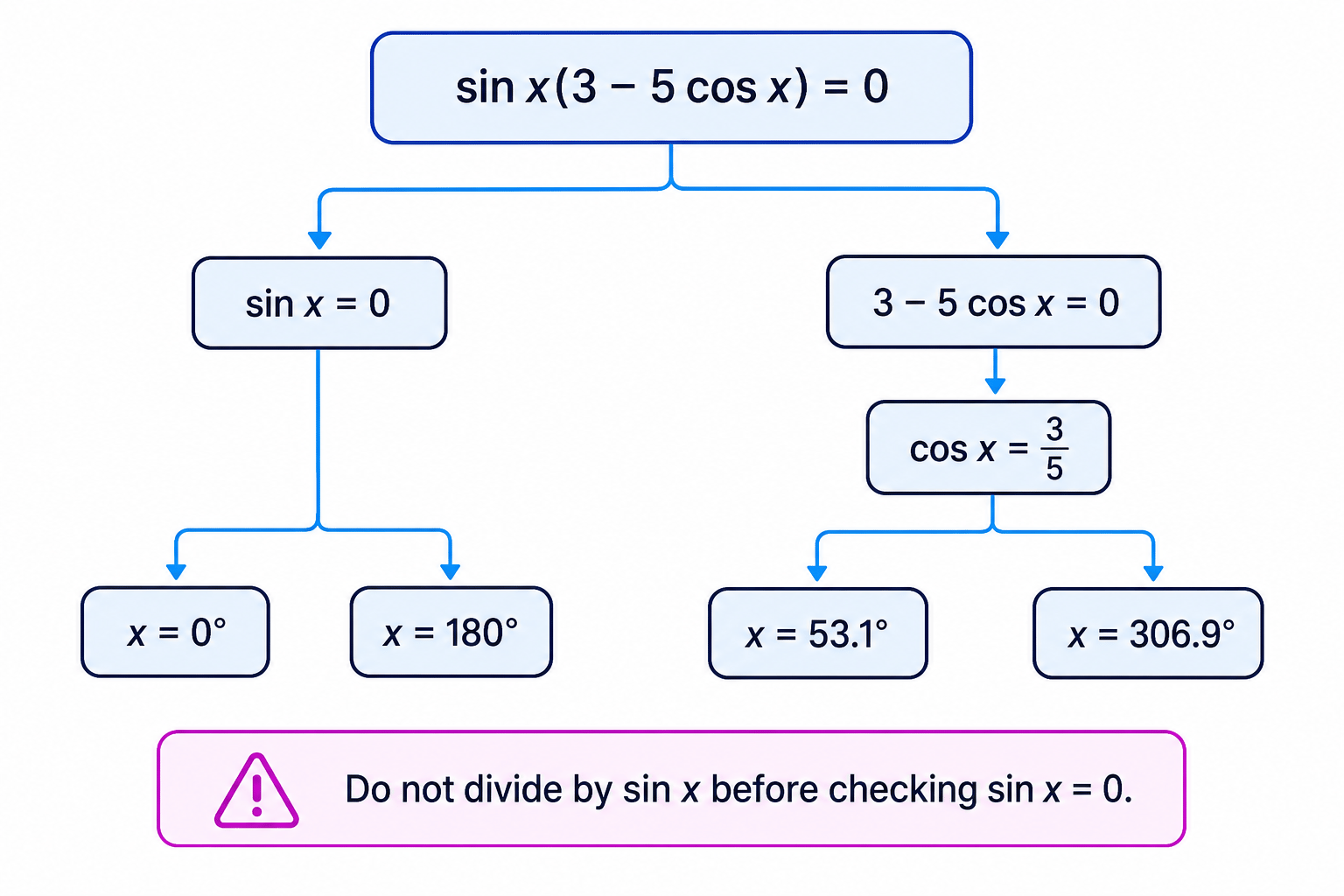
\sin x(3-5\cos x)=0
$$
4. Solve each factor:
$$
\sin x=0\quad \text{or}\quad \cos x=\frac{3}{5}
$$
5. Find all values in the interval:
$$
x=0^\circ,\quad 53.1^\circ,\quad 180^\circ,\quad 306.9^\circ
$$
Cancelling away solutions
Do not divide both sides by sinx\sin xsinx unless you have separately checked sinx=0\sin x=0sinx=0. In this example, dividing by sinx\sin xsinx would lose x=0∘x=0^\circx=0∘ and x=180∘x=180^\circx=180∘.
5. Squared trig equations
If you see something like tan2x=3\tan^2 x=3tan2x=3, remember that this means:
tanx=3ortanx=−3\tan x=\sqrt{3}\quad \text{or}\quad \tan x=-\sqrt{3}tanx=3ortanx=−3So squared equations often produce more solutions than expected.
Solving a squared tangent equation
Solve tan2(2x)=3\tan^2(2x)=3tan2(2x)=3 for 0∘≤x<180∘0^\circ \leq x < 180^\circ0∘≤x<180∘.
-
Take the square root carefully:
tan(2x)=±3\tan(2x)=\pm\sqrt{3}tan(2x)=±3 -
Let u=2xu=2xu=2x. The interval becomes:
0∘≤u<360∘0^\circ \leq u < 360^\circ0∘≤u<360∘ -
Since tanu=3\tan u=\sqrt{3}tanu=3 or tanu=−3\tan u=-\sqrt{3}tanu=−3, the solutions for uuu are:
u=60∘,120∘,240∘,300∘u=60^\circ,\quad 120^\circ,\quad 240^\circ,\quad 300^\circu=60∘,120∘,240∘,300∘ -
Divide by 2:
x=30∘,60∘,120∘,150∘x=30^\circ,\quad 60^\circ,\quad 120^\circ,\quad 150^\circx=30∘,60∘,120∘,150∘
6. Graphs and transformations
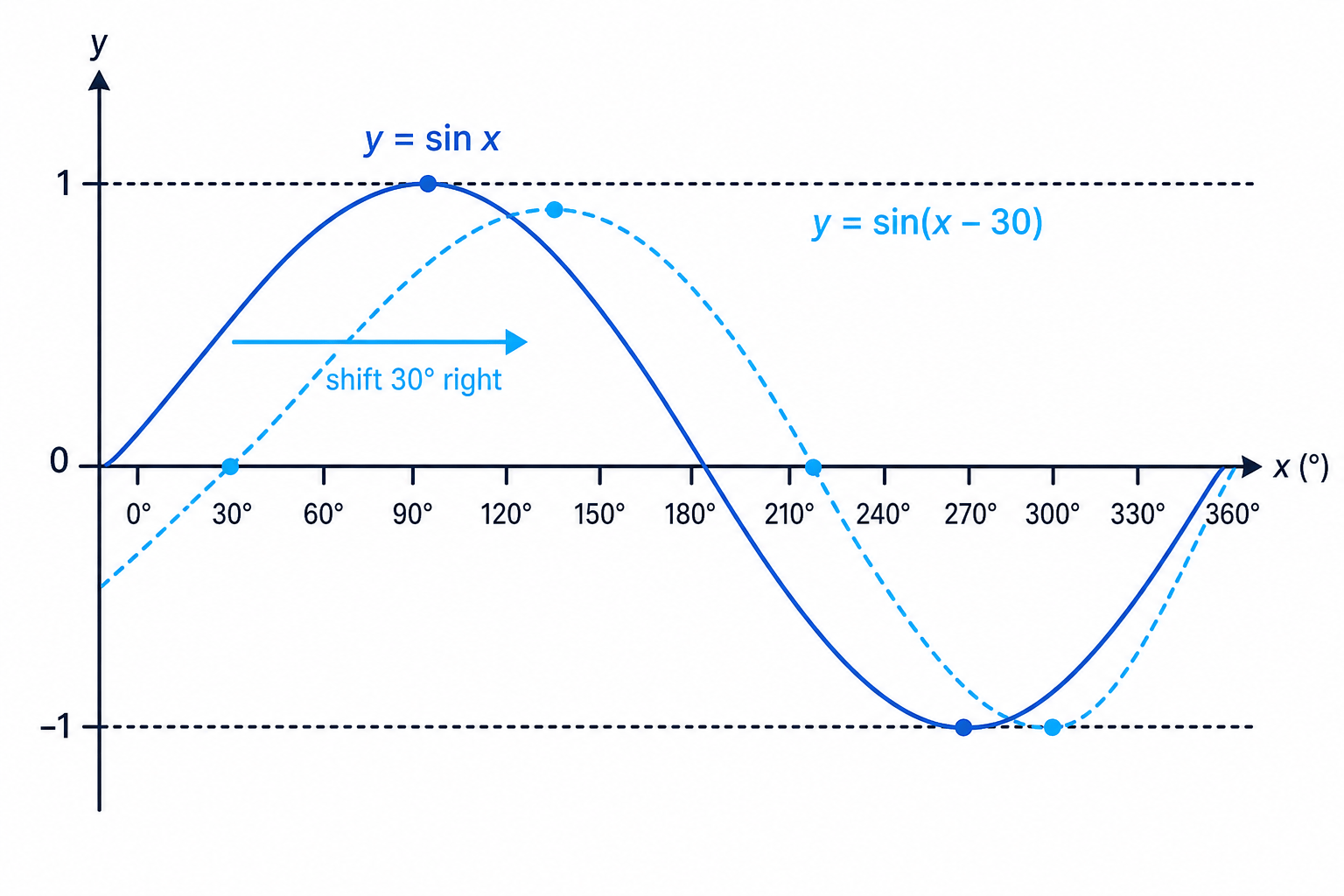
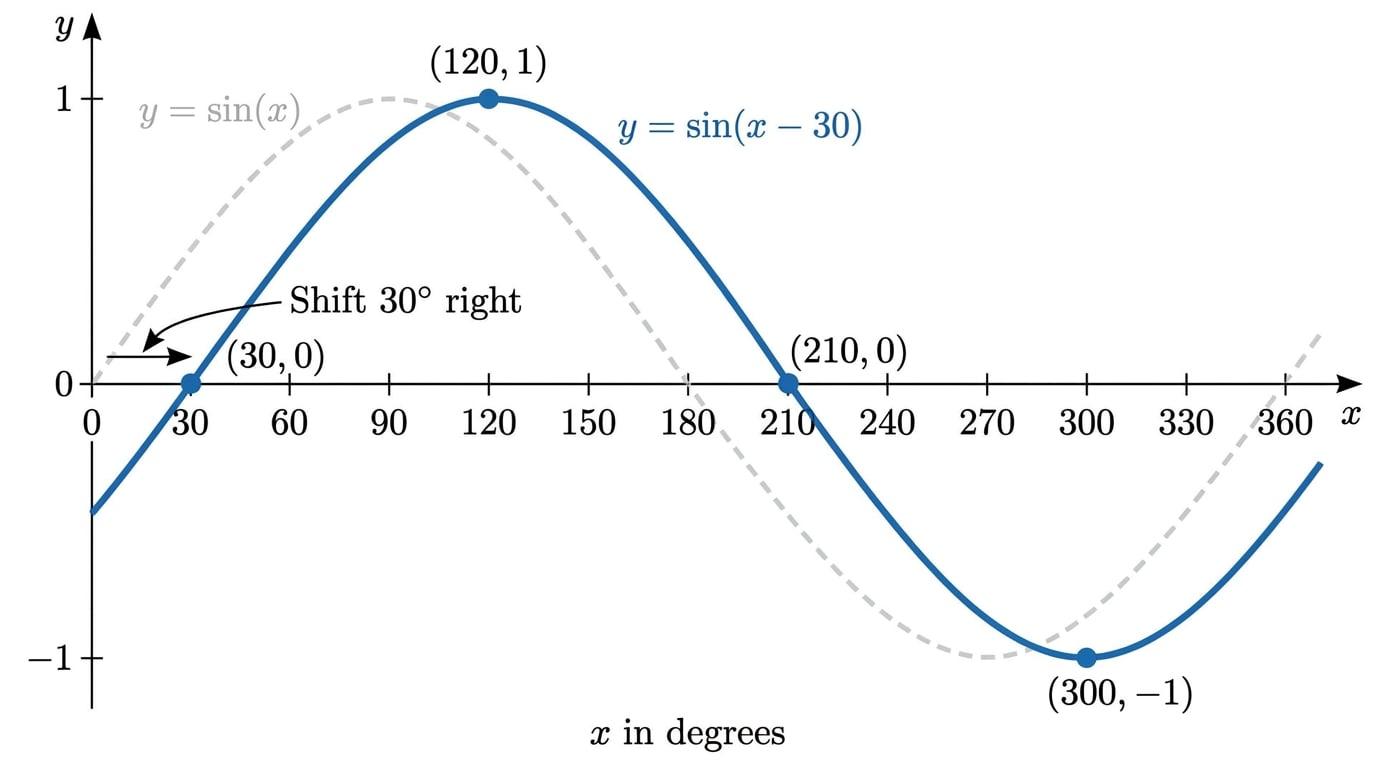
The graph of y=sin(x−30)y=\sin(x-30)y=sin(x−30) is the graph of y=sinxy=\sin xy=sinx shifted 30° to the right. This helps you check whether your number of solutions is sensible.
Using a transformed sine graph idea
Find all solutions of sin(x−30)=0.4\sin(x-30)=0.4sin(x−30)=0.4 for 0∘≤x<360∘0^\circ \leq x < 360^\circ0∘≤x<360∘.
-
Let u=x−30u=x-30u=x−30, so:
−30∘≤u<330∘-30^\circ \leq u < 330^\circ−30∘≤u<330∘ -
Find the reference angle:
α=sin−1(0.4)=23.5781…∘\alpha=\sin^{-1}(0.4)=23.5781\ldots^\circα=sin−1(0.4)=23.5781…∘ -
Sine is positive in Quadrants I and II, so:
u=23.5781…∘,156.4218…∘u=23.5781\ldots^\circ,\quad 156.4218\ldots^\circu=23.5781…∘,156.4218…∘ -
Add 30° to return to xxx:
x=53.6∘,186.4∘x=53.6^\circ,\quad 186.4^\circx=53.6∘,186.4∘
7. Proving identities by simplifying one side
To prove an identity, usually start with the more complicated side and use known identities until it becomes the simpler side.
Proving a fractional identity
Prove that 3sinx−cos2x+13+sinx≡sinx\frac{3\sin x-\cos^2 x+1}{3+\sin x}\equiv \sin x3+sinx3sinx−cos2x+1≡sinx.
-
Start with the left-hand side:
3sinx−cos2x+13+sinx\frac{3\sin x-\cos^2 x+1}{3+\sin x}3+sinx3sinx−cos2x+1 -
Replace cos2x\cos^2 xcos2x with 1−sin2x1-\sin^2 x1−sin2x:
3sinx−(1−sin2x)+13+sinx\frac{3\sin x-(1-\sin^2 x)+1}{3+\sin x}3+sinx3sinx−(1−sin2x)+1 -
Simplify the numerator:
3sinx+sin2x3+sinx\frac{3\sin x+\sin^2 x}{3+\sin x}3+sinx3sinx+sin2x -
Factorise the numerator:
sinx(3+sinx)3+sinx\frac{\sin x(3+\sin x)}{3+\sin x}3+sinxsinx(3+sinx) -
Cancel the common factor:
sinx\sin xsinx
In the exam
- Write the transformed interval when you use a substitution like u=2x+15u=2x+15u=2x+15.
- Use CAST or a sketch to find every solution, not just the calculator’s first answer.
- Avoid dividing by sinx\sin xsinx or cosx\cos xcosx unless you have checked the zero case and any undefined tangent values.
Check yourself
- Can you explain why cosx=0.4\cos x=0.4cosx=0.4 has two solutions between 0° and 360°?
- When solving sin(3x−10)=0.5\sin(3x-10)=0.5sin(3x−10)=0.5, what interval should you use for the argument?
- Why might dividing an equation by sinx\sin xsinx cause you to lose a solution?

