What you'll learn
- How to find all solutions to trigonometric equations in a given interval.
- How to handle shifted or stretched angles such as 2x+10∘2x+10^\circ2x+10∘.
- How to solve equations involving sin2x\sin^2 xsin2x, cos2x\cos^2 xcos2x or tan2x\tan^2 xtan2x.
- How to use identities and factorisation without losing valid answers.
The big idea: one trig equation can have several answers
A trigonometric equation is an equation involving a trig function such as sinx\sin xsinx, cosx\cos xcosx or tanx\tan xtanx.
In this topic, angles are measured in degrees, so make sure your calculator is in degree mode. The key challenge is that trig graphs repeat, so one calculator answer is usually not enough.
Solution interval
A solution interval tells you the range of angles you are allowed to give as answers. For example, 0≤x<360∘0 \le x < 360^\circ0≤x<360∘ means include 0°, include everything up to 360°, but do not include 360° itself.
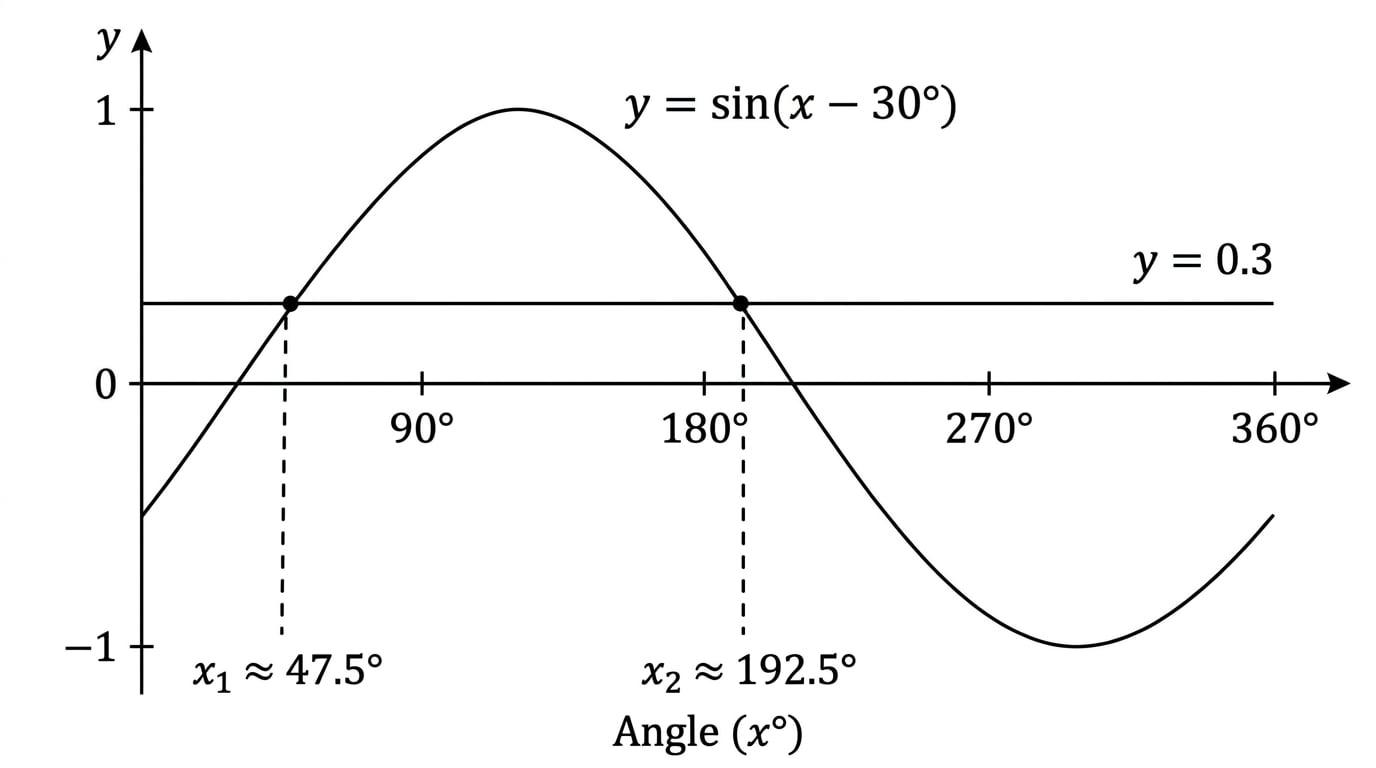
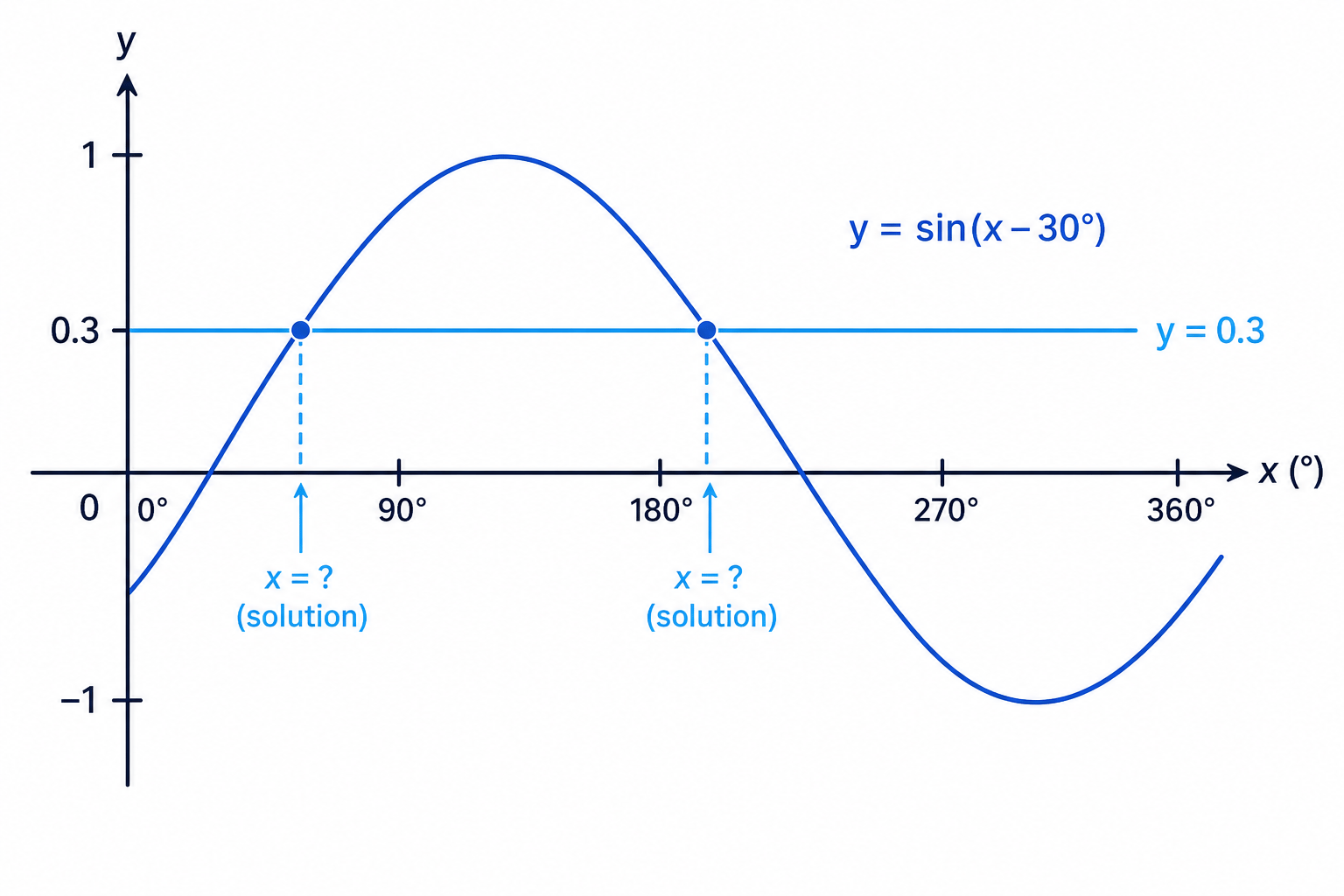
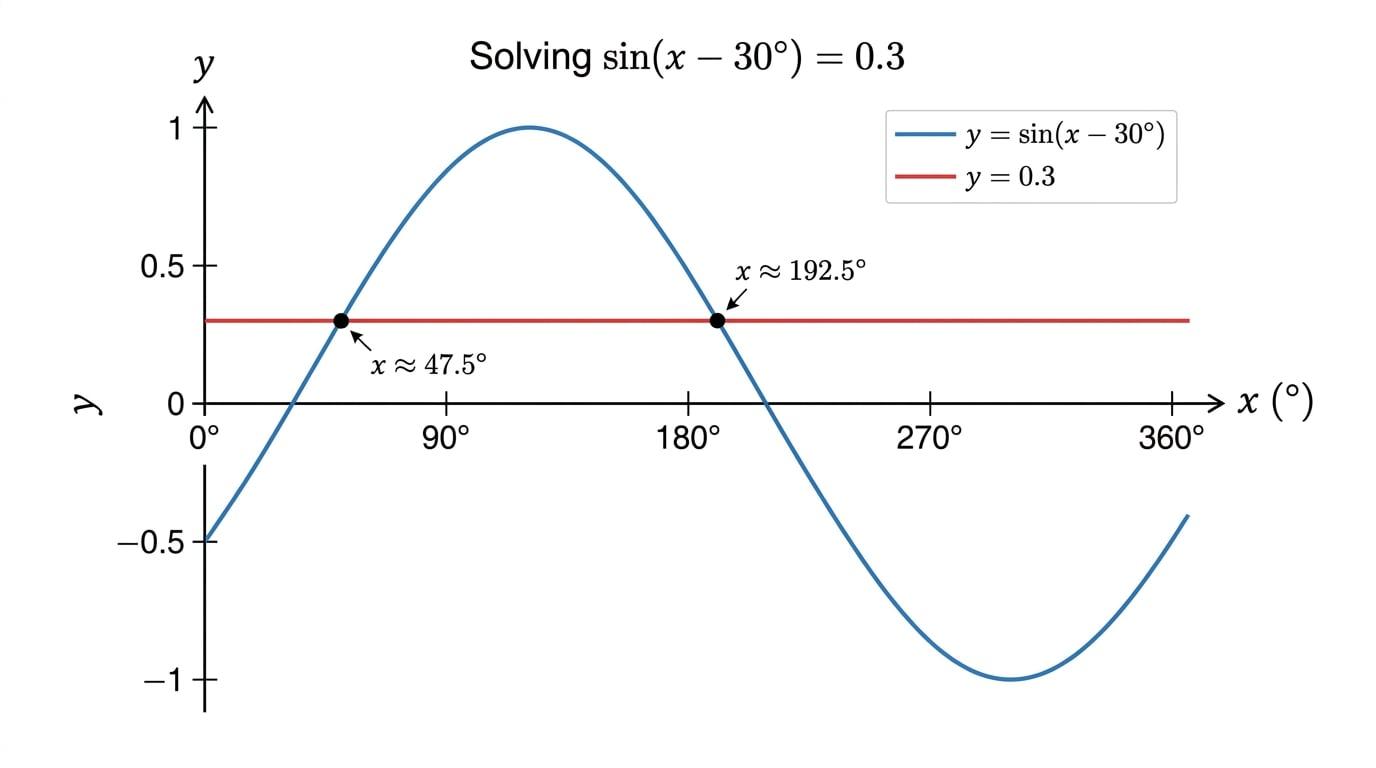
A graph helps you see why there can be more than one answer. Solving sin(x−30∘)=0.3\sin(x-30^\circ)=0.3sin(x−30∘)=0.3 means finding where the sine curve meets the horizontal line y=0.3y=0.3y=0.3.
The calculator gives a starting point
Your calculator gives a principal value, which is the first angle it finds. You must then use symmetry and periodicity to find all the other angles in the required interval.
A reliable routine for shifted sine and cosine equations
For equations like cos(2x+10∘)=0.4\cos(2x+10^\circ)=0.4cos(2x+10∘)=0.4, the expression inside the trig function is not just xxx. A good method is to temporarily replace the inside angle with a new letter.
Period
The period of a trig function is how long it takes before the graph repeats. Sine and cosine repeat every 360°, while tangent repeats every 180°.
Solving a shifted cosine equation
Solve cos(2x+10∘)=0.4\cos(2x+10^\circ)=0.4cos(2x+10∘)=0.4 for 0≤x<180∘0 \le x < 180^\circ0≤x<180∘. Give your answers to one decimal place.
-
Let the inside angle be uuu:
u=2x+10∘u = 2x+10^\circu=2x+10∘ -
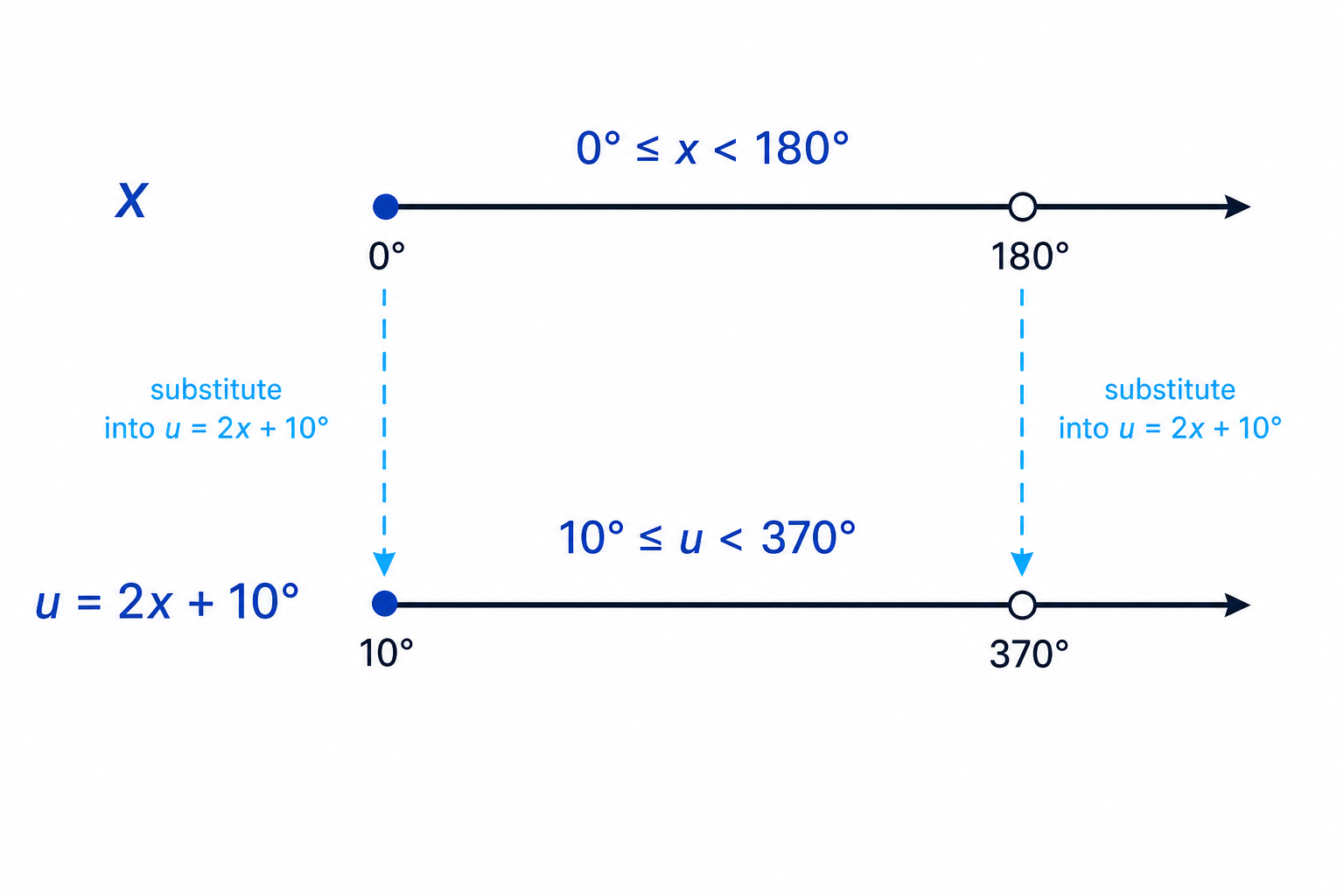
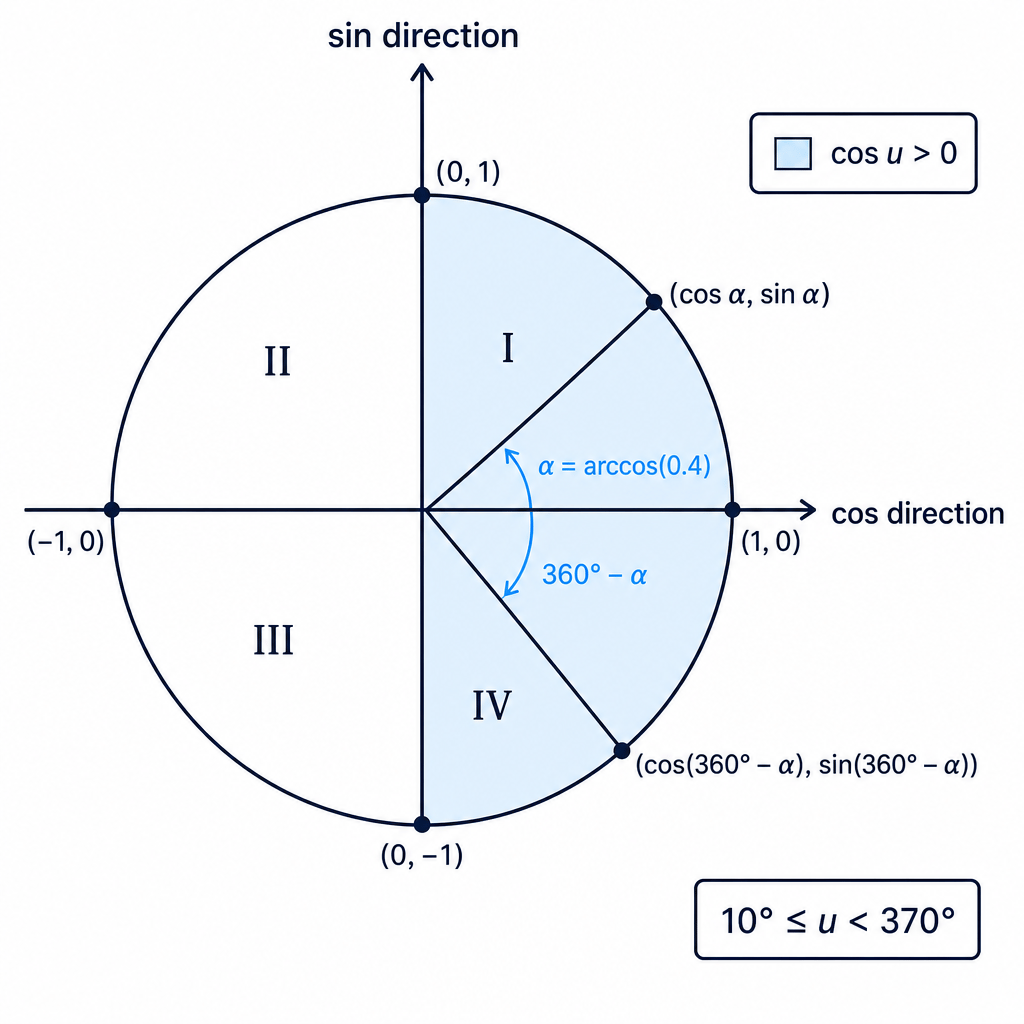
Convert the interval for xxx into an interval for uuu. If 0≤x<180∘0 \le x < 180^\circ0≤x<180∘, then:
$$
10^\circ \le u < 370^\circ
$$
3. Use your calculator to find the principal value:
$$
\arccos(0.4)=66.4218\ldots^\circ
$$
4. Cosine is positive in quadrants I and IV, so within 10∘≤u<370∘10^\circ \le u < 370^\circ10∘≤u<370∘:
$$
u = 66.4218\ldots^\circ,\quad 293.5781\ldots^\circ
$$
5. Convert back to xxx using u=2x+10∘u=2x+10^\circu=2x+10∘:
$$
\begin{aligned}
x &= \frac{66.4218\ldots-10}{2}=28.2109\ldots^\circ \\
x &= \frac{293.5781\ldots-10}{2}=141.7890\ldots^\circ
\end{aligned}
$$
6. Round to one decimal place:
$$
x = 28.2^\circ,\ 141.8^\circ
$$
Work with the inside angle first
If the equation contains sin(3θ−20∘)\sin(3\theta-20^\circ)sin(3θ−20∘), solve for the whole angle 3θ−20∘3\theta-20^\circ3θ−20∘ first. Only divide by 3 and add 20° at the end.
Tangent equations: remember the shorter period
Tangent behaves differently from sine and cosine because tanx\tan xtanx repeats every 180°. This often makes tangent equations quicker, but it is easy to miss a solution if you only use the calculator answer.
Solving a shifted tangent equation
Solve tan(θ+40∘)=−1.8\tan(\theta+40^\circ)=-1.8tan(θ+40∘)=−1.8 for −180∘≤θ<180∘-180^\circ \le \theta < 180^\circ−180∘≤θ<180∘. Give your answers to one decimal place.
-
Let the inside angle be uuu:
u=θ+40∘u=\theta+40^\circu=θ+40∘ -
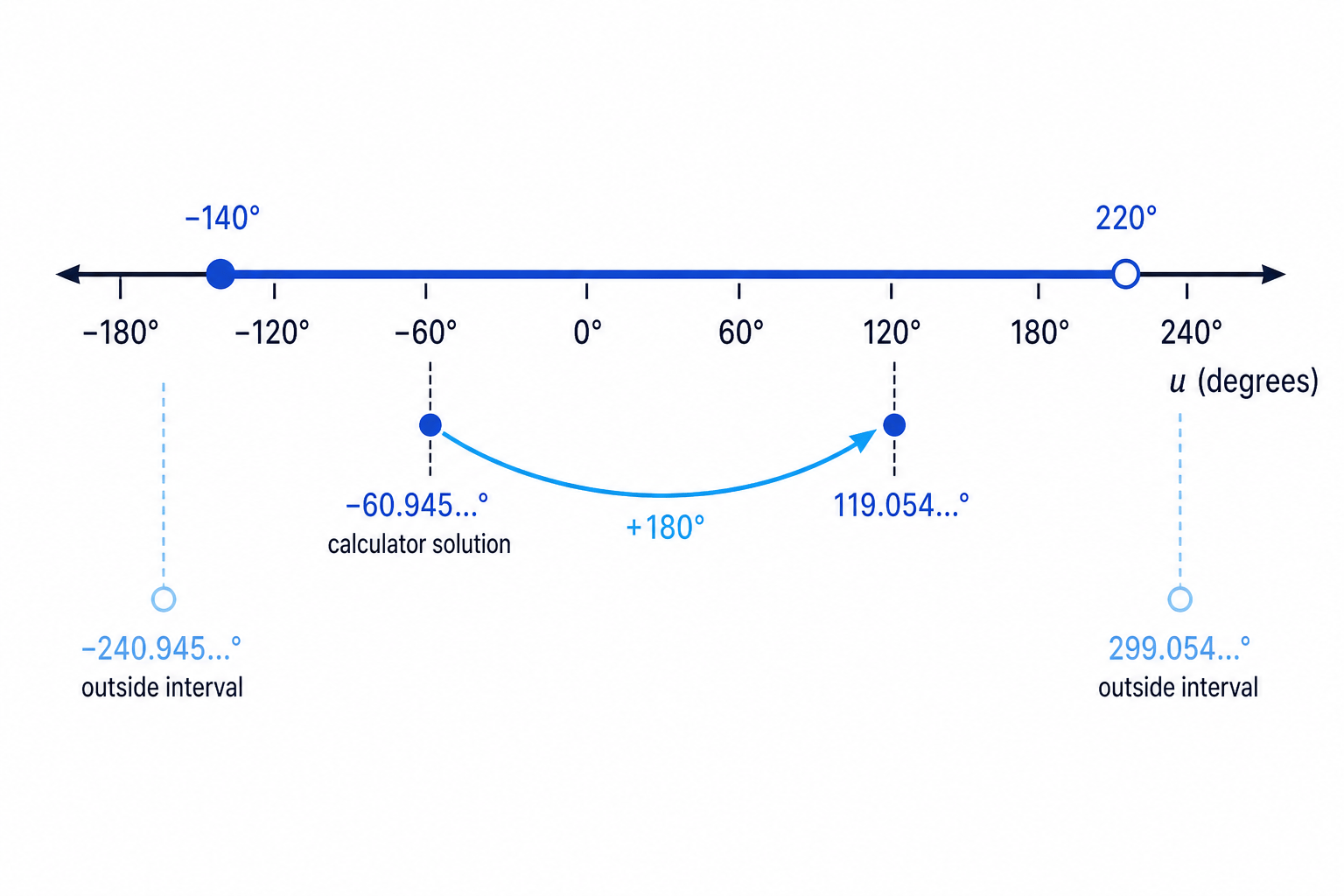
Convert the interval. If −180∘≤θ<180∘-180^\circ \le \theta < 180^\circ−180∘≤θ<180∘, then:
−140∘≤u<220∘-140^\circ \le u < 220^\circ−140∘≤u<220∘ -
Find one calculator solution:
arctan(−1.8)=−60.9453…∘\arctan(-1.8)=-60.9453\ldots^\circarctan(−1.8)=−60.9453…∘ -
Since tangent has period 180°, add or subtract 180° until you have all values in the interval:
$$
u=-60.9453\ldots^\circ,\quad 119.0546\ldots^\circ
$$
5. Convert back to θ\thetaθ using θ=u−40∘\theta=u-40^\circθ=u−40∘:
$$
\theta=-100.9453\ldots^\circ,\quad 79.0546\ldots^\circ
$$
6. Round to one decimal place:
$$
\theta=-100.9^\circ,\ 79.1^\circ
$$
Squared trig functions
A squared trig function means the whole trig value is squared. For example, tan2x\tan^2 xtan2x means (tanx)2(\tan x)^2(tanx)2, not tan(x2)\tan(x^2)tan(x2).
When you square-root both sides, remember the positive and negative possibilities.
Solving a squared tangent equation
Solve tan2x=5\tan^2 x=5tan2x=5 for 0≤x<360∘0 \le x < 360^\circ0≤x<360∘. Give your answers to one decimal place.
-
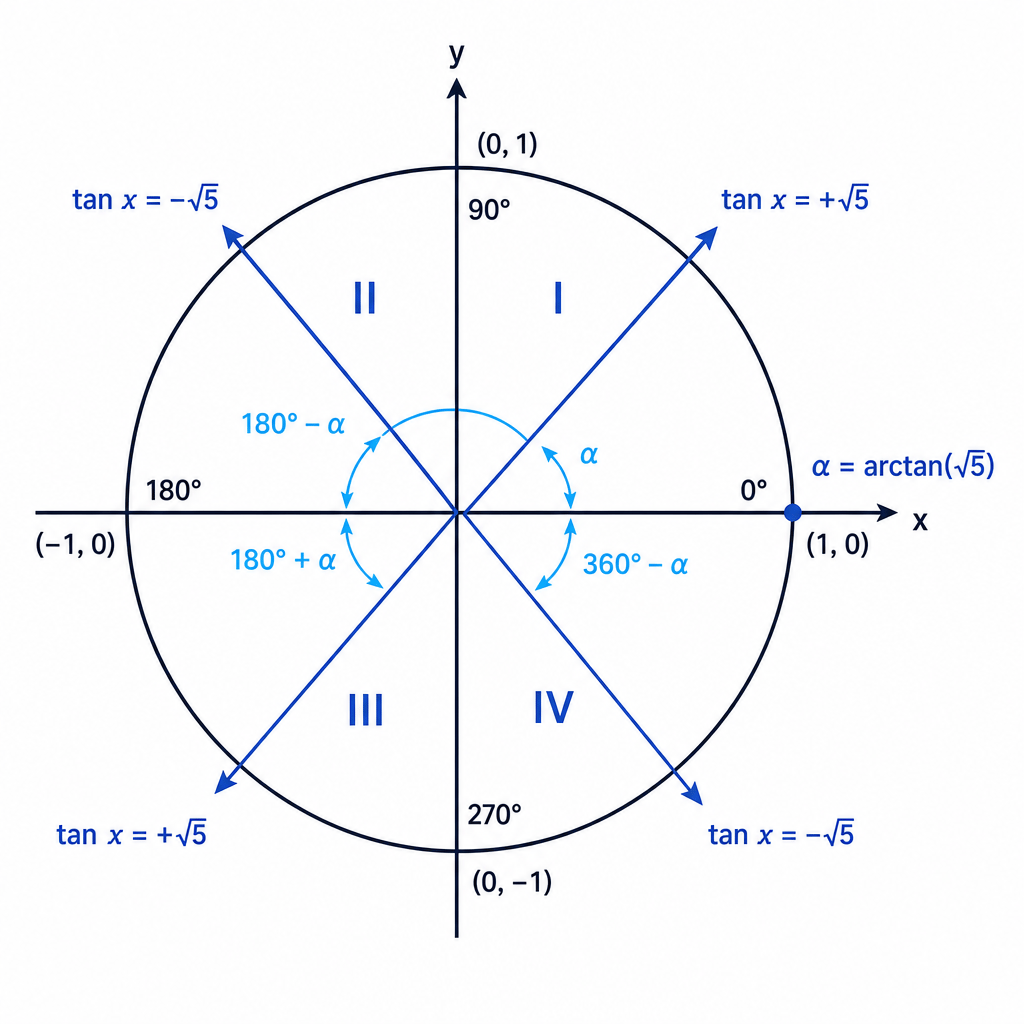
Square-root both sides:
tanx=±5\tan x=\pm\sqrt{5}tanx=±5 -
Find the reference angle:
$$
\arctan(\sqrt{5})=65.9051\ldots^\circ
$$
3. For tanx=5\tan x=\sqrt{5}tanx=5, tangent is positive in quadrants I and III:
$$
x=65.9051\ldots^\circ,\quad 245.9051\ldots^\circ
$$
4. For tanx=−5\tan x=-\sqrt{5}tanx=−5, tangent is negative in quadrants II and IV:
$$
x=114.0948\ldots^\circ,\quad 294.0948\ldots^\circ
$$
5. Round to one decimal place:
$$
x=65.9^\circ,\ 114.1^\circ,\ 245.9^\circ,\ 294.1^\circ
$$
Forgetting the negative square root
From tan2x=5\tan^2 x=5tan2x=5, do not only write tanx=5\tan x=\sqrt{5}tanx=5. You also need tanx=−5\tan x=-\sqrt{5}tanx=−5.
Using identities to make quadratics
An identity is an equation that is true for all allowed values of the variable. The most useful identity here is:
sin2x+cos2x=1\sin^2 x+\cos^2 x=1sin2x+cos2x=1So:
sin2x=1−cos2x\sin^2 x=1-\cos^2 xsin2x=1−cos2xand:
cos2x=1−sin2x\cos^2 x=1-\sin^2 xcos2x=1−sin2xA quadratic equation is an equation involving a squared term, such as c2c^2c2. In trig equations, you might make a quadratic in sinx\sin xsinx or cosx\cos xcosx.
Changing to a quadratic in cosine
Solve 3sin2x=5cosx+13\sin^2 x=5\cos x+13sin2x=5cosx+1 for 0≤x<360∘0 \le x < 360^\circ0≤x<360∘. Give your answers to one decimal place.
-
Since the right-hand side contains cosx\cos xcosx, rewrite sin2x\sin^2 xsin2x using sin2x=1−cos2x\sin^2 x=1-\cos^2 xsin2x=1−cos2x:
3(1−cos2x)=5cosx+13(1-\cos^2 x)=5\cos x+13(1−cos2x)=5cosx+1 -
Rearrange into a quadratic:
3−3cos2x=5cosx+13cos2x+5cosx−2=0\begin{aligned} 3-3\cos^2 x &= 5\cos x+1 \\ 3\cos^2 x+5\cos x-2 &= 0 \end{aligned}3−3cos2x3cos2x+5cosx−2=5cosx+1=0 -
Factorise the quadratic:
(3cosx−1)(cosx+2)=0(3\cos x-1)(\cos x+2)=0(3cosx−1)(cosx+2)=0 -
Solve each factor:
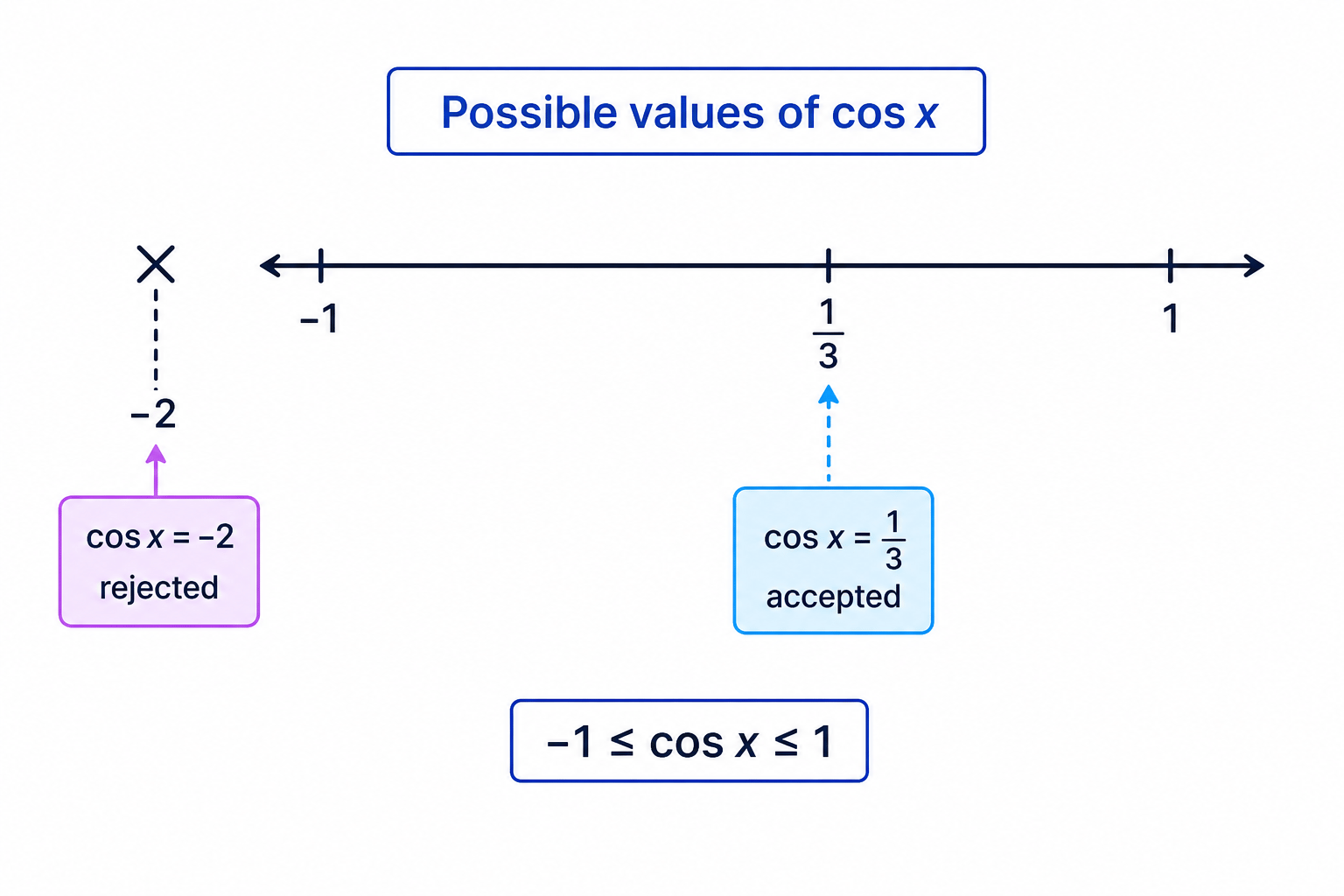
cosx=13orcosx=−2\cos x=\frac{1}{3}\quad \text{or}\quad \cos x=-2cosx=31orcosx=−2 -
Reject cosx=−2\cos x=-2cosx=−2 because cosine values must be between -1 and 1. Now solve cosx=13\cos x=\frac{1}{3}cosx=31:
$$
x=70.5287\ldots^\circ,\quad 289.4712\ldots^\circ
$$
6. Round to one decimal place:
$$
x=70.5^\circ,\ 289.5^\circ
$$
Check possible trig values
For real angles, sinx\sin xsinx and cosx\cos xcosx must lie between -1 and 1. If a quadratic gives sinx=1.4\sin x=1.4sinx=1.4 or cosx=−2\cos x=-2cosx=−2, reject that branch.
Factorising without losing solutions
Some equations mix tangent with sine or cosine. The safest method is usually to rewrite tanx\tan xtanx as sinxcosx\frac{\sin x}{\cos x}cosxsinx, then factorise.
Do not divide away a solution
Solve 2tanx=3sinx2\tan x=3\sin x2tanx=3sinx for 0≤x<360∘0 \le x < 360^\circ0≤x<360∘. Give your answers to one decimal place where appropriate.
-
Rewrite tangent as sine over cosine:
2sinxcosx=3sinx\frac{2\sin x}{\cos x}=3\sin xcosx2sinx=3sinx -
Multiply by cosx\cos xcosx. The original equation is already undefined when cosx=0\cos x=0cosx=0, so 90° and 270° cannot be answers:
2sinx=3sinxcosx2\sin x=3\sin x\cos x2sinx=3sinxcosx -
Bring everything to one side and factorise:
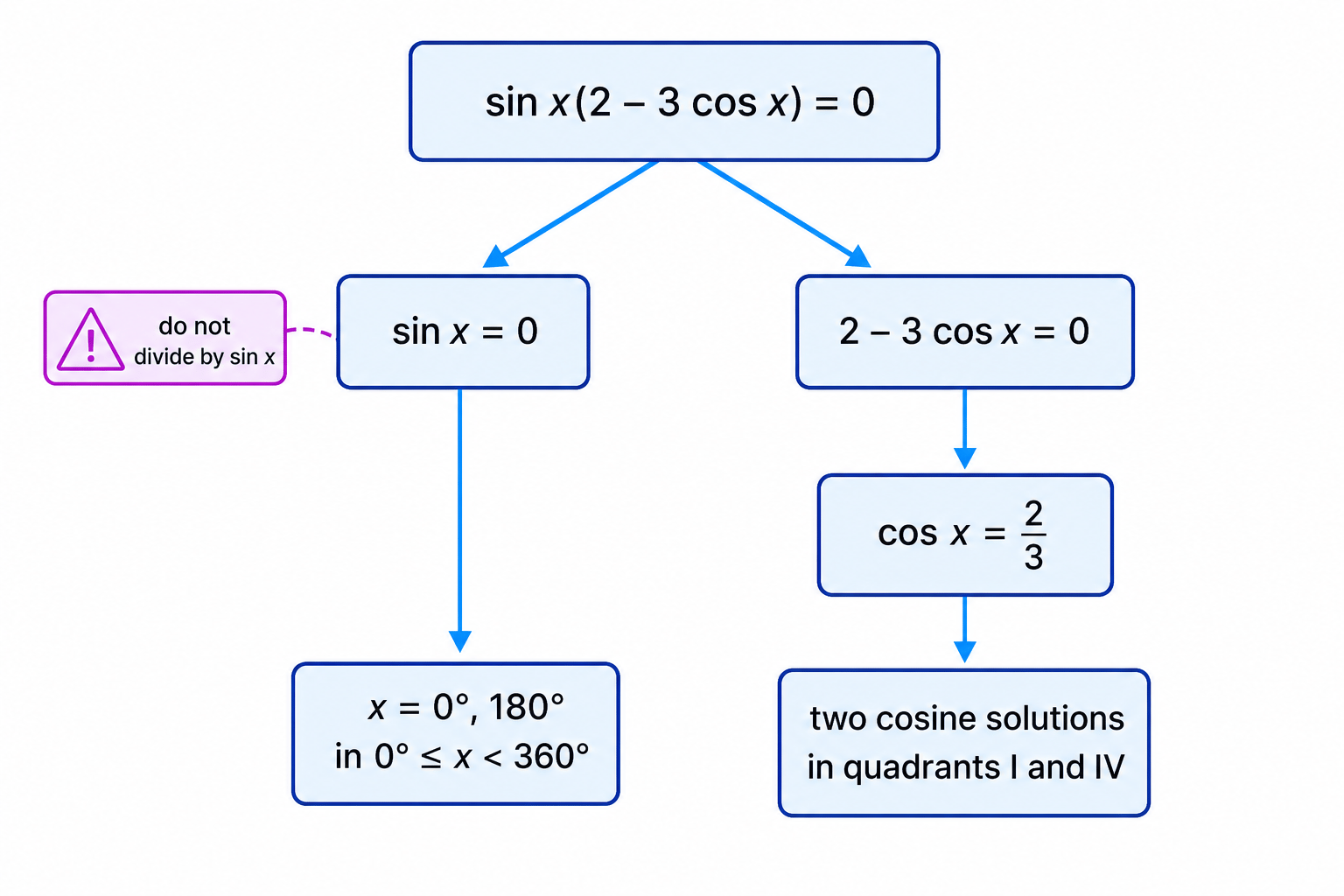
$$
\sin x(2-3\cos x)=0
$$
4. Solve each factor:
$$
\sin x=0\quad \text{or}\quad \cos x=\frac{2}{3}
$$
5. Find the values in 0≤x<360∘0 \le x < 360^\circ0≤x<360∘:
$$
x=0^\circ,\ 48.1896\ldots^\circ,\ 180^\circ,\ 311.8103\ldots^\circ
$$
6. Round where needed:
$$
x=0^\circ,\ 48.2^\circ,\ 180^\circ,\ 311.8^\circ
$$
Dividing by a trig factor
If you divide both sides by sinx\sin xsinx, you lose the solutions where sinx=0\sin x=0sinx=0. Factorising keeps those solutions visible.
Double-angle equations
A double angle is an angle such as 2x2x2x. Treat 2x2x2x as the angle you are solving for first, then divide by 2 at the end.
Solving a double-angle equation
Solve 2sin(2x)tan(2x)=cos(2x)+12\sin(2x)\tan(2x)=\cos(2x)+12sin(2x)tan(2x)=cos(2x)+1 for 0≤x<180∘0 \le x < 180^\circ0≤x<180∘. Give your answers to two decimal places.
-
Let c=cos(2x)c=\cos(2x)c=cos(2x). Also use tan(2x)=sin(2x)cos(2x)\tan(2x)=\frac{\sin(2x)}{\cos(2x)}tan(2x)=cos(2x)sin(2x) and sin2(2x)=1−cos2(2x)\sin^2(2x)=1-\cos^2(2x)sin2(2x)=1−cos2(2x):
2(1−c2)c=c+1\frac{2(1-c^2)}{c}=c+1c2(1−c2)=c+1 -
Multiply by ccc and rearrange:
2−2c2=c2+c3c2+c−2=0\begin{aligned} 2-2c^2 &= c^2+c \\ 3c^2+c-2 &= 0 \end{aligned}2−2c23c2+c−2=c2+c=0 -
Factorise:
(3c−2)(c+1)=0(3c-2)(c+1)=0(3c−2)(c+1)=0 -
So:
cos(2x)=23orcos(2x)=−1\cos(2x)=\frac{2}{3}\quad \text{or}\quad \cos(2x)=-1cos(2x)=32orcos(2x)=−1 -
Since 0≤x<180∘0 \le x < 180^\circ0≤x<180∘, the inside angle satisfies 0≤2x<360∘0 \le 2x < 360^\circ0≤2x<360∘:
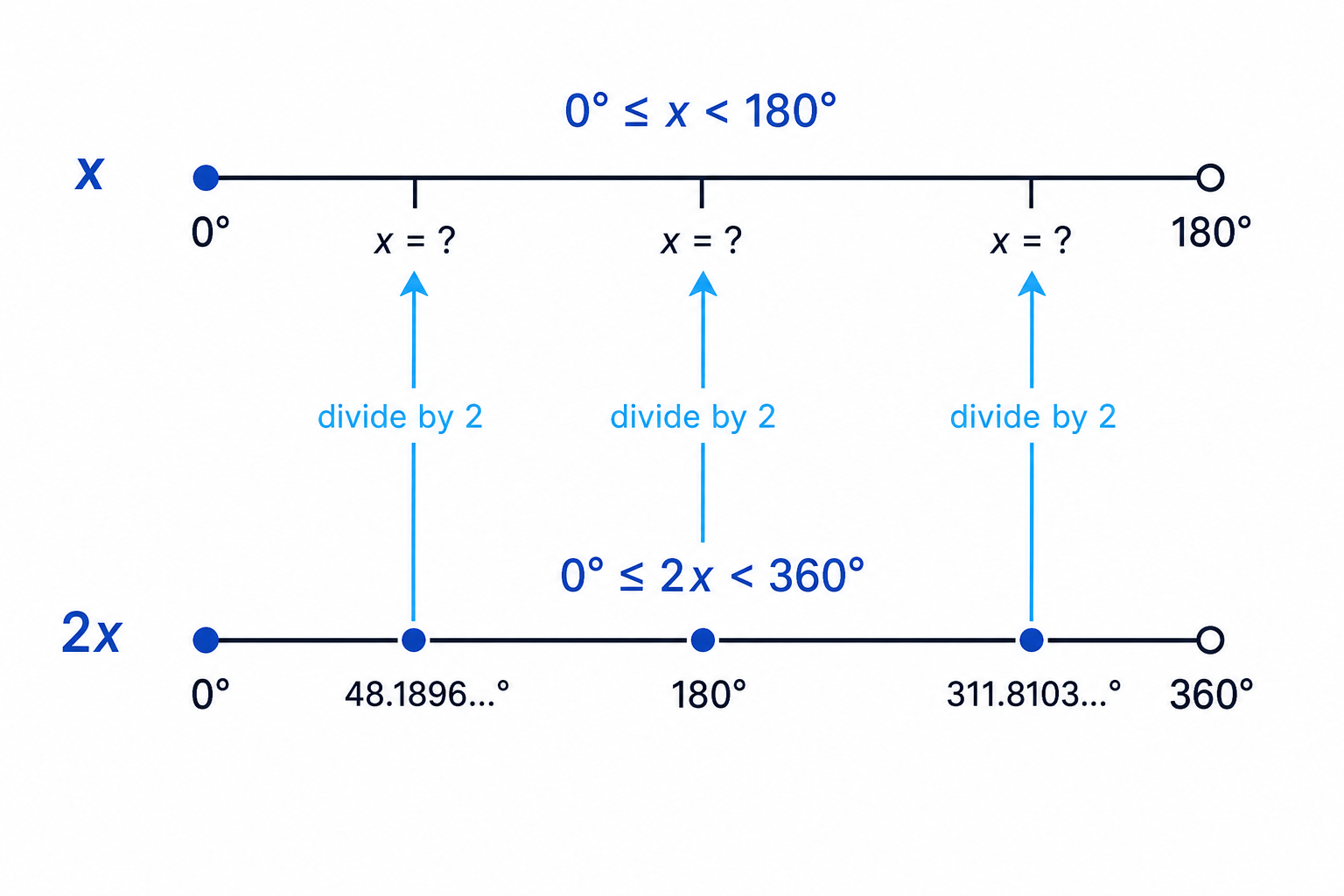
$$
2x=48.1896\ldots^\circ,\ 180^\circ,\ 311.8103\ldots^\circ
$$
6. Divide by 2:
$$
x=24.09^\circ,\ 90^\circ,\ 155.91^\circ
$$
In the exam
-
Write down the interval for the inside angle before using your calculator.
-
Use symmetry or the period of the trig function to find every possible angle.
-
If the equation can be factorised, factorise instead of dividing by a trig expression.
-
Substitute or mentally check your answers in the original equation, especially if you multiplied by something involving trig.
Check yourself
-
Which trig functions have period 360°, and which has period 180°?
-
Why does tan2x=4\tan^2 x=4tan2x=4 lead to two separate equations?
-
In an equation like 4sinxcosx=2sinx4\sin x\cos x=2\sin x4sinxcosx=2sinx, why might dividing by sinx\sin xsinx be dangerous?