

What you'll learn
- How to simplify expressions involving powers, roots and negative indices.
- How to rewrite exponential expressions using a common base.
- How to factorise, expand and simplify algebraic expressions accurately.
- How to rationalise surd denominators and give answers in exact form.
Expressions, terms and simplification
An algebraic expression is a mathematical phrase containing numbers, letters and operations, but no equals sign to solve.
For example, 3x2−5x+13x^2 - 5x + 13x2−5x+1 is an expression. The separate parts 3x23x^23x2, −5x-5x−5x and 1 are called terms.
Key vocabulary
- A term is one part of an expression, separated by addition or subtraction.
- A coefficient is the number multiplying a variable, such as 3 in 3x23x^23x2.
- Like terms have exactly the same variable part, such as 4x24x^24x2 and −7x2-7x^2−7x2.
To simplify means to rewrite an expression in an equivalent but cleaner form. In this topic, that often means using index laws, expanding brackets, factorising, or rationalising surds.
Index laws: powers and roots
An index or exponent tells you how many times a base is used as a factor. In ana^nan, the base is aaa and the index is nnn.
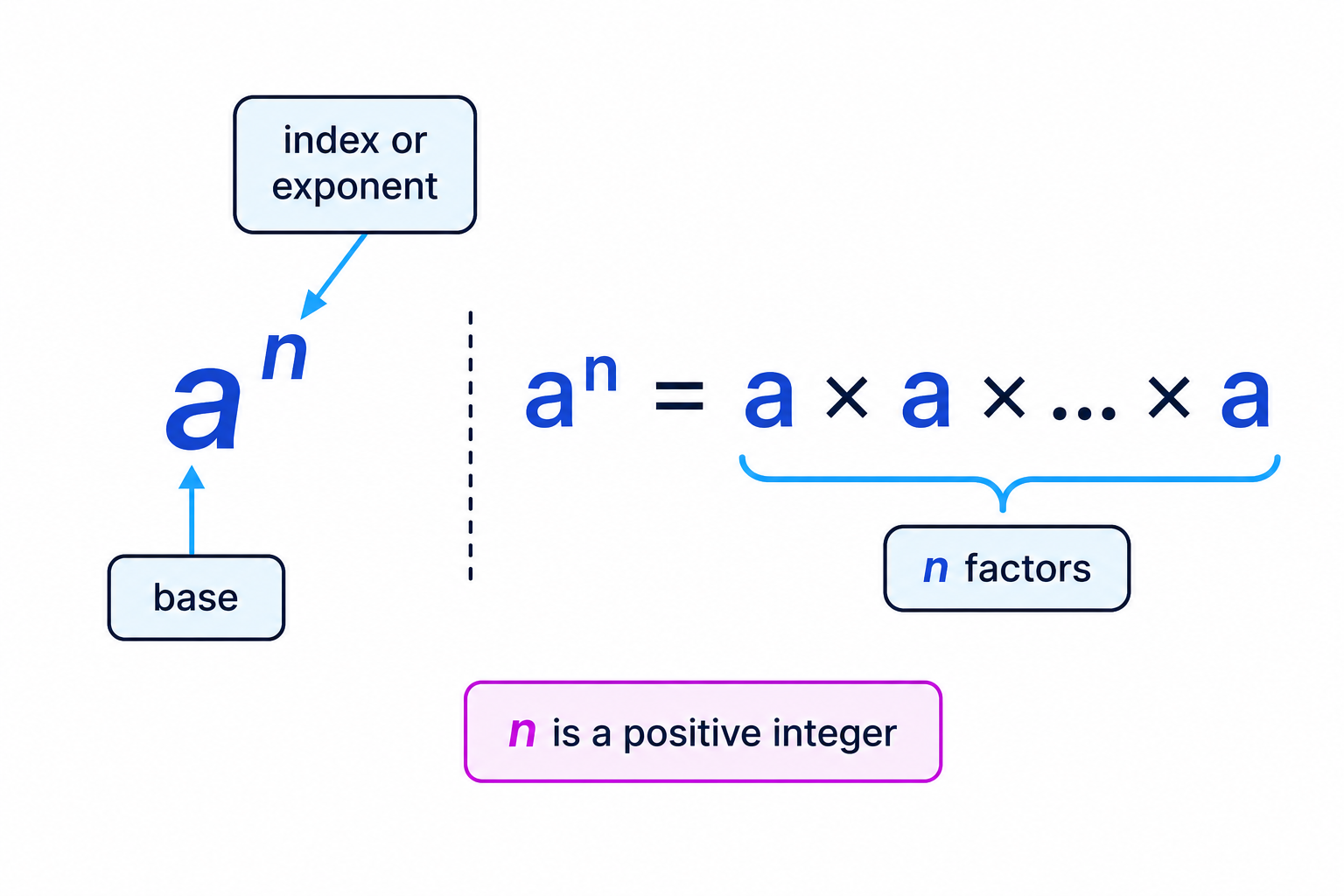
The most useful index laws are:
- am×an=am+na^m \times a^n = a^{m+n}am×an=am+n
- aman=am−n\frac{a^m}{a^n} = a^{m-n}anam=am−n, where a≠0a \neq 0a=0
- (am)n=amn(a^m)^n = a^{mn}(am)n=amn
- a−n=1ana^{-n} = \frac{1}{a^n}a−n=an1
- a1n=ana^{\frac{1}{n}} = \sqrt[n]{a}an1=na
Fractional powers
A fractional power combines a root and a power: amna^{\frac{m}{n}}anm means take the nth root and the mth power.
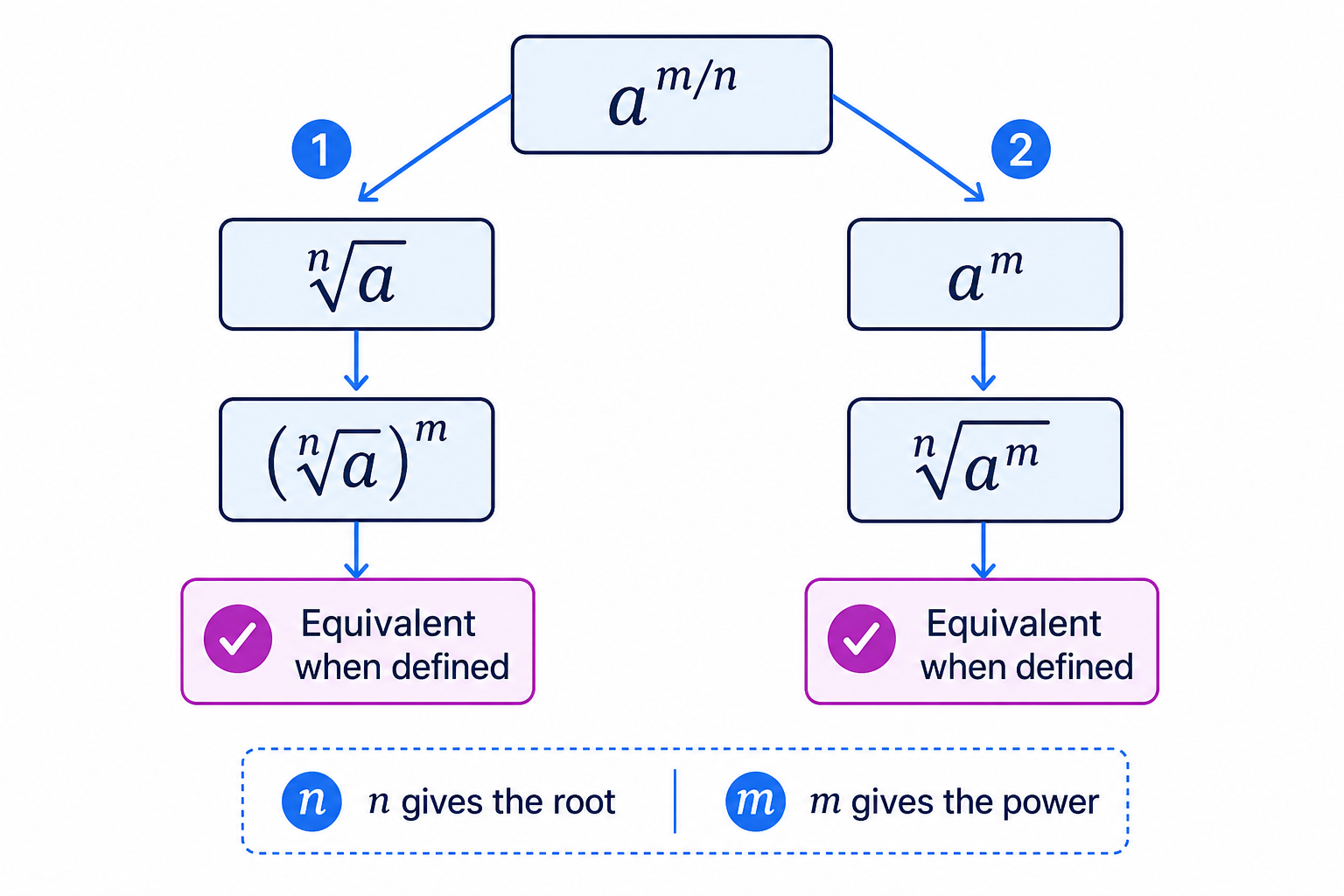
Simplifying a fractional power
Simplify (343x6125)13\left(\frac{343x^6}{125}\right)^{\frac{1}{3}}(125343x6)31.
-
Recognise that a power of 13\frac{1}{3}31 means a cube root.
(343x6125)13=343x61253\left(\frac{343x^6}{125}\right)^{\frac{1}{3}} = \sqrt[3]{\frac{343x^6}{125}}(125343x6)31=3125343x6 -
Take the cube root of the numerator and denominator.
343x61253=343x631253\sqrt[3]{\frac{343x^6}{125}} = \frac{\sqrt[3]{343x^6}}{\sqrt[3]{125}}3125343x6=31253343x6 -
Use 343=73343 = 7^3343=73, 125=53125 = 5^3125=53 and x6=(x2)3x^6 = (x^2)^3x6=(x2)3.
343x631253=7x25\frac{\sqrt[3]{343x^6}}{\sqrt[3]{125}} = \frac{7x^2}{5}31253343x6=57x2
Simplifying with a negative fractional power
Simplify (125x68y3)−23\left(\frac{125x^6}{8y^3}\right)^{-\frac{2}{3}}(8y3125x6)−32.
-
A negative index means take the reciprocal first.
(125x68y3)−23=(8y3125x6)23\left(\frac{125x^6}{8y^3}\right)^{-\frac{2}{3}} = \left(\frac{8y^3}{125x^6}\right)^{\frac{2}{3}}(8y3125x6)−32=(125x68y3)32 -
A power of 23\frac{2}{3}32 means take the cube root, then square.
(8y3125x6)23=(2y5x2)2\left(\frac{8y^3}{125x^6}\right)^{\frac{2}{3}} = \left(\frac{2y}{5x^2}\right)^2(125x68y3)32=(5x22y)2 -
Square the numerator and denominator.
(2y5x2)2=4y225x4\left(\frac{2y}{5x^2}\right)^2 = \frac{4y^2}{25x^4}(5x22y)2=25x44y2
Even roots and variables
Strictly, x2=∣x∣\sqrt{x^2} = |x|x2=∣x∣. In many index-law simplifications, variables are treated as positive unless a domain is stated. If a domain is given, use it.
Rewriting powers using a common base
Many exponential questions become easier once all powers are written with the same base.
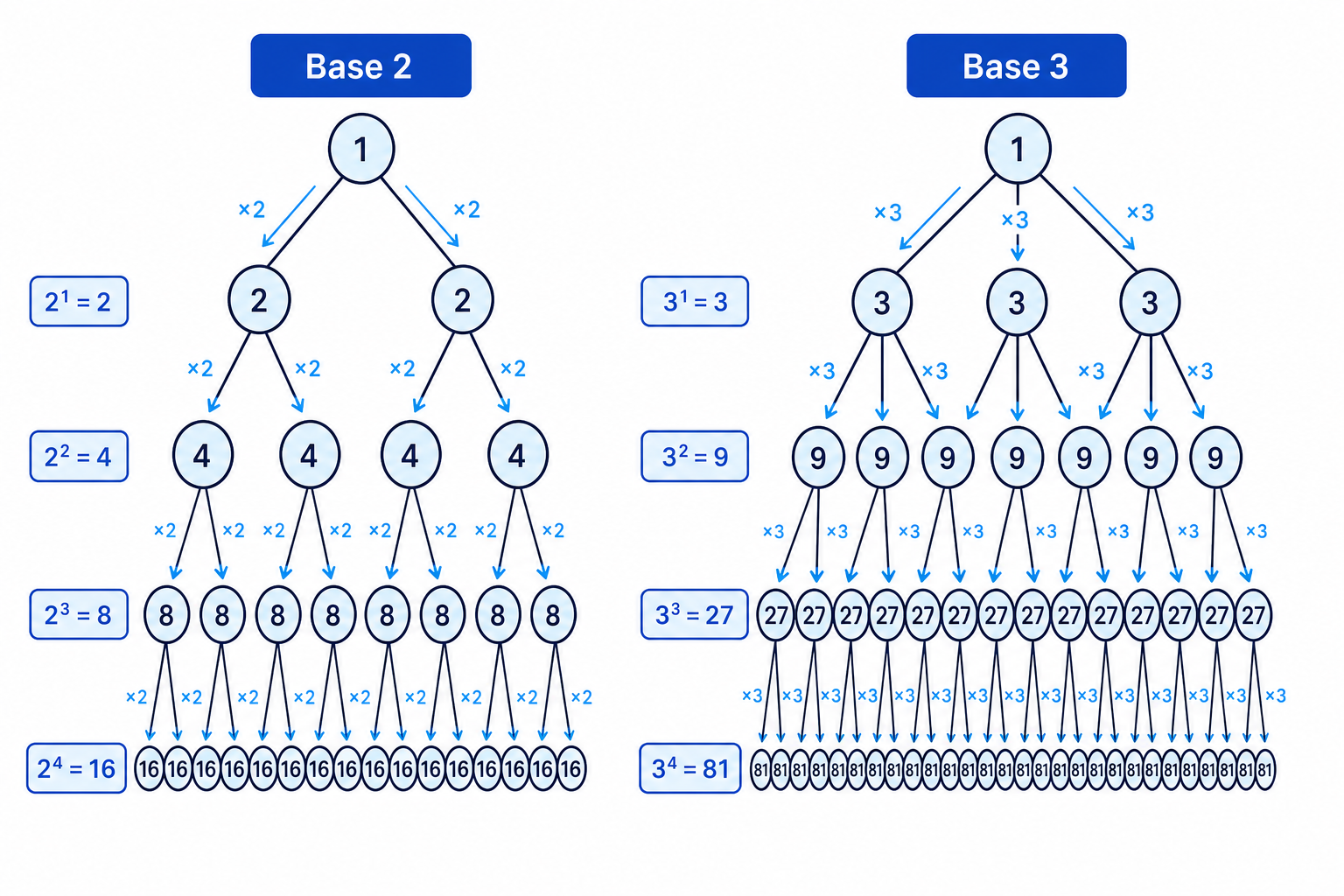
For example:
- 4=224 = 2^24=22
- 8=238 = 2^38=23
- 9=329 = 3^29=32
- 27=3327 = 3^327=33
Writing an expression as a power of 3
Express 272x−127^{2x-1}272x−1 in the form 3y3^y3y, giving yyy in the form ax+bax + bax+b.
-
Rewrite 27 as a power of 3.
272x−1=(33)2x−127^{2x-1} = (3^3)^{2x-1}272x−1=(33)2x−1 -
Use (am)n=amn(a^m)^n = a^{mn}(am)n=amn.
(33)2x−1=33(2x−1)(3^3)^{2x-1} = 3^{3(2x-1)}(33)2x−1=33(2x−1) -
Expand the index.
33(2x−1)=36x−33^{3(2x-1)} = 3^{6x-3}33(2x−1)=36x−3 -
Therefore y=6x−3y = 6x - 3y=6x−3.
Multiplying the base instead of the index
When simplifying (33)2x−1(3^3)^{2x-1}(33)2x−1, multiply the indices to get 36x−33^{6x-3}36x−3. Do not write 92x−19^{2x-1}92x−1 or 32x+23^{2x+2}32x+2.
Solving exponential equations
An exponential equation is an equation where the unknown appears in an index, such as 2x2^x2x or 8x+18^{x+1}8x+1.
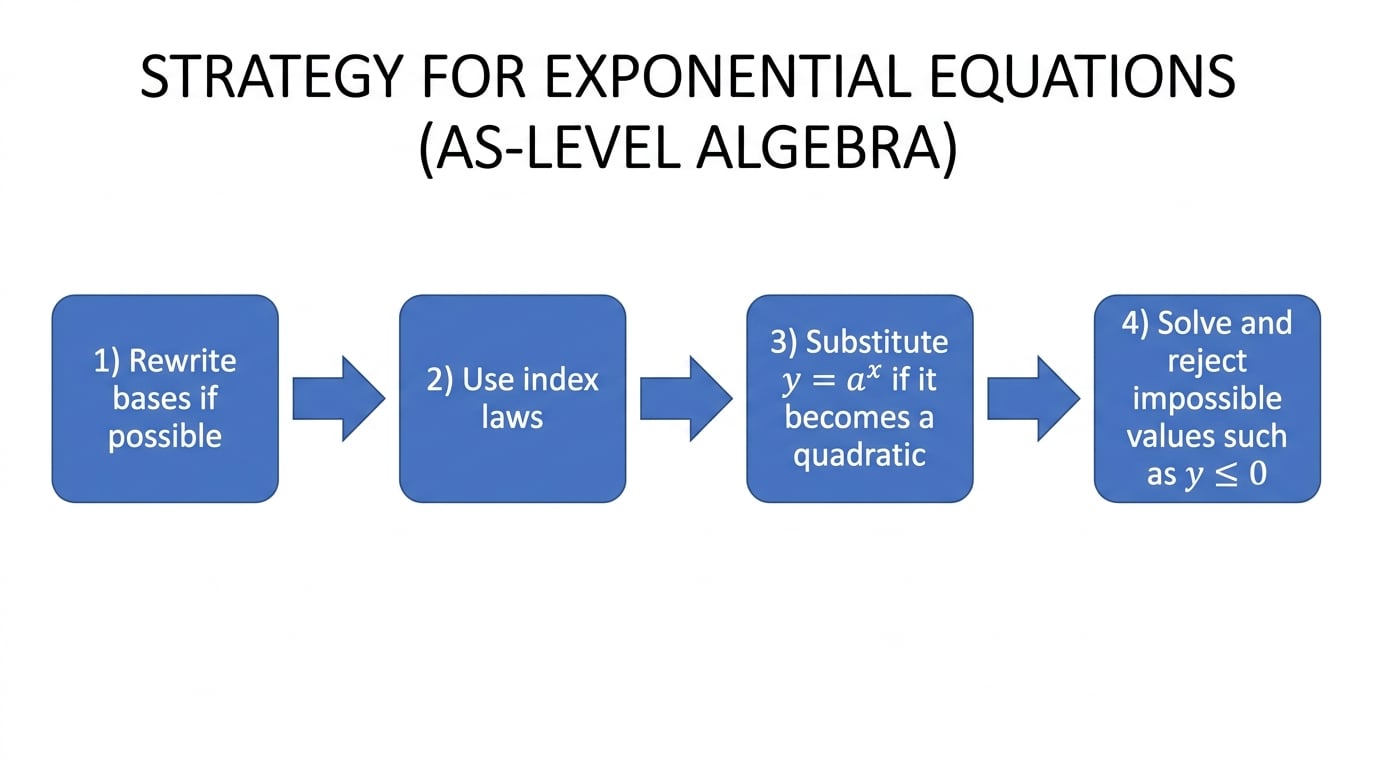
If both sides can be written with the same base, equate the indices. If the equation contains terms like 4x4^x4x and 2x2^x2x, use a substitution such as y=2xy = 2^xy=2x.
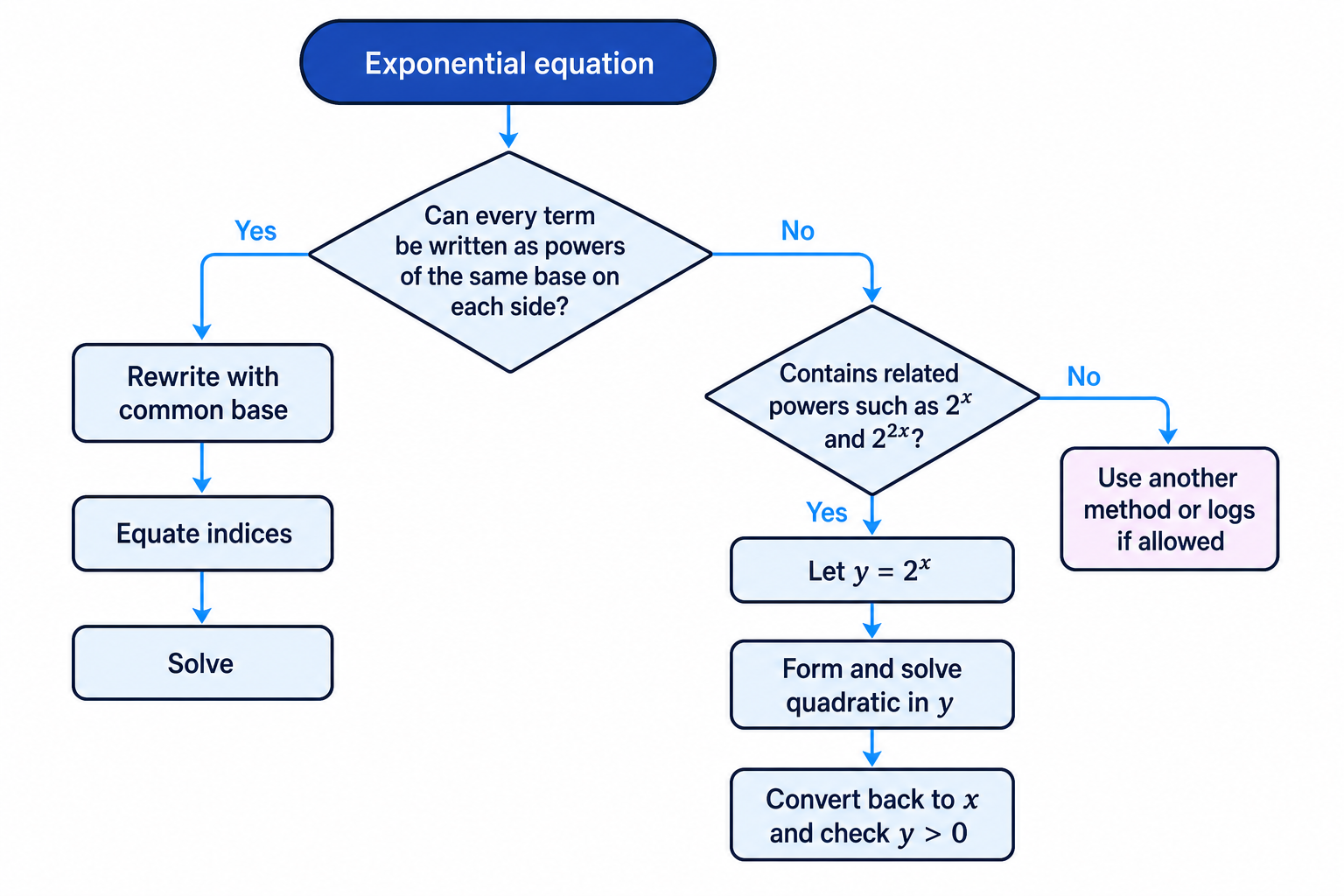
Here is the decision process for exponential equations.
Solving by using a common base
Find xxx if 8x+1=42x−38^{x+1} = 4^{2x-3}8x+1=42x−3.
-
Rewrite both sides as powers of 2.
(23)x+1=(22)2x−3(2^3)^{x+1} = (2^2)^{2x-3}(23)x+1=(22)2x−3 -
Multiply the indices.
23x+3=24x−62^{3x+3} = 2^{4x-6}23x+3=24x−6 -
Since the bases are equal, equate the indices.
3x+3=4x−63x + 3 = 4x - 63x+3=4x−6 -
Solve the linear equation.
x=9x = 9x=9
Solving by substitution
Solve 4x−10(2x)+16=04^x - 10(2^x) + 16 = 04x−10(2x)+16=0.
-
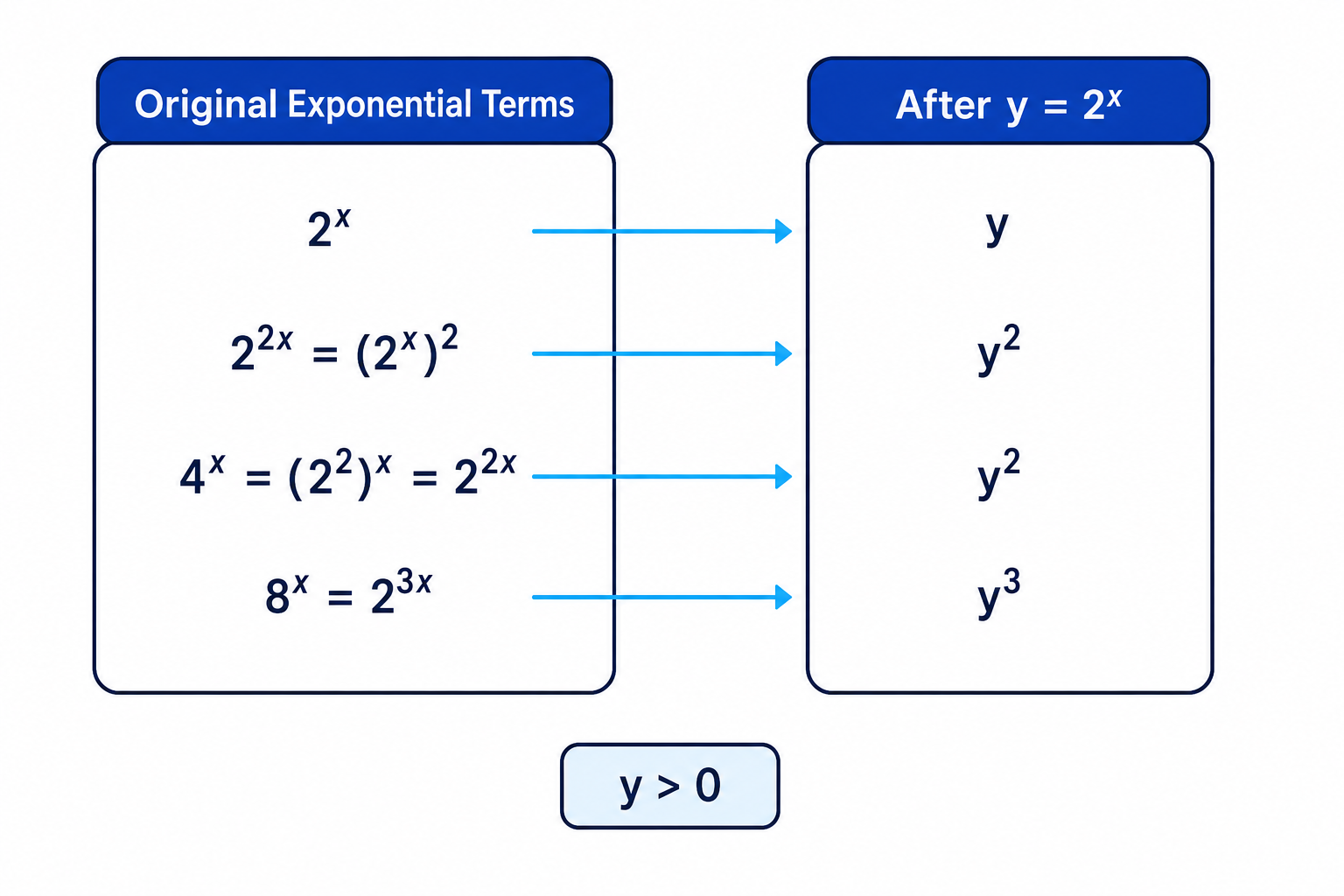
Let y=2xy = 2^xy=2x. Then rewrite 4x4^x4x.
4x=(22)x=(2x)2=y24^x = (2^2)^x = (2^x)^2 = y^24x=(22)x=(2x)2=y2 -
Substitute into the equation.
y2−10y+16=0y^2 - 10y + 16 = 0y2−10y+16=0 -
Factorise the quadratic.
(y−2)(y−8)=0(y - 2)(y - 8) = 0(y−2)(y−8)=0 -
Solve for yyy.
y=2ory=8y = 2 \quad \text{or} \quad y = 8y=2ory=8 -
Convert back to xxx.
2x=2or2x=82^x = 2 \quad \text{or} \quad 2^x = 82x=2or2x=8 -
Therefore x=1x = 1x=1 or x=3x = 3x=3.
Substitution clue
If you see both 2x2^x2x and 22x2^{2x}22x, try letting y=2xy = 2^xy=2x. Then 22x=(2x)2=y22^{2x} = (2^x)^2 = y^222x=(2x)2=y2, which creates a quadratic.
Accepting impossible substitution values
If y=2xy = 2^xy=2x, then yyy is always positive. So if your quadratic gives a negative value of yyy, reject it.
“Hence” equations using a known quadratic
Sometimes you first solve a quadratic, then reuse its structure in a disguised equation.
Using a previous quadratic result
Solve u2−35u+216=0u^2 - 35u + 216 = 0u2−35u+216=0. Hence solve t3−35t32+216=0t^3 - 35t^{\frac{3}{2}} + 216 = 0t3−35t23+216=0.
-
Factorise the quadratic.
u2−35u+216=(u−8)(u−27)u^2 - 35u + 216 = (u - 8)(u - 27)u2−35u+216=(u−8)(u−27) -
So the quadratic has roots u=8u = 8u=8 and u=27u = 27u=27.
-
In the second equation, let u=t32u = t^{\frac{3}{2}}u=t23. Then u2=t3u^2 = t^3u2=t3.
-
The equation becomes the same quadratic as before.
u2−35u+216=0u^2 - 35u + 216 = 0u2−35u+216=0 -
Therefore t32=8t^{\frac{3}{2}} = 8t23=8 or t32=27t^{\frac{3}{2}} = 27t23=27.
-
Raise both sides to the power 23\frac{2}{3}32.
t=823ort=2723t = 8^{\frac{2}{3}} \quad \text{or} \quad t = 27^{\frac{2}{3}}t=832ort=2732 -
Simplify the answers.
t=4ort=9t = 4 \quad \text{or} \quad t = 9t=4ort=9
Factorising and expanding
To factorise means to put an expression into brackets. To expand means to remove brackets by multiplying out.
Factorising completely usually means:
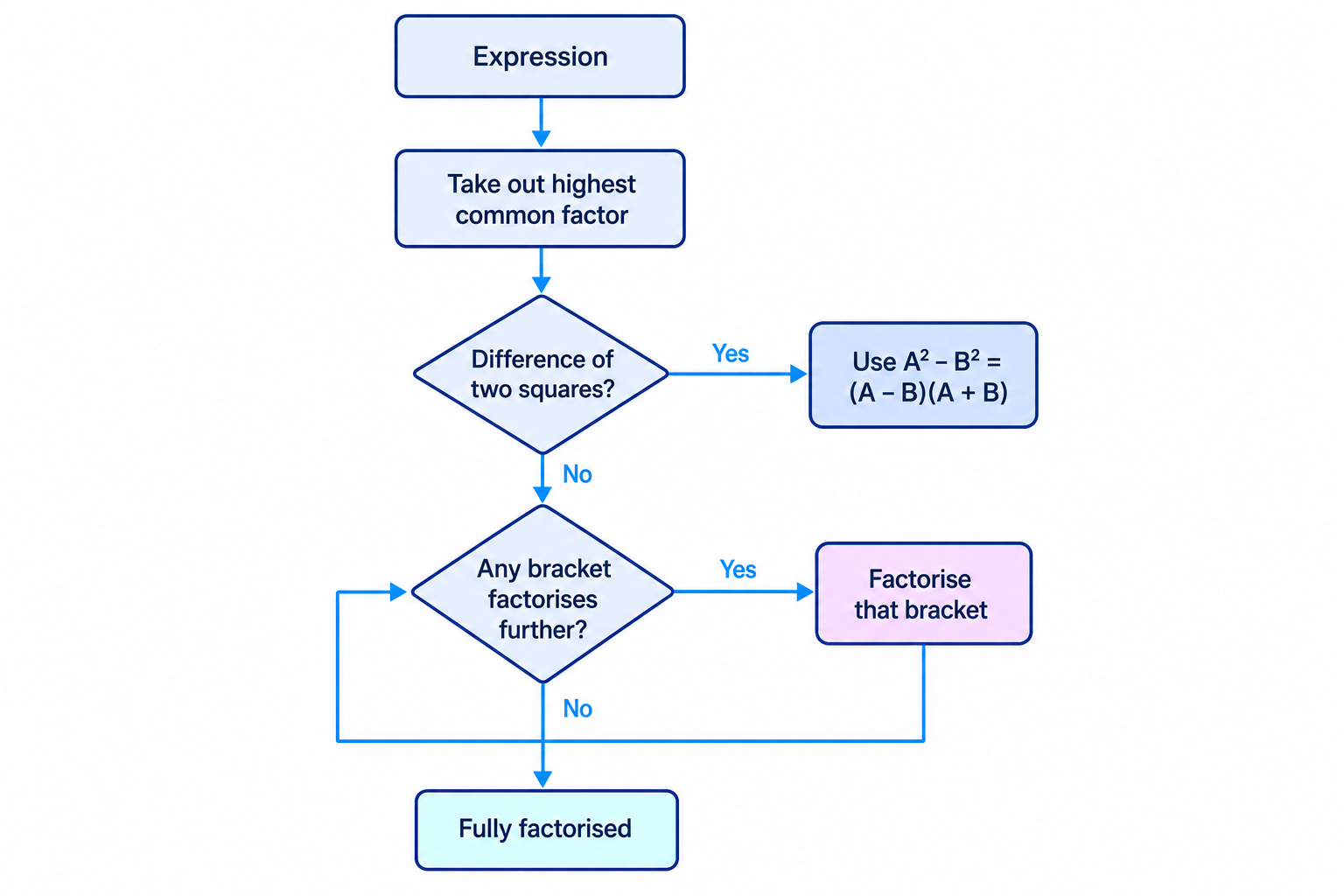
- Take out the highest common factor.
- Look for a difference of two squares.
- Check whether any bracket can be factorised further.
Factorising completely
Factorise 6x−24x36x - 24x^36x−24x3 completely.
-
Take out the highest common factor, which is 6x6x6x.
6x−24x3=6x(1−4x2)6x - 24x^3 = 6x(1 - 4x^2)6x−24x3=6x(1−4x2) -
Recognise a difference of two squares.
1−4x2=12−(2x)21 - 4x^2 = 1^2 - (2x)^21−4x2=12−(2x)2 -
Factorise the bracket.
1−4x2=(1−2x)(1+2x)1 - 4x^2 = (1 - 2x)(1 + 2x)1−4x2=(1−2x)(1+2x) -
Write the final answer.
6x−24x3=6x(1−2x)(1+2x)6x - 24x^3 = 6x(1 - 2x)(1 + 2x)6x−24x3=6x(1−2x)(1+2x)
Expanding and simplifying brackets
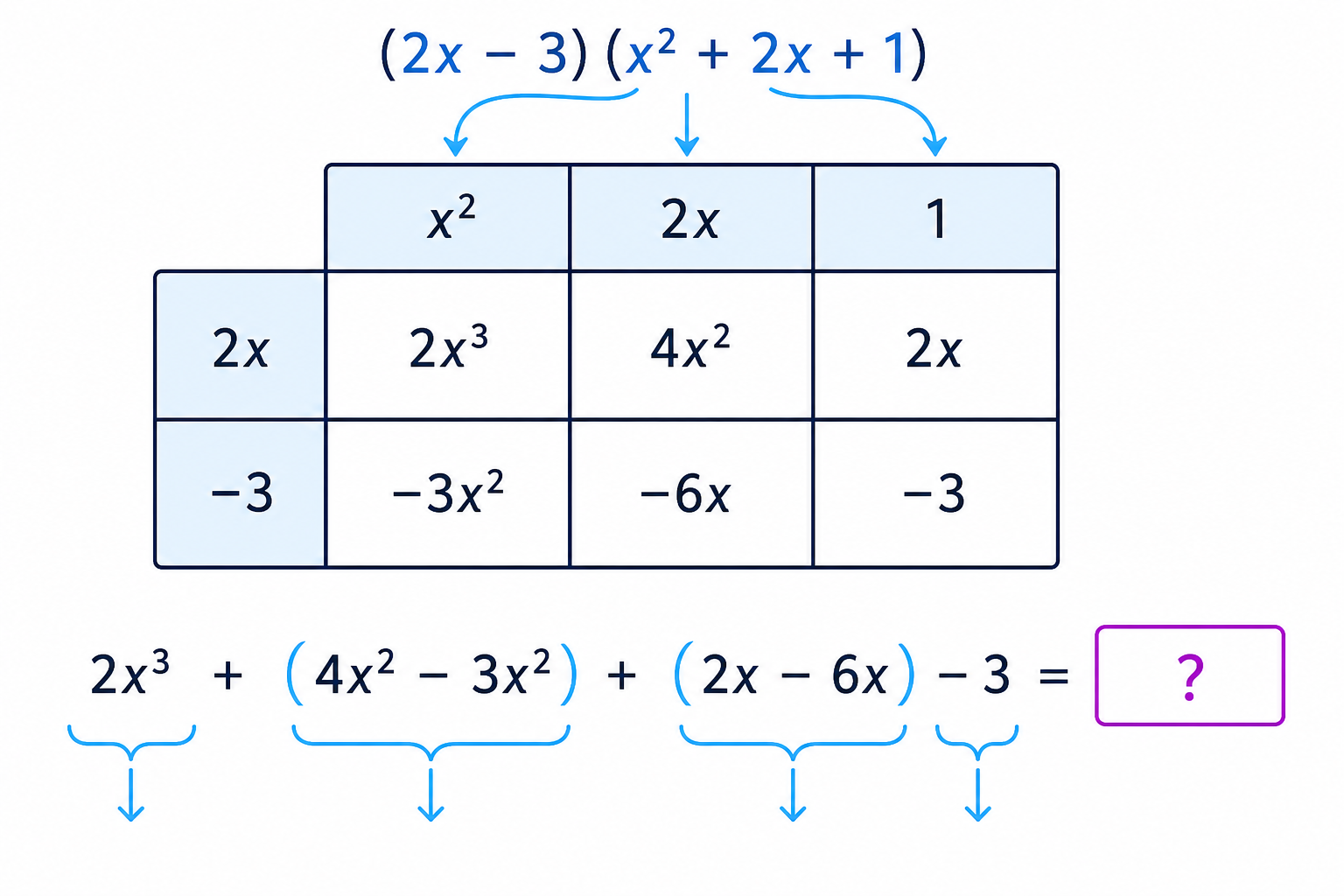
Expand and simplify (2x−3)(x+1)2(2x - 3)(x + 1)^2(2x−3)(x+1)2.
-
Square the repeated bracket first.
(x+1)2=x2+2x+1(x + 1)^2 = x^2 + 2x + 1(x+1)2=x2+2x+1 -
Multiply by the remaining bracket.
(2x−3)(x2+2x+1)=2x3+4x2+2x−3x2−6x−3(2x - 3)(x^2 + 2x + 1) = 2x^3 + 4x^2 + 2x - 3x^2 - 6x - 3(2x−3)(x2+2x+1)=2x3+4x2+2x−3x2−6x−3 -
Collect like terms.
2x3+x2−4x−32x^3 + x^2 - 4x - 32x3+x2−4x−3
Surds and rationalising denominators
A surd is an irrational root left in exact form, such as 2\sqrt{2}2 or 5\sqrt{5}5.
To rationalise the denominator means to rewrite a fraction so there is no surd on the bottom. For denominators like a+ba + \sqrt{b}a+b, multiply by the conjugate a−ba - \sqrt{b}a−b.
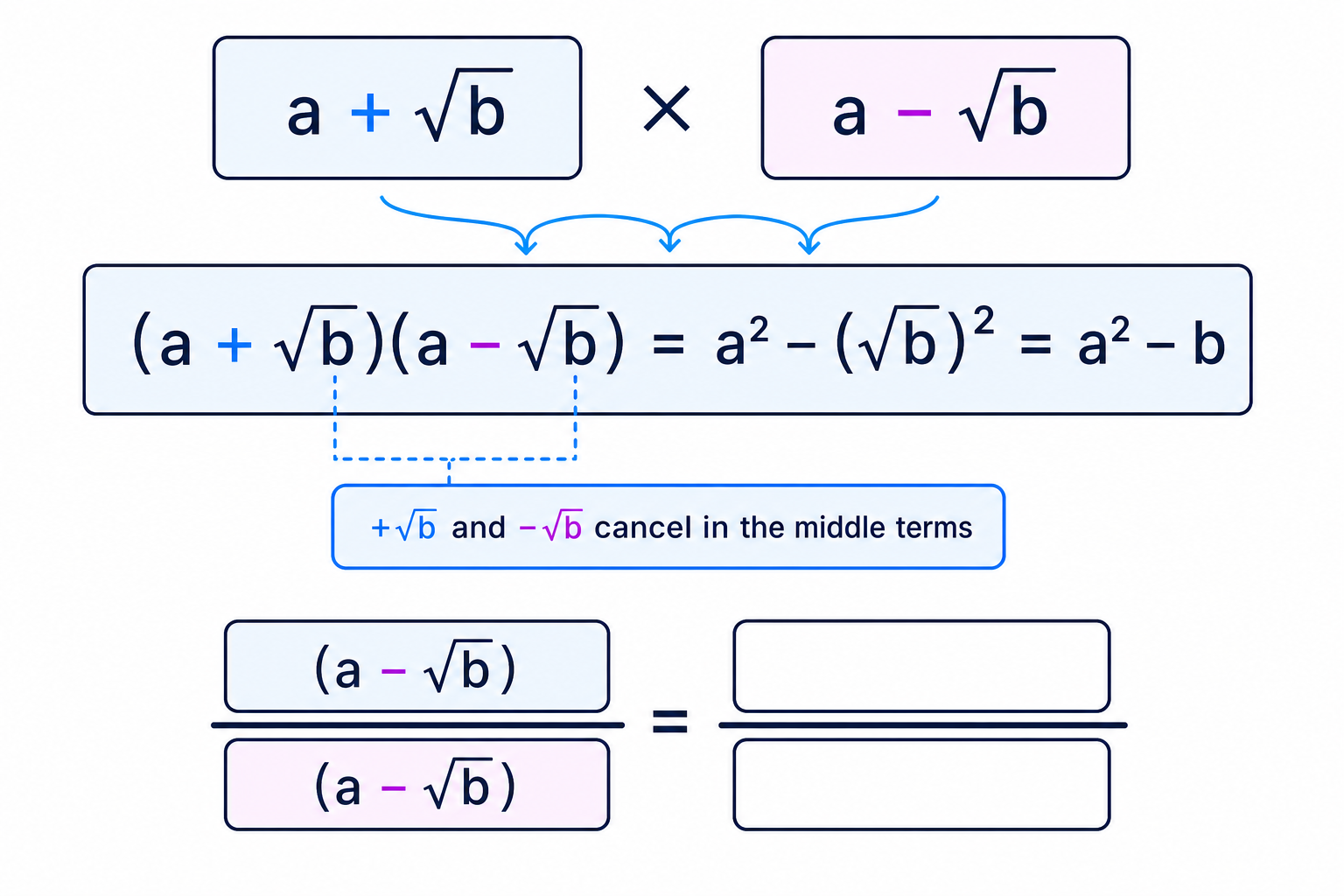
Conjugate
The conjugate of a+ba + \sqrt{b}a+b is a−ba - \sqrt{b}a−b. Multiplying conjugates uses the difference of two squares.
Rationalising a denominator
Simplify 4+23−2\frac{4 + \sqrt{2}}{3 - \sqrt{2}}3−24+2.
-
Multiply the top and bottom by the conjugate of the denominator.
4+23−2×3+23+2\frac{4 + \sqrt{2}}{3 - \sqrt{2}} \times \frac{3 + \sqrt{2}}{3 + \sqrt{2}}3−24+2×3+23+2 -
Expand the numerator.
(4+2)(3+2)=14+72(4 + \sqrt{2})(3 + \sqrt{2}) = 14 + 7\sqrt{2}(4+2)(3+2)=14+72 -
Expand the denominator.
(3−2)(3+2)=9−2=7(3 - \sqrt{2})(3 + \sqrt{2}) = 9 - 2 = 7(3−2)(3+2)=9−2=7 -
Divide by 7.
14+727=2+2\frac{14 + 7\sqrt{2}}{7} = 2 + \sqrt{2}714+72=2+2
Solving and giving the answer in surd form
Find xxx if 2+xx=5\frac{2 + x}{x} = \sqrt{5}x2+x=5, giving your answer in the form a+b5a + b\sqrt{5}a+b5.
-
Multiply both sides by xxx, where x≠0x \neq 0x=0.
2+x=x52 + x = x\sqrt{5}2+x=x5 -
Collect the xxx terms on one side.
2=x5−x2 = x\sqrt{5} - x2=x5−x -
Factorise the right-hand side.
2=x(5−1)2 = x(\sqrt{5} - 1)2=x(5−1) -
Divide by 5−1\sqrt{5} - 15−1.
x=25−1x = \frac{2}{\sqrt{5} - 1}x=5−12 -
Rationalise the denominator.
x=25−1×5+15+1=2(5+1)4x = \frac{2}{\sqrt{5} - 1} \times \frac{\sqrt{5} + 1}{\sqrt{5} + 1} = \frac{2(\sqrt{5} + 1)}{4}x=5−12×5+15+1=42(5+1) -
Write in the required form.
x=12+125x = \frac{1}{2} + \frac{1}{2}\sqrt{5}x=21+215
In the exam
-
Look for the structure first: common base, quadratic substitution, common factor, or surd denominator.
-
Show enough working to make your method clear, especially when changing bases or rationalising.
-
Check restrictions: denominators cannot be zero, and substitutions like y=2xy = 2^xy=2x must be positive.
Check yourself
- Can you simplify an expression with a negative fractional index without skipping the reciprocal step?
- When should you use a substitution such as y=2xy = 2^xy=2x?
- Can you rationalise a denominator using the correct conjugate?
