What you'll learn
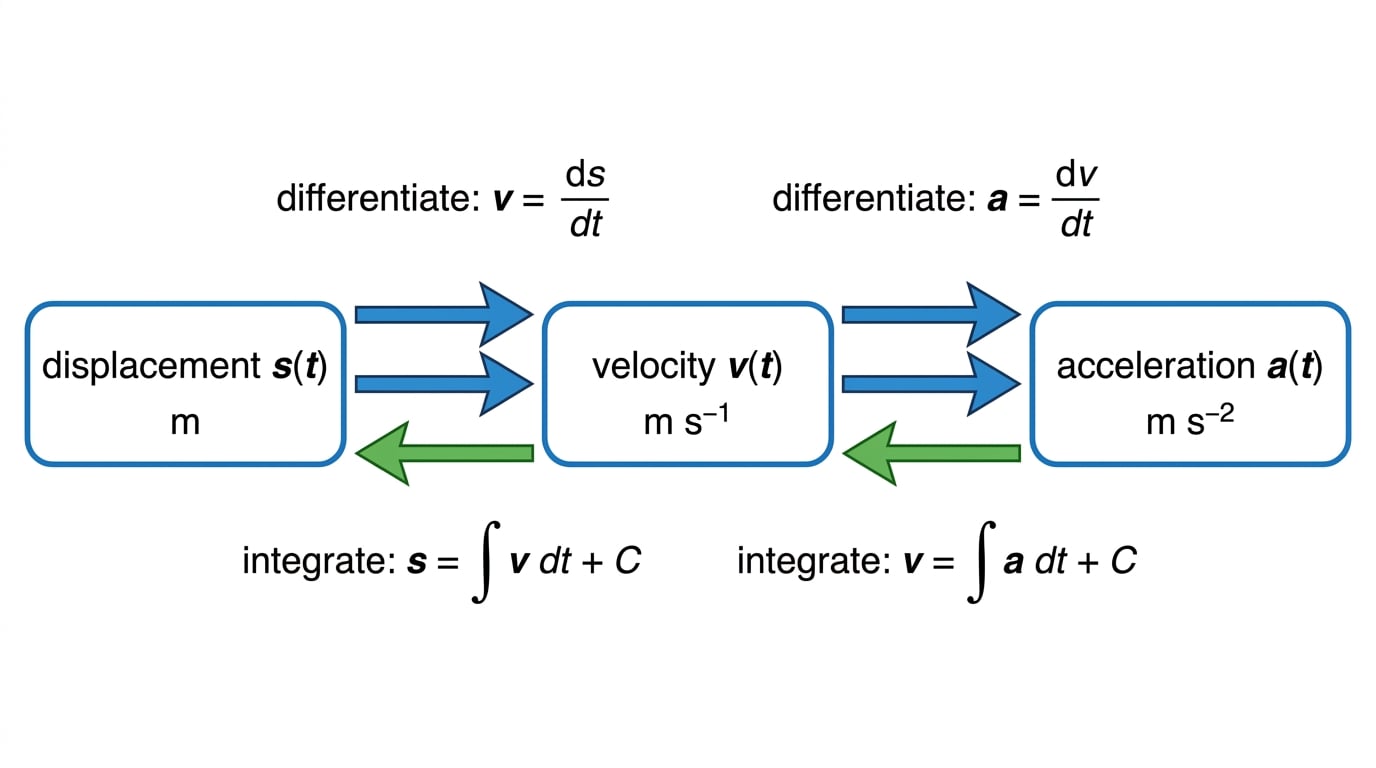
- How displacement, velocity and acceleration are linked using calculus.
- How to use initial conditions to find constants of integration.
- How to find when a particle is instantaneously at rest or changes direction.
- How to calculate total distance travelled, including when velocity becomes negative.
Why this topic needs calculus
In constant acceleration questions, you used SUVAT. In variable acceleration, acceleration is not fixed; it changes with time. That means the SUVAT formulae usually do not apply.
Instead, you use differentiation and integration.
Variable acceleration
A particle has variable acceleration when its acceleration is given as a function of time, such as a=4t−8a = 4t - 8a=4t−8, rather than as one constant value.
The big idea is:
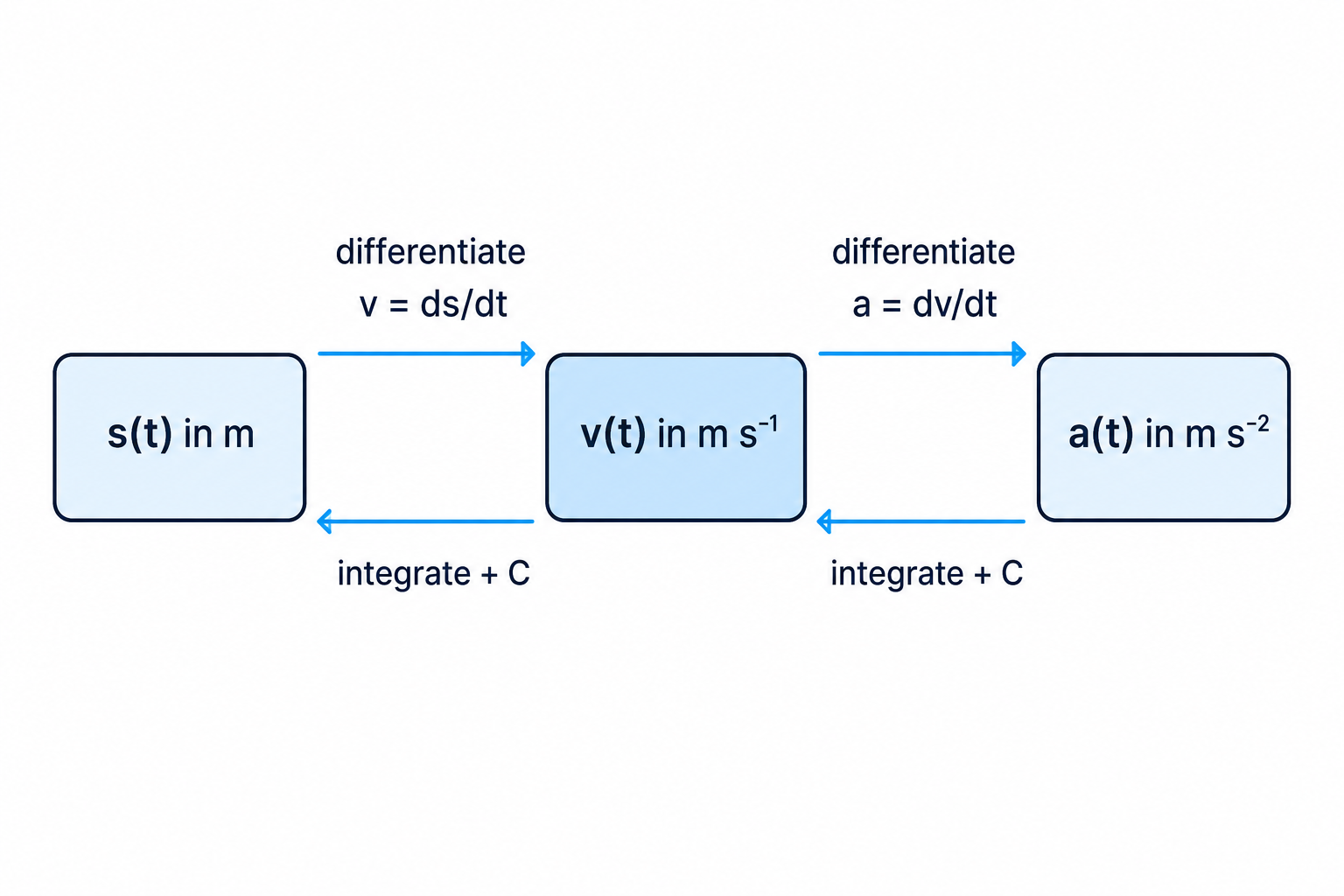
So:
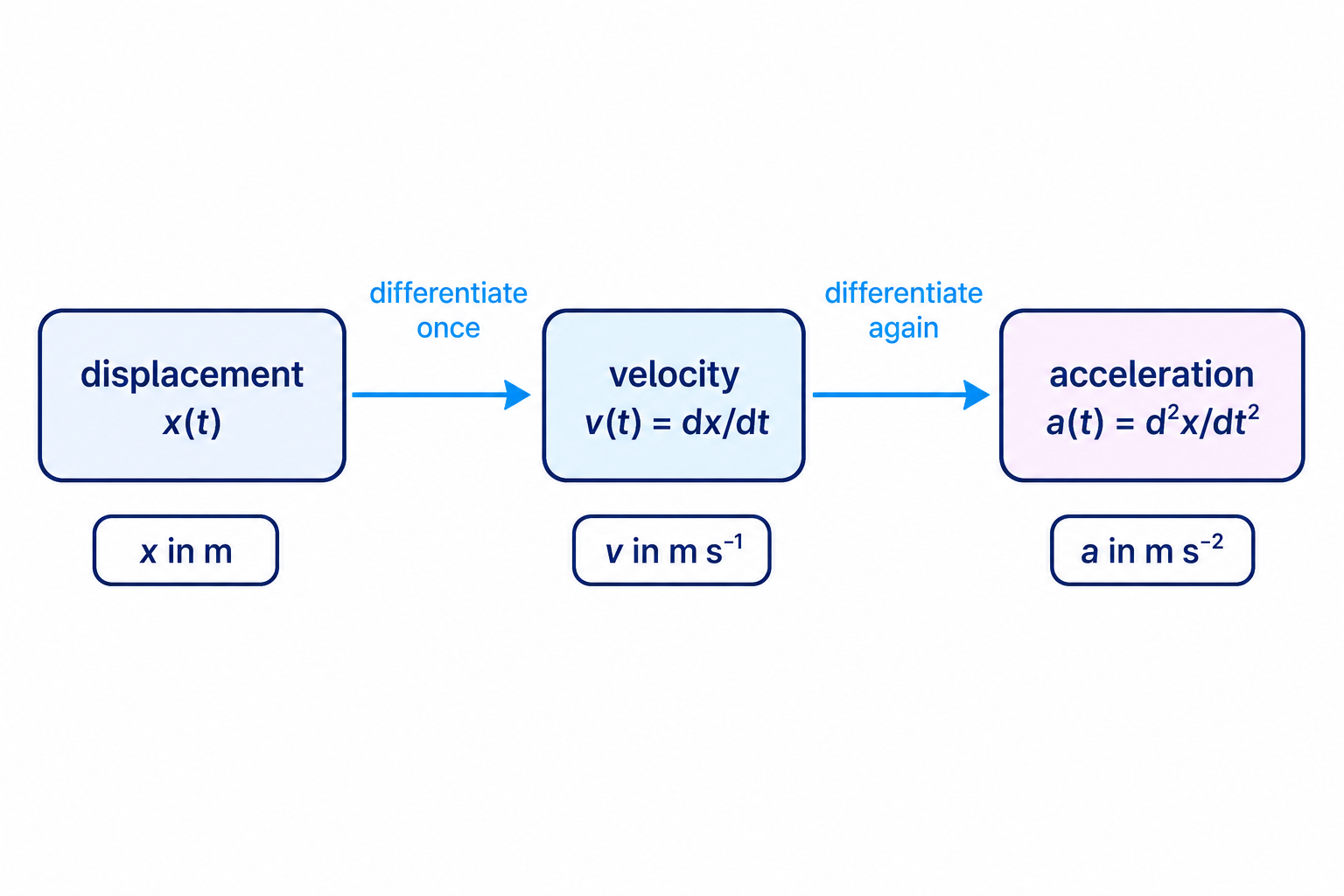
- Differentiate displacement to get velocity.
- Differentiate velocity to get acceleration.
- Integrate acceleration to get velocity.
- Integrate velocity to get displacement.
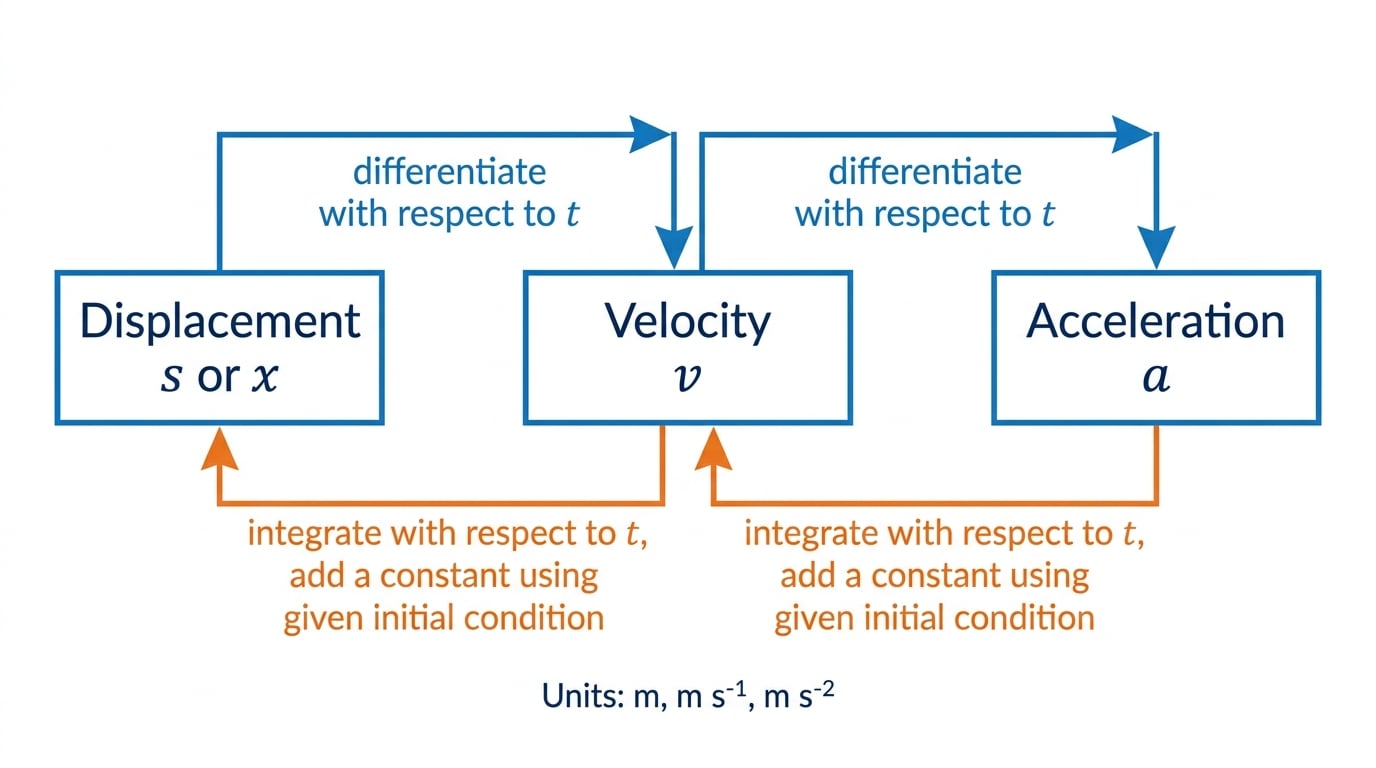
The calculus chain
If you move from displacement to velocity to acceleration, you differentiate. If you move backwards from acceleration to velocity to displacement, you integrate and include a constant.
From acceleration to velocity
If you are given acceleration as a function of time, use
a=dvdta = \frac{dv}{dt}a=dtdvSo to find velocity, integrate acceleration:
v=∫a dtv = \int a \, dtv=∫adtBecause integration introduces a constant, you then use information like “initially the velocity is 6 m s^-1” to find that constant.
Finding velocity from acceleration
A particle moves in a straight line. Its acceleration at time ttt seconds is a=6t−12a = 6t - 12a=6t−12. Initially, its velocity is 9 m s^-1. Find vvv in terms of ttt.
-
Start from the relationship between acceleration and velocity:
a=dvdta = \frac{dv}{dt}a=dtdv -
Integrate a=6t−12a = 6t - 12a=6t−12 with respect to ttt:
v=∫(6t−12) dtv = \int (6t - 12)\,dtv=∫(6t−12)dt -
Carry out the integration, remembering the constant:
v=3t2−12t+Cv = 3t^2 - 12t + Cv=3t2−12t+C -
Use the initial condition. Initially means t=0t = 0t=0, and the velocity is 9:
9=3(0)2−12(0)+C9 = 3(0)^2 - 12(0) + C9=3(0)2−12(0)+C -
Hence C=9C = 9C=9, so the velocity is:
v=3t2−12t+9v = 3t^2 - 12t + 9v=3t2−12t+9
Forgetting the constant
When you integrate, always include +C+C+C. Many mechanics marks come from using the given initial condition correctly.
From velocity to displacement
Displacement
Displacement is the signed position of a particle from a fixed point, such as the origin OOO. It can be positive, negative or zero depending on direction.
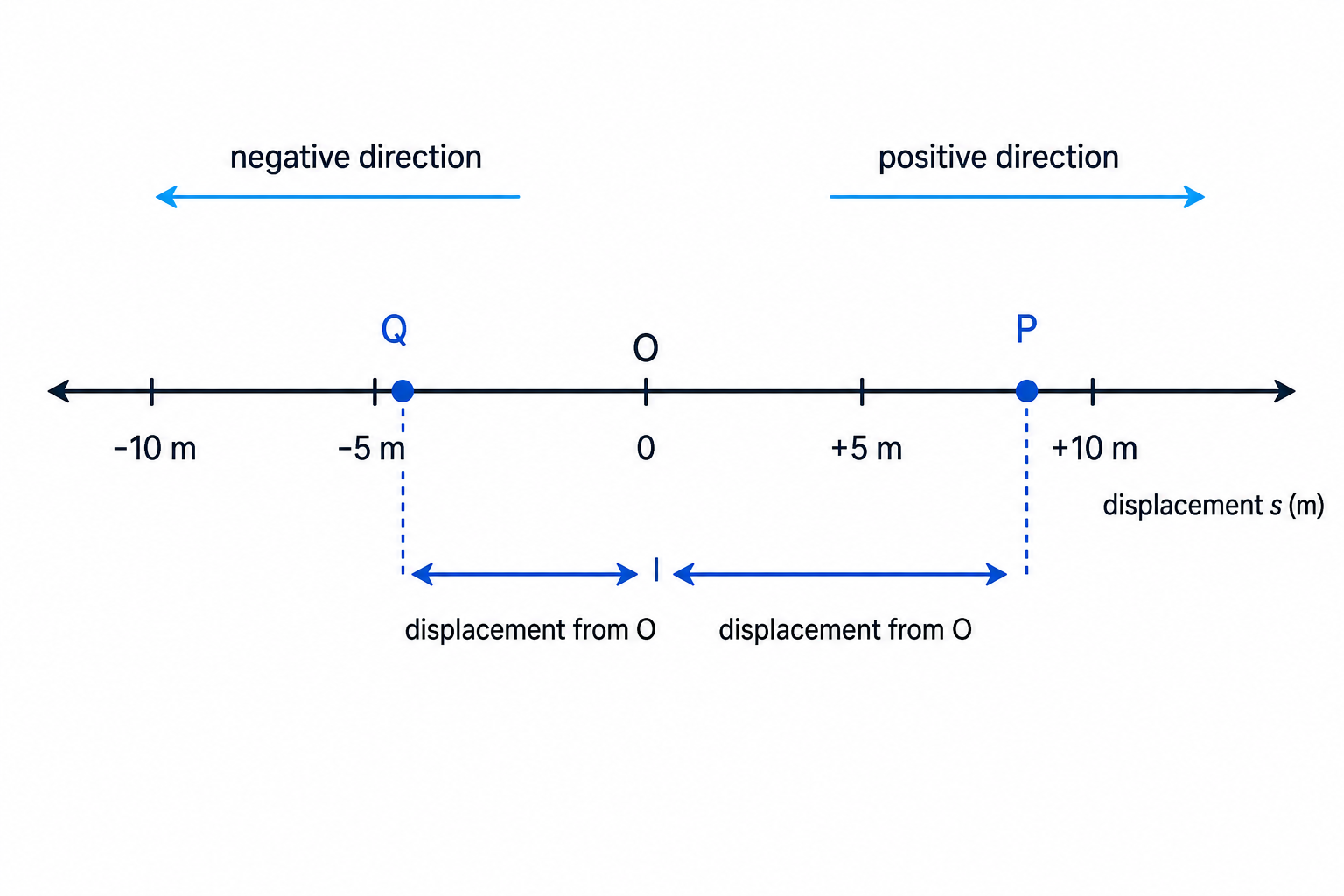
Since velocity is the rate of change of displacement,
v=dsdtv = \frac{ds}{dt}v=dtdsSo to find displacement, integrate velocity:
s=∫v dts = \int v \, dts=∫vdtAgain, you must use a given displacement value to find the constant.
Finding displacement from velocity
A particle has velocity v=5t−3v = 5t - 3v=5t−3 m s^-1. When t=4t = 4t=4, its displacement from OOO is 52 m. Find an expression for sss, then find its displacement when t=8t = 8t=8.
-
Use v=dsdtv = \frac{ds}{dt}v=dtds, so integrate velocity:
s=∫(5t−3) dts = \int (5t - 3)\,dts=∫(5t−3)dt -
Integrate term by term:
s=52t2−3t+Cs = \frac{5}{2}t^2 - 3t + Cs=25t2−3t+C -
Use the condition s=52s = 52s=52 when t=4t = 4t=4:
52=52(4)2−3(4)+C52 = \frac{5}{2}(4)^2 - 3(4) + C52=25(4)2−3(4)+C -
Simplify to find CCC:
52=40−12+C52 = 40 - 12 + C52=40−12+C -
So C=24C = 24C=24, giving:
s=52t2−3t+24s = \frac{5}{2}t^2 - 3t + 24s=25t2−3t+24 -
Substitute t=8t = 8t=8:
s=52(8)2−3(8)+24=160s = \frac{5}{2}(8)^2 - 3(8) + 24 = 160s=25(8)2−3(8)+24=160
Check your units
Velocity has units m s^-1, acceleration has units m s^-2, and displacement has units m. If your answer is a distance or displacement, it should end in metres.
Instantaneously at rest
Instantaneously at rest
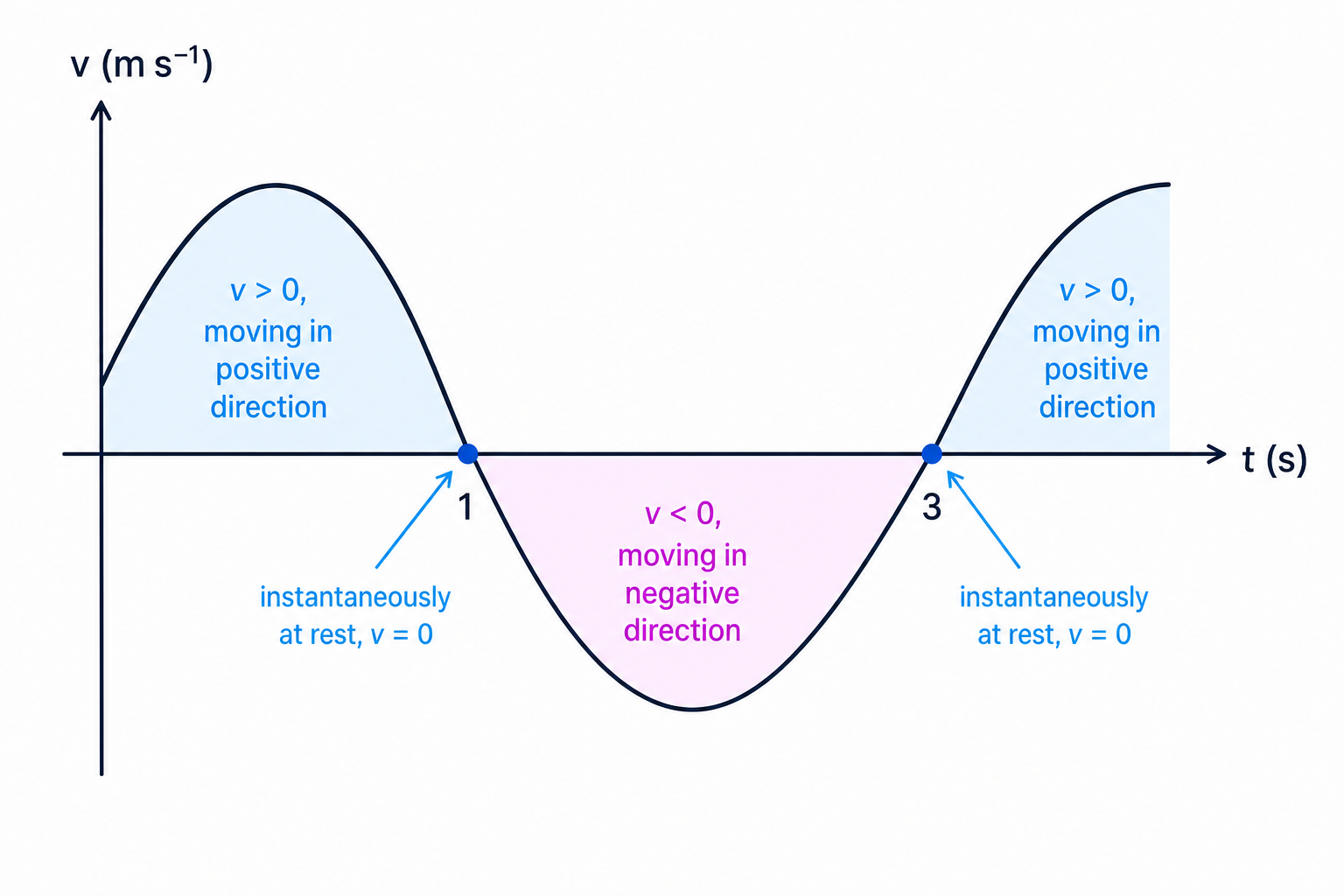
A particle is instantaneously at rest when its velocity is zero at that instant. This means solve v=0v = 0v=0.
This does not necessarily mean the particle stops forever. It may turn around immediately afterwards.
Distance between two rest positions
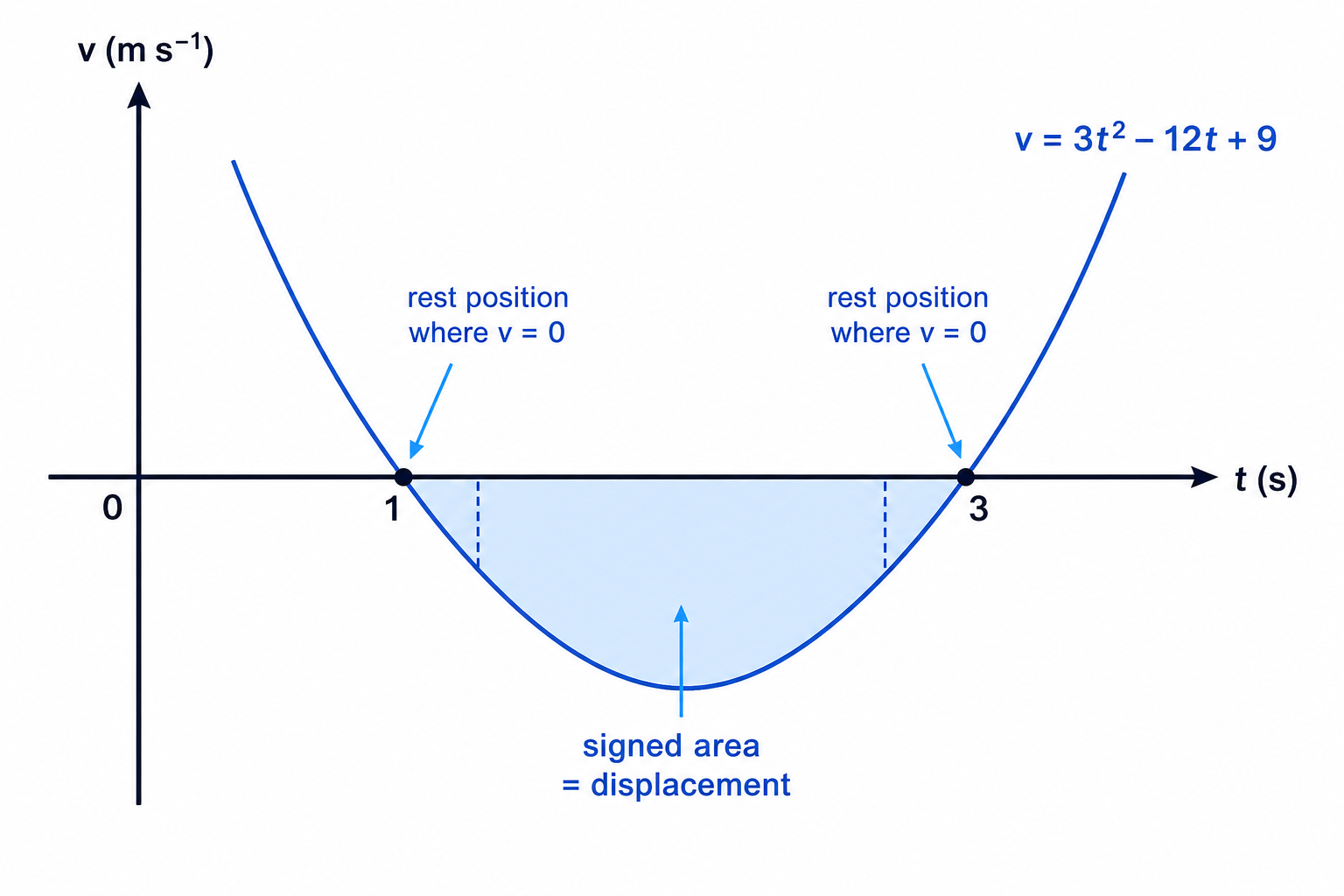
A particle has acceleration a=6t−12a = 6t - 12a=6t−12 m s^-2. Initially its velocity is 9 m s^-1. Find the distance between the two positions where the particle is instantaneously at rest.
-
From the earlier result for this acceleration and initial velocity:
v=3t2−12t+9v = 3t^2 - 12t + 9v=3t2−12t+9 -
Set v=0v = 0v=0 to find the rest times:
3t2−12t+9=03t^2 - 12t + 9 = 03t2−12t+9=0 -
Factorise:
3(t2−4t+3)=03(t^2 - 4t + 3) = 03(t2−4t+3)=0 -
So the particle is at rest when:
t=1ort=3t = 1 \quad \text{or} \quad t = 3t=1ort=3 -
To find the displacement between these times, integrate velocity from t=1t = 1t=1 to t=3t = 3t=3:
$$
\int_1^3 (3t^2 - 12t + 9)\,dt
$$
6. Find an antiderivative:
$$
\int (3t^2 - 12t + 9)\,dt = t^3 - 6t^2 + 9t
$$
7. Evaluate between the limits:
$$
\left[t^3 - 6t^2 + 9t\right]_1^3 = 0 - 4 = -4
$$
8. The displacement is -4 m, so the distance between the two positions is 4 m.
Distance is not always displacement
A negative displacement means the movement was in the negative direction. Distance is never negative, so take the magnitude when the question asks for a distance between two positions.
Total distance travelled
Distance travelled
Total distance travelled is the total length of the path followed. It ignores direction, so it cannot be negative.
On a velocity-time graph:
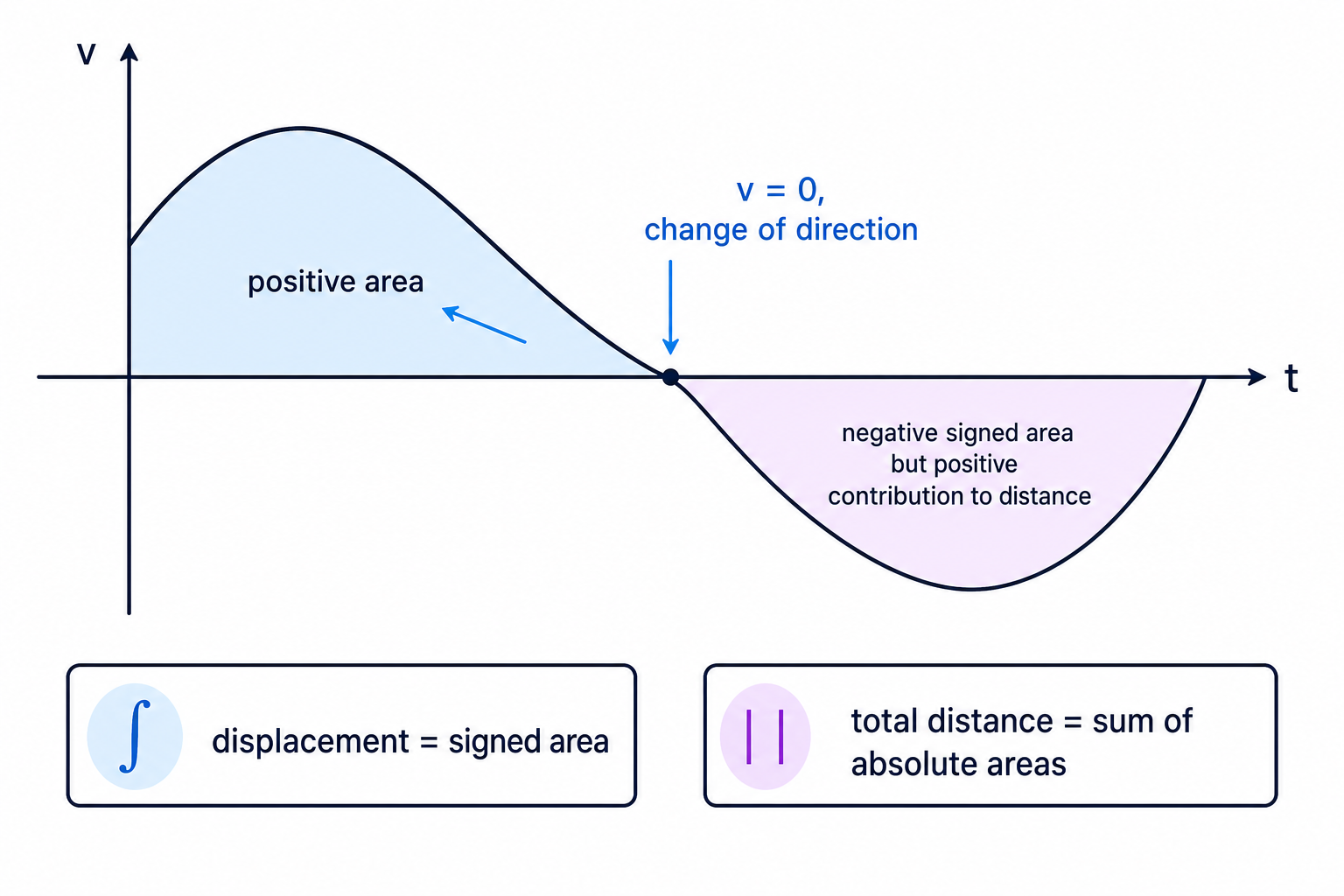
- Displacement is the signed area under the graph.
- Distance travelled is the total area, treating areas below the axis as positive.
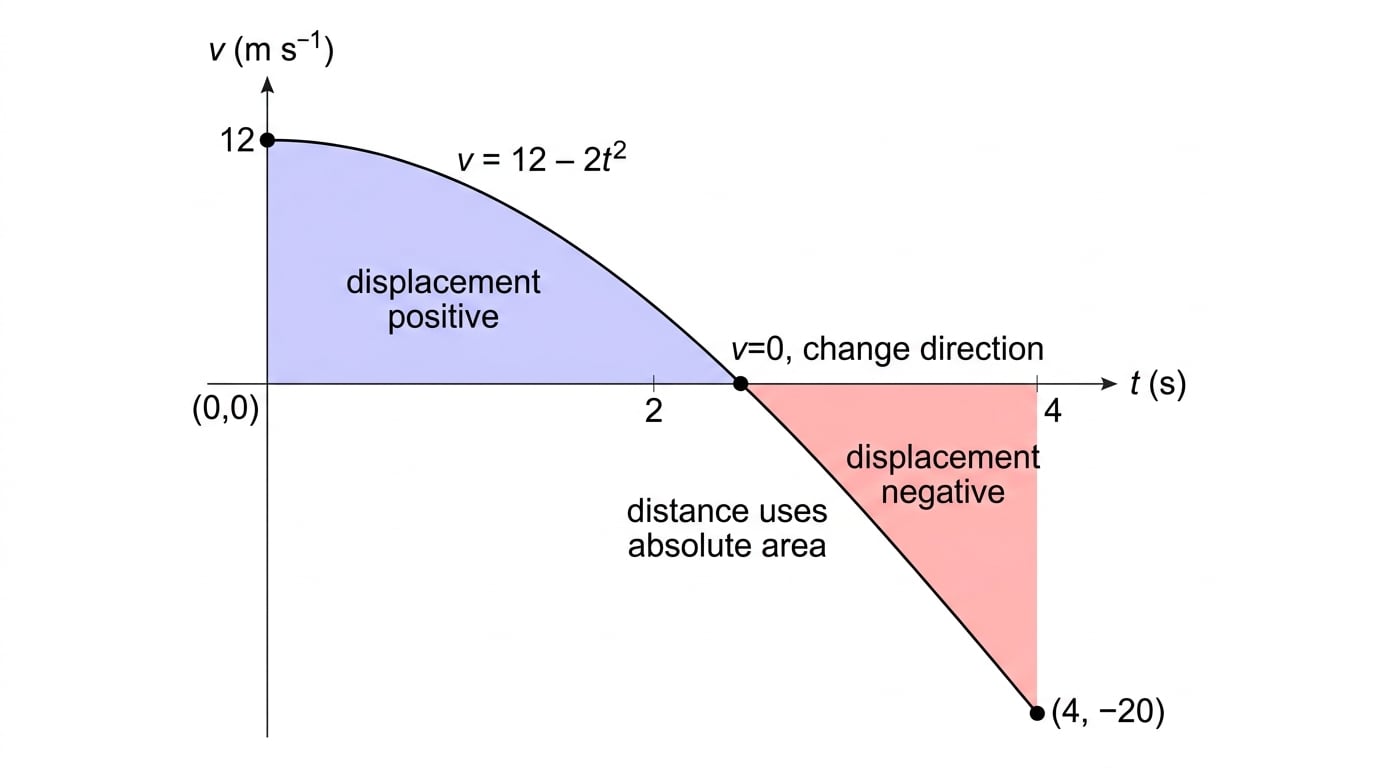
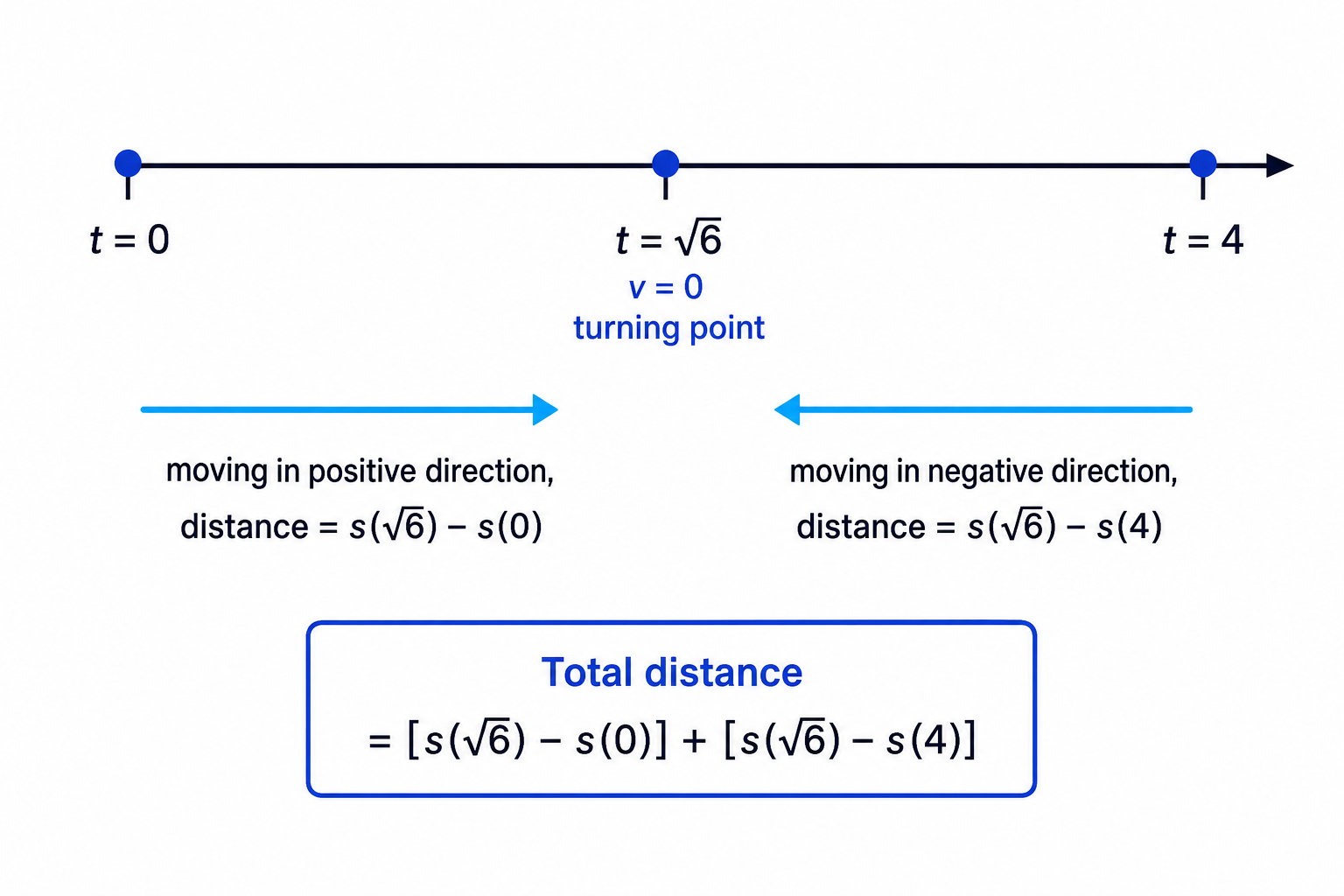
To calculate total distance, split the motion at any time where v=0v = 0v=0 and add the absolute changes in displacement.
Total distance when the particle changes direction
A particle has velocity v=12−2t2v = 12 - 2t^2v=12−2t2 m s^-1 for t≥0t \ge 0t≥0. Find the total distance travelled in the first 4 seconds.
-
First find when the particle changes direction by solving v=0v = 0v=0:
12−2t2=012 - 2t^2 = 012−2t2=0 -
Rearrange:
t2=6t^2 = 6t2=6 -
So the change of direction occurs at:
t=6t = \sqrt{6}t=6 -
Find the displacement function by integrating velocity:
s=∫(12−2t2) dt=12t−23t3+Cs = \int (12 - 2t^2)\,dt = 12t - \frac{2}{3}t^3 + Cs=∫(12−2t2)dt=12t−32t3+C -
For distance travelled from t=0t = 0t=0 to t=4t = 4t=4, calculate positions at the key times. Taking s(0)=0s(0) = 0s(0)=0:
s(t)=12t−23t3s(t) = 12t - \frac{2}{3}t^3s(t)=12t−32t3 -
At the turning time:
s(6)=126−23(6)3=86s(\sqrt{6}) = 12\sqrt{6} - \frac{2}{3}(\sqrt{6})^3 = 8\sqrt{6}s(6)=126−32(6)3=86 -
At t=4t = 4t=4:
s(4)=12(4)−23(4)3=163s(4) = 12(4) - \frac{2}{3}(4)^3 = \frac{16}{3}s(4)=12(4)−32(4)3=316 -
Add the two distances: from 000 to 6\sqrt{6}6, then from 6\sqrt{6}6 back to 444:
86+(86−163)8\sqrt{6} + \left(8\sqrt{6} - \frac{16}{3}\right)86+(86−316) -
Therefore the total distance is:
166−163≈33.916\sqrt{6} - \frac{16}{3} \approx 33.9166−316≈33.9
Use a mini timeline
When total distance is involved, write the key times in order: start time, any times where v=0v = 0v=0, and the end time. Then add the distances over each interval.
Differentiating displacement
Sometimes you are given displacement directly. Then you differentiate once for velocity and twice for acceleration.
Using displacement to find velocity and acceleration
A particle travels along a line with displacement x=t3−12t2+45tx = t^3 - 12t^2 + 45tx=t3−12t2+45t metres from a fixed point OOO. Find its initial velocity and the time when its acceleration is zero.
-
Differentiate displacement to get velocity:
v=dxdtv = \frac{dx}{dt}v=dtdx -
Differentiate x=t3−12t2+45tx = t^3 - 12t^2 + 45tx=t3−12t2+45t:
v=3t2−24t+45v = 3t^2 - 24t + 45v=3t2−24t+45 -
Initial velocity means the velocity when t=0t = 0t=0:
v(0)=45v(0) = 45v(0)=45 -
Differentiate velocity to get acceleration:
a=dvdt=6t−24a = \frac{dv}{dt} = 6t - 24a=dtdv=6t−24 -
Set acceleration equal to zero:
6t−24=06t - 24 = 06t−24=0 -
Solve:
t=4t = 4t=4
Piecewise acceleration or velocity
Piecewise function
A piecewise function uses different formulae on different intervals. For example, one formula may apply for 0≤t≤30 \le t \le 30≤t≤3, and another for t>3t > 3t>3.
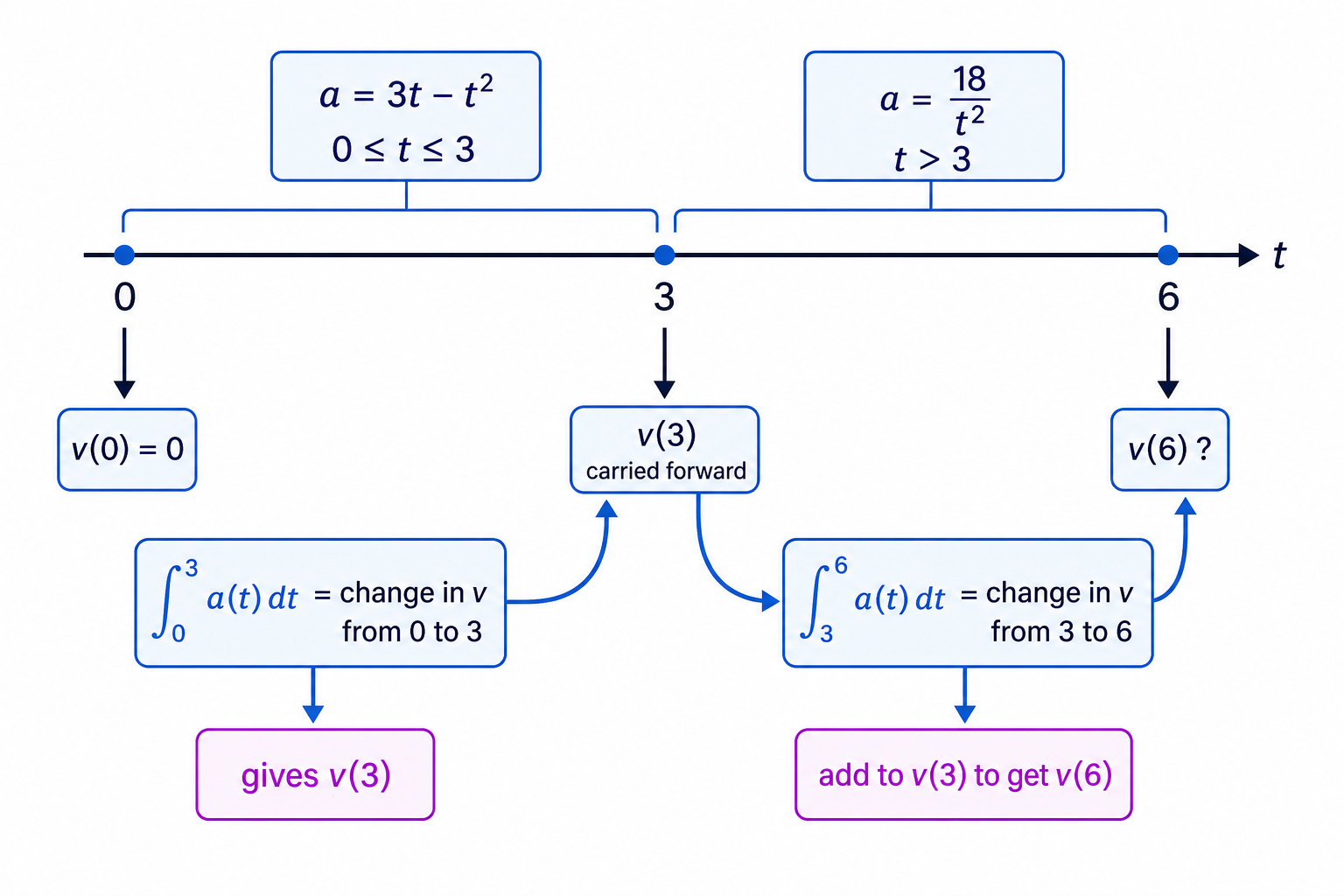
For piecewise motion, be very careful about which formula applies. At the joining time, the final velocity from the first interval becomes the starting velocity for the next interval.
Piecewise acceleration
A particle starts from rest. Its acceleration is given by
a={3t−t2,0≤t≤3,18t2,t>3.a = \begin{cases} 3t - t^2, & 0 \le t \le 3,\\ \frac{18}{t^2}, & t > 3. \end{cases}a={3t−t2,t218,0≤t≤3,t>3.Find its speed when t=6t = 6t=6.
-
For 0≤t≤30 \le t \le 30≤t≤3, integrate acceleration to get velocity. Since the particle starts from rest, v=0v = 0v=0 when t=0t = 0t=0:
v=∫(3t−t2) dt=32t2−13t3v = \int (3t - t^2)\,dt = \frac{3}{2}t^2 - \frac{1}{3}t^3v=∫(3t−t2)dt=23t2−31t3 -
Find the velocity at t=3t = 3t=3:
v(3)=32(3)2−13(3)3=92v(3) = \frac{3}{2}(3)^2 - \frac{1}{3}(3)^3 = \frac{9}{2}v(3)=23(3)2−31(3)3=29 -
For t>3t > 3t>3, use a definite integral from 3 to 6 and add it to the velocity at 3:
v(6)=92+∫3618t2 dtv(6) = \frac{9}{2} + \int_3^6 \frac{18}{t^2}\,dtv(6)=29+∫36t218dt -
Integrate:
∫18t2 dt=∫18t−2 dt=−18t−1\int \frac{18}{t^2}\,dt = \int 18t^{-2}\,dt = -18t^{-1}∫t218dt=∫18t−2dt=−18t−1 -
Evaluate from 3 to 6:
[−18t]36=−3−(−6)=3\left[-\frac{18}{t}\right]_3^6 = -3 - (-6) = 3[−t18]36=−3−(−6)=3 -
Therefore:
v(6)=92+3=152v(6) = \frac{9}{2} + 3 = \frac{15}{2}v(6)=29+3=215
Do not mix intervals
If a formula is only valid for t>3t > 3t>3, you cannot use it to calculate what happened before t=3t = 3t=3. Work interval by interval.
In the exam
-
Decide what you have been given: displacement, velocity or acceleration.
-
Move along the chain using differentiation or integration, and include constants when integrating.
-
For total distance, split at every time where v=0v = 0v=0 and add positive distances, not signed displacements.
Check yourself
- If you are given a(t)a(t)a(t) and an initial velocity, what operation finds v(t)v(t)v(t)?
- What equation do you solve to find when a particle is instantaneously at rest?
- Why might the total distance travelled be different from the final displacement?