Revision notes for Edexcel AS Level Maths Sampling. Open the guide for explanations and worked examples. Written against the Edexcel AS Level Maths (8MA0) specification, so the content matches what's examinable rather than general Maths background.
Sampling
What you'll learn
- What a population, sample, census, sampling frame, and sampling unit are.
- How to recognise common sampling methods from short descriptions.
- How to give sensible advantages and disadvantages of each method.
- How to calculate numbers for a stratified sample.
Why sampling matters
In statistics, we often want to find out something about a large group, but asking everyone may take too long or cost too much. Sampling is the process of choosing a smaller group to collect data from, then using that data to make conclusions about the larger group.
Definition
Core sampling words
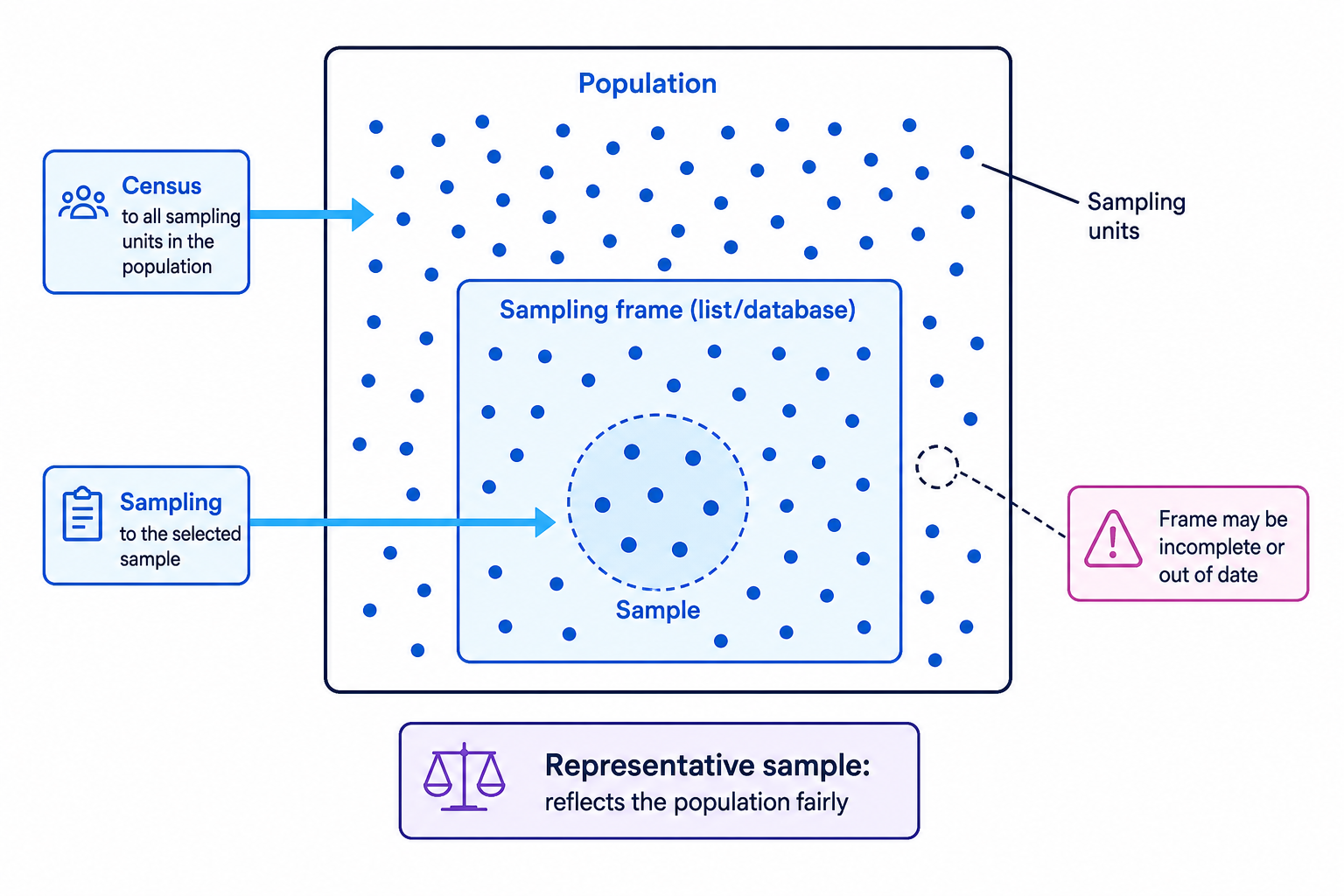
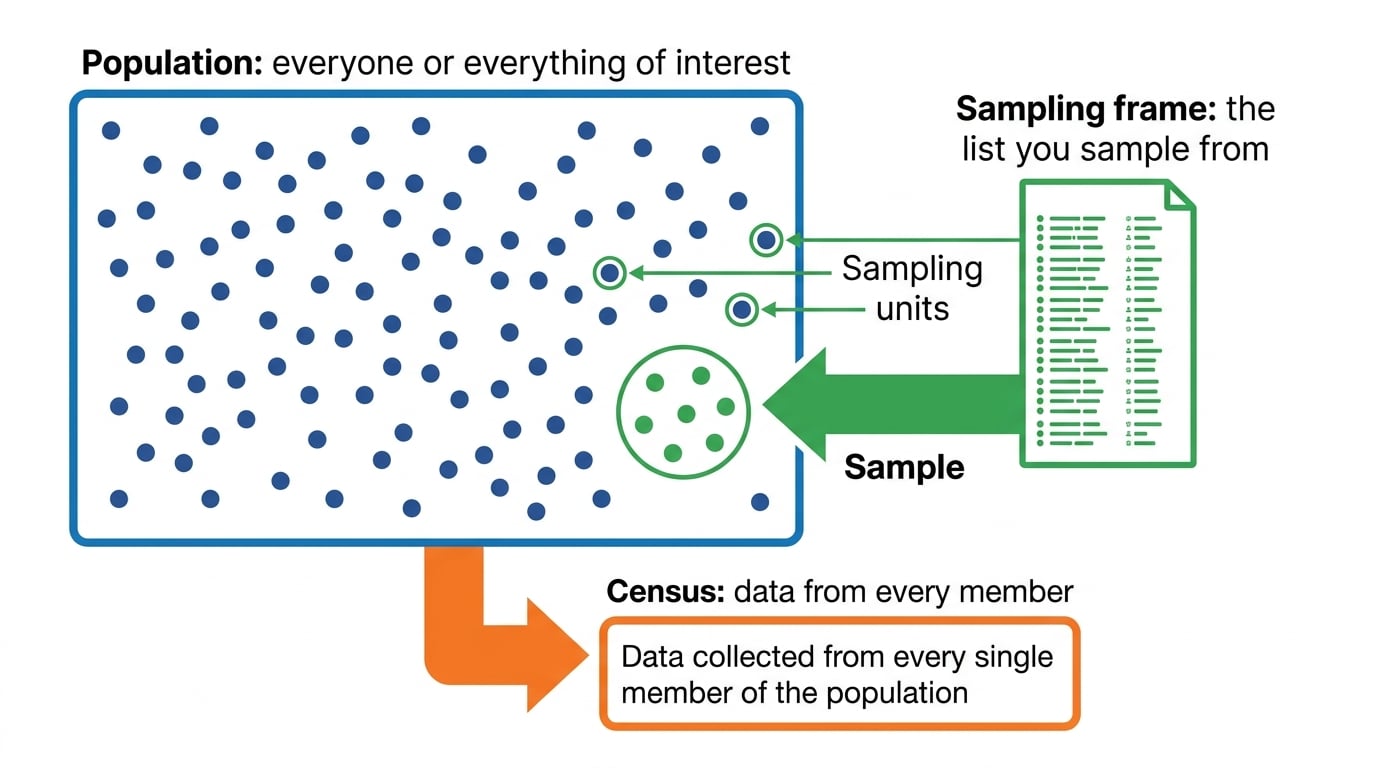
- The population is the whole group you are interested in.
- A census collects data from every member of the population.
- A sample is a smaller group chosen from the population.
- A sampling unit is one individual item or person that could be selected.
- A sampling frame is the list or database from which the sample is selected.
- A representative sample reflects the population fairly.
- Bias is a systematic unfairness that makes some outcomes or groups more likely than others.
The diagram below shows how these ideas fit together.
Key Idea
Census or sample?
A census can be very accurate because it includes everyone, but a sample is usually quicker, cheaper, and more practical.
Example
Population and census
A college principal wants to find out what students think about the new timetable. She decides to ask every student in the college.
-
Identify the population: the population is all students in the college, because these are the people whose opinions the principal wants.
-
Since she asks every student, the data collection method is a census.
-
One advantage is that the results should be very accurate for that college because every student is included.
-
One disadvantage is that it may take a long time to collect and process all the responses.
Common Mistake
Population is not always “everyone”
The population is not automatically “all people”. It is the exact group in the question. If the survey is about Year 12 students in one school, the population is Year 12 students in that school.
Sampling frames and sampling units
The sampling frame should match the population as closely as possible. For example, if a gym wants to survey its active members, a suitable sampling frame would be an up-to-date membership list of active members.
The sampling units are the individual members on that list.
Example
Choosing a sampling frame
A sports centre wants to investigate whether its members are satisfied with weekend opening times.
-
The population is all current members of the sports centre.
-
A suitable sampling frame is the centre’s current membership database, as long as it is up to date.
-
The sampling units are the individual members of the sports centre.
-
If the manager only asks the first 15 people who arrive on Monday morning, this is unlikely to represent all members, because people who attend at that time may have different views from evening or weekend users.
Simple random sampling
A simple random sample is chosen using chance, such as random numbers from a calculator or computer.
More formally, in a simple random sample, every member of the population has an equal chance of being selected.
Advantages
- It avoids personal choice by the researcher.
- It is relatively unbiased if the sampling frame is complete.
Disadvantages
- You need a complete sampling frame.
- By chance, some groups may still be under-represented.
Example
Recognising simple random sampling
A charity has a list of 1200 donors. It uses a computer to select 80 donor numbers at random for a feedback survey.
-
The method is simple random sampling because the donors are selected by a random process.
-
A suitable advantage is that every donor on the list has an equal chance of being selected.
-
A suitable disadvantage is that the charity needs an accurate, complete list of donors before it can do this properly.
Systematic sampling
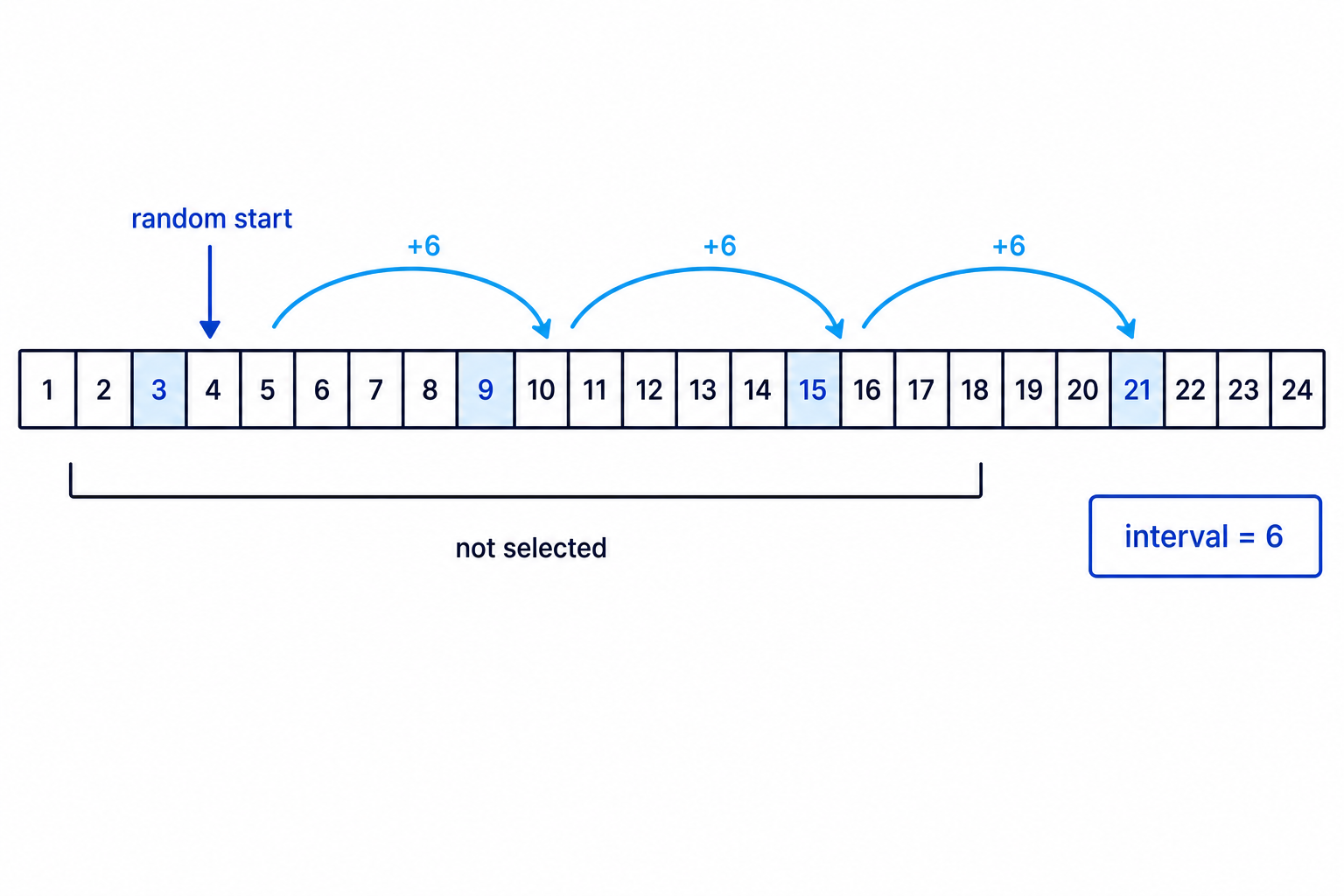
In systematic sampling, you select at regular intervals from an ordered list, for example every 8th person.
Often, you first choose a random starting point, then keep adding the same interval.
Advantages
- It is simple and quick once the list is available.
- It spreads the sample across the sampling frame.
Disadvantages
- It can be biased if the list has a pattern.
- You still need a sampling frame.
Example
Every nth person
A teacher has an alphabetical list of 300 pupils and chooses every 6th name for a questionnaire.
-
The sampling method is systematic sampling because the teacher uses a repeated pattern: every 6th name.
-
One advantage is that it is quick and easy to carry out.
-
One disadvantage is that if there is a hidden pattern in the list, the sample may be biased.
Common Mistake
Patterns can cause bias
Systematic sampling works badly if the list has a cycle that matches the sampling interval. For example, choosing every 7th customer could be biased if customer type changes strongly by day of the week.
Stratified sampling
A stratum is a subgroup of the population, such as a year group, gender group, or language studied.
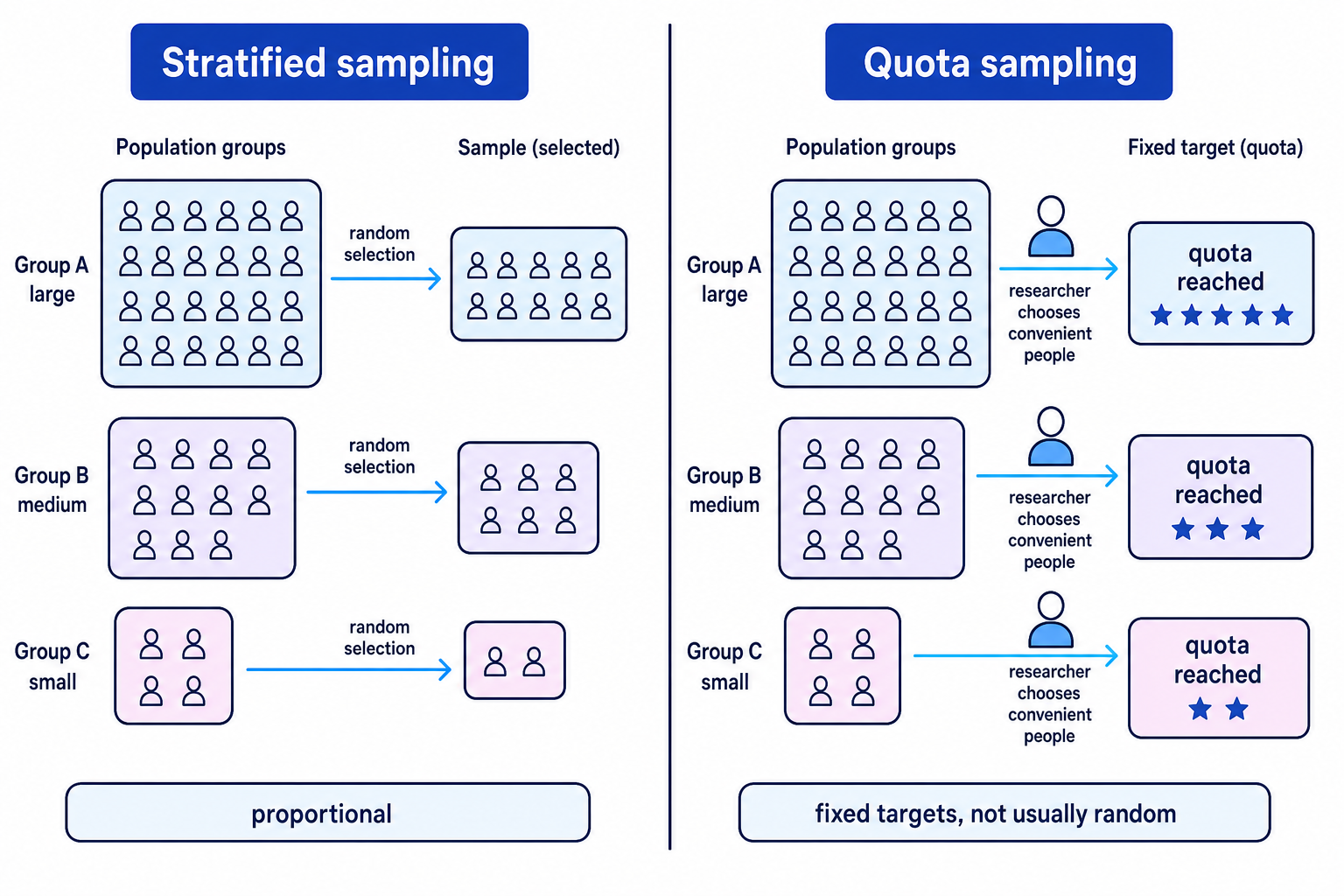
In stratified sampling, the population is divided into strata, then people are chosen from each stratum in proportion to the size of that stratum.
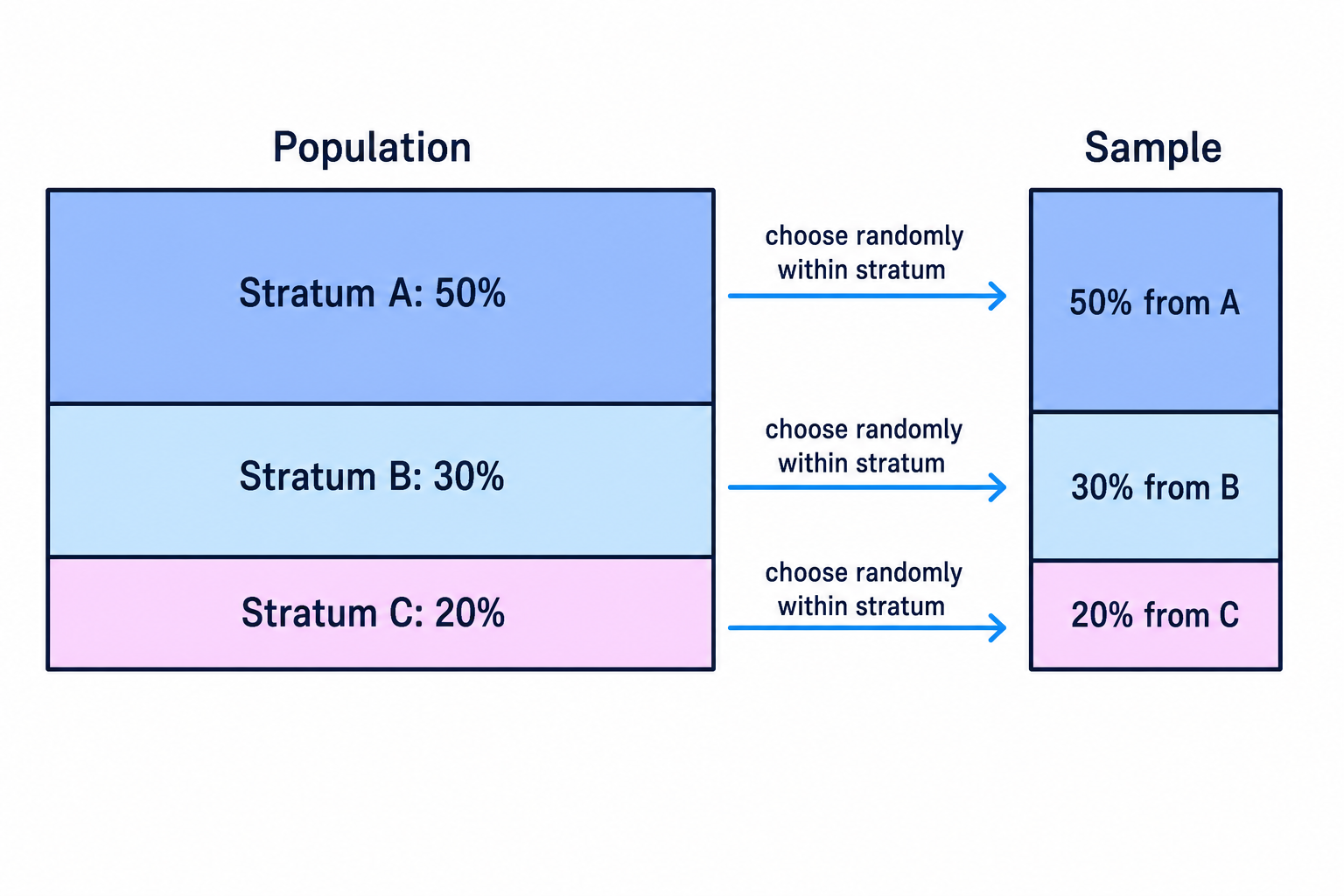
The key formula is:
number from stratum=stratum sizepopulation size×sample size\text{number from stratum}=\frac{\text{stratum size}}{\text{population size}}\times \text{sample size}number from stratum=population sizestratum size×sample sizeKey Idea
Stratified means proportional
In a stratified sample, bigger groups in the population should contribute more people to the sample than smaller groups.
Example
Calculating a stratified sample size
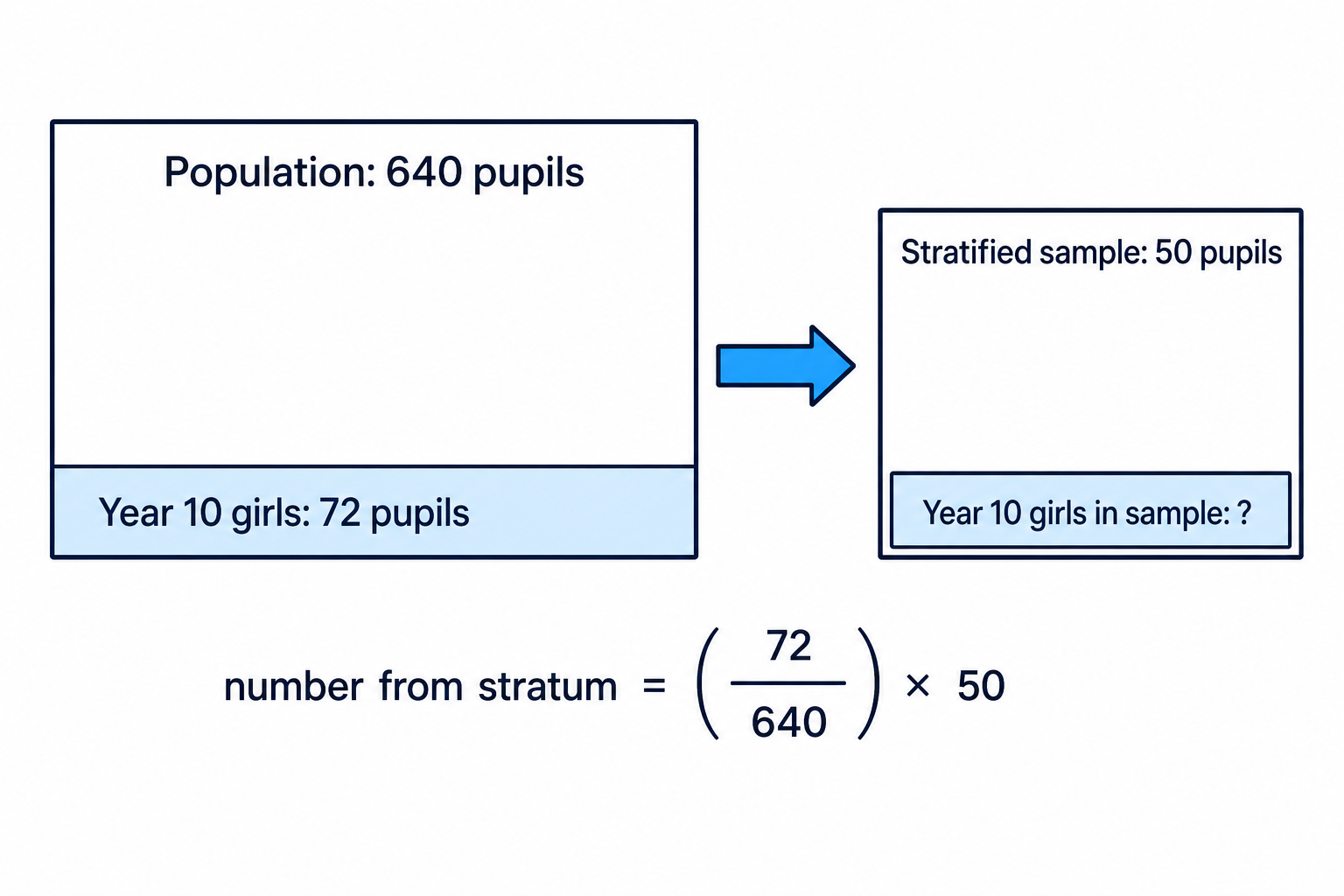
A school has 640 pupils. There are 72 Year 10 girls. A researcher wants a stratified sample of 50 pupils, using year group and gender as the strata. Calculate how many Year 10 girls should be in the sample.
-
Identify the stratum: Year 10 girls.
-
Use the stratified sampling formula:
72640×50=5.625\frac{72}{640}\times 50=5.62564072×50=5.625 -
The answer must be a whole number of pupils, so choose 6 Year 10 girls for the sample.
Tip
Rounding people
You cannot select 5.625 people. Round to a sensible whole number, but remember that in a full stratified sample the final group sizes should add to the required total sample size.
Quota sampling
In quota sampling, the population is split into groups, and the researcher keeps selecting people until a fixed number from each group has been reached.
The key difference from stratified sampling is that the people within each group are not usually chosen randomly.
Advantages
- It is quick and does not require a full sampling frame.
- It ensures certain groups are included.
Disadvantages
- It can be biased because the researcher chooses convenient people.
- It is not random.
Example
Recognising quota sampling
A student wants opinions about school lunches. He stands near the canteen and asks pupils until he has responses from 20 boys and 20 girls.
-
The method is quota sampling because he has fixed quotas for boys and girls.
-
One advantage is that both boys and girls are included in the survey.
-
One disadvantage is that the pupils are chosen by convenience, so the sample may be biased.
Common Mistake
Quota vs stratified
Both quota and stratified sampling use groups. Stratified sampling selects proportional numbers, usually randomly. Quota sampling fills set targets, often using whoever is easiest to ask.
Opportunity sampling
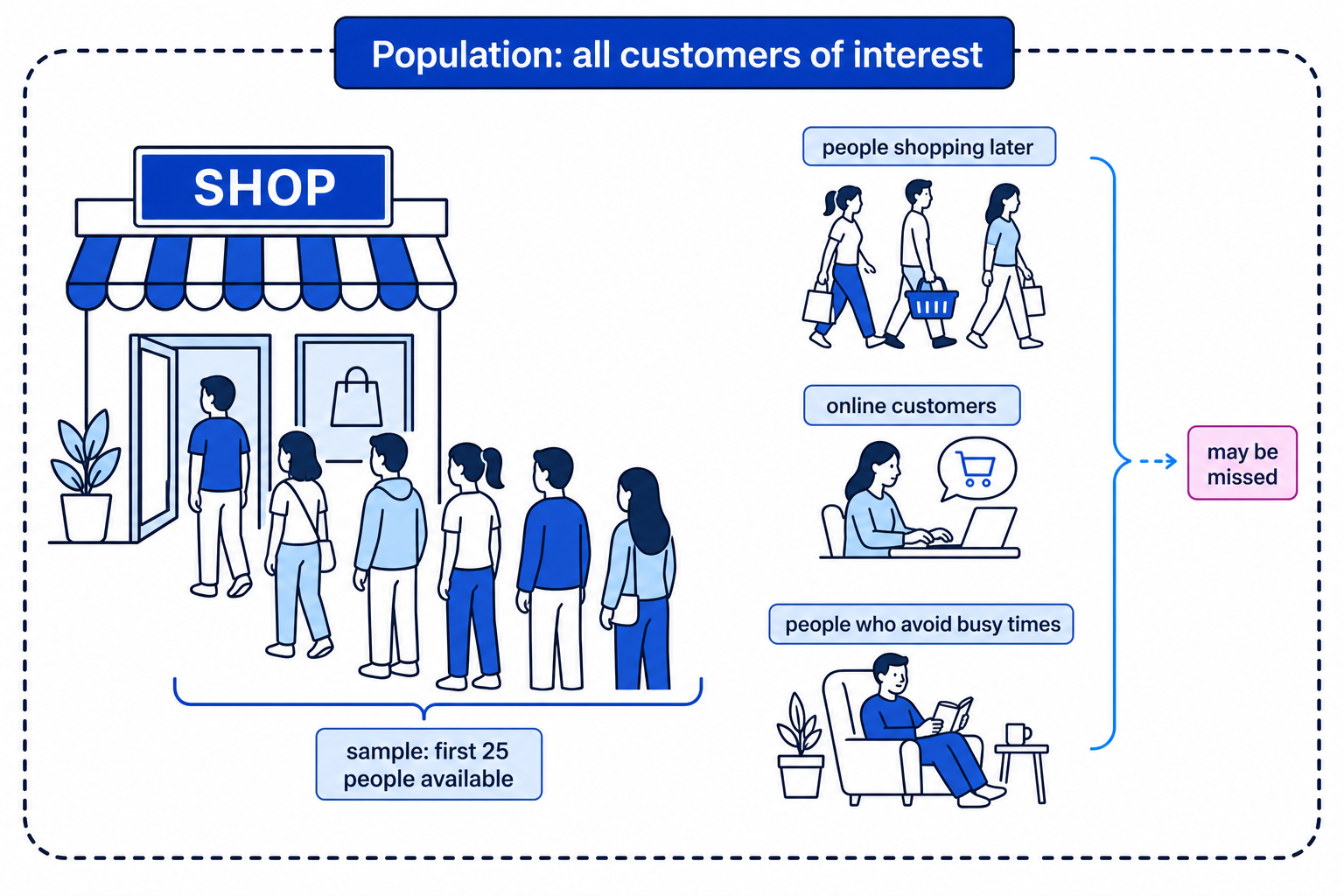
Opportunity sampling, also called convenience sampling, means selecting people who are easiest to reach at the time.
For example, asking the first 25 people who enter a shop is opportunity sampling.
Advantages
- It is very quick.
- It is cheap and easy to organise.
Disadvantages
- It is likely to be biased.
- The sample may not represent the whole population.
Example
First people available
A gym manager asks the first 30 members who enter the gym on a Tuesday morning to complete a survey.
-
The sampling method is opportunity sampling because the manager asks the people who are easiest to access.
-
One advantage is that the survey can be completed quickly.
-
One disadvantage is that morning gym users may not represent all members, especially those who usually attend in the evening or at weekends.
Matching methods to descriptions
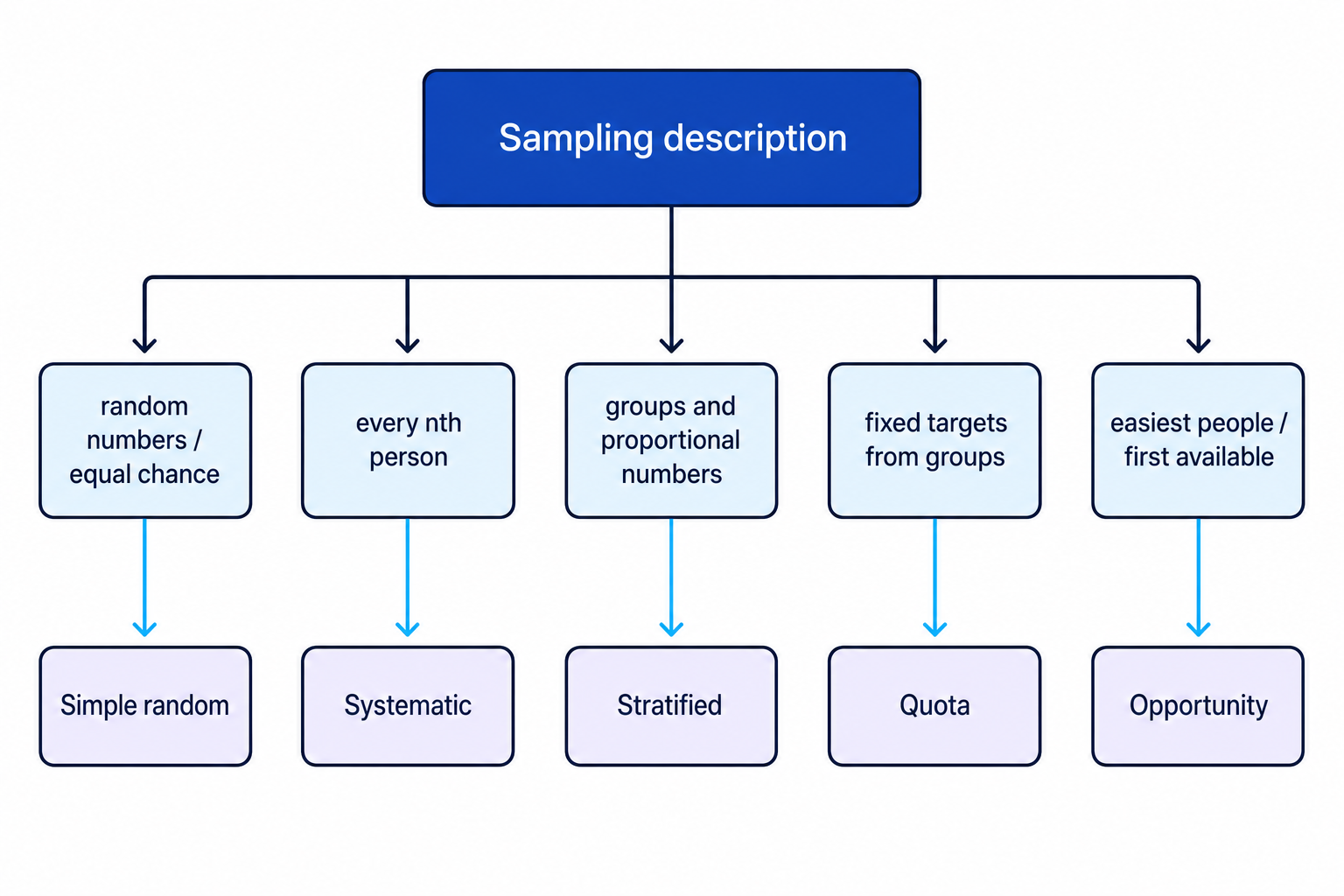
In exam questions, you may be asked to match sampling methods to short descriptions. Look for the key phrase.
Example
Identifying methods from clues
Match each description to the correct sampling method.
-
“Every person on the list is given a number, and a calculator chooses the numbers.” This is simple random sampling.
-
“The list is used to choose every 10th person.” This is systematic sampling.
-
“The population is split into year groups, and proportional numbers are chosen from each year group.” This is stratified sampling.
-
“The interviewer asks people nearby until enough responses have been collected.” This is opportunity sampling.
-
“The researcher keeps asking people until there are exactly 25 responses from each age band.” This is quota sampling.
Comparing the methods
Use these quick identifiers:
- Simple random: chosen by chance; equal chance for each member.
- Systematic: every nth member.
- Stratified: proportional numbers from groups.
- Quota: fixed numbers from groups, usually not random.
- Opportunity: whoever is easiest to ask.
Exam technique
In the exam
-
Identify the population first: ask yourself, “Who or what is the data about?”
-
For advantages and disadvantages, be specific to the context. Avoid vague answers like “it is good” or “it is bad”.
-
For stratified sampling, always use: stratum size divided by population size, multiplied by sample size.
Self review
Check yourself
- What is the difference between a population and a sampling frame?
- How can you tell the difference between quota sampling and stratified sampling?
- Why might asking the first 20 people you see lead to biased results?

Recap questions
Test yourself with 5 quick questions on this guide. Answer them all correctly to complete it.
You've reached the end
Test yourself on this topic, or move on to the next guide.
How was this guide?