Revision notes for Edexcel AS Level Maths Circles. Open each subtopic for explanations, worked examples, and summaries of 6.1 Midpoints and Perpendicular Bisectors, 6.2 Equation of a Circle, 6.3 Intersections of Straight Lines and Circles, 6.4 Use Tangent and Chord Properties, and 6.5 Circles and Triangles. Written against the Edexcel AS Level Maths (8MA0) specification, so the content matches what's examinable rather than general Maths background.
Circles
What you'll learn
- Write the equation of a circle from its centre, radius, or diameter.
- Complete the square to find the centre and radius from an expanded equation.
- Find intersections between circles and straight lines.
- Use perpendicular gradients to find equations of tangents.
Prerequisites: coordinate-geometry tools
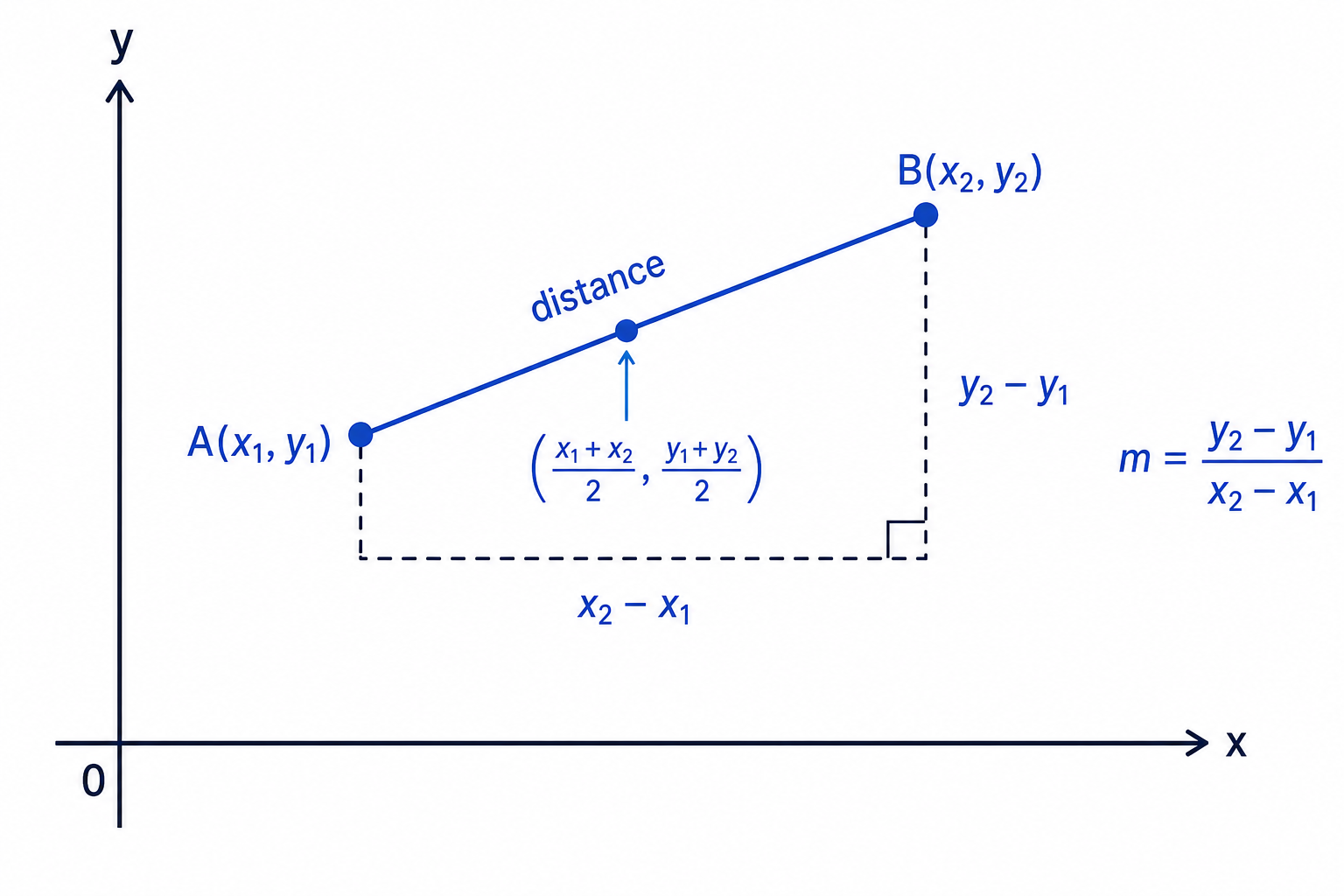
Before circles, you need three tools: distance, midpoint, and gradient.
For two points A(x1,y1)A(x_1, y_1)A(x1,y1) and B(x2,y2)B(x_2, y_2)B(x2,y2):
-
Distance measures the length of the line segment joining the points:
AB=(x2−x1)2+(y2−y1)2AB=\sqrt{(x_2-x_1)^2+(y_2-y_1)^2}AB=(x2−x1)2+(y2−y1)2 -
The midpoint is the point halfway between them:
(x1+x22,y1+y22)\left(\frac{x_1+x_2}{2},\frac{y_1+y_2}{2}\right)(2x1+x2,2y1+y2) -
Gradient measures steepness:
m=y2−y1x2−x1m=\frac{y_2-y_1}{x_2-x_1}m=x2−x1y2−y1
Example
Using distance, midpoint and gradient
For A(−2,4)A(-2,4)A(−2,4) and B(6,−2)B(6,-2)B(6,−2):
-
Find the distance using the distance formula.
AB=(6−(−2))2+(−2−4)2=82+(−6)2=100=10AB=\sqrt{(6-(-2))^2+(-2-4)^2} =\sqrt{8^2+(-6)^2} =\sqrt{100}=10AB=(6−(−2))2+(−2−4)2=82+(−6)2=100=10 -
Find the midpoint by averaging the coordinates.
(−2+62,4+(−2)2)=(2,1)\left(\frac{-2+6}{2},\frac{4+(-2)}{2}\right)=(2,1)(2−2+6,24+(−2))=(2,1) -
Find the gradient.
m=−2−46−(−2)=−68=−34m=\frac{-2-4}{6-(-2)}=\frac{-6}{8}=-\frac{3}{4}m=6−(−2)−2−4=8−6=−43
The standard equation of a circle
Definition
Circle
A circle is the set of all points that are the same distance from one fixed point. The fixed point is the centre, and the fixed distance is the radius.
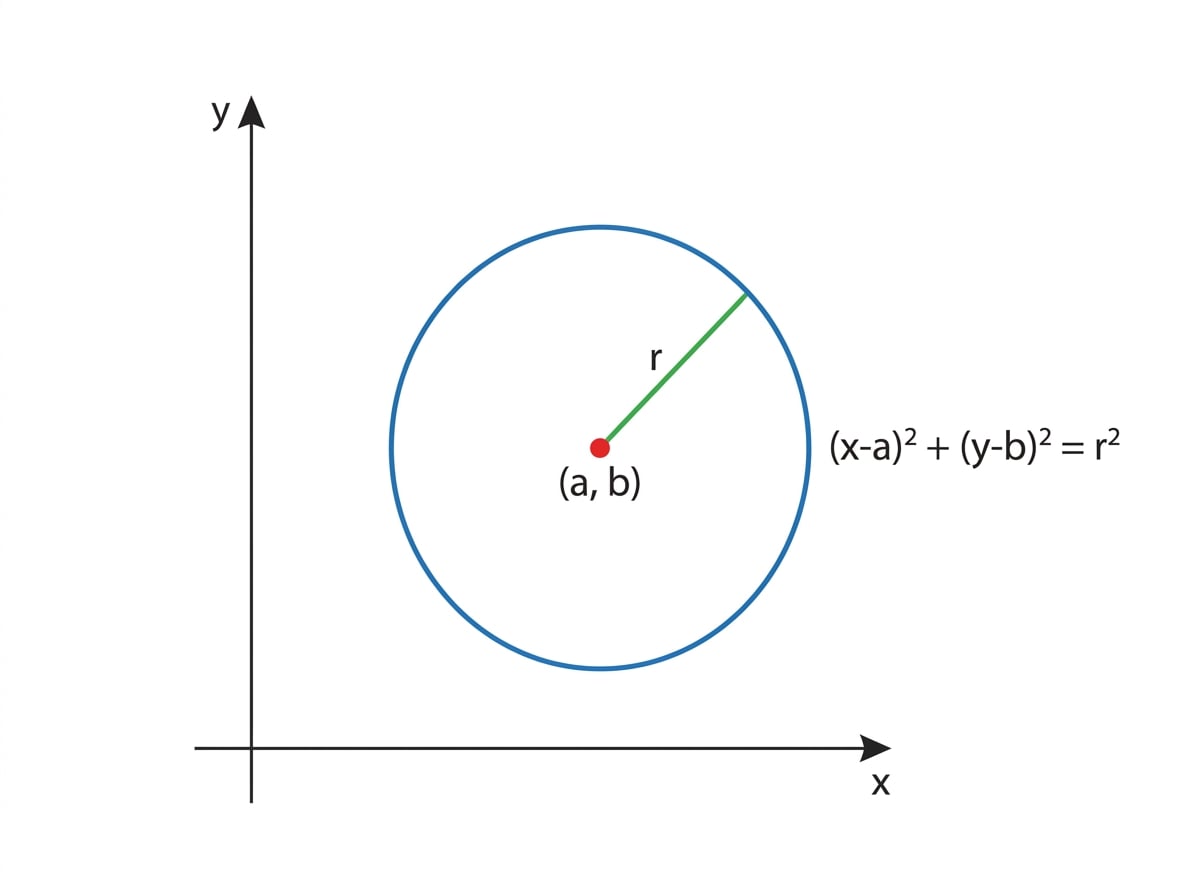
If a circle has centre (a,b)(a,b)(a,b) and radius rrr, its equation is:
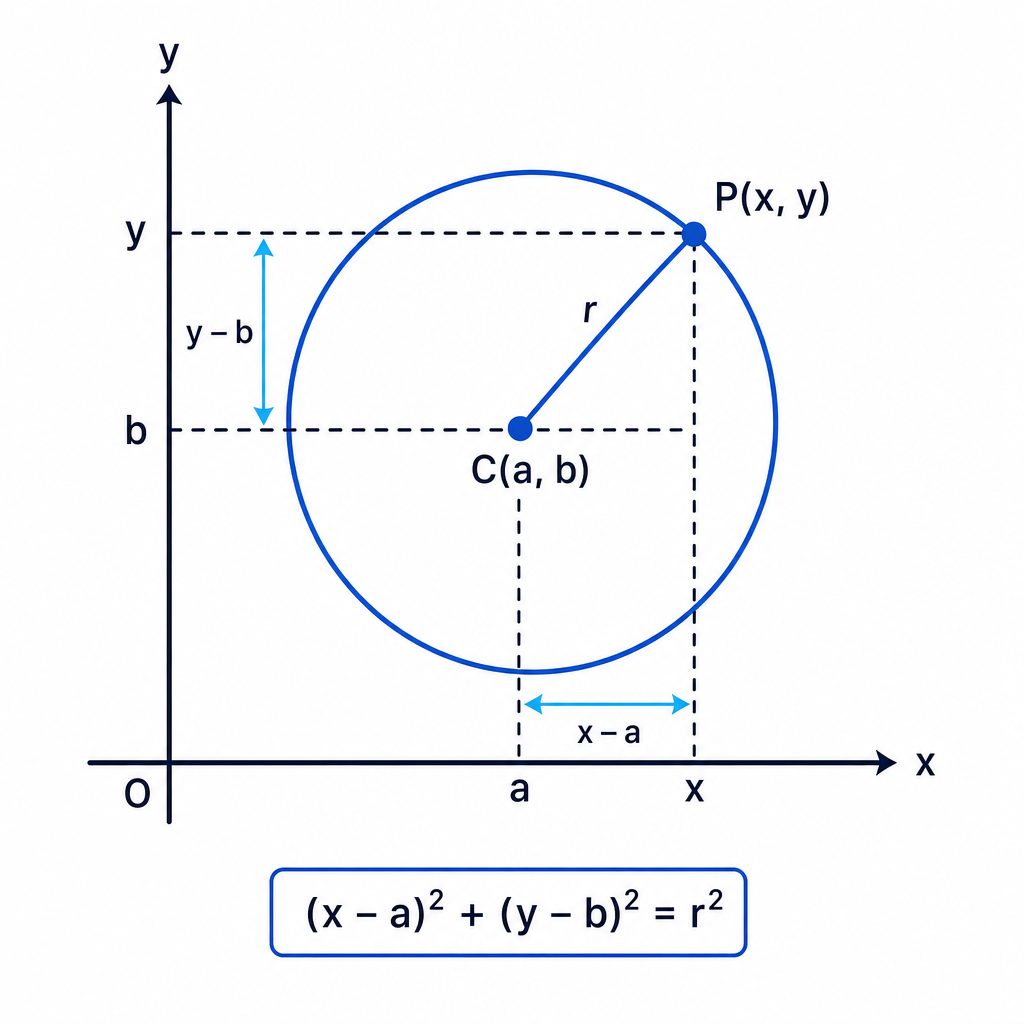
Notice the signs: centre (a,b)(a,b)(a,b) gives brackets (x−a)(x-a)(x−a) and (y−b)(y-b)(y−b).
Key Idea
Standard form
The equation (x−a)2+(y−b)2=r2(x-a)^2+(y-b)^2=r^2(x−a)2+(y−b)2=r2 means: “the distance from any point (x,y)(x,y)(x,y) on the circle to the centre (a,b)(a,b)(a,b) is always rrr.”
Example
Finding the equation from a centre and a point
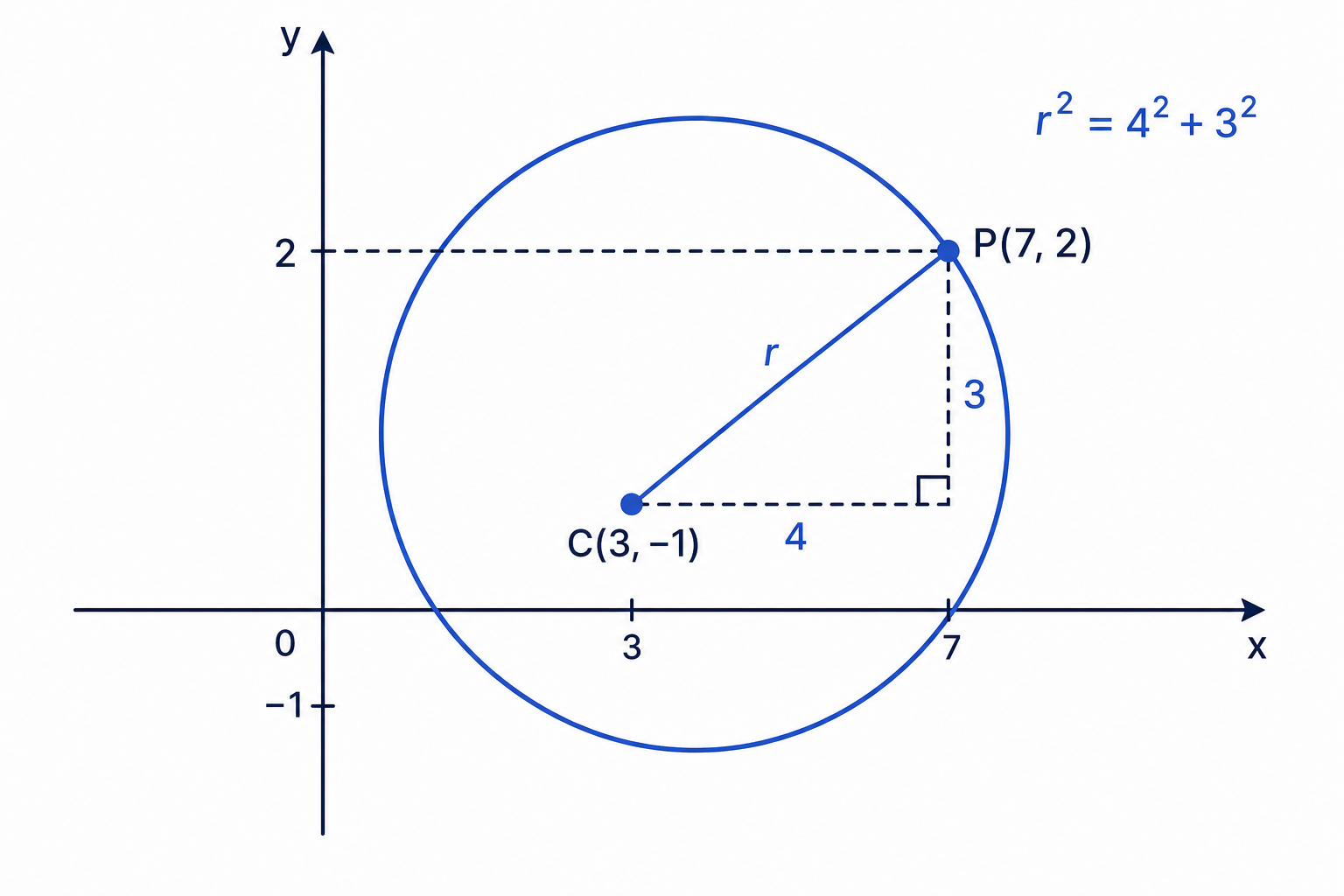
A circle has centre (3,−1)(3,-1)(3,−1) and passes through P(7,2)P(7,2)P(7,2). Find its equation.
-
Use the centre as (a,b)=(3,−1)(a,b)=(3,-1)(a,b)=(3,−1), so the equation begins:
(x−3)2+(y+1)2=r2(x-3)^2+(y+1)^2=r^2(x−3)2+(y+1)2=r2 -
Find r2r^2r2 using the distance from the centre to PPP.
r2=(7−3)2+(2−(−1))2=42+32=25r^2=(7-3)^2+(2-(-1))^2=4^2+3^2=25r2=(7−3)2+(2−(−1))2=42+32=25 -
Substitute into the circle equation.
(x−3)2+(y+1)2=25(x-3)^2+(y+1)^2=25(x−3)2+(y+1)2=25
Circles from a diameter
If you are told that a line segment is a diameter, its endpoints lie opposite each other on the circle. The centre is the midpoint of the diameter.
Definition
Diameter
A diameter is a chord that passes through the centre of the circle. Its length is twice the radius.
Example
Finding a circle from the endpoints of a diameter
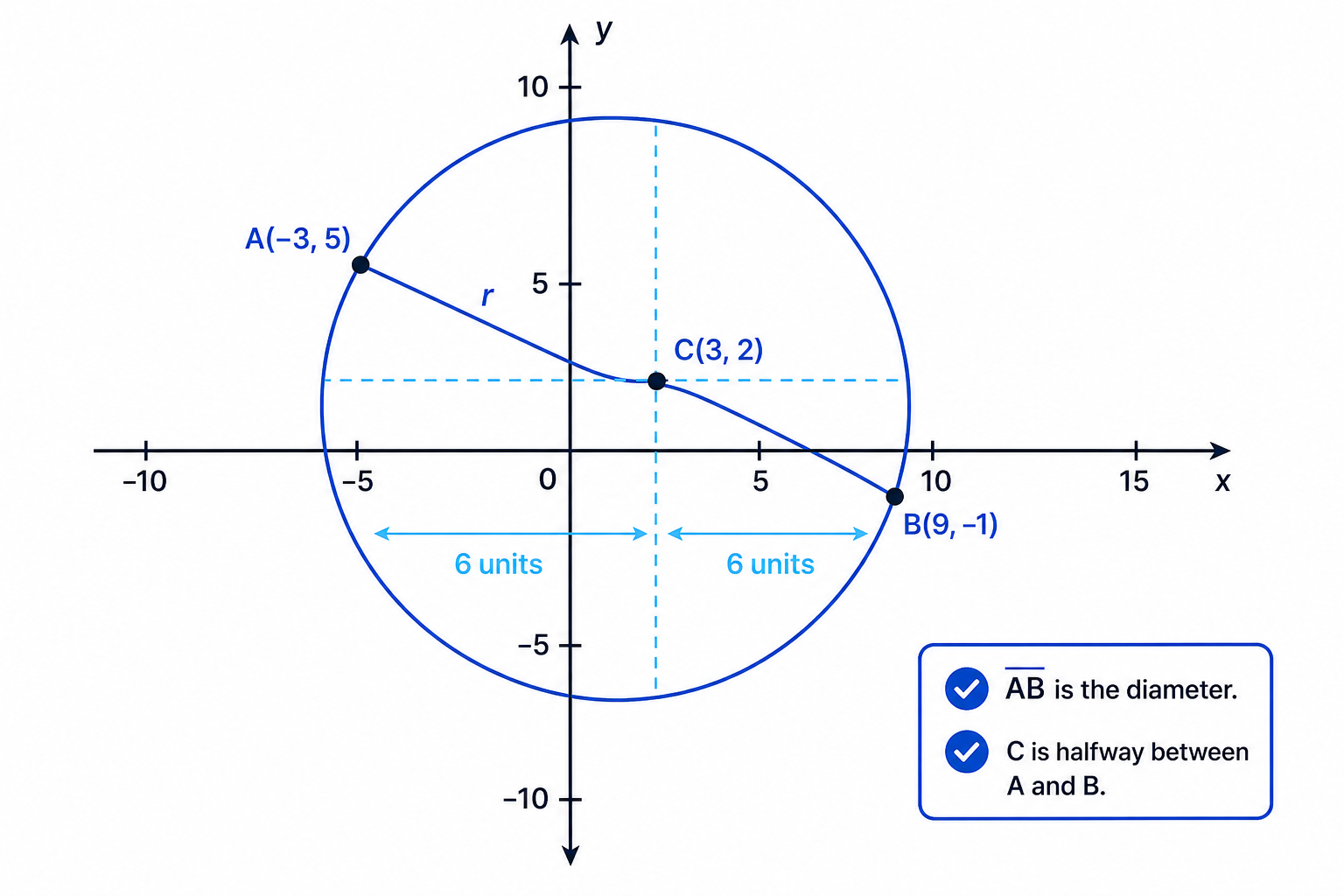
The points A(−3,5)A(-3,5)A(−3,5) and B(9,−1)B(9,-1)B(9,−1) are the endpoints of a diameter. Find the equation of the circle.
-
Find the centre using the midpoint of ABABAB.
(−3+92,5+(−1)2)=(3,2)\left(\frac{-3+9}{2},\frac{5+(-1)}{2}\right)=(3,2)(2−3+9,25+(−1))=(3,2) -
Find r2r^2r2 using the distance from the centre to one endpoint.
r2=(−3−3)2+(5−2)2=(−6)2+32=45r^2=(-3-3)^2+(5-2)^2=(-6)^2+3^2=45r2=(−3−3)2+(5−2)2=(−6)2+32=45 -
Write the equation.
(x−3)2+(y−2)2=45(x-3)^2+(y-2)^2=45(x−3)2+(y−2)2=45
Tip
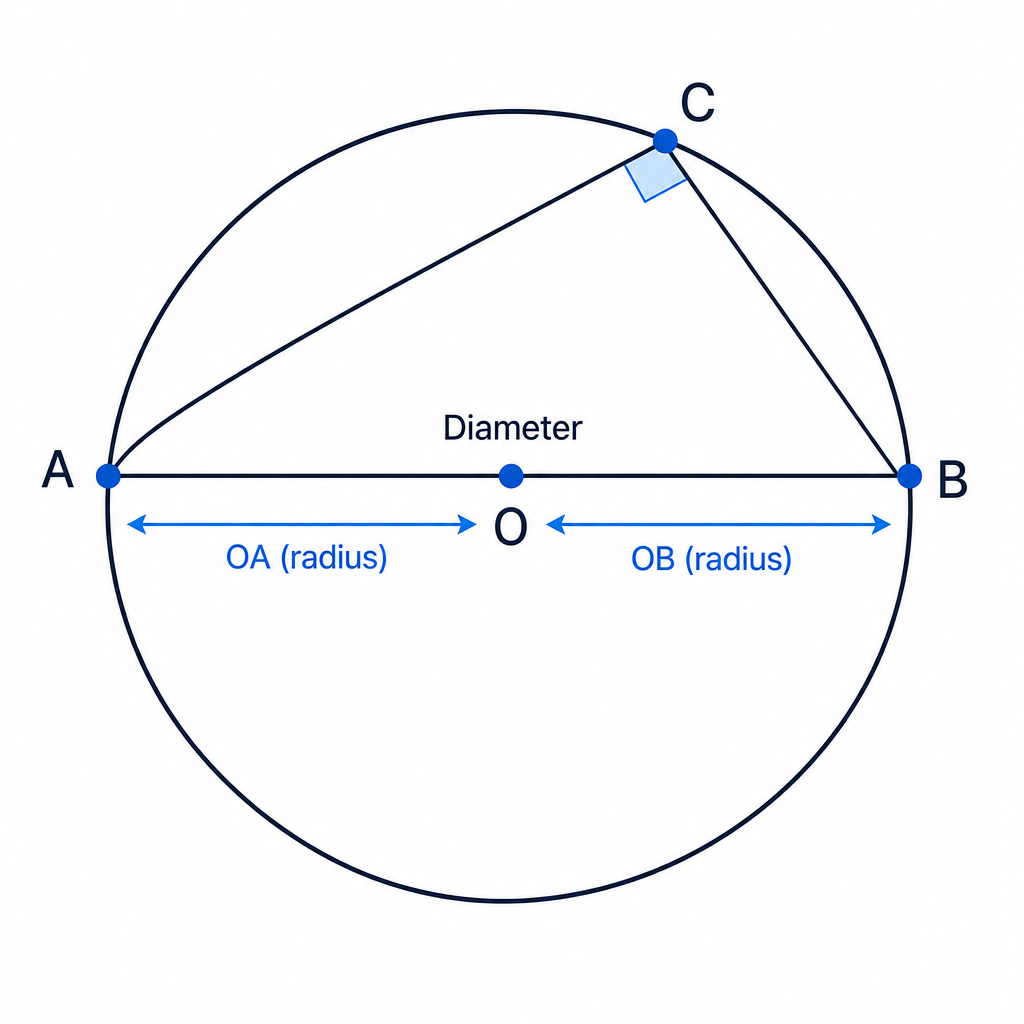
Right-angle shortcut
If three points on a circle make a right angle at one point, the side opposite the right angle is a diameter. This is often the fastest way to locate the centre.
Completing the square
Circle equations are not always given in standard form. You may see something like:
x2+y2+4x−10y=7x^2+y^2+4x-10y=7x2+y2+4x−10y=7To find the centre and radius, you complete the square separately for the xxx terms and the yyy terms.
Example
Finding the centre and radius by completing the square
Find the centre and radius of the circle
x2+y2+4x−10y=7x^2+y^2+4x-10y=7x2+y2+4x−10y=7-
Group the xxx terms and yyy terms.
x2+4x+y2−10y=7x^2+4x+y^2-10y=7x2+4x+y2−10y=7 -
Complete the square for each pair.
x2+4x=(x+2)2−4x^2+4x=(x+2)^2-4x2+4x=(x+2)2−4 y2−10y=(y−5)2−25y^2-10y=(y-5)^2-25y2−10y=(y−5)2−25 -
Substitute these into the equation.
(x+2)2−4+(y−5)2−25=7(x+2)^2-4+(y-5)^2-25=7(x+2)2−4+(y−5)2−25=7 -
Move the constants to the right-hand side.
(x+2)2+(y−5)2=36(x+2)^2+(y-5)^2=36(x+2)2+(y−5)2=36 -
Read off the centre and radius.
centre =(−2,5),r=6\text{centre }=(-2,5),\quad r=6centre =(−2,5),r=6
Common Mistake
Sign errors in the centre
If the equation contains (x+2)2(x+2)^2(x+2)2, the centre has xxx-coordinate -2, not 2. The sign inside the bracket is the opposite sign of the centre coordinate.
Finding a missing constant
If a point lies on a circle, its coordinates satisfy the circle equation. Substitute the point in to find the missing value.
Example
Using a point on the circle to find a constant
The circle has equation
x2+y2−6x+4y+k=0x^2+y^2-6x+4y+k=0x2+y2−6x+4y+k=0and passes through (2,3)(2,3)(2,3). Find kkk, then find the centre and radius.
-
Substitute x=2x=2x=2 and y=3y=3y=3 into the equation.
22+32−6(2)+4(3)+k=02^2+3^2-6(2)+4(3)+k=022+32−6(2)+4(3)+k=0 -
Simplify to find kkk.
4+9−12+12+k=04+9-12+12+k=04+9−12+12+k=0 13+k=013+k=013+k=0 k=−13k=-13k=−13 -
Write the equation with k=−13k=-13k=−13.
x2+y2−6x+4y−13=0x^2+y^2-6x+4y-13=0x2+y2−6x+4y−13=0 -
Complete the square.
(x−3)2−9+(y+2)2−4−13=0(x-3)^2-9+(y+2)^2-4-13=0(x−3)2−9+(y+2)2−4−13=0 -
Rearrange into standard form.
(x−3)2+(y+2)2=26(x-3)^2+(y+2)^2=26(x−3)2+(y+2)2=26 -
Read off the centre and radius.
centre =(3,−2),r=26\text{centre }=(3,-2),\quad r=\sqrt{26}centre =(3,−2),r=26
Intersections with lines
To find where a line meets a circle, substitute the line equation into the circle equation. This usually creates a quadratic.
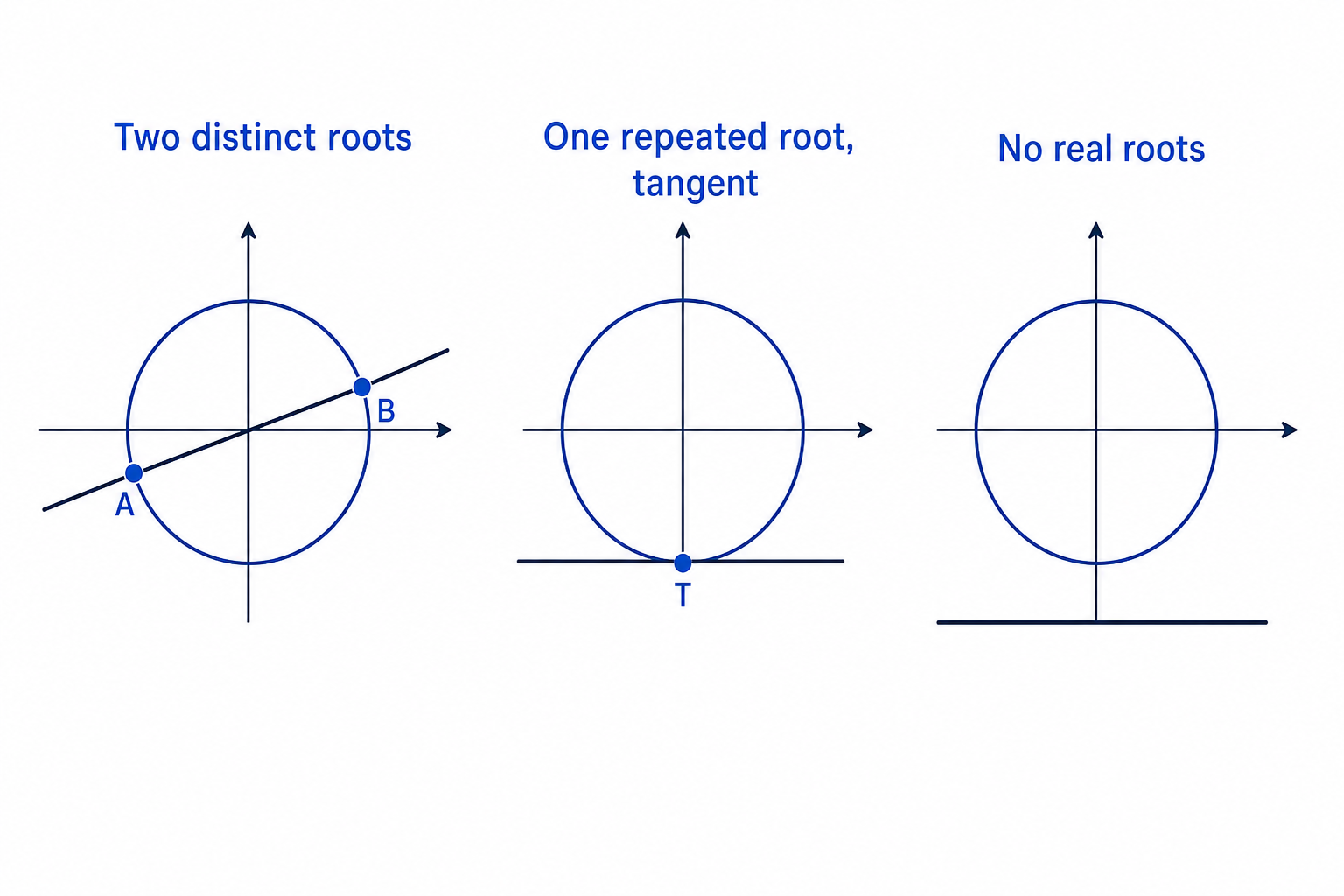
- Two distinct roots means the line cuts the circle at two points.
- One repeated root means the line is a tangent.
- No real roots means the line misses the circle.
Example
Finding the points where a line meets a circle
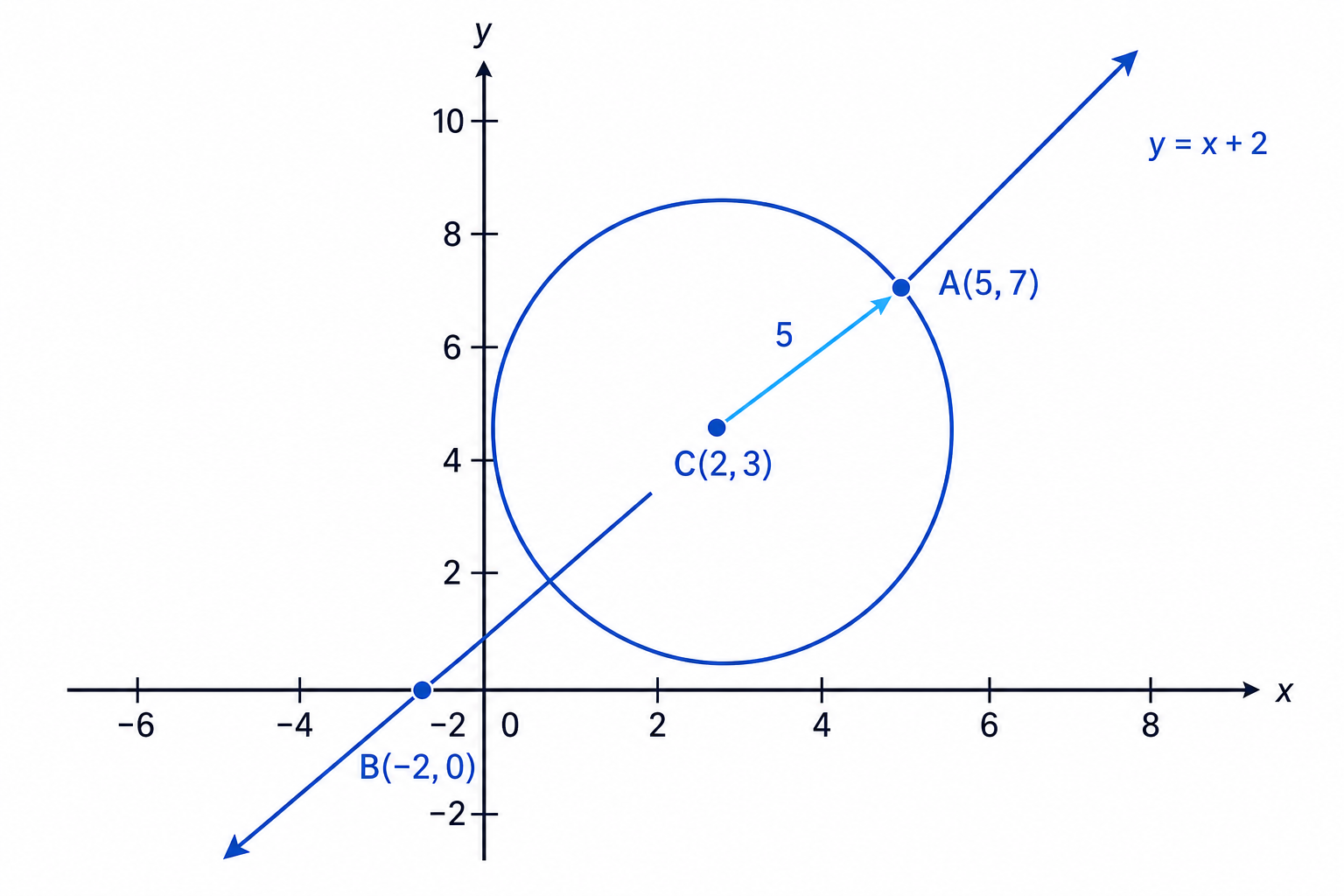
The circle has centre (2,3)(2,3)(2,3) and radius 5. The line y=x+2y=x+2y=x+2 intersects the circle at AAA and BBB. Find their coordinates.
-
Write the circle equation.
(x−2)2+(y−3)2=25(x-2)^2+(y-3)^2=25(x−2)2+(y−3)2=25 -
Substitute y=x+2y=x+2y=x+2 into the circle equation.
(x−2)2+(x+2−3)2=25(x-2)^2+(x+2-3)^2=25(x−2)2+(x+2−3)2=25 -
Simplify and solve the quadratic.
(x−2)2+(x−1)2=25(x-2)^2+(x-1)^2=25(x−2)2+(x−1)2=25 x2−4x+4+x2−2x+1=25x^2-4x+4+x^2-2x+1=25x2−4x+4+x2−2x+1=25 2x2−6x−20=02x^2-6x-20=02x2−6x−20=0 x2−3x−10=0x^2-3x-10=0x2−3x−10=0 (x−5)(x+2)=0(x-5)(x+2)=0(x−5)(x+2)=0 -
Find the corresponding yyy values using y=x+2y=x+2y=x+2.
x=5⇒y=7x=5 \Rightarrow y=7x=5⇒y=7 x=−2⇒y=0x=-2 \Rightarrow y=0x=−2⇒y=0 -
State the intersection points.
A(5,7),B(−2,0)A(5,7),\quad B(-2,0)A(5,7),B(−2,0)
Tip
Axis intersections
For intersections with the yyy-axis, set x=0x=0x=0. For intersections with the xxx-axis, set y=0y=0y=0.
Tangents to circles
Definition
Tangent
A tangent is a straight line that touches a circle at exactly one point. The point where it touches is called the point of contact.
The key fact is that the radius to the point of contact is perpendicular to the tangent.
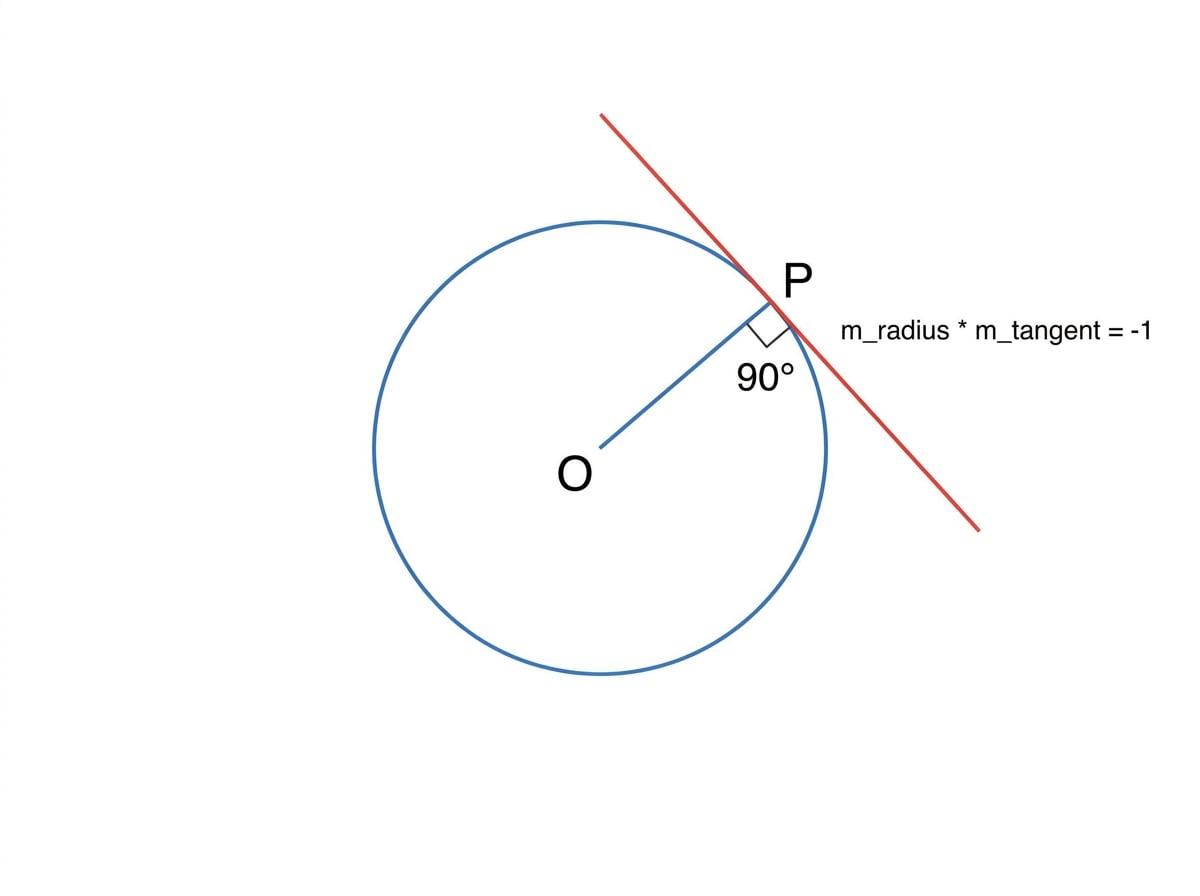
If two non-vertical lines are perpendicular, their gradients multiply to -1. So if the radius has gradient mmm, the tangent has gradient −1m-\frac{1}{m}−m1.
Example
Finding the equation of a tangent at a point
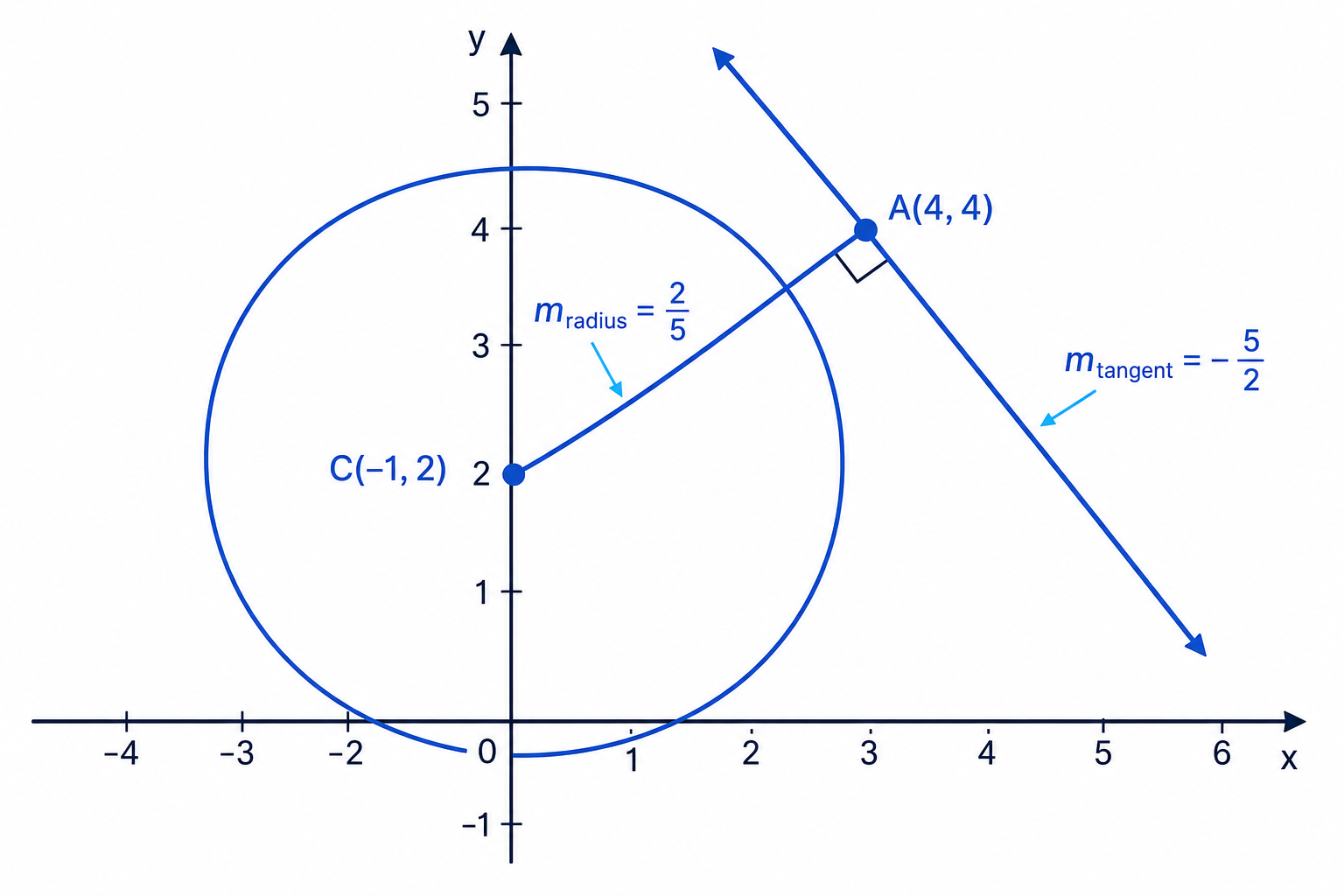
A circle has centre (−1,2)(-1,2)(−1,2) and passes through A(4,4)A(4,4)A(4,4). Find the equation of the tangent at AAA in the form ax+by+c=0ax+by+c=0ax+by+c=0.
-
Find the gradient of the radius from the centre to AAA.
mradius=4−24−(−1)=25m_{\text{radius}}=\frac{4-2}{4-(-1)}=\frac{2}{5}mradius=4−(−1)4−2=52 -
Use the negative reciprocal for the tangent gradient.
mtangent=−52m_{\text{tangent}}=-\frac{5}{2}mtangent=−25 -
Use the point-gradient form through A(4,4)A(4,4)A(4,4).
y−4=−52(x−4)y-4=-\frac{5}{2}(x-4)y−4=−25(x−4) -
Rearrange into integer form.
2y−8=−5x+202y-8=-5x+202y−8=−5x+20 5x+2y−28=05x+2y-28=05x+2y−28=0
Common Mistake
Using the radius gradient as the tangent gradient
The tangent is not parallel to the radius. It is perpendicular to it, so you must use the negative reciprocal gradient.
Tangency using distance from a point to a line
Sometimes you are given a centre and a tangent line, but not the radius. The radius is the perpendicular distance from the centre to the tangent line.
For a line ax+by+c=0ax+by+c=0ax+by+c=0, the distance from (x1,y1)(x_1,y_1)(x1,y1) to the line is:
∣ax1+by1+c∣a2+b2\frac{|ax_1+by_1+c|}{\sqrt{a^2+b^2}}a2+b2∣ax1+by1+c∣Example
Finding a circle from its centre and a tangent line
A circle has centre (6,−1)(6,-1)(6,−1). The line 3x+y−4=03x+y-4=03x+y−4=0 is tangent to the circle. Find the equation of the circle.
-
Use the distance from the centre to the tangent line to find the radius.
r=∣3(6)+(−1)−4∣32+12r=\frac{|3(6)+(-1)-4|}{\sqrt{3^2+1^2}}r=32+12∣3(6)+(−1)−4∣ -
Simplify.
r=∣18−1−4∣10=1310r=\frac{|18-1-4|}{\sqrt{10}}=\frac{13}{\sqrt{10}}r=10∣18−1−4∣=1013 -
Square the radius for the circle equation.
r2=(1310)2=16910r^2=\left(\frac{13}{\sqrt{10}}\right)^2=\frac{169}{10}r2=(1013)2=10169 -
Write the equation using centre (6,−1)(6,-1)(6,−1).
(x−6)2+(y+1)2=16910(x-6)^2+(y+1)^2=\frac{169}{10}(x−6)2+(y+1)2=10169
Exam technique
In the exam
- Put circle equations into standard form as early as possible, because the centre and radius then become easy to read.
- For tangents, draw a quick sketch and mark the radius at 90° to the tangent.
- When substituting a line into a circle, expect a quadratic and use the discriminant if the question asks about tangency or ranges.
Self review
Check yourself
- Can you find the centre and radius of x2+y2−8x+6y=12x^2+y^2-8x+6y=12x2+y2−8x+6y=12?
- If a circle has centre (4,−2)(4,-2)(4,−2) and passes through (1,2)(1,2)(1,2), can you write its equation?
- Can you find the tangent gradient at a point once you know the gradient of the radius?

Recap questions
Test yourself with 5 quick questions on this guide. Answer them all correctly to complete it.
You've reached the end
Test yourself on this topic, or move on to the next guide.
How was this guide?