

What you'll learn
- How to rearrange a quadratic inequality so it can be factorised.
- How roots split the number line into intervals.
- How to decide whether the answer is “between” or “outside” the roots.
- How to combine a quadratic inequality with a linear inequality.
1. What is a quadratic inequality?
A quadratic expression is an expression where the highest power of the variable is squared, such as x2+7x−18x^2+7x-18x2+7x−18.
An inequality compares two expressions using words such as “less than” or “greater than”, rather than saying they are equal.
Quadratic inequality
A quadratic inequality is an inequality involving a quadratic expression, for example x2+7x>18x^2+7x>18x2+7x>18 or (x+4)(x+2)<35(x+4)(x+2)<35(x+4)(x+2)<35.
The aim is to find the solution set: all the values of xxx that make the inequality true.
2. First prerequisite: get everything on one side
For quadratic inequalities, you usually want one side to be zero:
quadratic expression>0\text{quadratic expression} > 0quadratic expression>0or
quadratic expression<0\text{quadratic expression} < 0quadratic expression<0This lets you look at whether the quadratic is positive or negative.
Standard form first
Before you try to solve a quadratic inequality, rearrange it so that one side is zero. Then factorise the quadratic expression if possible.
Worked example: rearrange and factorise
Solving
-
Move everything to the left-hand side so that the right-hand side is zero:
x2+7x−18>0x^2+7x-18>0x2+7x−18>0 -
Factorise the quadratic expression. Look for two numbers that multiply to negative 18 and add to 7:
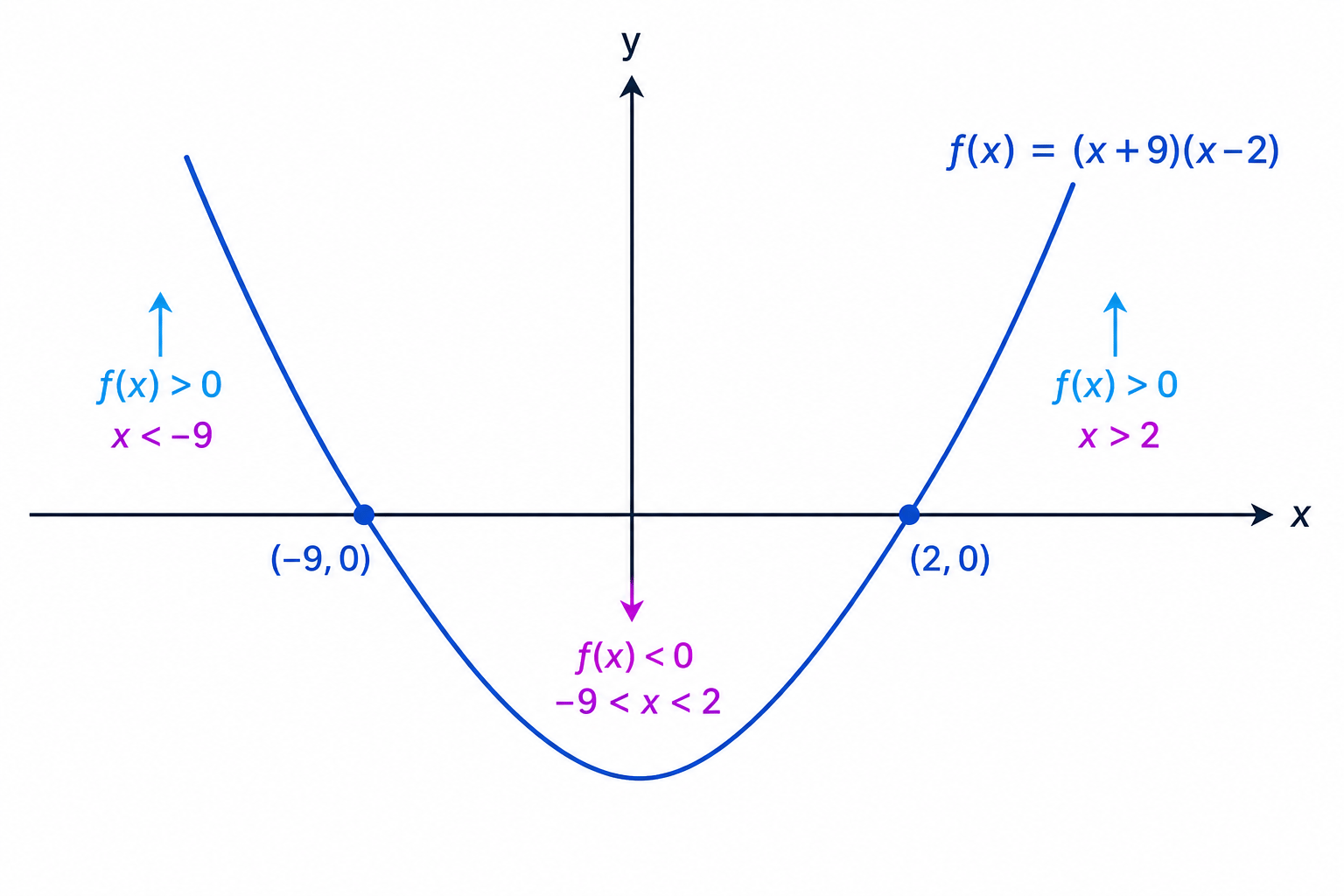
x2+7x−18=(x+9)(x−2)x^2+7x-18=(x+9)(x-2)x2+7x−18=(x+9)(x−2) -
Replace the inequality with an equation to find the critical values. These are the values where the expression changes sign:
(x+9)(x−2)=0(x+9)(x-2)=0(x+9)(x−2)=0 -
Solve the equation:
x=−9orx=2x=-9 \quad \text{or} \quad x=2x=−9orx=2 -
The coefficient of x2x^2x2 is positive, so the parabola opens upwards. The expression is positive outside the two roots:
$$
x<-9 \quad \text{or} \quad x>2
$$
Stopping at the roots
The roots are not usually the final answer. They are boundary values that split the number line into intervals. You must still decide which intervals satisfy the inequality.
3. Why the answer is sometimes “between” and sometimes “outside”
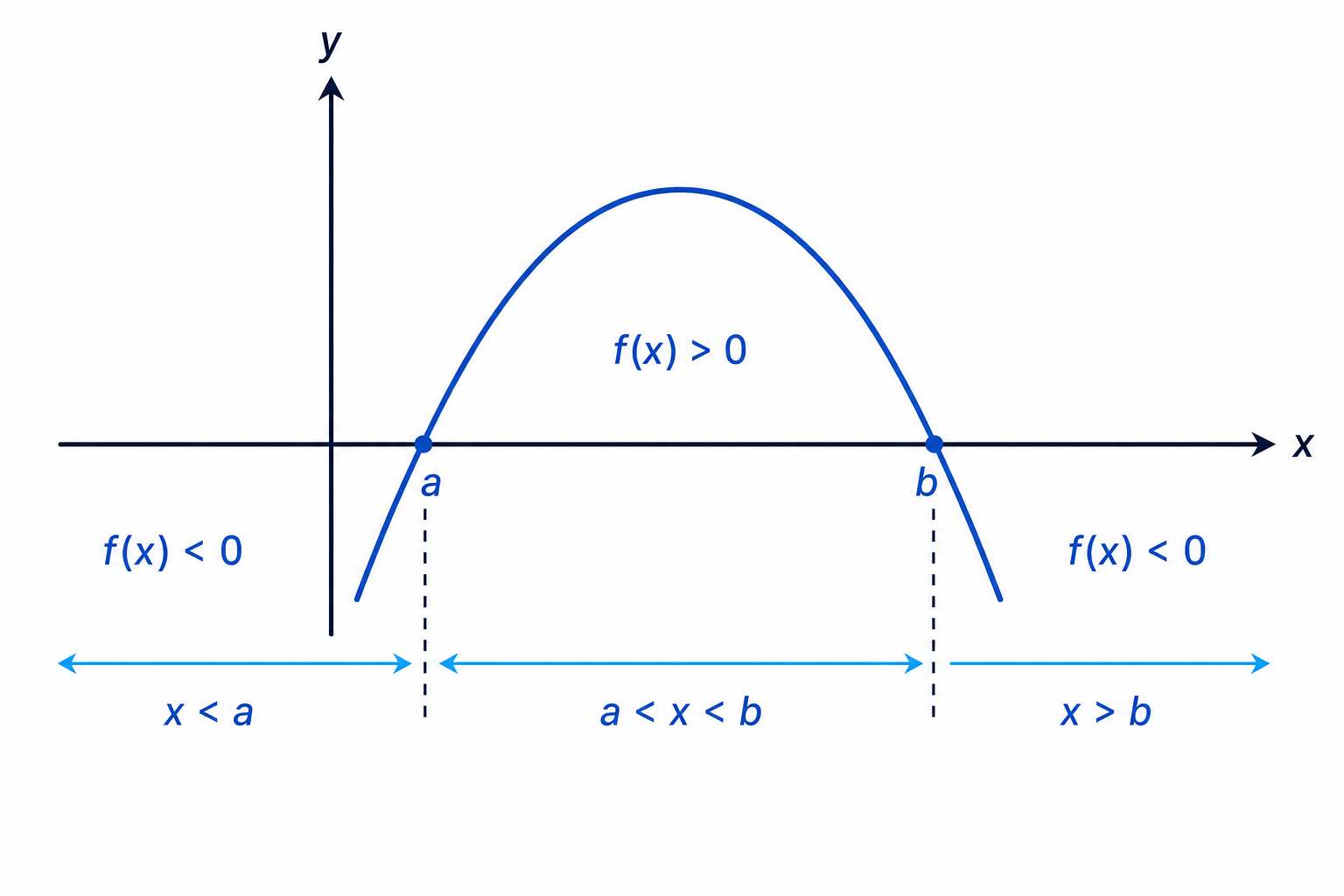
The graph of a quadratic is called a parabola. A parabola is a U-shaped curve if the coefficient of x2x^2x2 is positive, and an upside-down U-shape if the coefficient of x2x^2x2 is negative.
A root is an xxx-value where the expression equals zero. On a graph, roots are the points where the curve crosses or touches the xxx-axis.
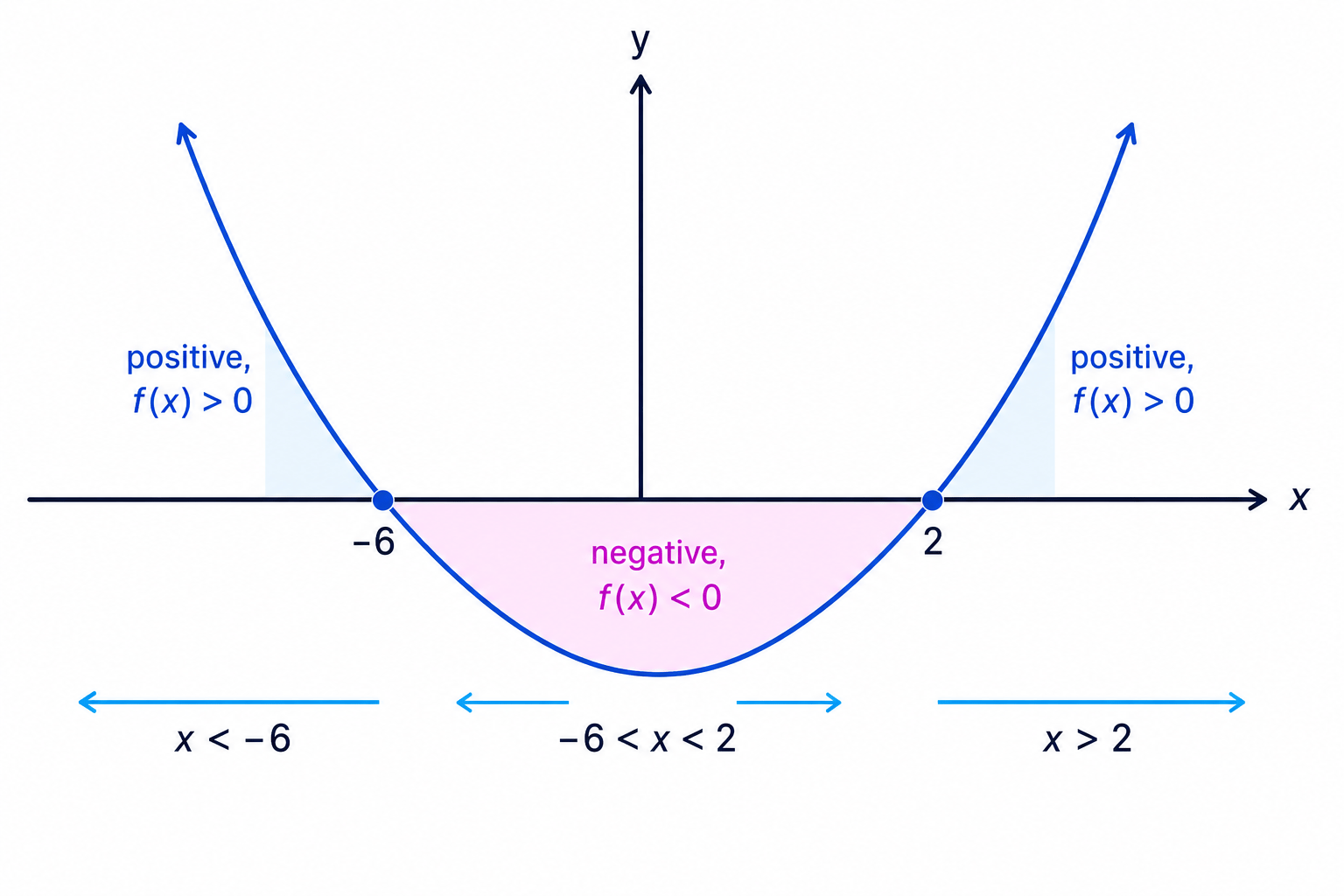
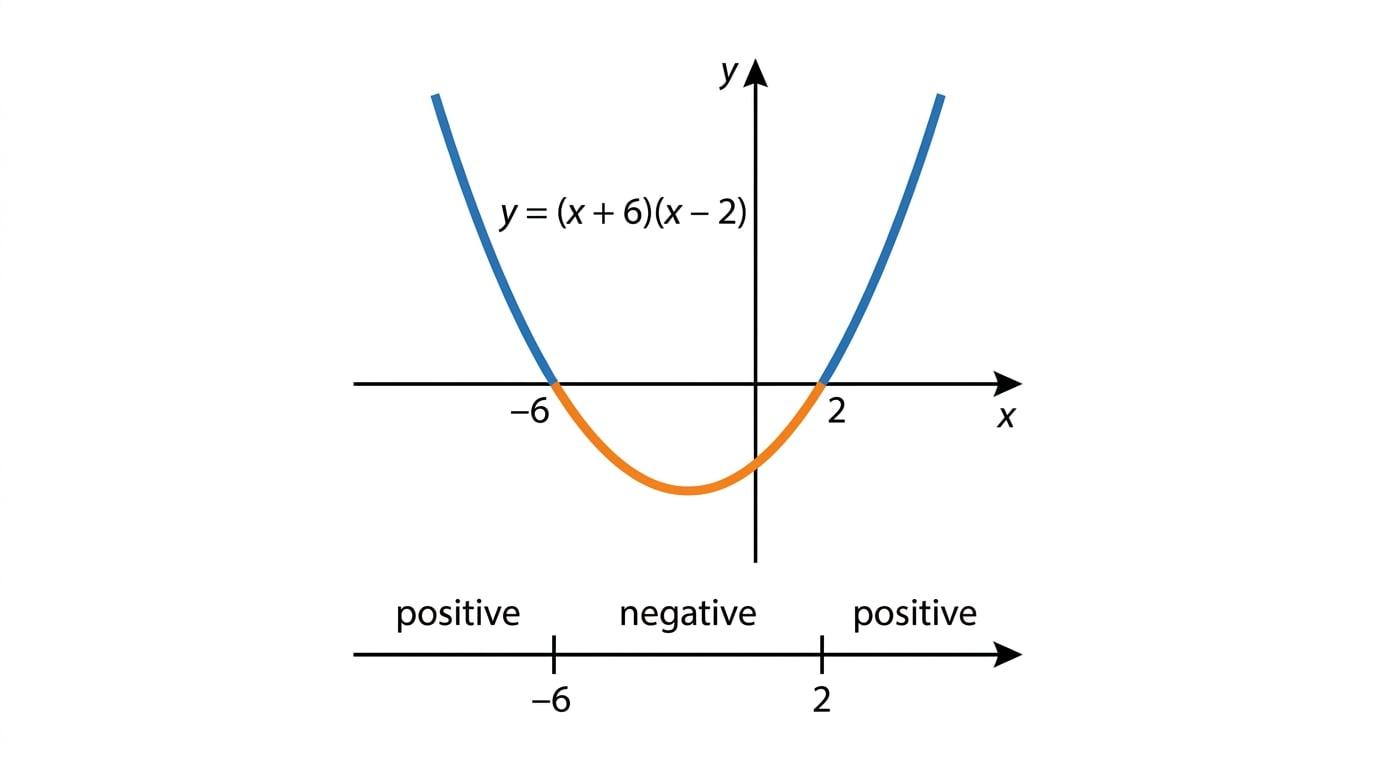
For an upward-opening quadratic:
- The expression is positive where the graph is above the xxx-axis.
- The expression is negative where the graph is below the xxx-axis.
Here is the key picture for an upward-opening quadratic with roots at x=−6x=-6x=−6 and x=2x=2x=2.
Between or outside
For an upward-opening quadratic with two distinct roots: use the outside intervals for >0>0>0, and the interval between the roots for <0<0<0.
Worked example: brackets already included
Solving
-
Expand the left-hand side:
(x+4)(x+2)=x2+6x+8(x+4)(x+2)=x^2+6x+8(x+4)(x+2)=x2+6x+8 -
Rearrange so that the right-hand side is zero:
x2+6x+8<35x^2+6x+8<35x2+6x+8<35 x2+6x−27<0x^2+6x-27<0x2+6x−27<0 -
Factorise:
x2+6x−27=(x+9)(x−3)x^2+6x-27=(x+9)(x-3)x2+6x−27=(x+9)(x−3) -
Find the critical values:
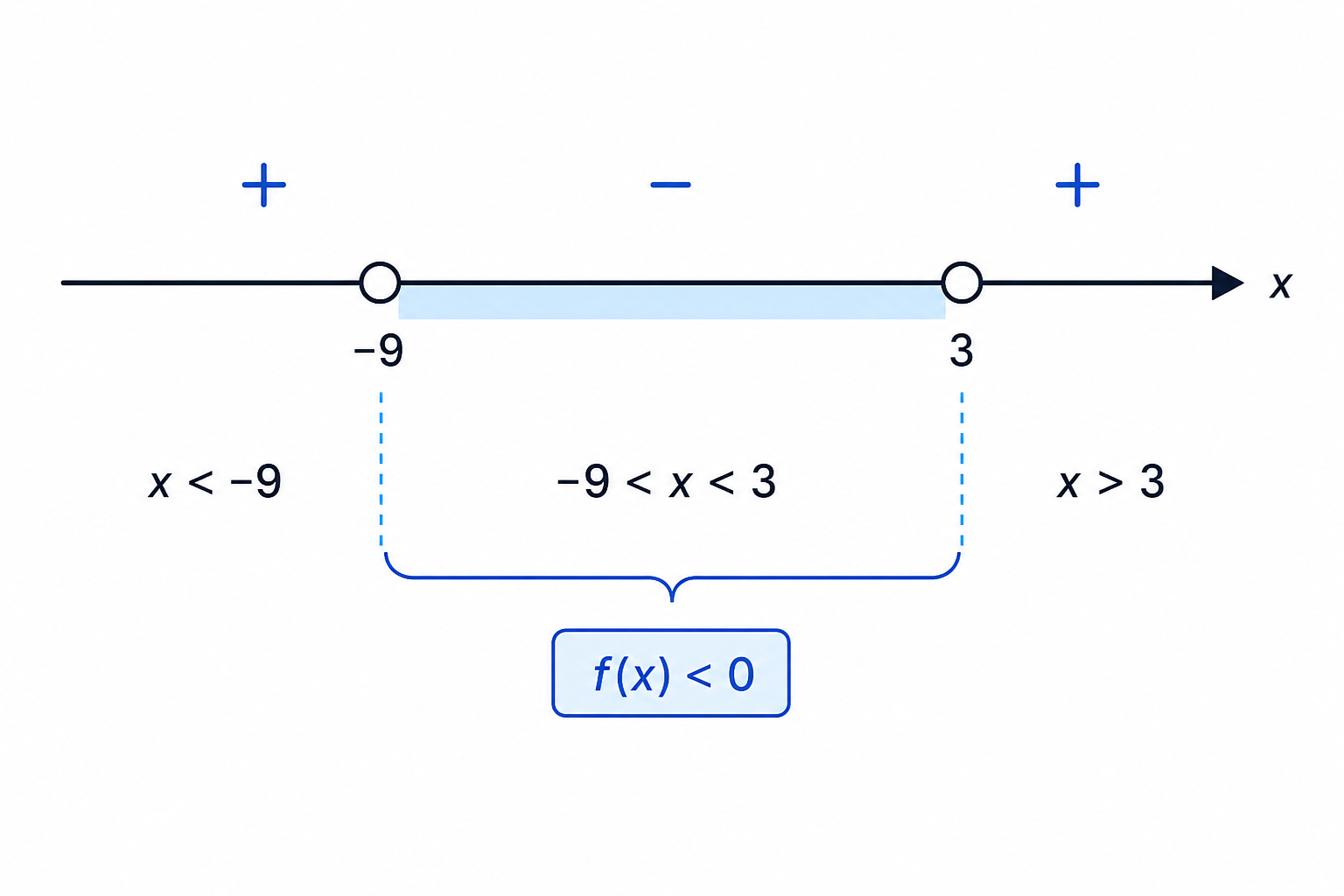
(x+9)(x−3)=0(x+9)(x-3)=0(x+9)(x−3)=0 x=−9orx=3x=-9 \quad \text{or} \quad x=3x=−9orx=3 -
The coefficient of x2x^2x2 is positive, and the inequality asks for values where the expression is less than zero, so choose the interval between the roots:
$$
-9<x<3
$$
Quick sign check
If you are unsure which interval works, test a simple value. In the example above, try x=0x=0x=0: (0+9)(0−3)=−27(0+9)(0-3)=-27(0+9)(0−3)=−27, which is less than zero, so the middle interval is correct.
4. Strict and non-strict inequalities
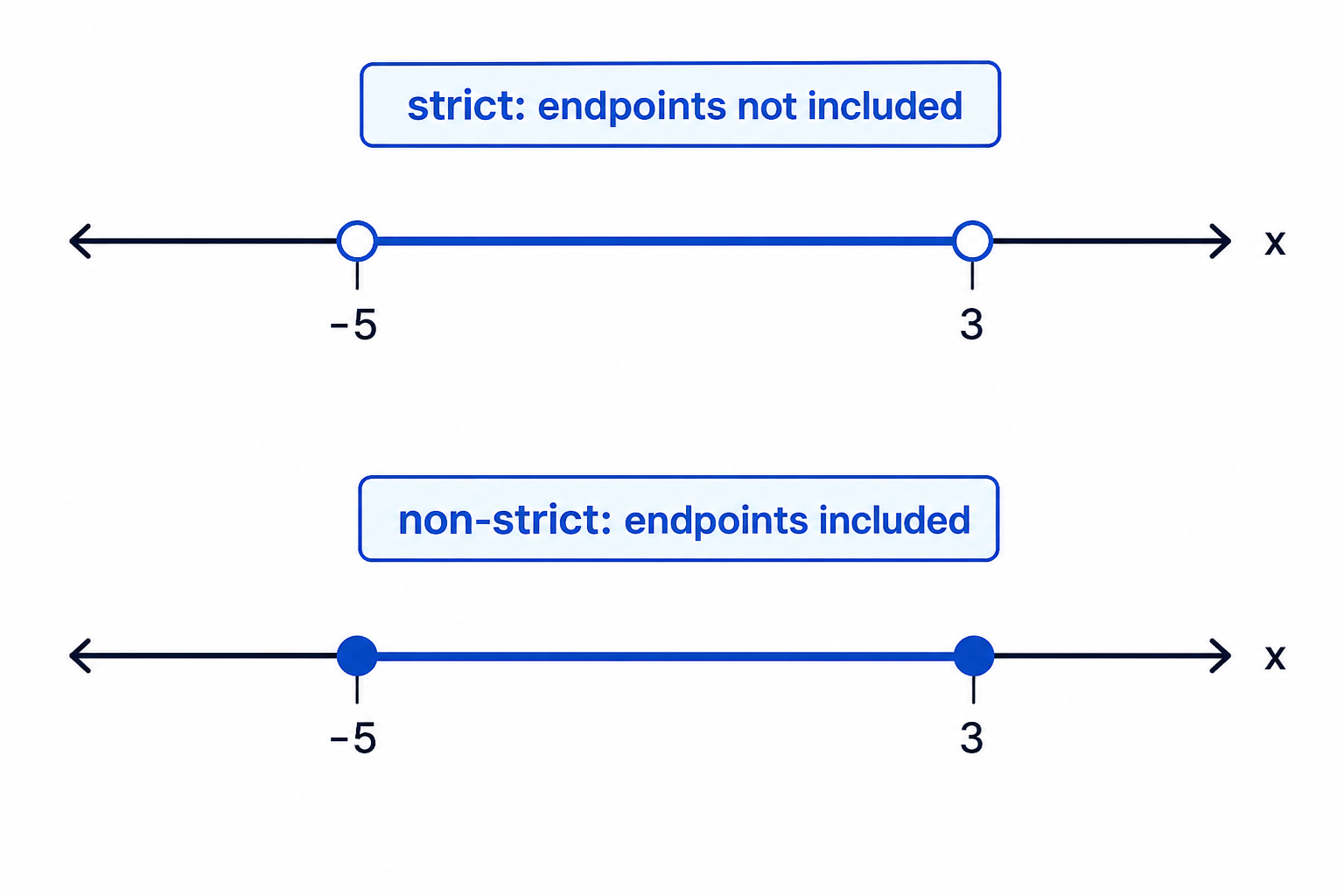
A strict inequality uses “less than” or “greater than”. The boundary values are not included.
For example, if the answer is between negative 5 and 3 but not including the ends, write:
−5<x<3-5<x<3−5<x<3A non-strict inequality uses “less than or equal to” or “greater than or equal to”. The boundary values are included.
For example:
−5≤x≤3-5\le x\le 3−5≤x≤3On a number line, strict inequalities use open circles, while non-strict inequalities use closed circles.
Worked example: including the endpoints
Solving
-
Expand the left-hand side:
x(x+2)=x2+2xx(x+2)=x^2+2xx(x+2)=x2+2x -
Rearrange so that the right-hand side is zero:
x2+2x−15≤0x^2+2x-15\le 0x2+2x−15≤0 -
Factorise the quadratic expression:
x2+2x−15=(x+5)(x−3)x^2+2x-15=(x+5)(x-3)x2+2x−15=(x+5)(x−3) -
Find the critical values:
(x+5)(x−3)=0(x+5)(x-3)=0(x+5)(x−3)=0 x=−5orx=3x=-5 \quad \text{or} \quad x=3x=−5orx=3 -
The parabola opens upwards, and we need values less than or equal to zero, so choose the interval between the roots and include the endpoints:
−5≤x≤3-5\le x\le 3−5≤x≤3
Forgetting the equality part
If the sign is “less than or equal to” or “greater than or equal to”, the roots are included in the answer because they make the quadratic equal to zero.
5. What if the quadratic opens downwards?
If the coefficient of x2x^2x2 is negative, the parabola opens downwards. That reverses the usual “between/outside” pattern.
You can handle this in either of two ways:
- Sketch the downward-opening parabola and choose the correct region.
- Multiply the whole inequality by negative 1 to make the x2x^2x2 coefficient positive, remembering to reverse the inequality sign.
Multiplying by a negative
When you multiply or divide an inequality by a negative number, the inequality sign reverses. For example, −x>4-x>4−x>4 becomes x<−4x<-4x<−4.
6. Combining a quadratic inequality with a linear inequality
Sometimes you are asked to find values of xxx that satisfy two inequalities at the same time.
A linear inequality is an inequality where the highest power of xxx is one, such as 8+3x≤10+x8+3x\le 10+x8+3x≤10+x.
The intersection of two solution sets means the overlap: the values of xxx that satisfy both conditions.
Both inequalities means overlap
When a question says values that satisfy both inequalities, solve each inequality separately, then keep only the overlapping part of the answers.
Worked example: satisfying two inequalities
Finding the values satisfying both inequalities
Solve the two inequalities at the same time:
x2+4x−12<0x^2+4x-12<0x2+4x−12<0and
8+3x≤10+x8+3x\le 10+x8+3x≤10+x-
Factorise the quadratic inequality:
x2+4x−12=(x+6)(x−2)x^2+4x-12=(x+6)(x-2)x2+4x−12=(x+6)(x−2) -
Solve the related quadratic equation:
(x+6)(x−2)=0(x+6)(x-2)=0(x+6)(x−2)=0 x=−6orx=2x=-6 \quad \text{or} \quad x=2x=−6orx=2 -
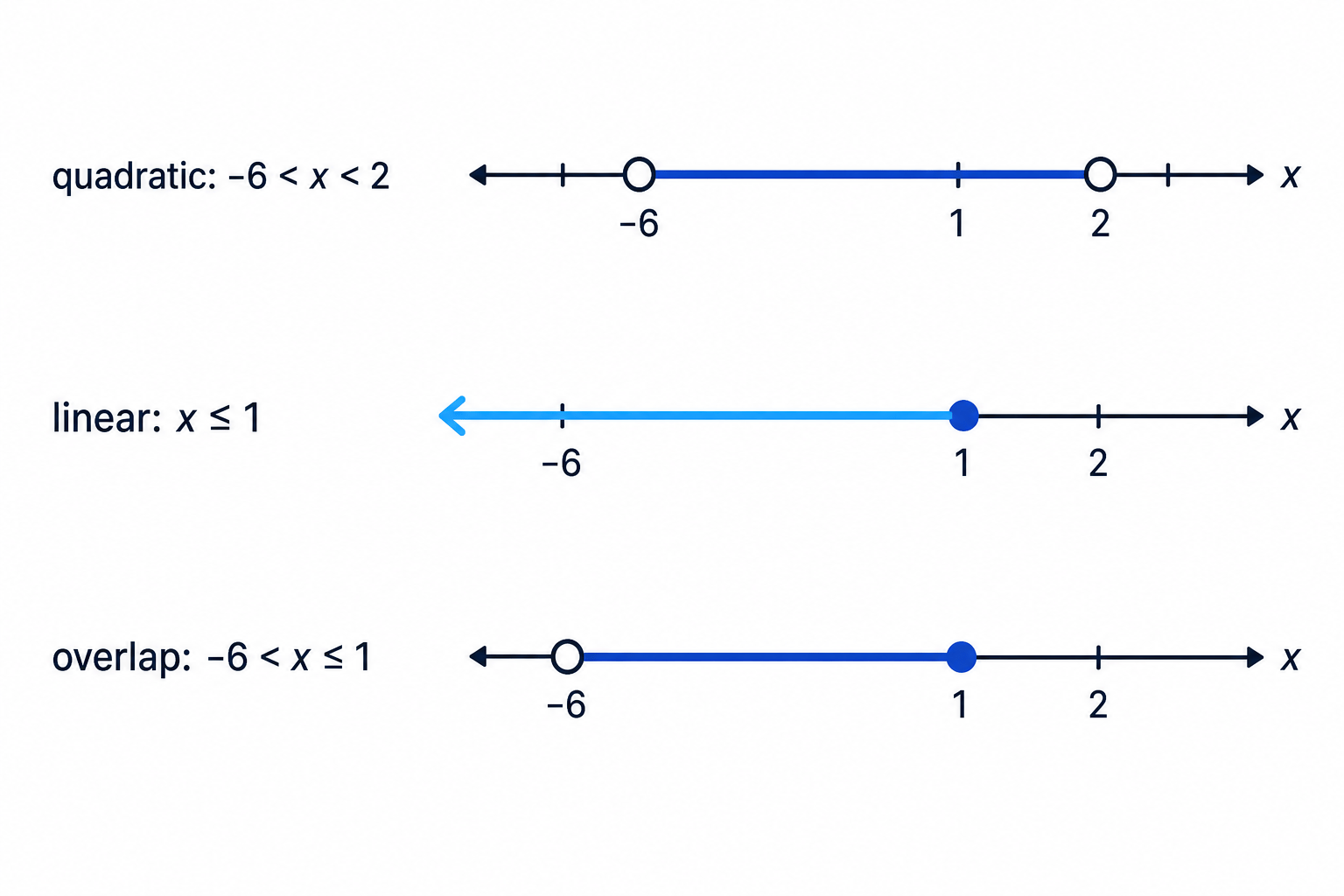
Since the quadratic opens upwards and the inequality is less than zero, choose the interval between the roots:
−6<x<2-6<x<2−6<x<2 -
Now solve the linear inequality:
8+3x≤10+x8+3x\le 10+x8+3x≤10+x 2x≤22x\le 22x≤2 x≤1x\le 1x≤1 -
Find the overlap of −6<x<2-6<x<2−6<x<2 and x≤1x\le 1x≤1:
$$
-6<x\le 1
$$
7. The full method to remember
For most quadratic inequality questions, follow this routine:
- Rearrange so that one side is zero.
- Factorise the quadratic expression.
- Solve the related equation to find the critical values.
- Decide whether you need the interval between the roots or the outside intervals.
- Use strict or non-strict inequality signs correctly.
- If there is a second inequality, solve it separately and take the overlap.
In the exam
-
Always show the rearranged inequality and the factorisation; these are easy method marks.
-
Do not write just the roots as your final answer. Your final answer should be an interval, such as −6<x<2-6<x<2−6<x<2, or two outside intervals, such as x<−9x<-9x<−9 or x>2x>2x>2.
-
For “both inequalities” questions, draw a quick number line if the overlap is not obvious.
Check yourself
-
If an upward-opening quadratic has roots at x=−4x=-4x=−4 and x=7x=7x=7, where is it negative?
-
What is the difference between solving x2−5x+6<0x^2-5x+6<0x2−5x+6<0 and x2−5x+6≤0x^2-5x+6\le 0x2−5x+6≤0?
-
When combining two inequalities, why is the word “both” important?
