Revision notes for Edexcel AS Level Maths Algebraic Expressions. Open each subtopic for explanations, worked examples, and summaries of 1.1 Index Laws, 1.2 Expanding Brackets, 1.3 Factorising, 1.4 Negative and Fractional Indices, and 1.5 Surds. Written against the Edexcel AS Level Maths (8MA0) specification, so the content matches what's examinable rather than general Maths background.
Algebraic Expressions
What you'll learn
- How to simplify expressions involving powers, roots and negative indices.
- How to rewrite exponential expressions using a common base.
- How to factorise, expand and simplify algebraic expressions accurately.
- How to rationalise surd denominators and give answers in exact form.
Expressions, terms and simplification
An algebraic expression is a mathematical phrase containing numbers, letters and operations, but no equals sign to solve.
For example, 3x2−5x+13x^2 - 5x + 13x2−5x+1 is an expression. The separate parts 3x23x^23x2, −5x-5x−5x and 1 are called terms.
Definition
Key vocabulary
- A term is one part of an expression, separated by addition or subtraction.
- A coefficient is the number multiplying a variable, such as 3 in 3x23x^23x2.
- Like terms have exactly the same variable part, such as 4x24x^24x2 and −7x2-7x^2−7x2.
To simplify means to rewrite an expression in an equivalent but cleaner form. In this topic, that often means using index laws, expanding brackets, factorising, or rationalising surds.
Index laws: powers and roots
An index or exponent tells you how many times a base is used as a factor. In ana^nan, the base is aaa and the index is nnn.
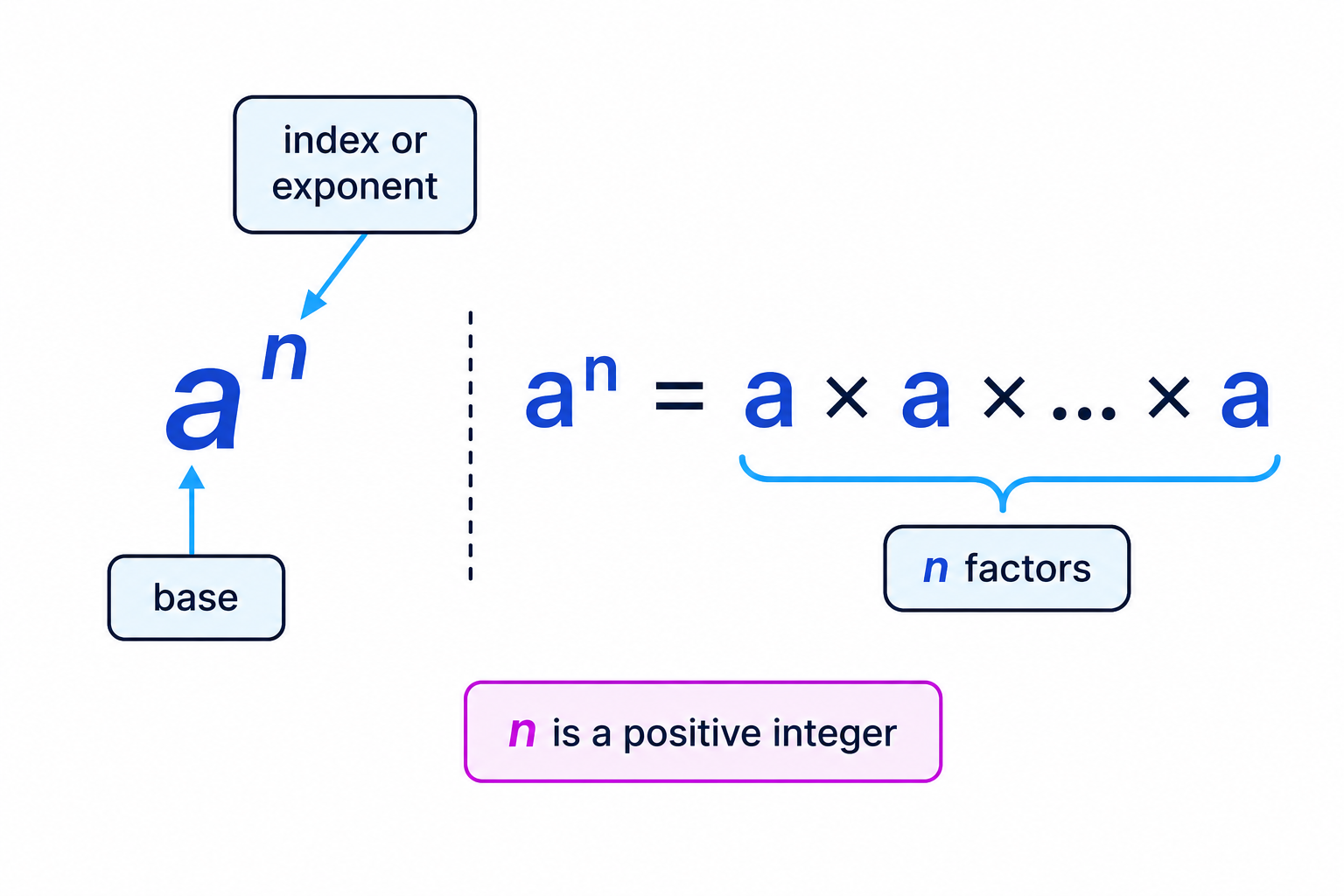
The most useful index laws are:
- am×an=am+na^m \times a^n = a^{m+n}am×an=am+n
- aman=am−n\frac{a^m}{a^n} = a^{m-n}anam=am−n, where a≠0a \neq 0a=0
- (am)n=amn(a^m)^n = a^{mn}(am)n=amn
- a−n=1ana^{-n} = \frac{1}{a^n}a−n=an1
- a1n=ana^{\frac{1}{n}} = \sqrt[n]{a}an1=na
Key Idea
Fractional powers
A fractional power combines a root and a power: amna^{\frac{m}{n}}anm means take the nth root and the mth power.
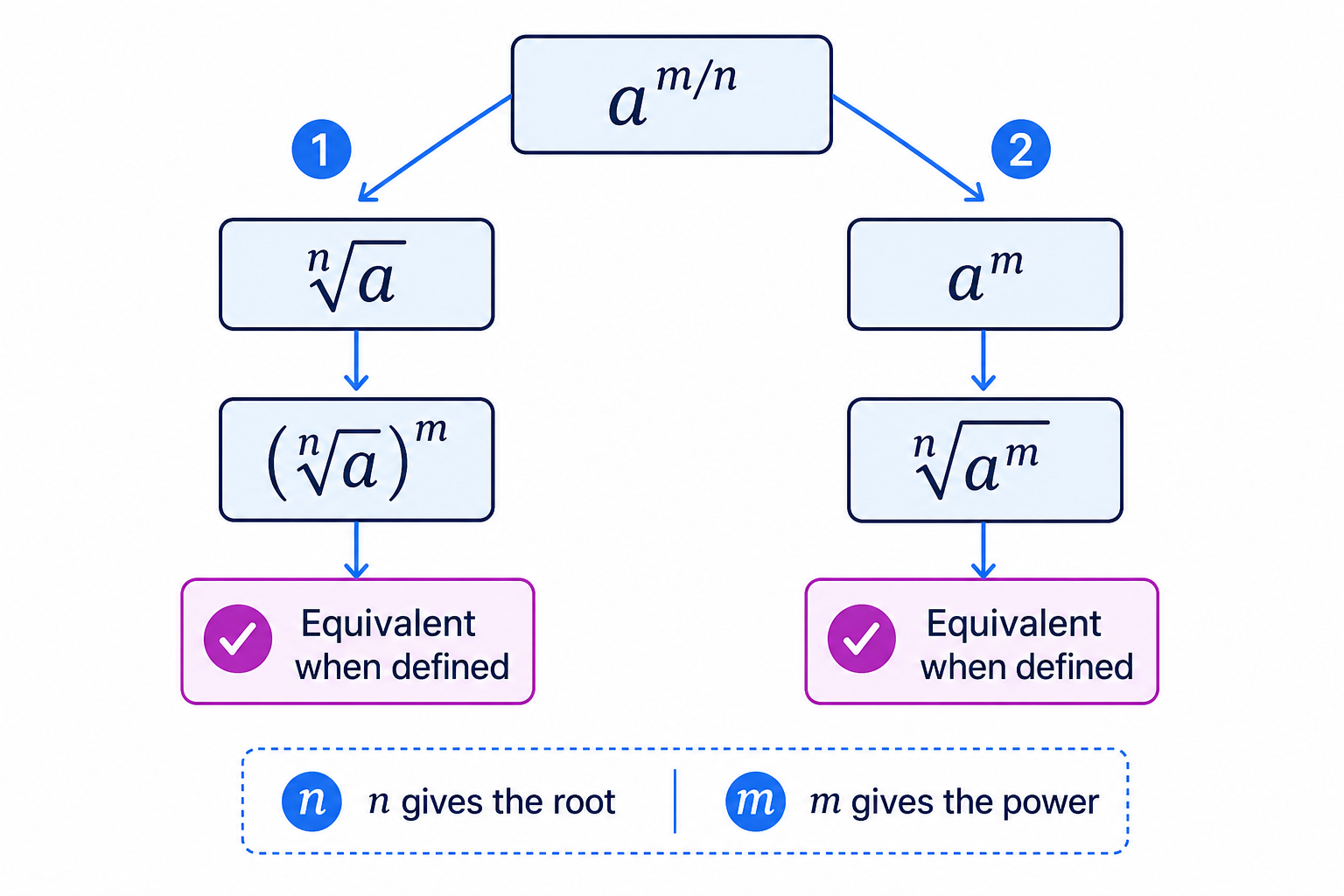
Example
Simplifying a fractional power
Simplify (343x6125)13\left(\frac{343x^6}{125}\right)^{\frac{1}{3}}(125343x6)31.
-
Recognise that a power of 13\frac{1}{3}31 means a cube root.
(343x6125)13=343x61253\left(\frac{343x^6}{125}\right)^{\frac{1}{3}} = \sqrt[3]{\frac{343x^6}{125}}(125343x6)31=3125343x6 -
Take the cube root of the numerator and denominator.
343x61253=343x631253\sqrt[3]{\frac{343x^6}{125}} = \frac{\sqrt[3]{343x^6}}{\sqrt[3]{125}}3125343x6=31253343x6 -
Use 343=73343 = 7^3343=73, 125=53125 = 5^3125=53 and x6=(x2)3x^6 = (x^2)^3x6=(x2)3.
343x631253=7x25\frac{\sqrt[3]{343x^6}}{\sqrt[3]{125}} = \frac{7x^2}{5}31253343x6=57x2
Example
Simplifying with a negative fractional power
Simplify (125x68y3)−23\left(\frac{125x^6}{8y^3}\right)^{-\frac{2}{3}}(8y3125x6)−32.
-
A negative index means take the reciprocal first.
(125x68y3)−23=(8y3125x6)23\left(\frac{125x^6}{8y^3}\right)^{-\frac{2}{3}} = \left(\frac{8y^3}{125x^6}\right)^{\frac{2}{3}}(8y3125x6)−32=(125x68y3)32 -
A power of 23\frac{2}{3}32 means take the cube root, then square.
(8y3125x6)23=(2y5x2)2\left(\frac{8y^3}{125x^6}\right)^{\frac{2}{3}} = \left(\frac{2y}{5x^2}\right)^2(125x68y3)32=(5x22y)2 -
Square the numerator and denominator.
(2y5x2)2=4y225x4\left(\frac{2y}{5x^2}\right)^2 = \frac{4y^2}{25x^4}(5x22y)2=25x44y2
Common Mistake
Even roots and variables
Strictly, x2=∣x∣\sqrt{x^2} = |x|x2=∣x∣. In many index-law simplifications, variables are treated as positive unless a domain is stated. If a domain is given, use it.
Rewriting powers using a common base
Many exponential questions become easier once all powers are written with the same base.
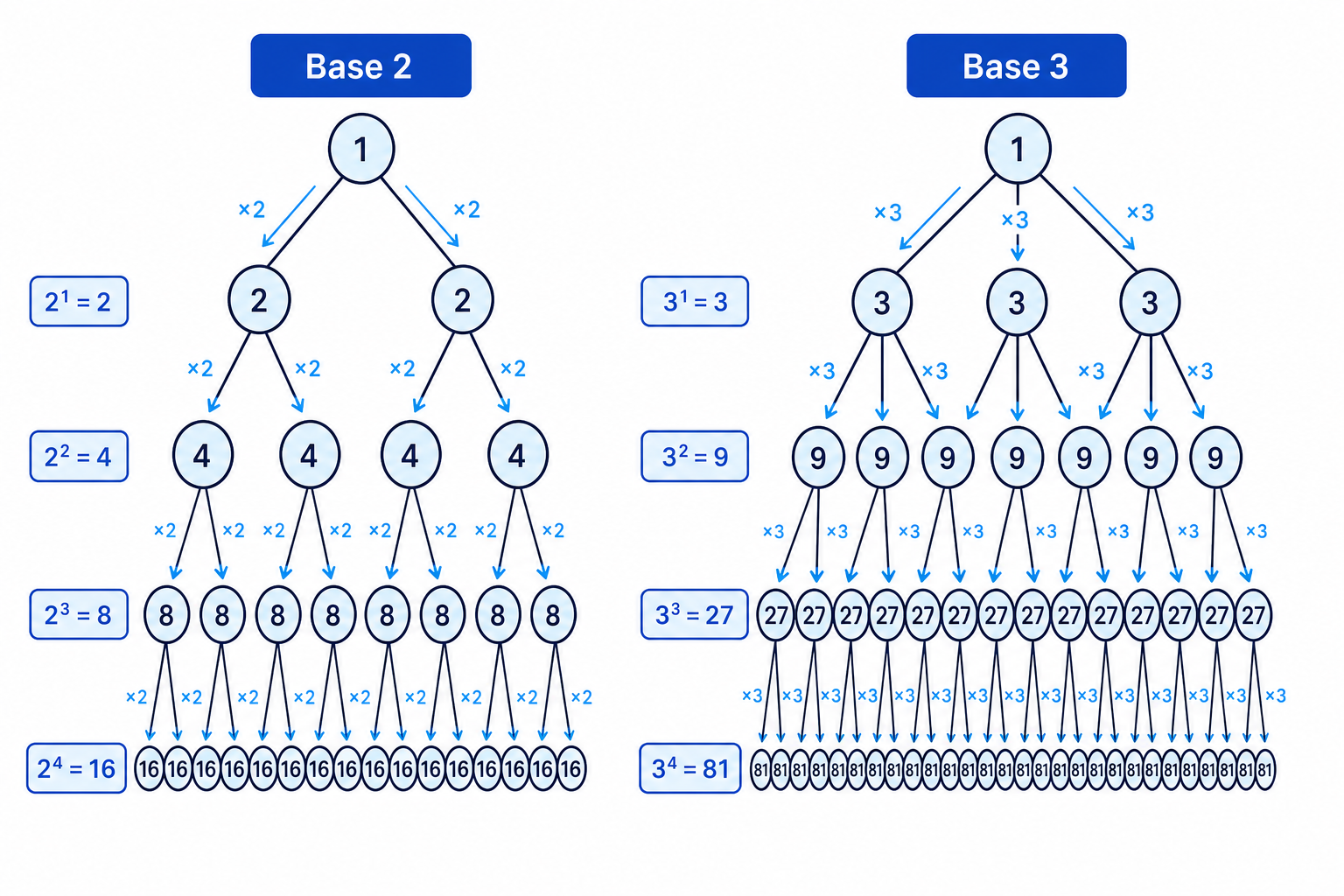
For example:
- 4=224 = 2^24=22
- 8=238 = 2^38=23
- 9=329 = 3^29=32
- 27=3327 = 3^327=33
Example
Writing an expression as a power of 3
Express 272x−127^{2x-1}272x−1 in the form 3y3^y3y, giving yyy in the form ax+bax + bax+b.
-
Rewrite 27 as a power of 3.
272x−1=(33)2x−127^{2x-1} = (3^3)^{2x-1}272x−1=(33)2x−1 -
Use (am)n=amn(a^m)^n = a^{mn}(am)n=amn.
(33)2x−1=33(2x−1)(3^3)^{2x-1} = 3^{3(2x-1)}(33)2x−1=33(2x−1) -
Expand the index.
33(2x−1)=36x−33^{3(2x-1)} = 3^{6x-3}33(2x−1)=36x−3 -
Therefore y=6x−3y = 6x - 3y=6x−3.
Common Mistake
Multiplying the base instead of the index
When simplifying (33)2x−1(3^3)^{2x-1}(33)2x−1, multiply the indices to get 36x−33^{6x-3}36x−3. Do not write 92x−19^{2x-1}92x−1 or 32x+23^{2x+2}32x+2.
Solving exponential equations
An exponential equation is an equation where the unknown appears in an index, such as 2x2^x2x or 8x+18^{x+1}8x+1.
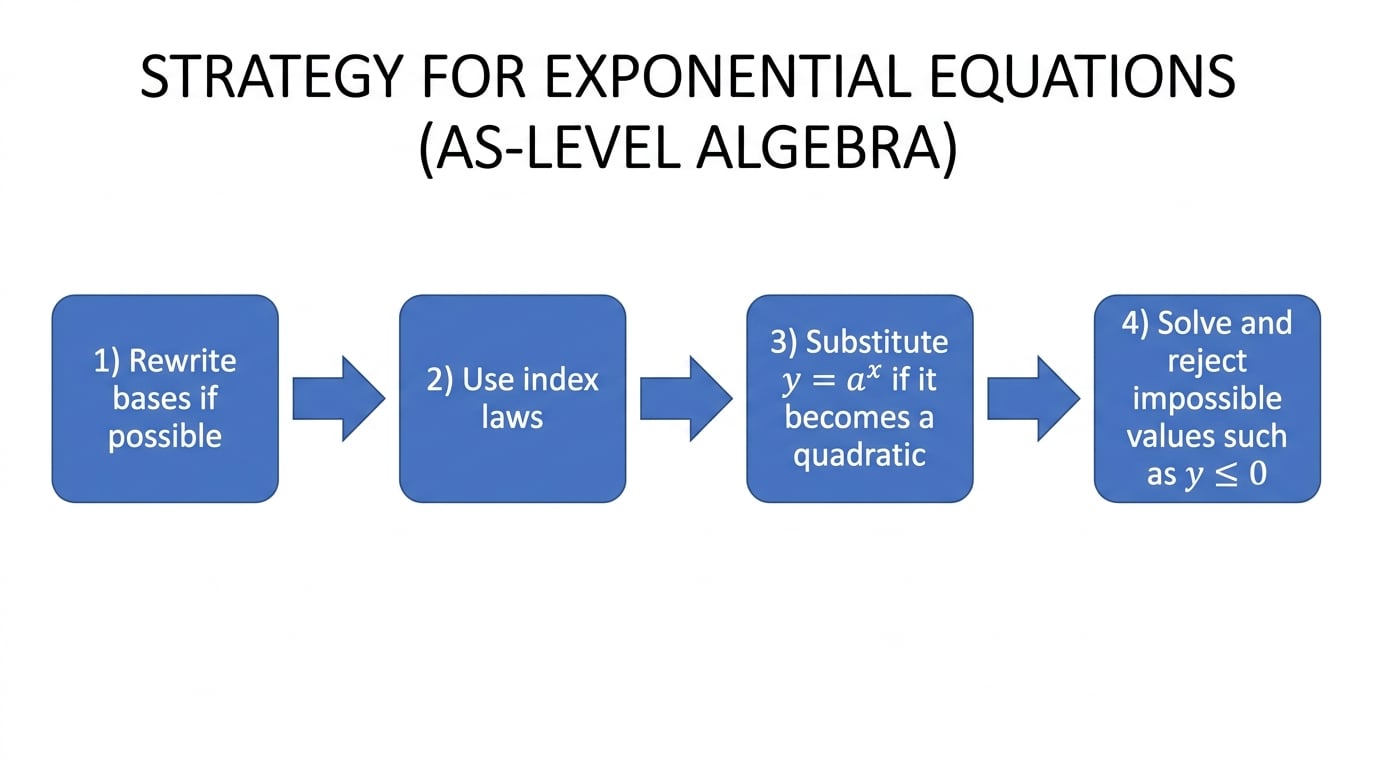
If both sides can be written with the same base, equate the indices. If the equation contains terms like 4x4^x4x and 2x2^x2x, use a substitution such as y=2xy = 2^xy=2x.
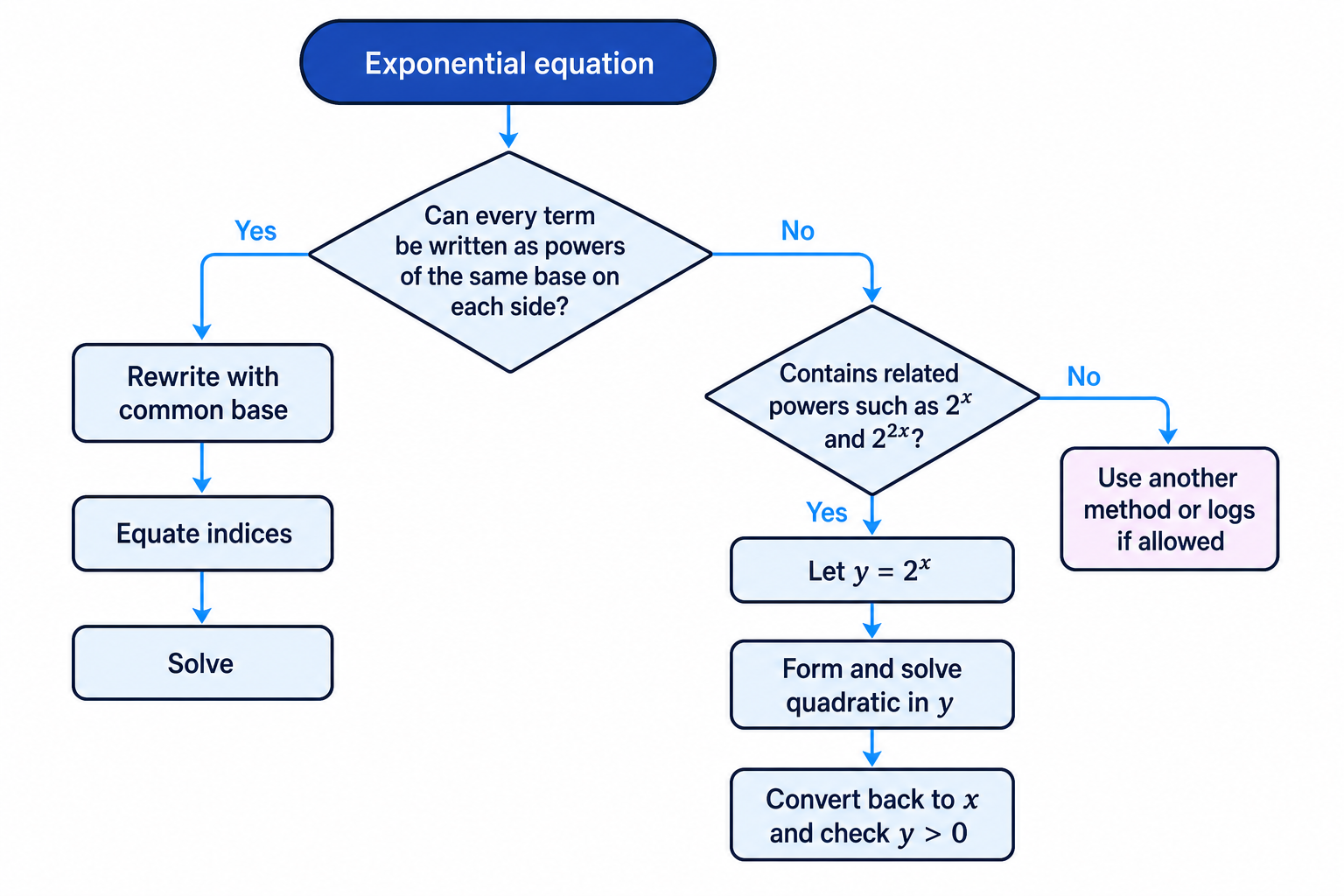
Here is the decision process for exponential equations.
Example
Solving by using a common base
Find xxx if 8x+1=42x−38^{x+1} = 4^{2x-3}8x+1=42x−3.
-
Rewrite both sides as powers of 2.
(23)x+1=(22)2x−3(2^3)^{x+1} = (2^2)^{2x-3}(23)x+1=(22)2x−3 -
Multiply the indices.
23x+3=24x−62^{3x+3} = 2^{4x-6}23x+3=24x−6 -
Since the bases are equal, equate the indices.
3x+3=4x−63x + 3 = 4x - 63x+3=4x−6 -
Solve the linear equation.
x=9x = 9x=9
Example
Solving by substitution
Solve 4x−10(2x)+16=04^x - 10(2^x) + 16 = 04x−10(2x)+16=0.
-
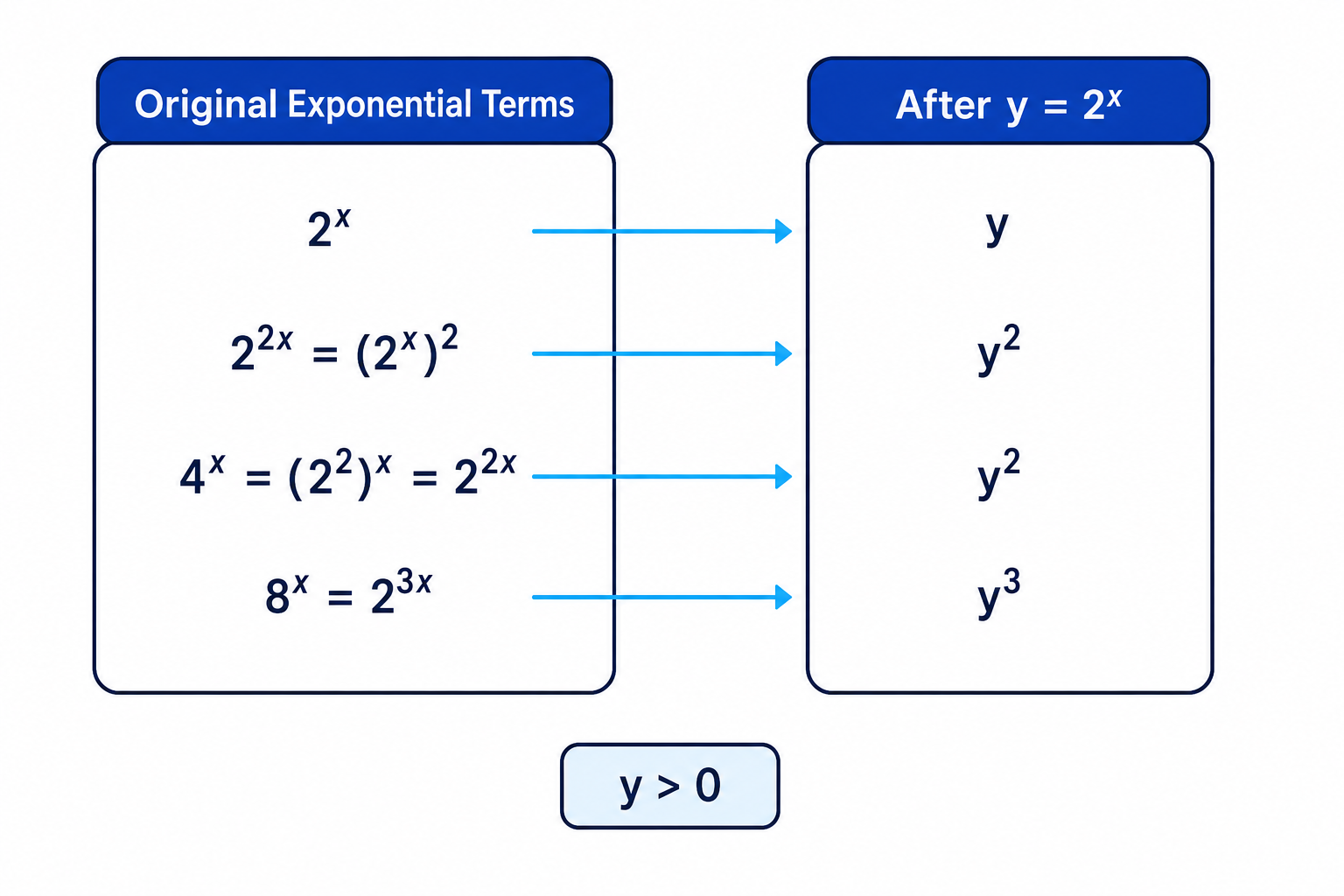
Let y=2xy = 2^xy=2x. Then rewrite 4x4^x4x.
4x=(22)x=(2x)2=y24^x = (2^2)^x = (2^x)^2 = y^24x=(22)x=(2x)2=y2 -
Substitute into the equation.
y2−10y+16=0y^2 - 10y + 16 = 0y2−10y+16=0 -
Factorise the quadratic.
(y−2)(y−8)=0(y - 2)(y - 8) = 0(y−2)(y−8)=0 -
Solve for yyy.
y=2ory=8y = 2 \quad \text{or} \quad y = 8y=2ory=8 -
Convert back to xxx.
2x=2or2x=82^x = 2 \quad \text{or} \quad 2^x = 82x=2or2x=8 -
Therefore x=1x = 1x=1 or x=3x = 3x=3.
Tip
Substitution clue
If you see both 2x2^x2x and 22x2^{2x}22x, try letting y=2xy = 2^xy=2x. Then 22x=(2x)2=y22^{2x} = (2^x)^2 = y^222x=(2x)2=y2, which creates a quadratic.
Common Mistake
Accepting impossible substitution values
If y=2xy = 2^xy=2x, then yyy is always positive. So if your quadratic gives a negative value of yyy, reject it.
“Hence” equations using a known quadratic
Sometimes you first solve a quadratic, then reuse its structure in a disguised equation.
Example
Using a previous quadratic result
Solve u2−35u+216=0u^2 - 35u + 216 = 0u2−35u+216=0. Hence solve t3−35t32+216=0t^3 - 35t^{\frac{3}{2}} + 216 = 0t3−35t23+216=0.
-
Factorise the quadratic.
u2−35u+216=(u−8)(u−27)u^2 - 35u + 216 = (u - 8)(u - 27)u2−35u+216=(u−8)(u−27) -
So the quadratic has roots u=8u = 8u=8 and u=27u = 27u=27.
-
In the second equation, let u=t32u = t^{\frac{3}{2}}u=t23. Then u2=t3u^2 = t^3u2=t3.
-
The equation becomes the same quadratic as before.
u2−35u+216=0u^2 - 35u + 216 = 0u2−35u+216=0 -
Therefore t32=8t^{\frac{3}{2}} = 8t23=8 or t32=27t^{\frac{3}{2}} = 27t23=27.
-
Raise both sides to the power 23\frac{2}{3}32.
t=823ort=2723t = 8^{\frac{2}{3}} \quad \text{or} \quad t = 27^{\frac{2}{3}}t=832ort=2732 -
Simplify the answers.
t=4ort=9t = 4 \quad \text{or} \quad t = 9t=4ort=9
Factorising and expanding
To factorise means to put an expression into brackets. To expand means to remove brackets by multiplying out.
Factorising completely usually means:
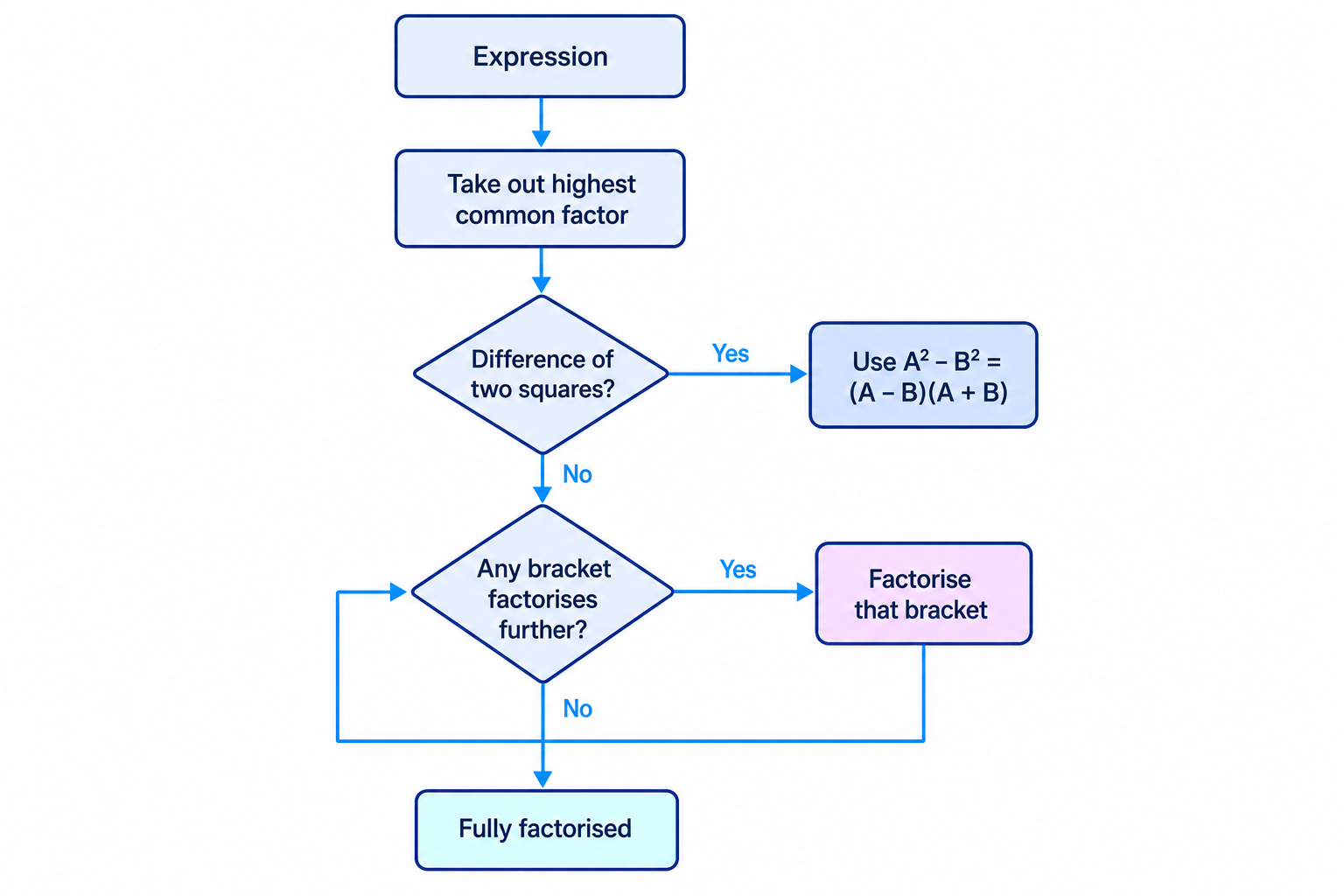
- Take out the highest common factor.
- Look for a difference of two squares.
- Check whether any bracket can be factorised further.
Example
Factorising completely
Factorise 6x−24x36x - 24x^36x−24x3 completely.
-
Take out the highest common factor, which is 6x6x6x.
6x−24x3=6x(1−4x2)6x - 24x^3 = 6x(1 - 4x^2)6x−24x3=6x(1−4x2) -
Recognise a difference of two squares.
1−4x2=12−(2x)21 - 4x^2 = 1^2 - (2x)^21−4x2=12−(2x)2 -
Factorise the bracket.
1−4x2=(1−2x)(1+2x)1 - 4x^2 = (1 - 2x)(1 + 2x)1−4x2=(1−2x)(1+2x) -
Write the final answer.
6x−24x3=6x(1−2x)(1+2x)6x - 24x^3 = 6x(1 - 2x)(1 + 2x)6x−24x3=6x(1−2x)(1+2x)
Example
Expanding and simplifying brackets
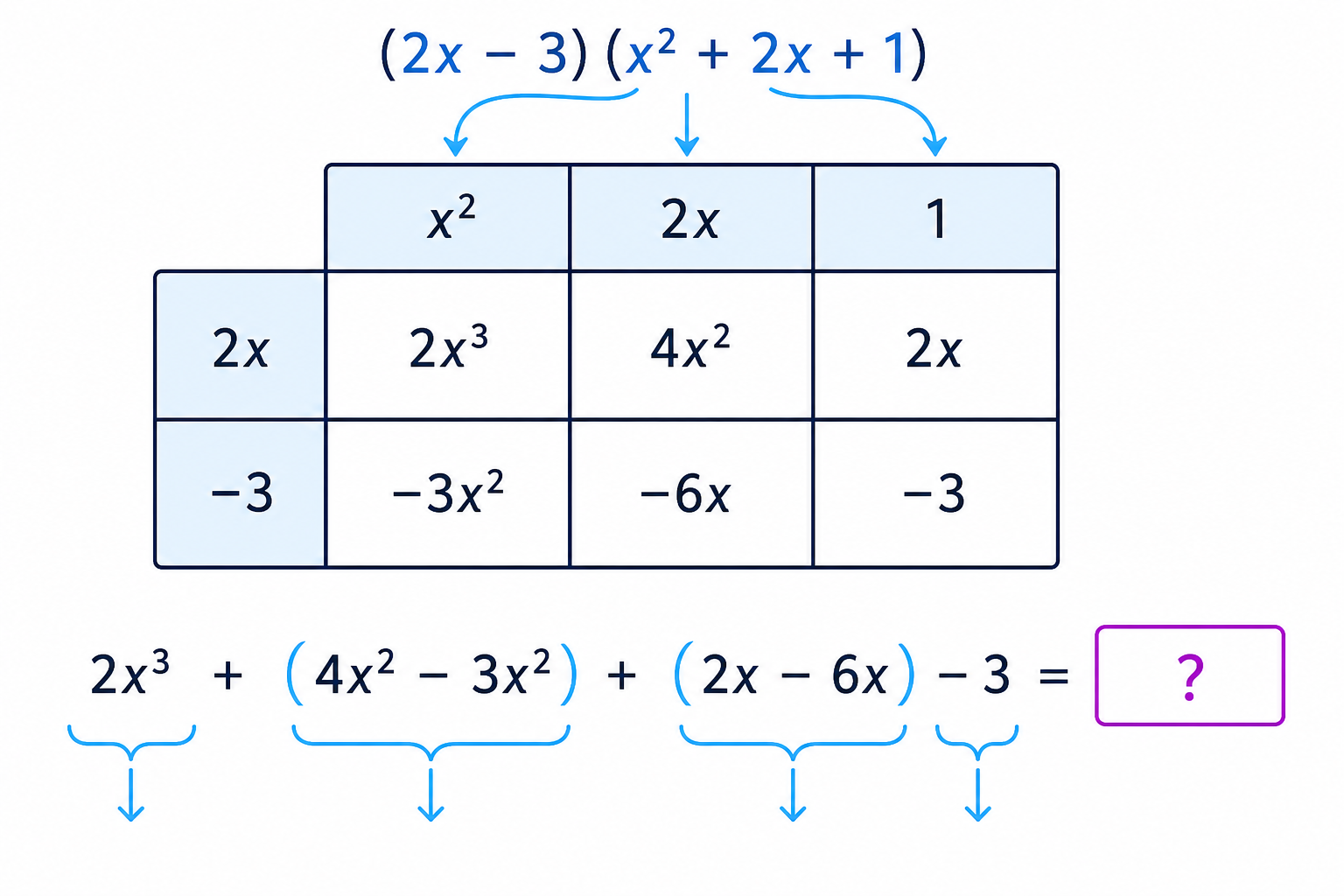
Expand and simplify (2x−3)(x+1)2(2x - 3)(x + 1)^2(2x−3)(x+1)2.
-
Square the repeated bracket first.
(x+1)2=x2+2x+1(x + 1)^2 = x^2 + 2x + 1(x+1)2=x2+2x+1 -
Multiply by the remaining bracket.
(2x−3)(x2+2x+1)=2x3+4x2+2x−3x2−6x−3(2x - 3)(x^2 + 2x + 1) = 2x^3 + 4x^2 + 2x - 3x^2 - 6x - 3(2x−3)(x2+2x+1)=2x3+4x2+2x−3x2−6x−3 -
Collect like terms.
2x3+x2−4x−32x^3 + x^2 - 4x - 32x3+x2−4x−3
Surds and rationalising denominators
A surd is an irrational root left in exact form, such as 2\sqrt{2}2 or 5\sqrt{5}5.
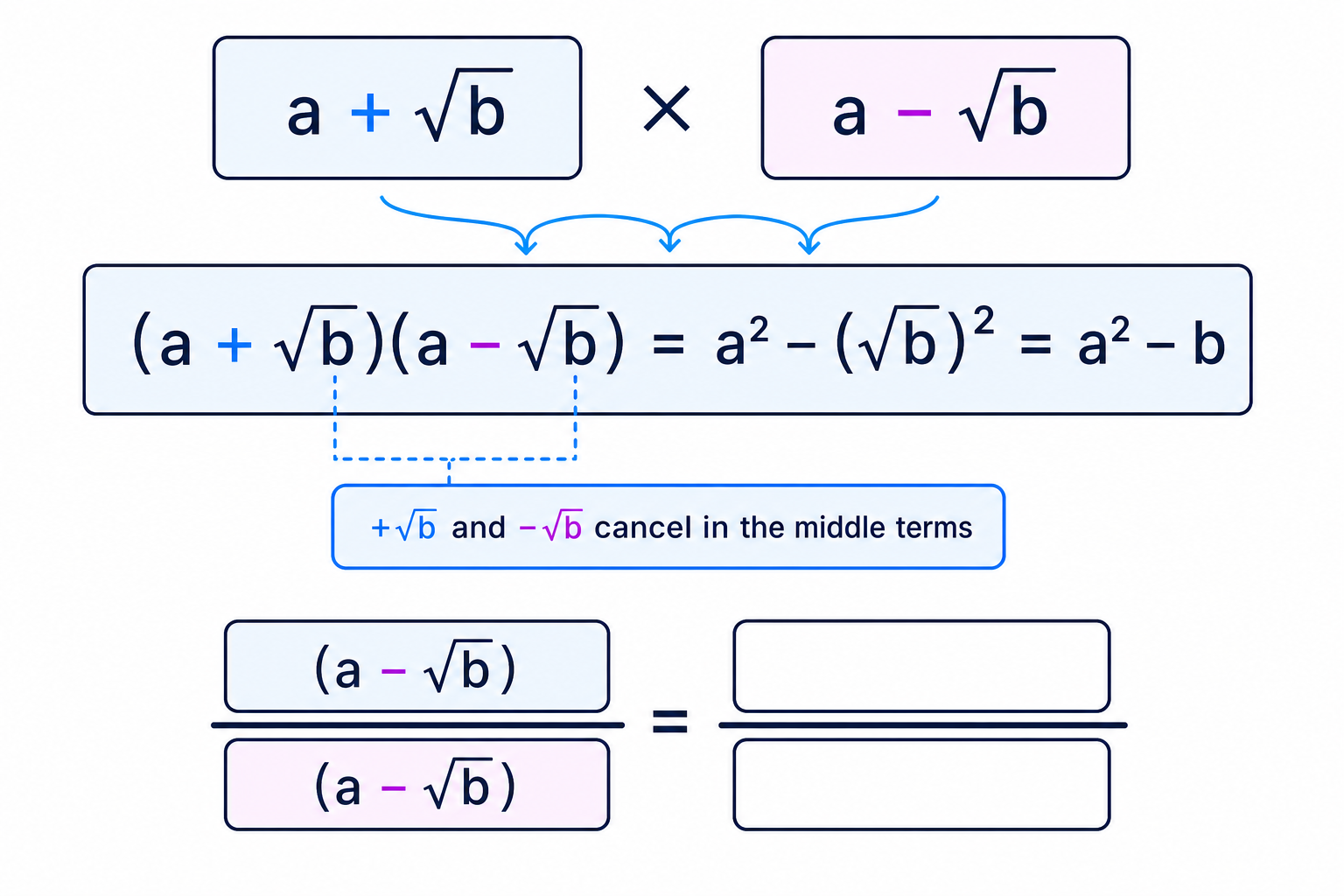
To rationalise the denominator means to rewrite a fraction so there is no surd on the bottom. For denominators like a+ba + \sqrt{b}a+b, multiply by the conjugate a−ba - \sqrt{b}a−b.
Definition
Conjugate
The conjugate of a+ba + \sqrt{b}a+b is a−ba - \sqrt{b}a−b. Multiplying conjugates uses the difference of two squares.
Example
Rationalising a denominator
Simplify 4+23−2\frac{4 + \sqrt{2}}{3 - \sqrt{2}}3−24+2.
-
Multiply the top and bottom by the conjugate of the denominator.
4+23−2×3+23+2\frac{4 + \sqrt{2}}{3 - \sqrt{2}} \times \frac{3 + \sqrt{2}}{3 + \sqrt{2}}3−24+2×3+23+2 -
Expand the numerator.
(4+2)(3+2)=14+72(4 + \sqrt{2})(3 + \sqrt{2}) = 14 + 7\sqrt{2}(4+2)(3+2)=14+72 -
Expand the denominator.
(3−2)(3+2)=9−2=7(3 - \sqrt{2})(3 + \sqrt{2}) = 9 - 2 = 7(3−2)(3+2)=9−2=7 -
Divide by 7.
14+727=2+2\frac{14 + 7\sqrt{2}}{7} = 2 + \sqrt{2}714+72=2+2
Example
Solving and giving the answer in surd form
Find xxx if 2+xx=5\frac{2 + x}{x} = \sqrt{5}x2+x=5, giving your answer in the form a+b5a + b\sqrt{5}a+b5.
-
Multiply both sides by xxx, where x≠0x \neq 0x=0.
2+x=x52 + x = x\sqrt{5}2+x=x5 -
Collect the xxx terms on one side.
2=x5−x2 = x\sqrt{5} - x2=x5−x -
Factorise the right-hand side.
2=x(5−1)2 = x(\sqrt{5} - 1)2=x(5−1) -
Divide by 5−1\sqrt{5} - 15−1.
x=25−1x = \frac{2}{\sqrt{5} - 1}x=5−12 -
Rationalise the denominator.
x=25−1×5+15+1=2(5+1)4x = \frac{2}{\sqrt{5} - 1} \times \frac{\sqrt{5} + 1}{\sqrt{5} + 1} = \frac{2(\sqrt{5} + 1)}{4}x=5−12×5+15+1=42(5+1) -
Write in the required form.
x=12+125x = \frac{1}{2} + \frac{1}{2}\sqrt{5}x=21+215
Exam technique
In the exam
-
Look for the structure first: common base, quadratic substitution, common factor, or surd denominator.
-
Show enough working to make your method clear, especially when changing bases or rationalising.
-
Check restrictions: denominators cannot be zero, and substitutions like y=2xy = 2^xy=2x must be positive.
Self review
Check yourself
- Can you simplify an expression with a negative fractional index without skipping the reciprocal step?
- When should you use a substitution such as y=2xy = 2^xy=2x?
- Can you rationalise a denominator using the correct conjugate?

Recap questions
Test yourself with 5 quick questions on this guide. Answer them all correctly to complete it.
You've reached the end
Test yourself on this topic, or move on to the next guide.
How was this guide?