Revision notes for Edexcel AS Level Maths Modelling Assumptions. Open the guide for explanations and worked examples. Written against the Edexcel AS Level Maths (8MA0) specification, so the content matches what's examinable rather than general Maths background.
Modelling Assumptions
What you'll learn
- What a mathematical model is, and why AS Mechanics uses simplifying assumptions.
- The key modelling words: particle, smooth, rough, light, inextensible, and negligible air resistance.
- How assumptions justify using the constant-acceleration equations.
- How to write clear exam-style explanations about whether a model is suitable.
Why do we make modelling assumptions?
Real motion is messy. A football spins, air pushes back on it, the ground is uneven, and objects have size and shape. In Mechanics, we often replace the real situation with a simpler model so that we can use equations reliably.
Definition
Model and modelling assumption
- A model is a simplified version of a real situation.
- A modelling assumption is something we choose to ignore or simplify, such as air resistance, the size of an object, or friction.
- A model is useful if it keeps the important features of the situation while making the mathematics manageable.
Key Idea
The big idea
Modelling assumptions are not “extra words”: they tell you which forces and effects are being included, and therefore which equations you are allowed to use.
Example
Interpreting a simple model
A small parcel slides in a straight line along a horizontal track. It is modelled as a particle moving with constant acceleration.
-
The word particle means the parcel’s mass is treated as concentrated at a single point.
-
Because it is a particle, its size, shape, rotation and turning effects are ignored.
-
The phrase constant acceleration means the acceleration has the same value throughout the motion.
-
This model may be suitable if the parcel is small compared with the distance travelled and does not rotate significantly.
-
This model may be unsuitable if the parcel tumbles, spins, or if air resistance noticeably affects its motion.
The particle model
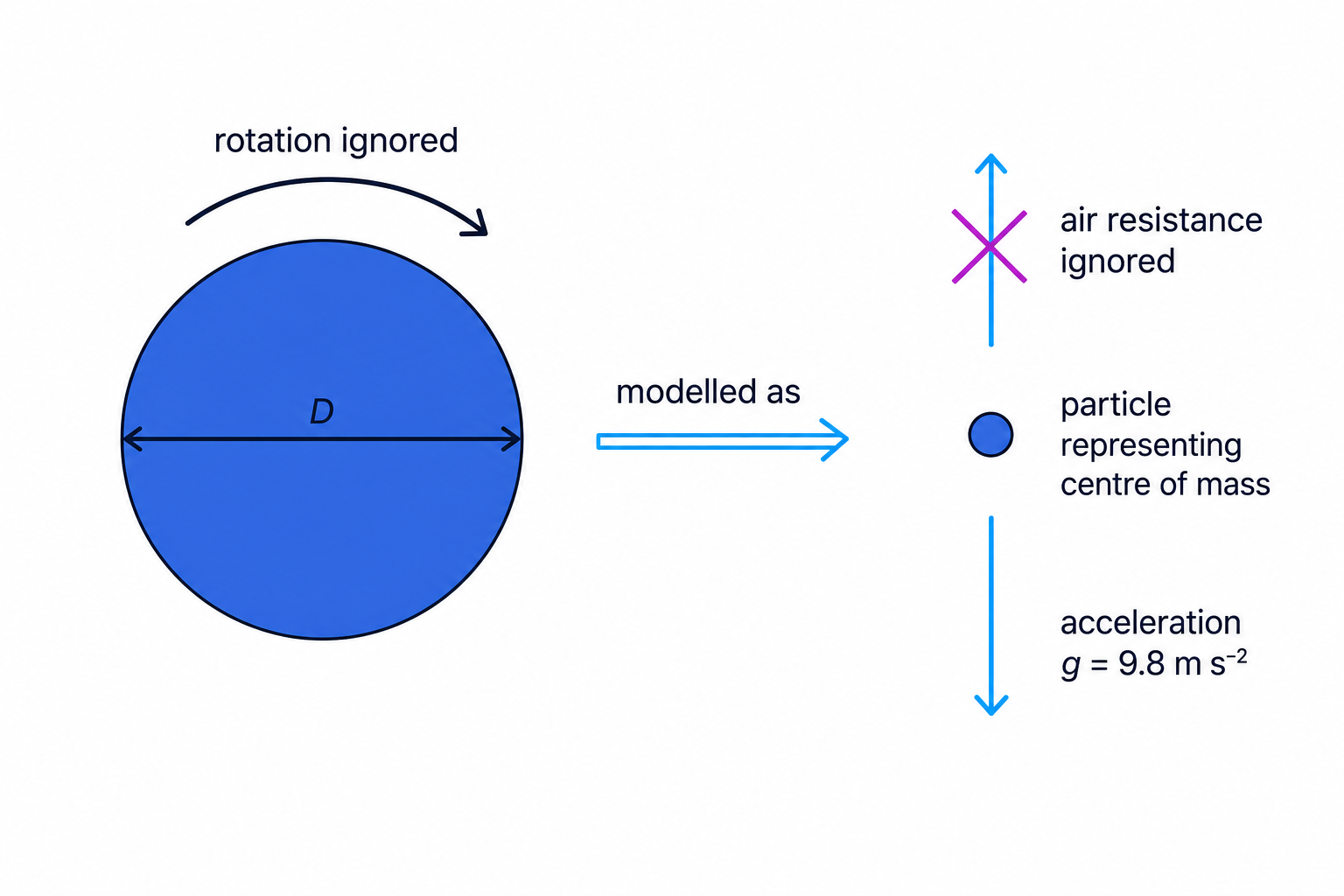
A particle is an object whose mass is treated as if it is concentrated at one point. This does not mean the object is literally tiny; it means its size and shape do not matter for the calculation you are doing.
For example, a car travelling 200 m along a straight road might be modelled as a particle if you only care about its speed and position. But the same car cannot be modelled as a particle if you are calculating whether it tips over.
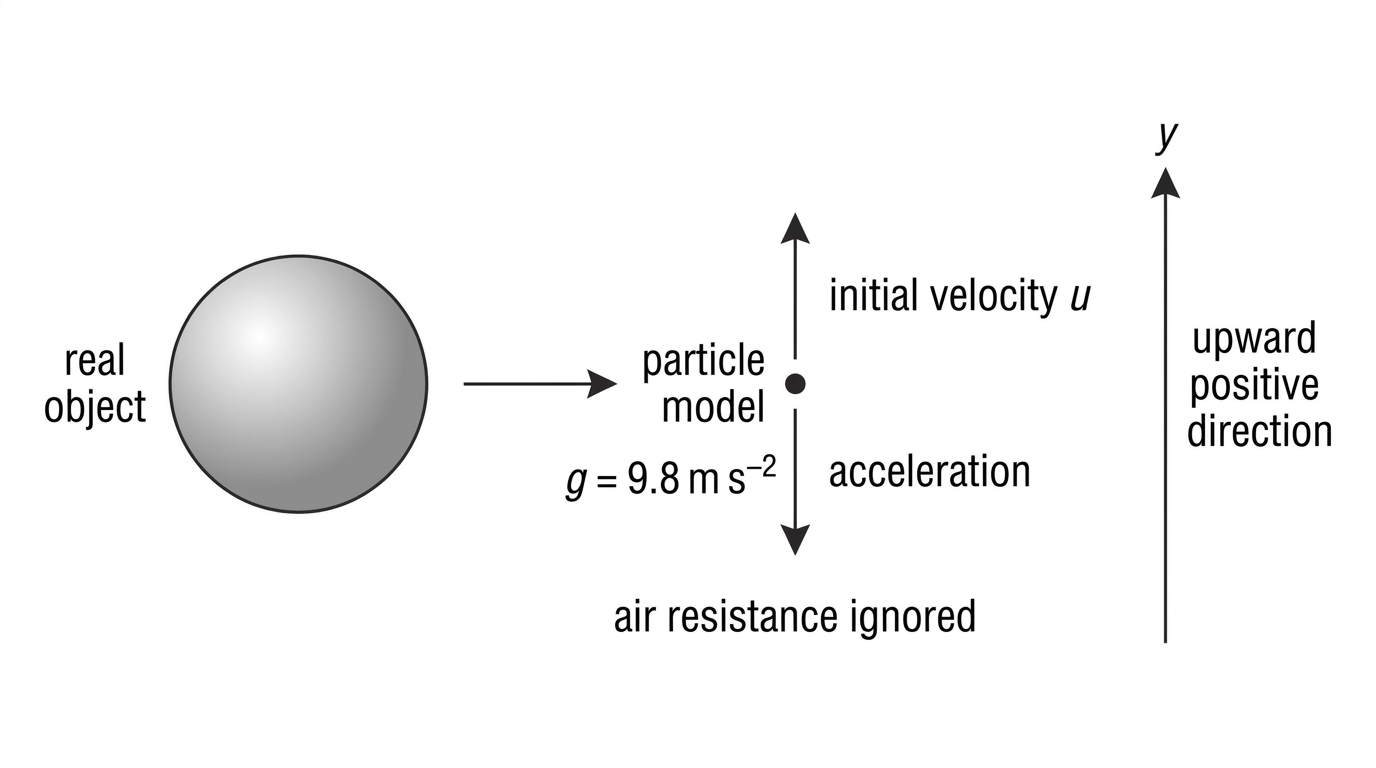
The diagram shows a real object being simplified into a particle model for vertical motion under gravity.
Example
Using the particle assumption
A drone flies along a straight horizontal path. It is modelled as a particle. State one assumption made by this model and give one limitation.
-
The particle model assumes the drone’s mass is concentrated at a single point.
-
This means the drone’s size, shape and rotation are ignored.
-
A limitation is that the model would not describe the drone tilting, spinning, or being affected differently at different parts of its body.
Common Mistake
Particle does not mean weightless
A particle can still have mass and weight. “Particle” only means the object’s size, shape and rotation are ignored.
Constant acceleration and SUVAT
Definition
Constant acceleration
Acceleration is the rate of change of velocity. Constant acceleration means the acceleration does not change during the motion.
When acceleration is constant and motion is in a straight line, you can use the SUVAT equations. The letters stand for:
- sss: displacement
- uuu: initial velocity
- vvv: final velocity
- aaa: acceleration
- ttt: time
The main constant-acceleration equations are:
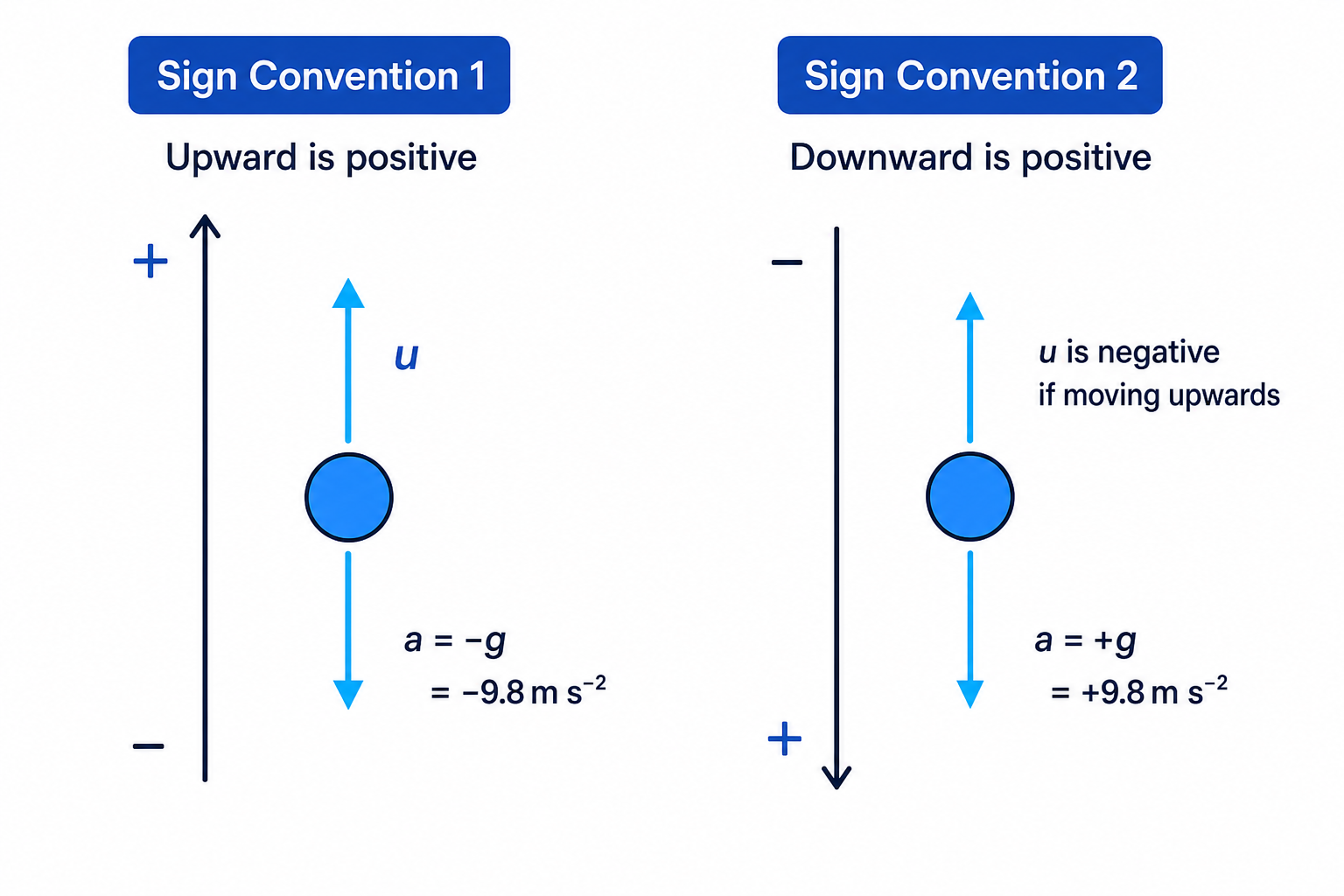
v=u+at,s=ut+12at2,v2=u2+2as,s=12(u+v)tv = u + at,\qquad s = ut + \frac{1}{2}at^2,\qquad v^2 = u^2 + 2as,\qquad s = \frac{1}{2}(u+v)tv=u+at,s=ut+21at2,v2=u2+2as,s=21(u+v)tYou must choose a positive direction before substituting values. For vertical motion, you might choose upwards as positive or downwards as positive — either is fine if you are consistent.
Example
Choosing signs in vertical motion
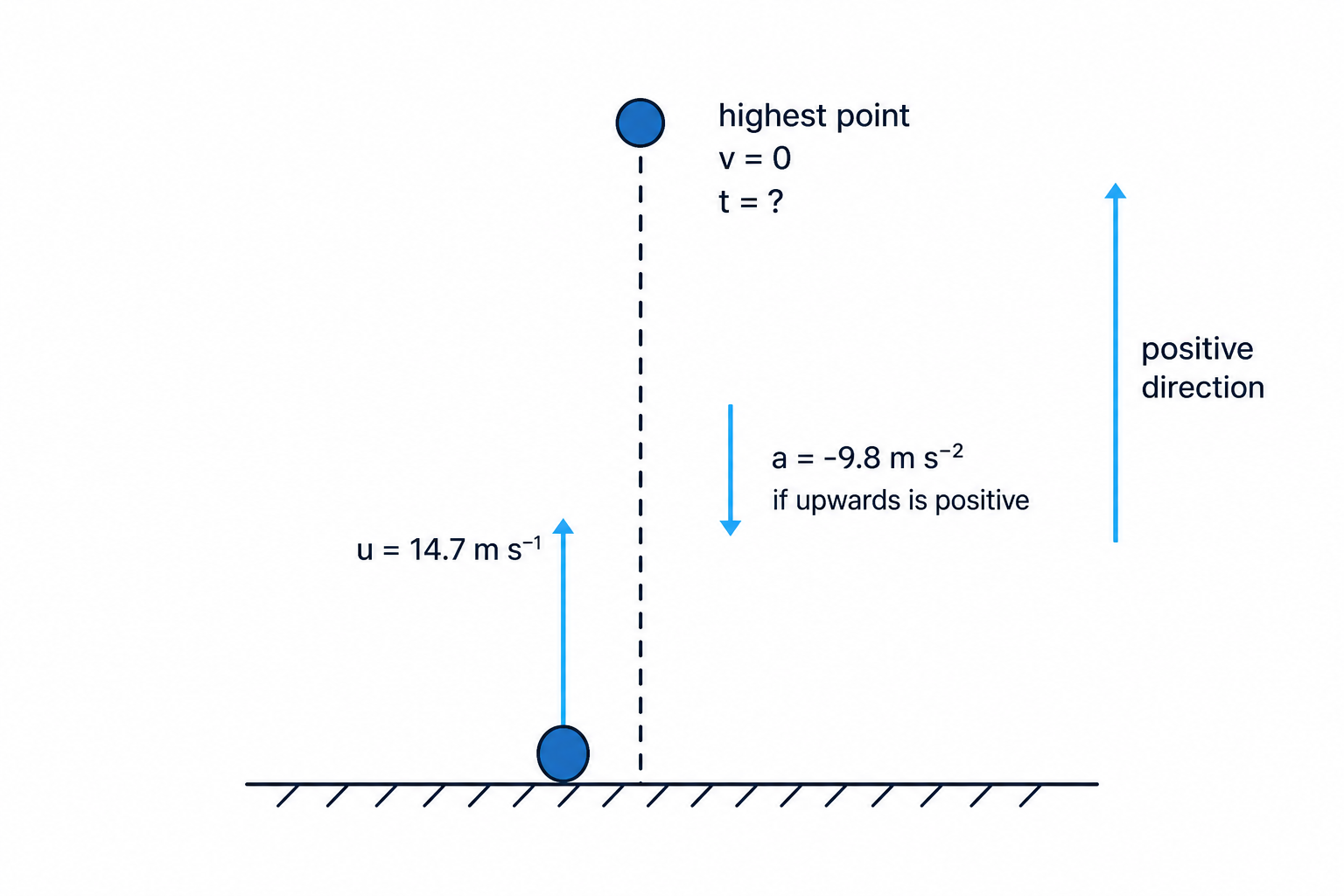
A small ball is thrown vertically upwards at 14.7 m s⁻¹. It is modelled as a particle moving freely under gravity with no air resistance. Find the time taken to reach its highest point.
-
At the highest point, the velocity is zero, so v=0v = 0v=0.
-
Choose upwards as positive. The initial velocity is u=14.7u = 14.7u=14.7 and acceleration is downwards, so a=−9.8a = -9.8a=−9.8.
-
Use v=u+atv = u + atv=u+at:
0=14.7−9.8t9.8t=14.7t=1.5\begin{aligned} 0 &= 14.7 - 9.8t \\ 9.8t &= 14.7 \\ t &= 1.5 \end{aligned}09.8tt=14.7−9.8t=14.7=1.5 -
The time to reach the highest point is 1.5 seconds.
Tip
Sign check
If you choose upwards as positive, gravity has acceleration −9.8 m s−2-9.8\text{ m s}^{-2}−9.8 m s−2. If you choose downwards as positive, gravity has acceleration +9.8 m s−2+9.8\text{ m s}^{-2}+9.8 m s−2.
Gravity and air resistance
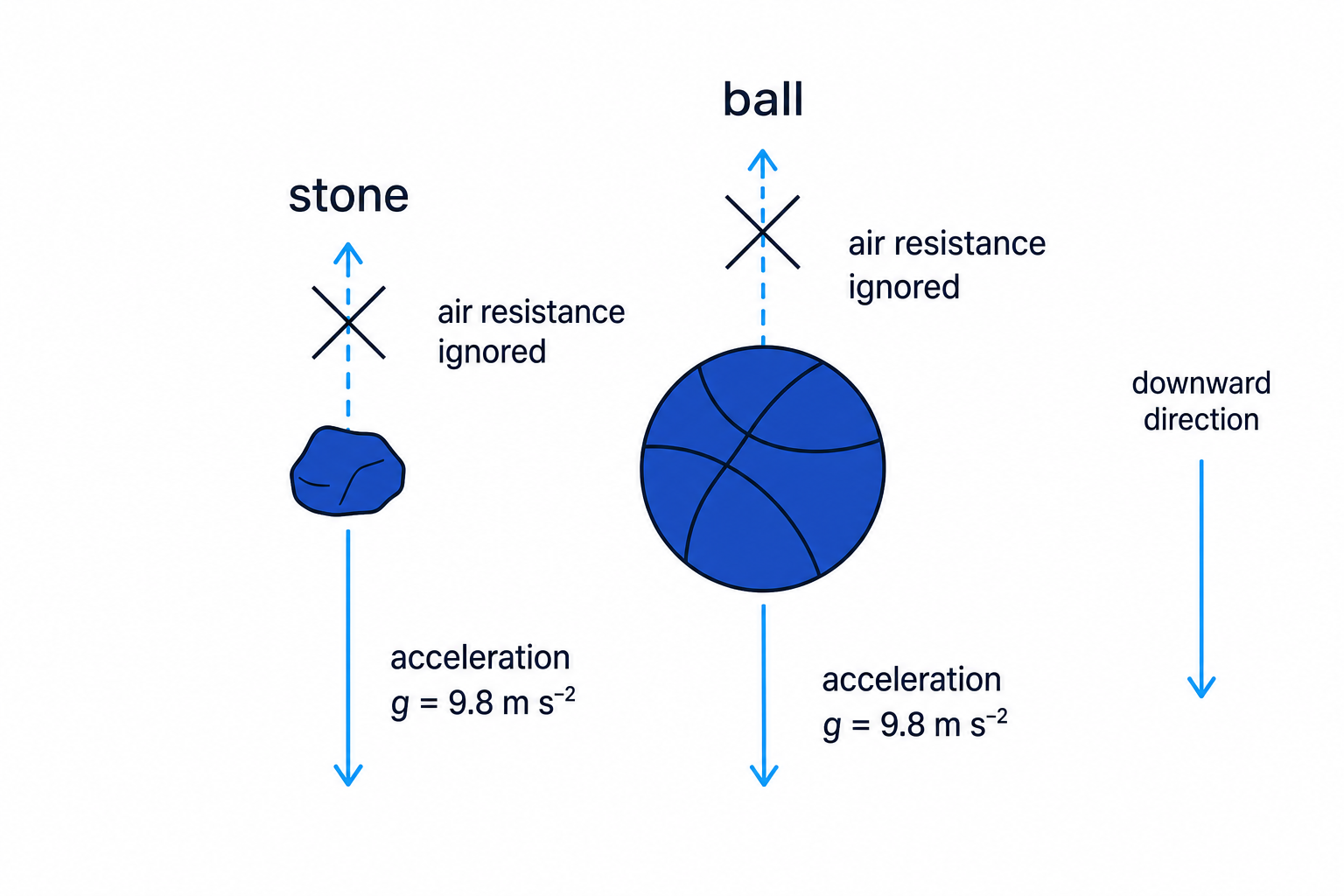
Near the surface of the Earth, Mechanics questions usually take the acceleration due to gravity as constant:
g=9.8 m s−2g = 9.8\text{ m s}^{-2}g=9.8 m s−2This means all freely moving objects accelerate downwards at 9.8 m s⁻², provided air resistance is ignored.
Definition
Air resistance
Air resistance is a force from the air that acts against the motion of an object. If it is modelled as negligible, we ignore it.
Ignoring air resistance is often reasonable for dense, compact objects moving at moderate speeds, such as a small stone. It is often less reasonable for objects with large surface area, such as a parachute, feather or sheet of paper.
Example
Explaining the effect of ignoring air resistance
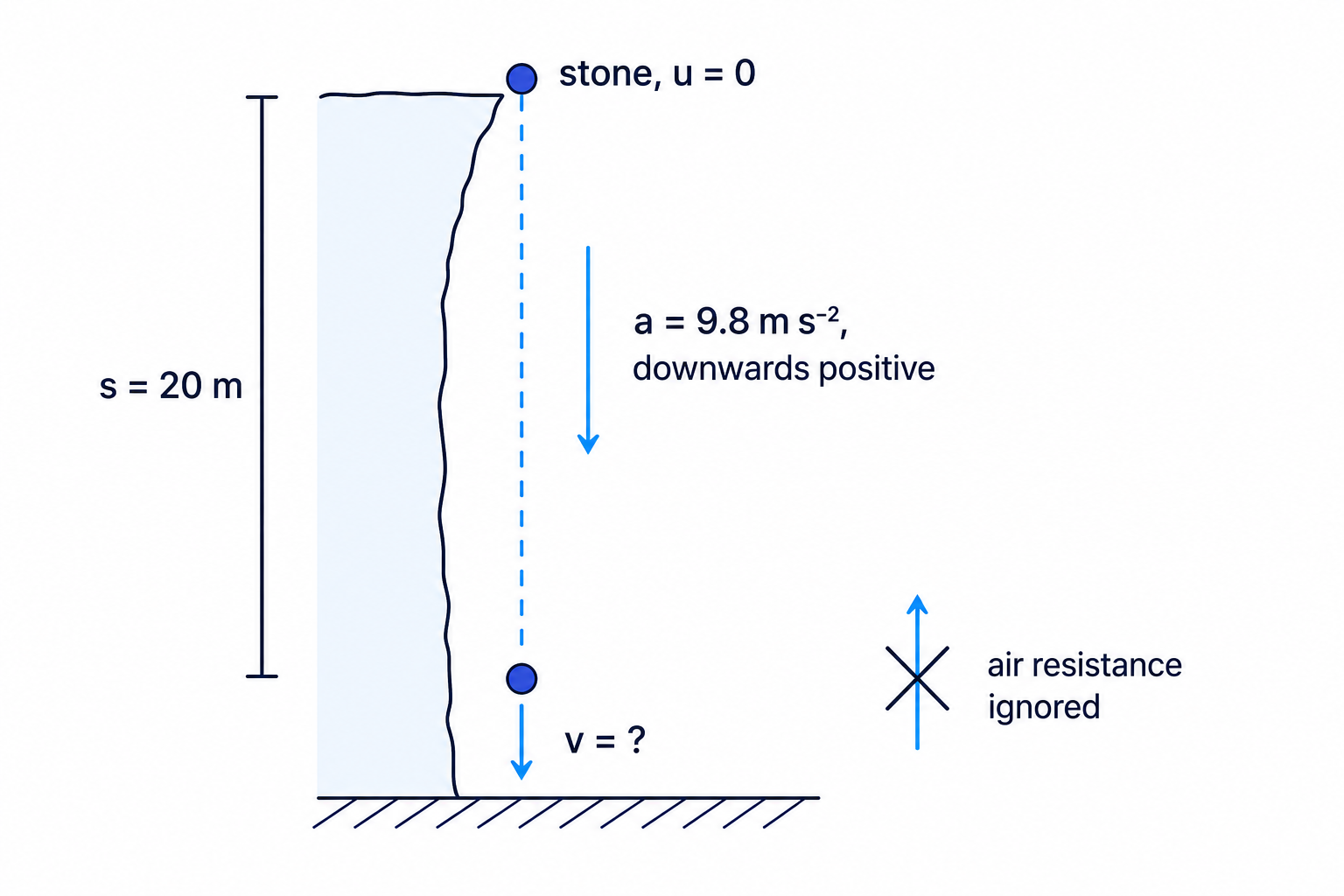
A small stone is dropped from rest from a height of 20 m. It is modelled as a particle falling freely under gravity, with air resistance ignored. Find the speed just before it reaches the ground, and comment on the model.
-
Choose downwards as positive. The stone starts from rest, so u=0u = 0u=0.
-
The displacement is s=20s = 20s=20 and acceleration is a=9.8a = 9.8a=9.8.
-
Use v2=u2+2asv^2 = u^2 + 2asv2=u2+2as:
v2=02+2(9.8)(20)v2=392v=392\begin{aligned} v^2 &= 0^2 + 2(9.8)(20) \\ v^2 &= 392 \\ v &= \sqrt{392} \end{aligned}v2v2v=02+2(9.8)(20)=392=392 -
The speed is about 19.8 m s⁻¹.
-
The model assumes air resistance is negligible. In reality, air resistance would reduce the acceleration slightly, so the actual speed may be a little smaller.
Common Mistake
Forgetting the word freely
If an object moves freely under gravity, the only force being modelled is its weight. That is why its acceleration is ggg downwards.
Smooth, rough, light and inextensible
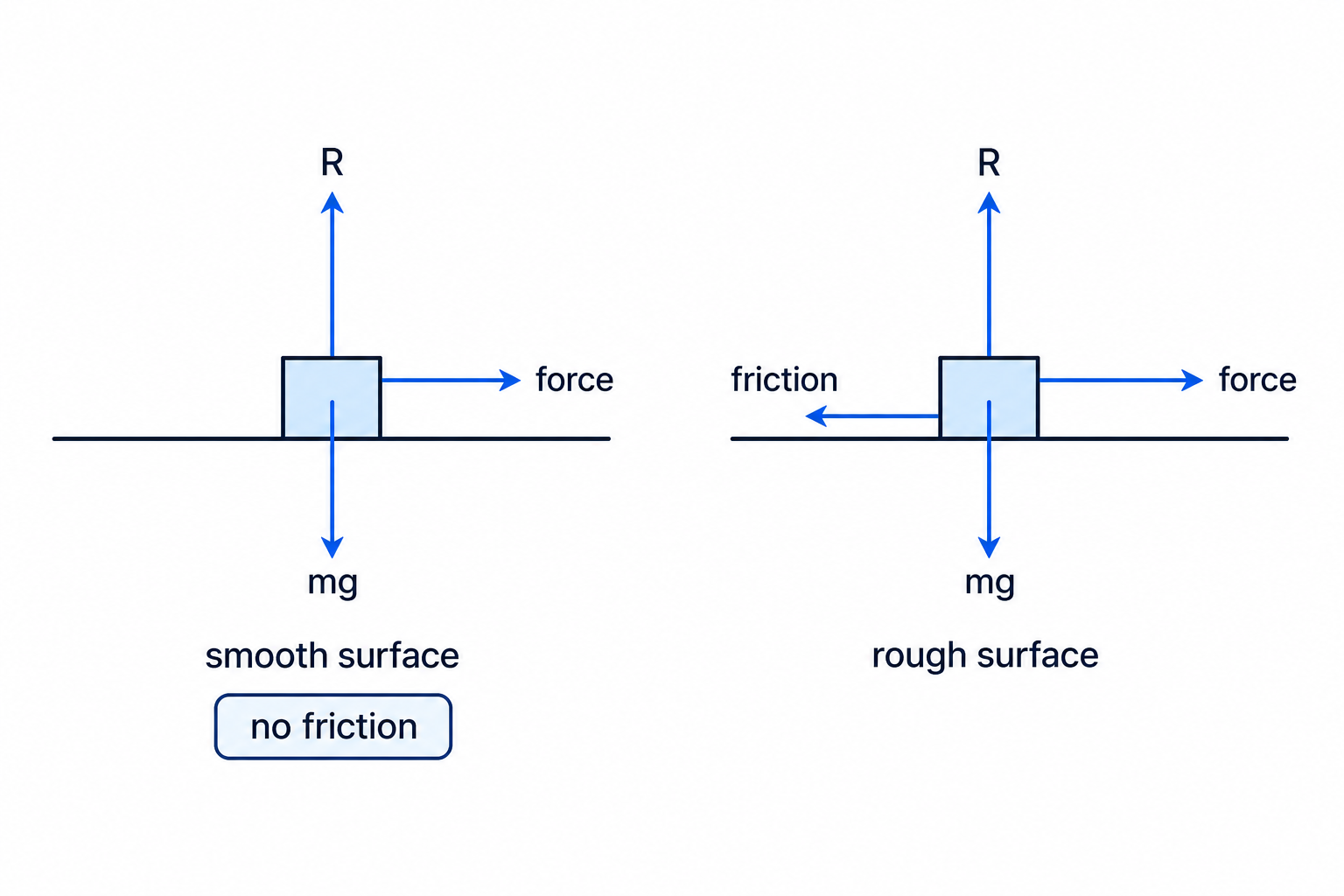
Some modelling words tell you what happens with forces.
Definition
Common mechanics modelling words
- A smooth surface has no friction.
- A rough surface has friction.
- A light object is treated as having zero mass.
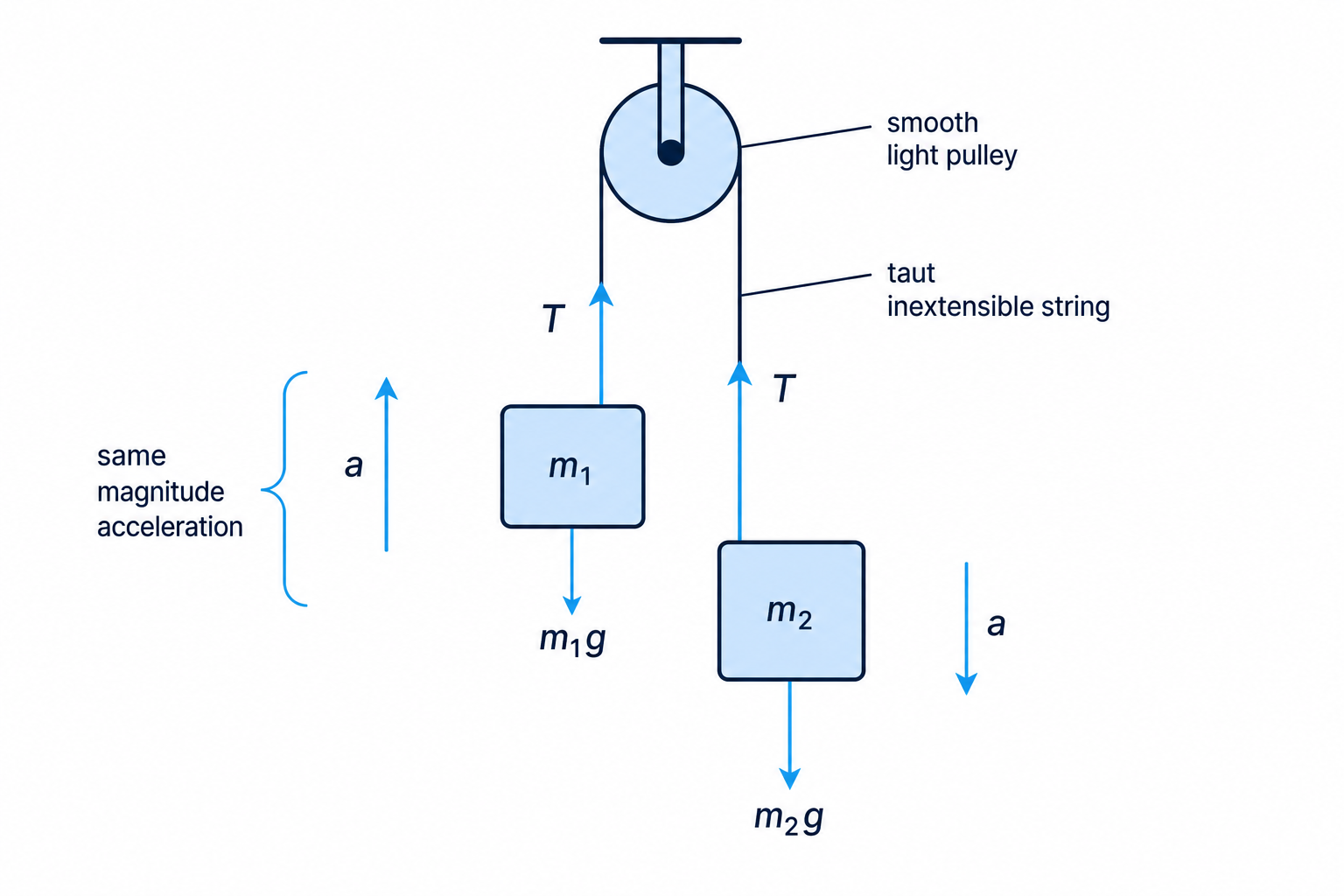
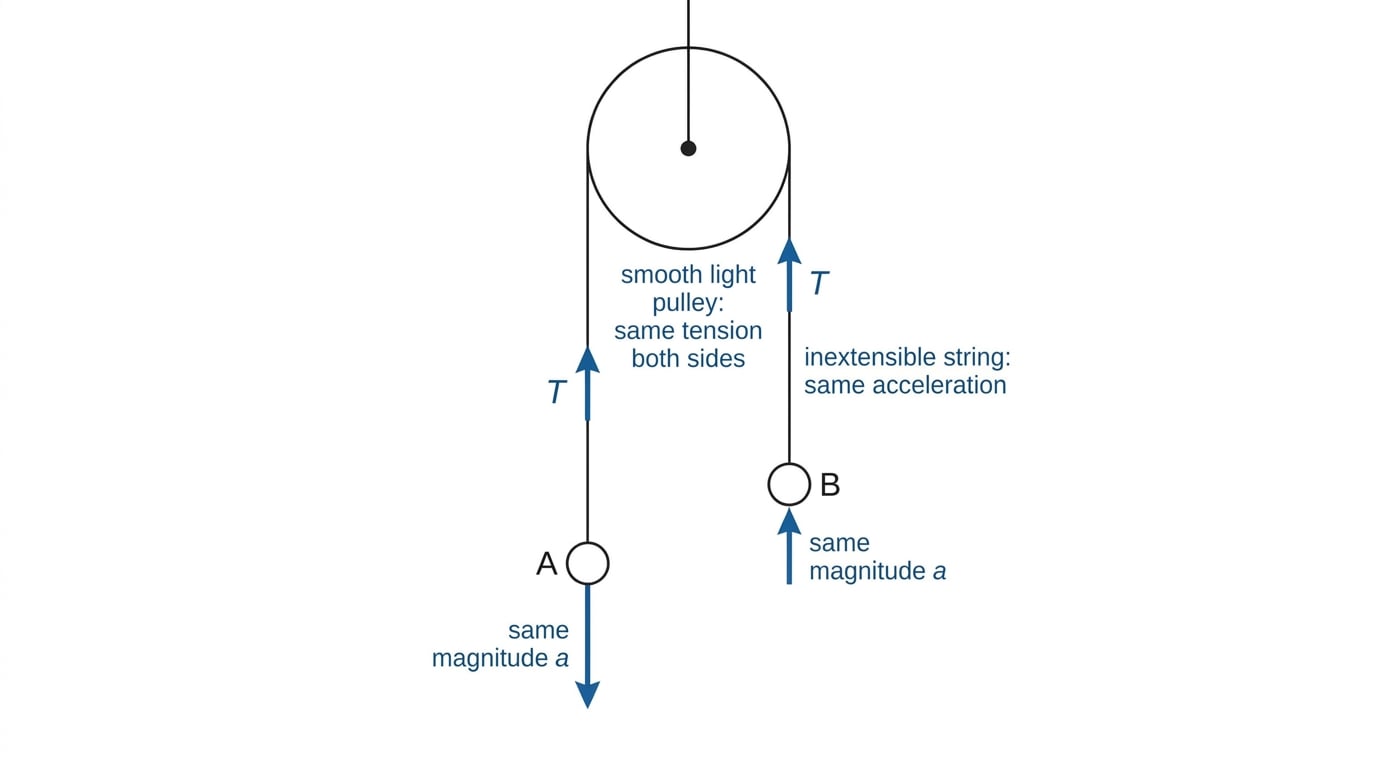
- An inextensible string does not stretch, so connected objects have the same magnitude of acceleration if the string is taut.
- A smooth light pulley has no mass and no friction, so the tension is the same on both sides of the string.
These assumptions are especially useful when objects are connected. If a string stretches, the two objects might not accelerate together. If a pulley has friction or mass, the tension might be different on each side.
Example
Connected particles and modelling assumptions
Two small blocks are connected by a taut inextensible string passing over a smooth light pulley. One block moves downwards and the other moves upwards. State two modelling consequences.
-
Since the string is inextensible and taut, the two blocks have accelerations of the same magnitude.
-
Since the pulley is smooth and light, the tension in the string is the same on both sides of the pulley.
-
Since the blocks are described as small particles, their size and rotation are ignored.
Common Mistake
The string must be taut
The “same acceleration” conclusion for an inextensible string only applies when the string is taut. If the string goes slack, the connected-particle model no longer works in that way.
Rods and light objects
A rod is modelled as a straight, rigid object. Its mass is concentrated along a line, it has no thickness, and it does not bend.
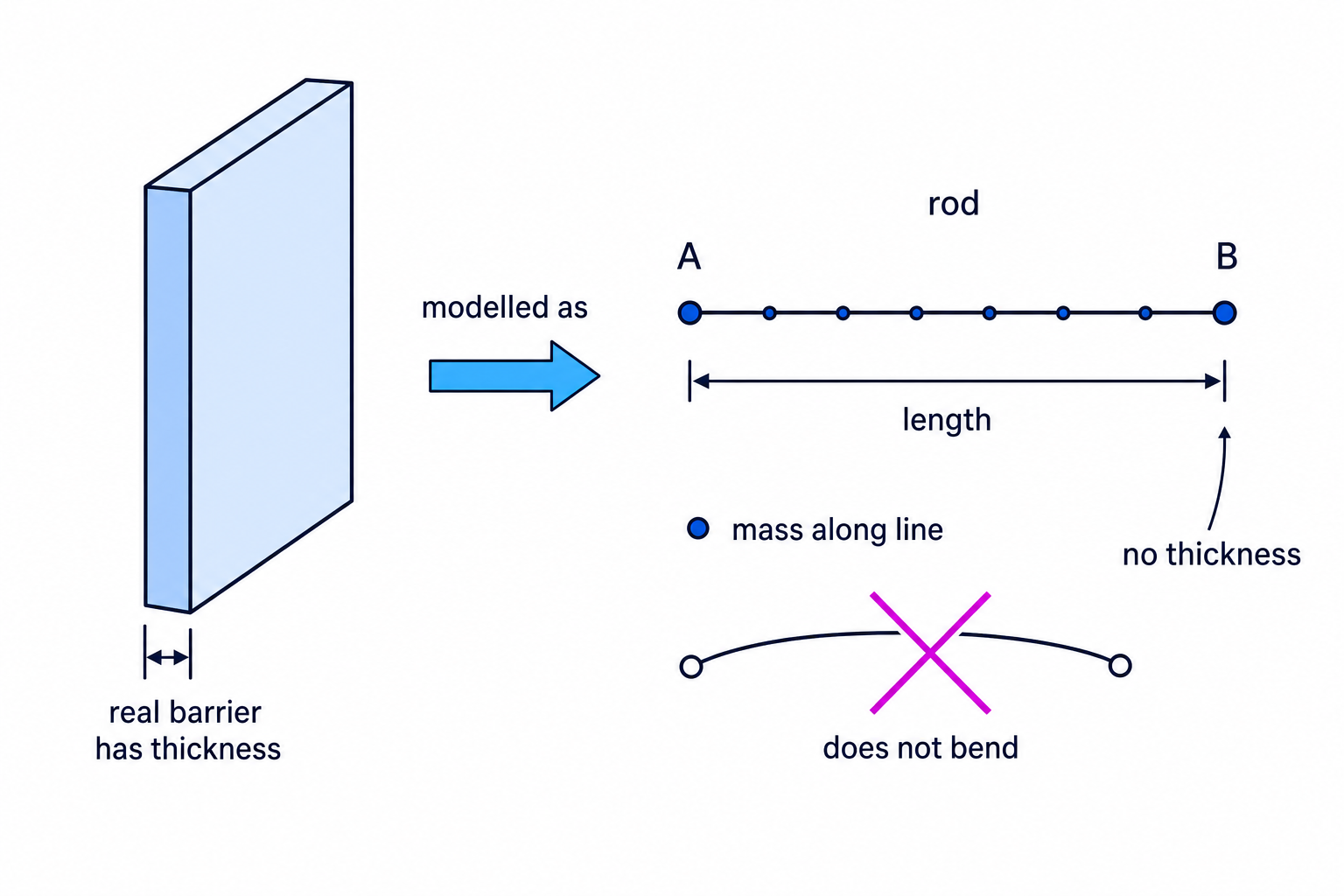
A light object is treated as having zero mass. For example, a light string or light rod has no weight in the model. This does not mean it is invisible or unimportant; it can still transmit forces such as tension or compression.
Example
Recognising rod assumptions
A uniform barrier is modelled as a rod in a mechanics calculation. State two assumptions made by this model.
-
The barrier is assumed to have no thickness, so it is treated as a line segment.
-
The barrier is assumed not to bend, so it remains straight and rigid.
-
If the model also says the rod is light, then its mass and weight are ignored.
Common Mistake
Light does not mean small
“Light” means zero mass in the model. “Small” usually suggests a particle model. They are different assumptions.
How to judge whether a model is suitable
In exam questions, you may be asked whether a model is realistic. A good answer links the assumption to the real situation.
Weak answer: “The model is bad because it is not realistic.”
Better answer: “Ignoring air resistance may be unsuitable because the object has a large surface area, so air resistance could noticeably reduce its acceleration.”
Example
Commenting on suitability
A table tennis ball is thrown vertically upwards and modelled as a particle moving freely under gravity. Give one reason why the model may be unsuitable.
-
The model ignores air resistance.
-
A table tennis ball is light and has a relatively large surface area.
-
Therefore air resistance may be significant, so its acceleration may not remain equal to ggg throughout the motion.
Tip
Use the phrase because
When explaining a limitation, write “This may be unsuitable because...” and link the modelling word to a physical effect.
Exam technique
In the exam
-
Identify the modelling word first: particle, smooth, rough, light, inextensible, or negligible air resistance.
-
Translate it into a consequence: no size, no friction, zero mass, same acceleration, same tension, or acceleration ggg downwards.
-
If asked to criticise the model, name a real-world effect that has been ignored and explain how it could change the motion.
Self review
Check yourself
- If an object is modelled as a particle, what features of the real object are ignored?
- Why does ignoring air resistance help you use the constant-acceleration equations?
- What two conclusions can you make from a taut inextensible string passing over a smooth light pulley?

Recap questions
Test yourself with 5 quick questions on this guide. Answer them all correctly to complete it.
You've reached the end
Test yourself on this topic, or move on to the next guide.
How was this guide?