Question 16
50%A ball A A\,A of mass 1.4 kg rests on a smooth horizontal table. Ball A A\,A is attached to one end of a rope which passes over a pulley fixed to the edge of the table. The other end of the rope is attached to ball B B\,B of mass 1.8 kg which hangs freely below the pulley. The system is released from rest with the string taut, with ball AAA 1.5 m from the pulley and ball BBB 0.6 m above the ground. Ball B B\,B descends, hits the floor and does not rebound. The balls are modelled as particles, the rope as a light inextensible string, and the pulley as small and smooth.
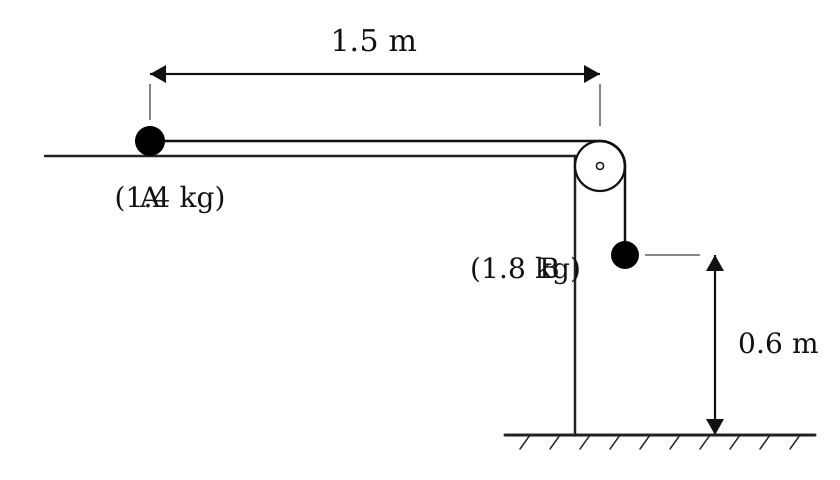
a.[5]
Find the acceleration of B B\,B as it falls.
b.[6]
Find the time taken for A A\,A to reach the pulley from the time the system was released.
c.[1]
State one limitation of the model that will affect your answer to part (a).
Forces and Motion Questions
30 exam-style questions on Edexcel AS Level Maths Forces and Motion, covering 10.1 Force Diagrams, 10.2 Forces as Vectors, 10.3 Forces and Acceleration, 10.4 Motion in 2 Dimensions, 10.5 Connected Particles, and 10.6 Pulleys. Each one has a worked solution and a mark scheme showing where the marks go.