What you'll learn
- How damages compensate for breach of contract.
- How to apply causation, remoteness, mitigation and liquidated damages rules.
- When courts may grant specific performance or injunctions.
- The key Consumer Rights Act 2015 remedies for faulty goods and poor services.
The big picture: what is a remedy?
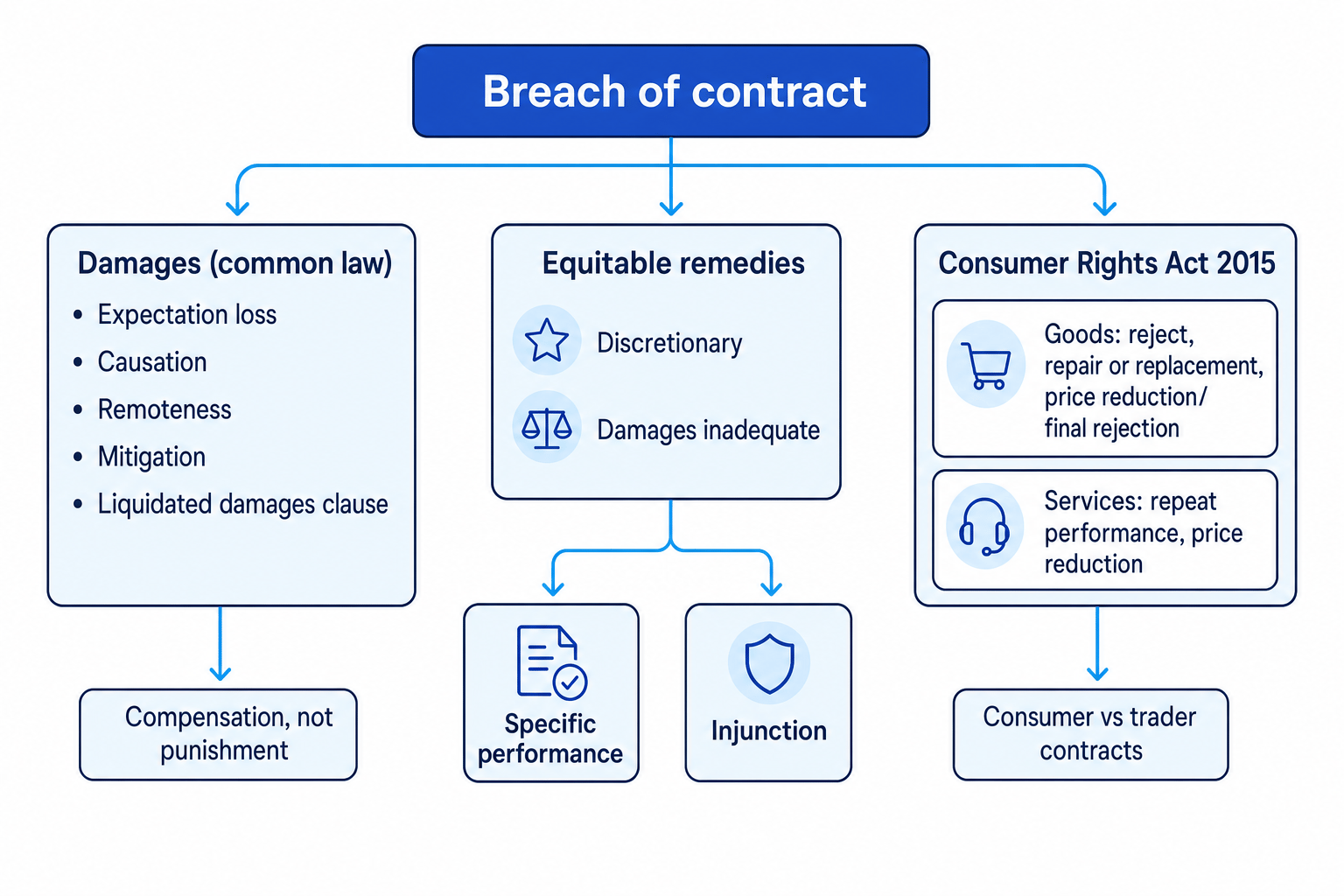
A breach of contract is a failure to perform a contractual promise without lawful excuse. Once breach is proved, the court asks: what legal response should follow?
A remedy is that legal response. In contract, the main remedies are money compensation, equitable court orders, and statutory consumer remedies.
Remedy
A remedy is the legal solution granted after a right has been breached, such as damages, specific performance, an injunction, rejection of goods, or a price reduction.
Damages: the normal remedy
Damages are a sum of money awarded by the court. They are a common law remedy, meaning a remedy developed by the courts rather than by equity or statute.
The basic aim is compensation, not punishment. In Robinson v Harman (1848), the defendant failed to grant a lease; the principle is that damages should put the claimant, so far as money can, in the position they would have been in if the contract had been performed.
This is called protecting the claimant’s expectation interest: the benefit they expected from the contract.
Compensation, not punishment
Contract damages usually aim to compensate the claimant for the value of the promised performance, not to punish the defendant for breaking the contract.
Basis for a claim in damages
If breach is proved, damages are generally available as of right. If no real loss is proved, the claimant may receive nominal damages, a small sum recognising that a legal right was breached.
Sometimes the claimant claims reliance loss, meaning wasted expenditure incurred because they relied on the contract. In Anglia Television v Reed (1972), an actor pulled out of a TV production; the company recovered wasted pre-production expenses because the profits were too uncertain to prove.
Special situations
Some losses are harder to measure.
- Non-pecuniary loss means non-financial loss, such as distress or disappointment. It is not usually recoverable: Addis v Gramophone (1909) involved wrongful dismissal, and damages for injured feelings were refused.
- An exception exists where pleasure, relaxation or peace of mind is an important object of the contract. In Jarvis v Swan Tours (1973), a disappointing holiday led to damages for loss of enjoyment.
- In Ruxley Electronics v Forsyth (1995), a swimming pool was built shallower than agreed; rebuilding it would be disproportionate, so the claimant received damages for loss of amenity, meaning loss of enjoyment or satisfaction.
Choosing the measure of damages
A builder installs a garden room slightly smaller than promised. Rebuilding it would cost £40,000, but the difference in market value is tiny and the room is still usable.
- Identify the issue: the claimant wants the benefit of the bargain, but the court must choose a fair measure of loss.
- Apply Robinson v Harman (1848): damages should reflect the position the claimant would have been in if the contract had been performed.
- Compare with Ruxley Electronics v Forsyth (1995): if the cost of cure is wildly disproportionate to the practical benefit, the court may refuse that amount.
- Conclude that the claimant is unlikely to recover £40,000, but may recover a smaller amount for loss of amenity.
Causation and remoteness of damage
Causation
Causation asks whether the breach actually caused the loss. If the loss would have happened anyway, the claimant cannot recover it.
In The Mihalis Angelos (1971), charterers wrongfully cancelled a ship contract, but the shipowner’s loss was limited because the contract would probably have been cancelled lawfully soon afterwards; damages reflect loss actually caused by the breach.
Remoteness
Remoteness is a legal limit on recoverable loss. Even if the breach caused the loss, it may be too unusual or unforeseeable to claim.
The main rule is from Hadley v Baxendale (1854). A mill’s broken shaft was delayed in delivery, causing lost profits. The carrier did not know the mill would be shut until the shaft returned. The principle is that loss is recoverable if it:
- arises naturally in the ordinary course of things; or
- was within the parties’ reasonable contemplation because special circumstances were known when the contract was made.
In Victoria Laundry v Newman Industries (1949), delayed delivery of a boiler meant ordinary lost profits were recoverable, but profits from a special lucrative dyeing contract were not, because the defendant did not know about it.
Causation is not remoteness
Do not merge the two tests. Causation asks whether the breach produced the loss. Remoteness asks whether that type of loss is legally recoverable.
Mitigation of loss
Mitigation means the claimant must take reasonable steps to reduce their loss. They cannot recover losses they could reasonably have avoided.
In British Westinghouse v Underground Electric Railways (1912), replacement turbines reduced the claimant’s losses; the benefit of reasonable mitigation had to be taken into account. In Payzu v Saunders (1919), a buyer should have accepted a reasonable alternative offer from the seller, even though the seller was in breach.
Applying causation, remoteness and mitigation
A machine is delivered five days late. The factory loses ordinary production profit. It also loses a secret one-off export contract. A hire machine was available after two days for £400, but the factory did not hire it.
- Apply causation: the late delivery caused the factory to lose production during the delay.
- Apply Hadley v Baxendale (1854): ordinary production losses are likely to arise naturally, so they are recoverable.
- Apply Victoria Laundry v Newman Industries (1949): the secret export profit is too remote unless the supplier knew about that special contract when the contract was made.
- Apply mitigation: under British Westinghouse (1912), the factory should take reasonable steps to reduce loss, so it may be limited to losses before the hire machine was available plus the reasonable £400 hire cost.
Damages checklist
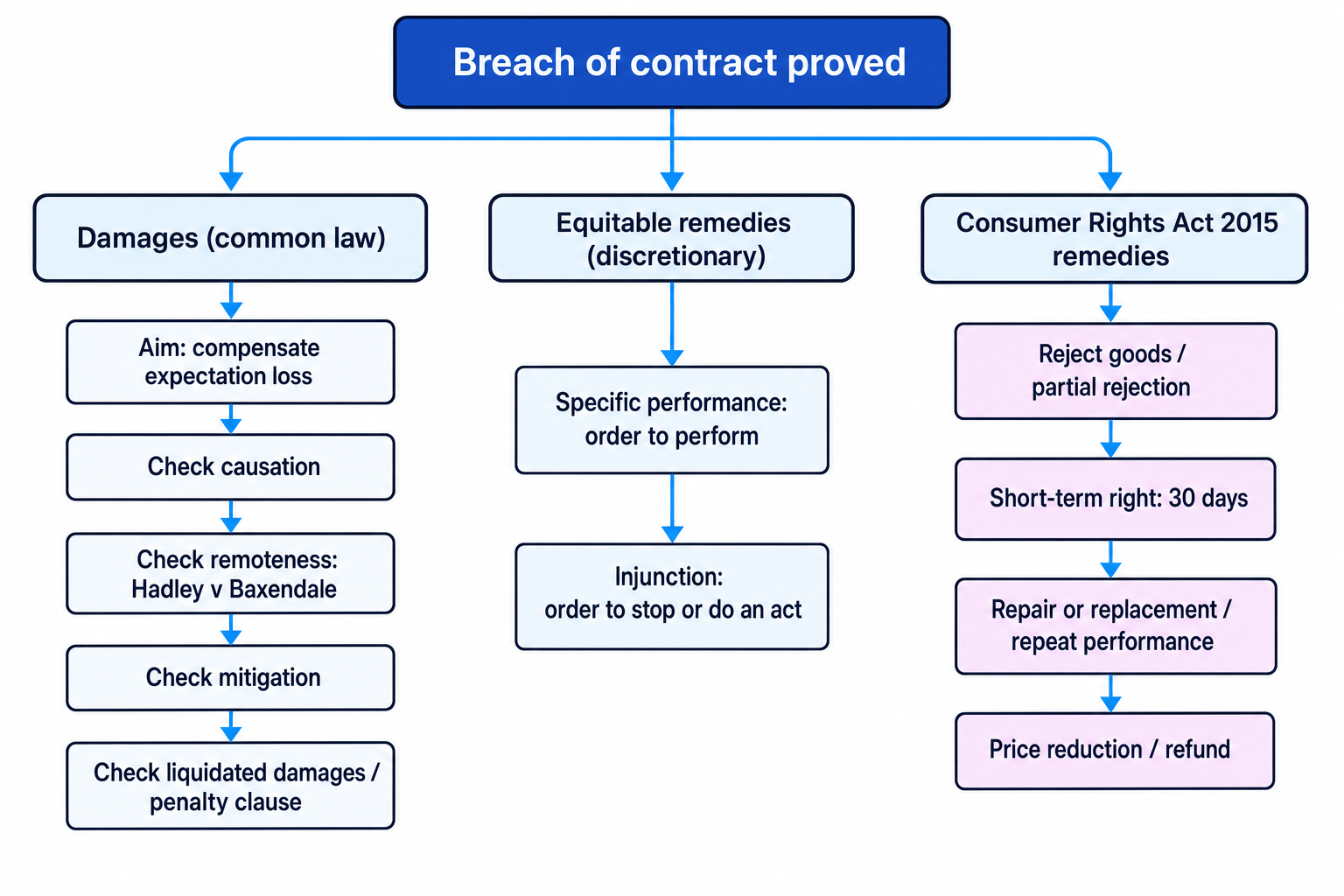
For a problem question, work through: breach → measure of loss → causation → remoteness → mitigation → any liquidated damages clause.
Liquidated damages clauses
A liquidated damages clause is a contract term fixing in advance the sum payable if breach occurs.
A penalty clause is a clause that imposes a punishment rather than a legitimate agreed remedy. Penalty clauses are unenforceable.
Older law in Dunlop Pneumatic Tyre v New Garage (1915) asked whether the sum was a genuine pre-estimate of loss. The modern approach from Cavendish Square Holding BV v Makdessi; ParkingEye v Beavis (2015) asks whether the clause protects a legitimate interest and is not out of all proportion to that interest. In ParkingEye, an £85 parking charge was enforceable because it helped manage parking spaces and was not disproportionate.
Assessing a liquidated damages clause
A venue contract says late cancellation within 48 hours requires payment of £1,000. Another term says returning the venue keys ten minutes late requires payment of £20,000.
- Identify the purpose of each clause: the £1,000 term protects the venue against lost bookings, staffing and wasted preparation.
- Apply Cavendish; ParkingEye (2015): the £1,000 sum is likely to protect a legitimate interest and be proportionate.
- Compare the £20,000 key term: it is far beyond any likely loss or legitimate interest.
- Conclude that the cancellation term is likely enforceable, but the key term is likely an unenforceable penalty.
Equitable remedies
Equitable remedies are discretionary court orders developed by equity. They are not automatic. The court considers whether damages are inadequate, whether the claimant acted fairly, whether there was delay, and whether the order would be oppressive or require constant supervision.
Equitable remedy
An equitable remedy is a discretionary remedy granted by the court where money alone may not achieve justice, such as specific performance or an injunction.
Specific performance
Specific performance is a court order requiring a party to carry out their contractual promise.
It is most likely where the subject matter is unique, such as land or rare goods. In Beswick v Beswick (1968), specific performance was ordered to enforce a promise to pay an annuity. In Sky Petroleum v VIP Petroleum (1974), the court ordered fuel supply during a petrol shortage because damages were inadequate.
It will not usually be ordered for personal service contracts or contracts needing constant supervision. In Co-operative Insurance v Argyll Stores (1997), the court refused to force a supermarket to stay open because it would require ongoing supervision and risk oppression.
Injunctions
An injunction is a court order requiring someone to do or stop doing something. A prohibitory injunction orders a person not to act. A mandatory injunction orders a positive act.
In contract, injunctions often enforce negative promises. In Lumley v Wagner (1852), an opera singer was restrained from singing elsewhere. But courts avoid indirectly forcing personal service: in Page One Records v Britton (1968), an injunction against the Troggs was refused because it would effectively force them to continue a personal working relationship.
Equity is discretionary
Even if breach is clear, do not say the claimant “will get” specific performance or an injunction. Say the court may grant it if damages are inadequate and the equitable factors support the order.
Choosing an equitable remedy
Ravi contracts to buy a rare painting. The seller refuses to transfer it and plans to sell it to someone else.
- Consider damages: because the painting is unique, money may not fully replace the promised performance.
- Consider specific performance: an order transferring the painting is realistic and does not require constant supervision, unlike Co-operative Insurance v Argyll Stores (1997).
- Consider an injunction: a temporary order preventing sale to anyone else could preserve the painting until the dispute is resolved.
- Conclude that specific performance and/or a prohibitory injunction may be appropriate.
Consumer remedies under the Consumer Rights Act 2015
The Consumer Rights Act 2015 gives remedies where a consumer — an individual acting mainly outside business purposes — contracts with a trader.
For goods, key rights include:
- s9 Consumer Rights Act 2015: goods must be of satisfactory quality.
- s10 Consumer Rights Act 2015: goods must be fit for a particular purpose made known to the trader.
- s11 Consumer Rights Act 2015: goods must match their description.
If these rights are breached, the consumer may use statutory remedies.
Under s20 Consumer Rights Act 2015, the consumer may reject goods. Under s21, this can include partial rejection, meaning rejecting some goods while keeping others. The right is exercised by clearly indicating to the trader that the goods are rejected and the contract is treated as at an end for those goods.
Under s22, the short-term right to reject usually lasts 30 days from delivery, ownership and any required installation being complete.
For goods, repair or replacement is available under s23, and price reduction or final rejection may follow under s24.
For services, if the trader fails to use reasonable care and skill under s49, the consumer may require repeat performance under s55 — in plain English, having the work redone. If that is impossible or not done within a reasonable time and without significant inconvenience, the consumer may claim a price reduction under s56.
Choosing the Consumer Rights Act remedy
Maya buys four dining chairs from a furniture shop. On delivery, two are cracked. Ten days later, she emails the shop saying she rejects the two cracked chairs and wants to keep the other two.
- Classify the contract: Maya is a consumer, the shop is a trader, and the chairs are goods under the Consumer Rights Act 2015.
- Apply s9 Consumer Rights Act 2015: cracked chairs are unlikely to be of satisfactory quality.
- Apply ss20–22: Maya is within the 30-day short-term rejection period and can clearly exercise rejection by email.
- Apply s21: partial rejection allows her to reject the faulty chairs while keeping the others, so she should receive an appropriate refund.
AO3 evaluation points
Damages are commercially useful because they are predictable and usually leave parties free to break a contract if they pay compensation. However, money may under-compensate where the contract involved enjoyment, peace of mind or something unique.
The rules on remoteness and mitigation prevent defendants being liable for unlimited losses, which supports certainty. The disadvantage is that a claimant may suffer real loss but still be unable to recover it if the loss was not foreseeable or could have been avoided.
Liquidated damages clauses promote certainty and reduce litigation, but the penalty rule can be difficult to apply after Cavendish; ParkingEye (2015) because “legitimate interest” and proportionality are flexible ideas.
Equitable remedies fill gaps where damages are inadequate, but discretion can make outcomes less predictable. The Consumer Rights Act 2015 gives clear rights, especially the 30-day rejection period, but consumers may still struggle if traders dispute the fault or delay refunds.
In the exam
- Start with the remedy route: common law damages first, then equitable remedies if money is inadequate, and Consumer Rights Act remedies for consumer contracts.
- For damages, apply Robinson v Harman (1848), then work through causation, Hadley v Baxendale (1854) remoteness, mitigation, and any liquidated damages clause.
- Use authority precisely: name the case or statutory section, apply it to the facts, and finish each issue with a clear likely conclusion.
Check yourself
- What are the two limbs of the rule in Hadley v Baxendale (1854)?
- Why might a court refuse specific performance even where breach is proved?
- How does a consumer exercise the short-term right to reject goods, and what is the usual time limit?