

What you'll learn
- Which civil cases go to the County Court and which go to the High Court.
- How a civil claim is prepared before trial and allocated to the small claims, fast track or multi-track.
- The main civil appeal routes and the reasons a party may appeal.
- How employment tribunals and ADR methods such as negotiation, mediation, conciliation and arbitration work.
The big picture: what is a civil dispute?
A civil dispute is a legal disagreement between individuals, businesses or organisations. The person bringing the case is the claimant. The person or organisation defending the case is the defendant.
Civil cases usually involve a remedy such as damages: money awarded to compensate for loss. They are different from criminal cases, where the state prosecutes an accused person and the focus is punishment.
Jurisdiction
Jurisdiction means the legal power of a court or tribunal to hear a particular type of case.
Civil procedure is about route choice
In this topic, you are not mainly learning “who is right”. You are learning where the dispute should go, how it is managed, and whether court or ADR is the better way to resolve it.
County Court and High Court jurisdictions
The County Court
The County Court deals with most ordinary civil claims in England and Wales. This includes many claims in contract, negligence, debt, consumer disputes, personal injury, housing and possession matters.
County Court cases are usually heard by District Judges or Circuit Judges. The County Court is designed to handle a large volume of civil disputes, especially lower-value and less complex claims.
The High Court
The High Court hears more serious, complex or high-value civil cases. It has three divisions.
| High Court division | Main jurisdiction |
|---|---|
| King’s Bench Division | Contract and tort claims, personal injury, negligence, defamation, commercial disputes and some public-law matters through the Administrative Court |
| Chancery Division | Property, trusts, company law, insolvency, intellectual property and complex financial disputes |
| Family Division | Family cases such as divorce, children disputes and some serious medical treatment issues |
As a broad guide, High Court cases are often high-value or legally complex. Many ordinary civil claims are better suited to the County Court.
Thinking value is the only factor
The amount of money claimed matters, but it is not the only issue. Complexity, importance, specialist subject matter and the need for High Court expertise can also affect where a case belongs.
Pre-trial procedure: before the case reaches trial
Civil cases are governed mainly by the Civil Procedure Rules 1998, often called the CPR. The CPR’s overriding objective is to deal with cases justly and at proportionate cost.
Pre-action protocol
A pre-action protocol is a set of steps parties should take before starting a court claim, such as exchanging information, setting out the dispute clearly and trying to settle.
A typical civil claim develops like this:
- The claimant follows any relevant pre-action protocol.
- The claimant issues a claim form, which starts proceedings.
- The defendant files a defence if they dispute the claim.
- Both sides complete a directions questionnaire, giving information about value, complexity, witnesses and likely trial length.
- The court allocates the case to one of the three civil tracks.
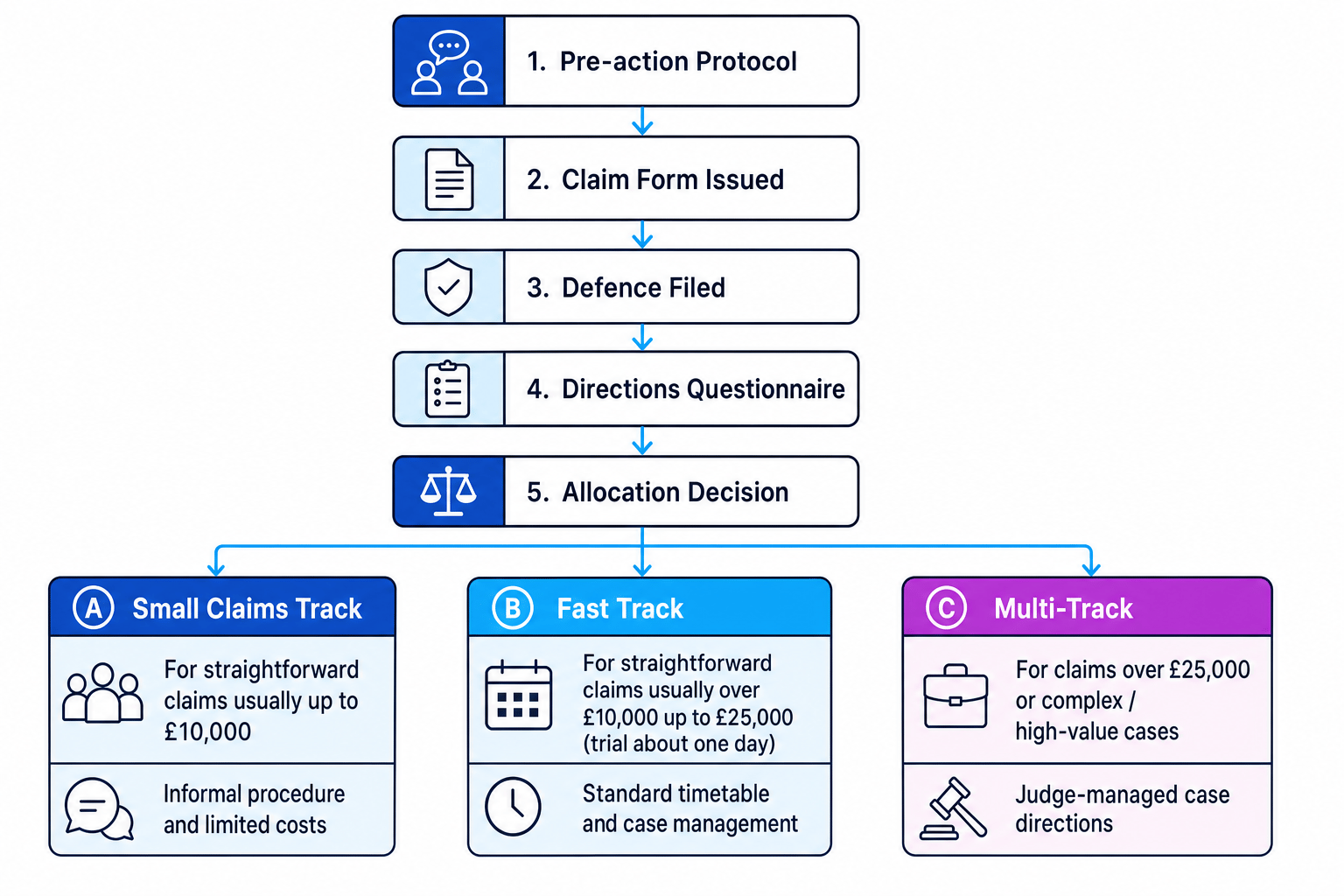
The three civil tracks
Small claims track
The small claims track is for straightforward lower-value claims, usually up to £10,000. It is relatively informal, and legal costs are usually limited. This helps ordinary people bring or defend smaller claims without being overwhelmed by legal expense.
Fast track
The fast track is usually for straightforward claims worth more than £10,000 and up to £25,000. Trials are expected to be fairly short, often around one day, with a more structured timetable than small claims.
Multi-track
The multi-track is for claims over £25,000 or cases that are complex, important or likely to require detailed case management. A judge gives tailored directions to manage evidence, experts, disclosure and trial preparation.
Allocating a civil claim to a track
A customer sues a kitchen company for £18,000 after an installation goes wrong. The facts are disputed, but the case is not technically complex and the trial should last one day.
- The claim is above the usual small claims limit of £10,000, so the small claims track is unlikely.
- The value is within the usual fast track range: more than £10,000 and up to £25,000.
- The likely trial length is short and the dispute is not especially complex, which supports fast track allocation.
- The most suitable track is therefore the fast track.
Appeals and appellate courts
An appeal is an application to a higher court asking it to review a decision made by a lower court. An appeal is not normally a full rehearing. The appellant must usually show a proper reason.
Grounds of appeal
Grounds of appeal are the legal reasons why a decision should be challenged, such as an error of law, a serious procedural irregularity, or a decision that was plainly wrong.
Common reasons to appeal include:
- the judge applied the wrong legal rule;
- the procedure was unfair;
- important evidence was wrongly admitted or excluded;
- the judge reached a conclusion that was not properly supported by the evidence.
Permission to appeal is usually required. This prevents weak appeals being used simply because one side is unhappy with the result.
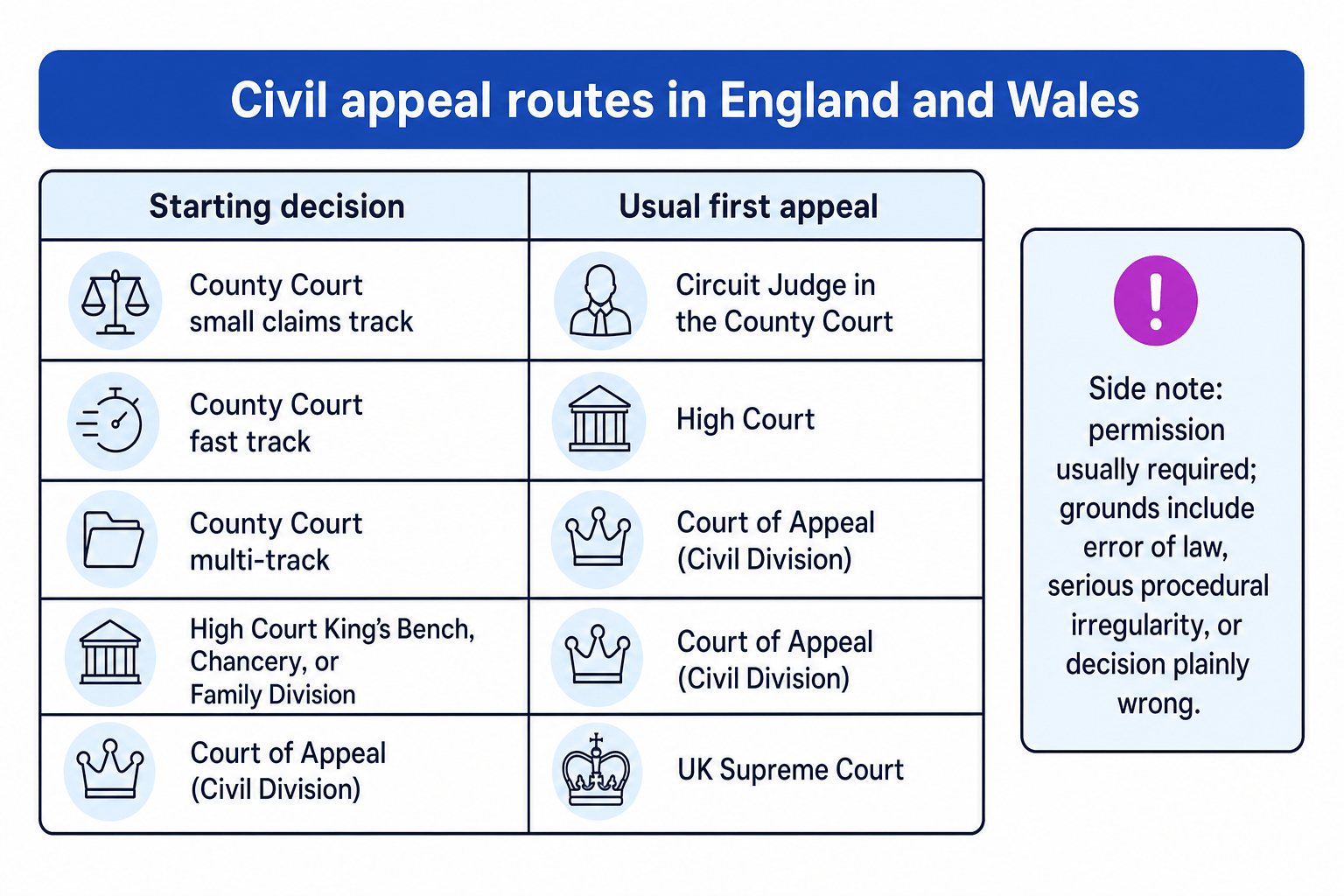
Usual civil appeal routes
For OCR, learn the usual first appeal route from each track:
| Starting point | Usual first appeal |
|---|---|
| County Court small claims track | Circuit Judge in the County Court |
| County Court fast track | High Court |
| County Court multi-track | Court of Appeal (Civil Division) |
| High Court | Court of Appeal (Civil Division) |
| Court of Appeal (Civil Division) | UK Supreme Court |
Choosing the correct appeal route
A claimant loses a fast track claim in the County Court and argues that the judge applied the wrong legal test.
- The decision came from the fast track in the County Court, so the usual first appeal route is to the High Court.
- The complaint is not simply “I lost”; it is that the judge used the wrong legal test, which is an alleged error of law.
- The claimant would usually need permission to appeal and would argue that the error affected the outcome.
- The correct first appeal court is therefore the High Court.
Employment tribunals
A tribunal is a specialist legal body that deals with particular types of disputes. An employment tribunal hears disputes between employers and workers or employees.
Employment tribunals commonly deal with:
- unfair dismissal;
- discrimination;
- unpaid wages;
- redundancy pay;
- breach of employment rights.
Before most employment tribunal claims, the claimant must contact ACAS for Early Conciliation. ACAS is the Advisory, Conciliation and Arbitration Service. It tries to help the parties settle without a full hearing. If settlement fails, ACAS issues a certificate and the claimant can proceed.
Tribunal claims are usually started using an ET1 claim form. The employer responds using an ET3. Cases may involve a preliminary hearing, then a final hearing before an employment judge, sometimes with lay members who bring workplace experience.
Remember ACAS before tribunal
For employment disputes, think: ACAS first, tribunal second. Early Conciliation is a key feature of how employment tribunals work.
Identifying the employment tribunal route
An employee says she was dismissed for whistleblowing and has not been paid her final wages.
- The dispute concerns employment rights, so it belongs in the specialist employment tribunal system rather than an ordinary civil claim in the County Court.
- The employee should usually contact ACAS for Early Conciliation before submitting the tribunal claim.
- If no settlement is reached, she can bring claims such as unfair dismissal and unlawful deduction from wages using an ET1.
- The tribunal can then decide liability and, if appropriate, award remedies such as compensation.
Alternative Dispute Resolution
Alternative Dispute Resolution, or ADR, means resolving a dispute without a full civil court trial.
ADR
ADR is a range of processes used to settle legal disputes outside ordinary court proceedings, often with more flexibility and privacy than litigation.
Negotiation
Negotiation is direct discussion between the parties, or between their solicitors, to reach a settlement. It is private and flexible. It is not binding until an agreement is reached.
Mediation
Mediation uses a neutral third party, the mediator, to help the parties communicate and explore settlement. The mediator does not impose a decision. The parties stay in control.
Conciliation
Conciliation is similar to mediation, but the conciliator may take a more active role in suggesting possible solutions. It is especially important in employment disputes through ACAS.
Arbitration
Arbitration is more formal than negotiation, mediation or conciliation. The parties agree to let an independent arbitrator decide the dispute. The decision is called an award and is usually binding. Arbitration is governed by the Arbitration Act 1996.
Treating all ADR as non-binding
Negotiation, mediation and conciliation normally depend on agreement. Arbitration is different: the arbitrator’s award is usually binding and enforceable.
Civil courts v ADR: advantages and disadvantages
Advantages of civil courts
Civil courts provide a formal process with clear rules. A court judgment is binding and enforceable. Hearings are generally public, which can promote transparency. Appeals allow legal errors to be corrected. Court judgments can also clarify the law for future cases.
Disadvantages of civil courts
Civil litigation can be expensive, slow and stressful. It can damage relationships because it is adversarial: each side argues against the other. Public hearings may also be unattractive where parties want privacy.
Advantages of ADR
ADR can be quicker, cheaper and more flexible. It can preserve relationships, especially in family, employment or business disputes. It is usually private. Mediation and negotiation allow creative settlements that a court may not be able to order.
Disadvantages of ADR
ADR may fail, causing extra delay before court proceedings. Power imbalances can matter: a weaker party may feel pressured to settle. ADR also produces less public guidance because it does not usually create precedent. Arbitration can become expensive, and appeal rights are limited.
Best method depends on the dispute
Court is stronger where a binding public ruling is needed. ADR is stronger where the parties want speed, privacy, flexibility and a chance to preserve the relationship.
In the exam
- For court-route questions, identify the court, then the track, then any appeal route.
- For ADR questions, define the method precisely: negotiation, mediation, conciliation and arbitration are not the same.
- For evaluation, compare practical factors: cost, delay, formality, privacy, enforceability, fairness and whether the process preserves relationships.
Check yourself
- Which High Court division is most likely to hear a complex trusts or insolvency dispute?
- Why is a fast track claim not normally treated as a small claim?
- What is the key difference between mediation and arbitration?
