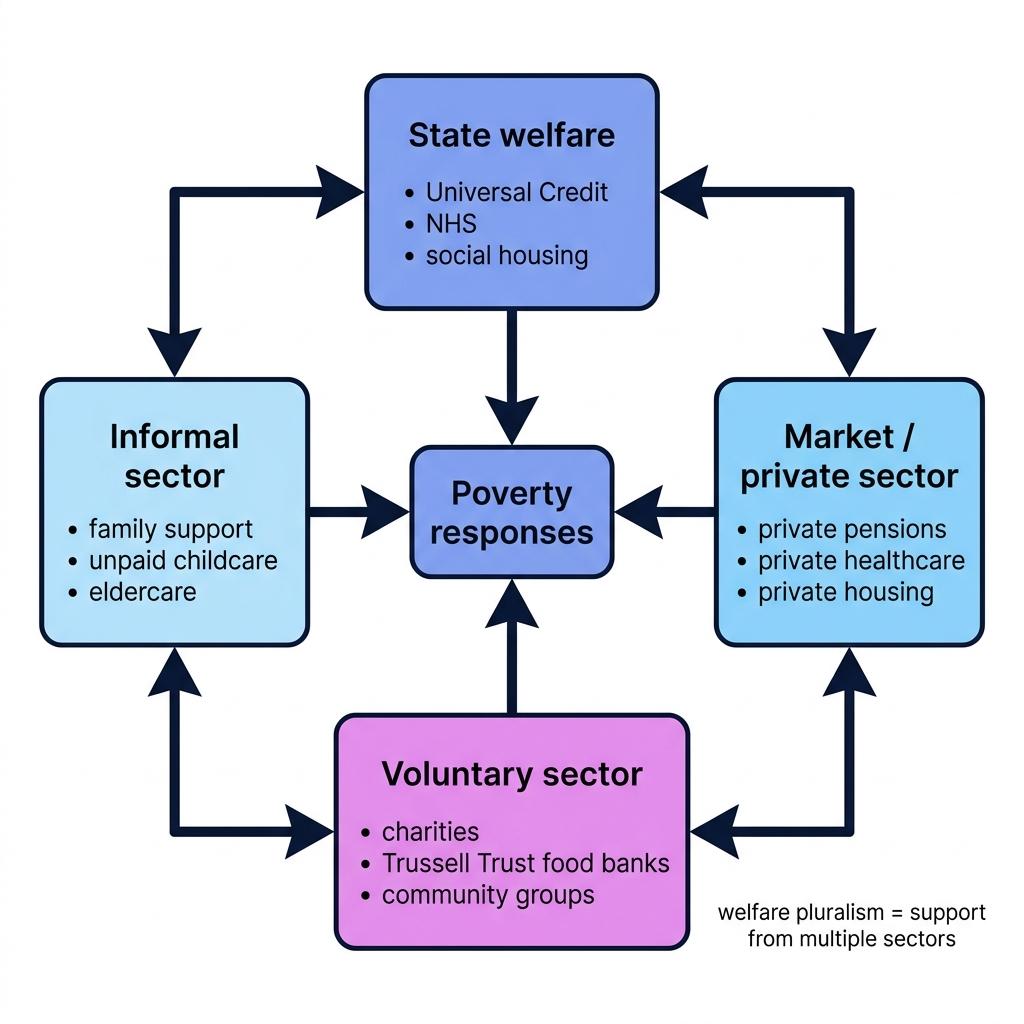
When sociologists look at how society tackles poverty, they don't just look at what the government does. They examine a complex web of different organisations and networks. In contemporary UK society, solutions to poverty come from a range of providers, from the state to charities, private businesses, and families themselves.
Understanding these responses requires you to evaluate how different sociological perspectives—such as the New Right, Social Democrats, Marxists, and Feminists—view the effectiveness and fairness of each approach.
What you'll learn
- The concept of the "Welfare Mix" and how different sectors respond to poverty.
- How state welfare policy has evolved and how different perspectives evaluate state solutions like Universal Credit.
- The expanding role of private, voluntary, and informal welfare providers in contemporary Britain.
- How to critically evaluate solutions to poverty using sociological perspectives and empirical evidence.
The Welfare Mix: Who Tackles Poverty?
To understand how poverty is addressed, we first need to look at who is providing the support. Rather than relying on a single source, the UK operates under what sociologists call welfare pluralism.
Welfare Pluralism (The Welfare Mix)
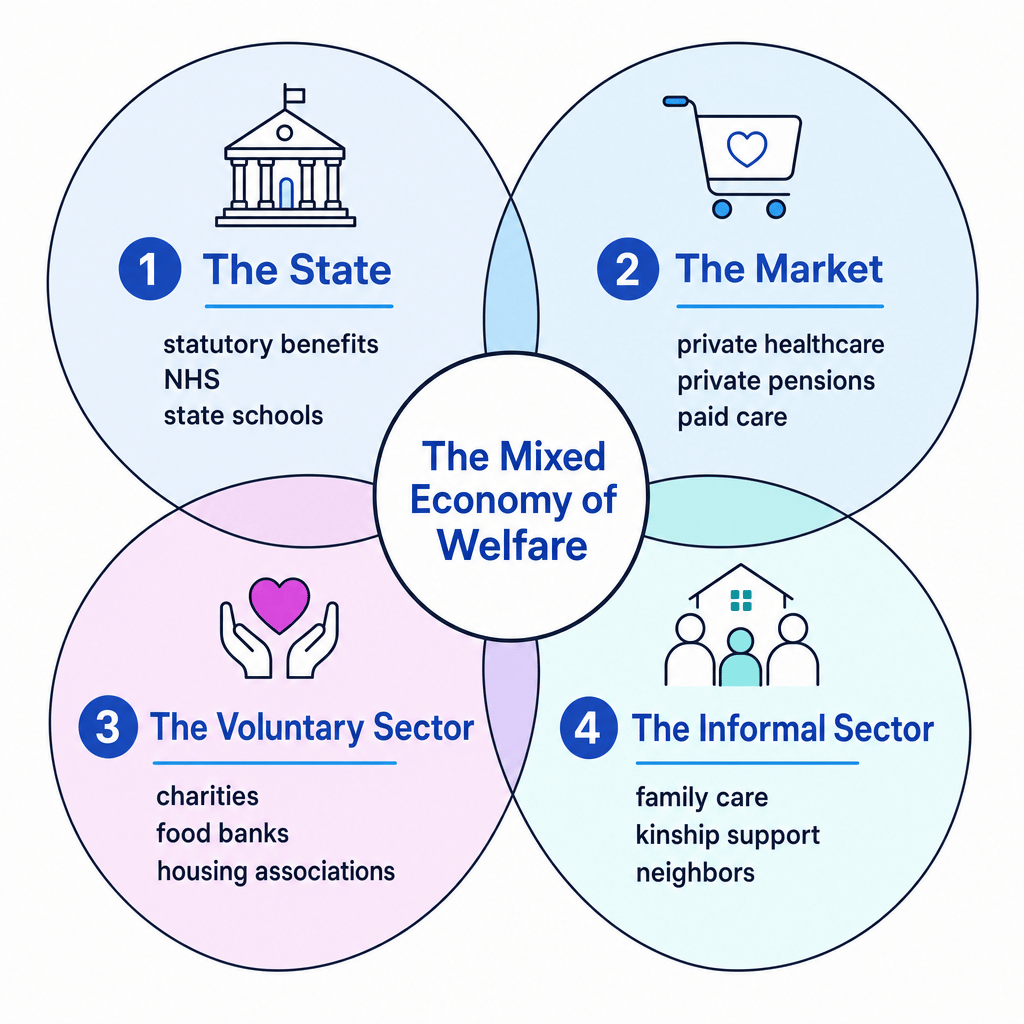
Welfare pluralism refers to a system where welfare services and support are provided by a combination of four distinct sectors: the state, the market (private sector), the voluntary sector (charities/NGOs), and the informal sector (family/friends).
This relationship is often visualised as the "Welfare Mix", illustrating how these four sectors interact to provide a safety net (or fail to do so) for those living in poverty.
Historically, the balance between these four sectors has shifted. Let's look at how each sector operates and how sociologists view their solutions.
1. State Responses to Poverty
The state has been the primary provider of welfare in the UK since the creation of the modern Welfare State following the landmark 1942 Beveridge Report.
Welfare State
A Welfare State is a system in which the government undertakes prime responsibility for the social and economic well-being of its citizens, particularly through provisions such as social security, healthcare, education, and housing.
The state uses two main types of benefits to redistribute income and tackle poverty:
- Universal Benefits: Payments made to everyone within a specific category, regardless of their income or wealth (e.g., State Pension, Winter Fuel Payments for pensioners, or Child Benefit historically).
- Means-Tested Benefits: Payments made only to those who can prove their income and savings fall below a certain threshold (e.g., Universal Credit, Income Support).
Means-testing
Means-testing is the process of measuring an individual's or family's financial resources (income and capital) to determine if they qualify for state financial assistance.
Universal Credit is not a 'universal benefit'
Because of its name, many students mistakenly write that "Universal Credit" is a universal benefit. It is actually a means-tested benefit. It is called "universal" because it merged six separate working-age benefits into a single, unified payment, not because everyone receives it.
Sociological Perspectives on State Solutions
The Social Democratic Perspective
Social Democrats (such as Peter Townsend and Anthony Crosland) argue that the state must take an active, heavily funded role in eradicating poverty.
- The Argument: Poverty is structural, caused by systemic inequalities in wealth, power, and opportunities.
- The Solution: Broad, universal benefits and progressive taxation (taxing the rich more to fund public services). Social Democrats argue that universal benefits are superior because they carry no social stigma, have a high uptake, and foster social solidarity.
- Evaluation: Critics argue that high public spending requires high taxation, which can stifle economic growth and investment.
The New Right / Neoliberal Perspective
The New Right (such as Charles Murray) strongly critiques state welfare provision.
- The Argument: Generous state welfare creates a dependency culture and leads to the emergence of an "underclass" that relies on benefits rather than work. This erodes individual responsibility and undermines the nuclear family (e.g., by making it viable for lone parents to live solely on state support).
- The Solution: Minimise state intervention. Benefits should be strictly means-tested, low enough to act as a deterrent, and designed to "make work pay." They advocate for policies like the benefit cap and tough job-seeking conditions.
Dependency Culture
A dependency culture is a set of values and behaviors, allegedly encouraged by welfare benefits, in which individuals rely on state support rather than taking personal responsibility for their own economic well-being through employment.
The Marxist Perspective
Marxists see state welfare as a contradictory mechanism that serves the interests of capitalism rather than the poor.
- The Argument: Welfare is a "sticking plaster" designed to prevent a working-class revolution. By providing a basic minimum of survival, the capitalist state pacifies the working class and reproduces a healthy labor force for exploitation.
- The Solution: True eradication of poverty cannot happen through welfare reforms within a capitalist framework; it requires the structural dismantling of capitalism itself.
The Feminist Perspective
Feminists argue that state welfare policies are designed around patriarchal assumptions.
- The Argument: Benefits and tax systems have historically assumed a "male breadwinner" and "female homemaker" model, which leaves women financially dependent on men and more vulnerable to poverty if relationships break down.
- The Solution: Welfare policies must treat individuals independently rather than as household units, and must actively fund childcare to allow women equal access to paid employment.
2. Private and Market Solutions
Under neoliberal and New Right influence, recent UK governments have encouraged "market-based" solutions to poverty. This involves the state stepping back and encouraging individuals to buy welfare services privately.
- Examples: Private pensions (encouraged through workplace pension auto-enrollment), private healthcare (Bupa), and private housing.
- Sociological Evaluation: While the New Right argues that market competition drives up quality and reduces the tax burden, critics argue it creates a two-tier system. Those who can afford to pay receive high-quality private care, while the poorest are left relying on underfunded, residual state services, deepening relative poverty and social exclusion.
3. Voluntary Sector Responses (The "Third Sector")
The voluntary sector consists of charities, non-profit organisations, and community groups. In contemporary Britain, this sector has stepped in to fill the gaps left by state spending cuts (often referred to as "austerity").
The most prominent example of this is the dramatic rise of food banks operated by charities like the Trussell Trust.
Food banks: Safety net or state failure?
Sociologists like Kayleigh Garthwaite (2016) argue that the growth of food banks is not a sign of a healthy "voluntary sector" doing its job, but rather clear evidence of the failure of the state welfare safety net. Garthwaite's research highlights that delays in Universal Credit payments, sanctions, and low wages are the primary drivers of food bank usage.
- New Right View: Voluntary action is positive. It shows community spirit, costs the taxpayer nothing, and avoids the cold, bureaucratic dependency of state benefits.
- Structuralist/Conflict View: Charity is an unreliable, degrading, and precarious way to handle poverty. It lets the government off the hook for its statutory duty to protect its citizens.
4. Informal Welfare (Family and Kinship)
Informal welfare is the support provided unpaid by family members, friends, and neighbors. This includes financial assistance (e.g., parents helping adult children with deposits), unpaid childcare, and eldercare.
- Feminist Critique: Feminists point out that the burden of informal welfare falls disproportionately on women. Women are more likely to reduce their working hours or leave employment to care for children or elderly relatives, which directly increases their own risk of poverty and lowers their lifetime pension contributions.
- The "Bank of Mum and Dad": Relying on family support reproduces class inequalities. Wealthy families can protect their children from poverty, whereas working-class families do not have the resources to offer this informal protection.
Worked Example: Analyzing Policy Impact
Sociologists must use quantitative literacy to evaluate whether a state policy has successfully reduced poverty or worsened it. Let's walk through how to interpret distribution data to evaluate the success of a welfare policy change.
Suppose the government introduces a tax-and-benefit reform package (limiting child tax credits and cutting income tax rates). An independent think tank publishes the following ONS-based data showing the change in weekly disposable income for households across different income deciles (where Decile 1 is the poorest 10% and Decile 10 is the richest 10%).
| Income Decile | Before Policy (£) | After Policy (£) |
|---|---|---|
| Decile 1 (Poorest) | 180 | 162 |
| Decile 10 (Richest) | 1500 | 1575 |
Analyzing the distributional impact of a welfare reform
-
Calculate the percentage change in disposable income for both deciles to identify the economic trend.
Using the percentage change formula:
Percentage Change=New Value−Original ValueOriginal Value×100 \text{Percentage Change} = \frac{\text{New Value} - \text{Original Value}}{\text{Original Value}} \times 100 Percentage Change=Original ValueNew Value−Original Value×100For the poorest 10% (Decile 1):
162−180180×100=−10% \frac{162 - 180}{180} \times 100 = -10\% 180162−180×100=−10%For the richest 10% (Decile 10):
1575−15001500×100=+5% \frac{1575 - 1500}{1500} \times 100 = +5\% 15001575−1500×100=+5% -
Determine the structural impact of this policy on relative poverty.
Because the poorest decile lost 10%10\%10% of their disposable income while the richest decile gained 5%5\%5%, the income gap between the top and bottom of society has widened. Because relative poverty is calculated in relation to the average (median) societal income, a widening gap indicates that relative poverty will increase as a direct result of this policy. The reform is therefore regressive rather than progressive.
-
Apply contrasting sociological perspectives to evaluate the policy's outcome.
- Social Democratic / Townsendian Evaluation: This policy is a clear failure. By cutting the incomes of the poorest, it reduces their ability to participate in the normal patterns of society, leading to increased relative poverty, social exclusion, and structural deprivation.
- New Right / Murrayite Evaluation: This policy is a success. By reducing state benefits (causing the drop in Decile 1 income), it removes the "cushion" of state support, thereby increasing the incentive for individuals to find employment. The rise in Decile 10 income is seen as a positive reward for wealth creation and investment.
Use terms like 'progressive' and 'regressive'
- Progressive policies reduce inequality by taking a larger percentage of income from high earners or redistributing resources to low earners.
- Regressive policies increase inequality by disproportionately reducing the real income of poorer households.
In the exam
- Define your terms immediately: If an exam question asks you to evaluate "solutions to poverty," start your essay by defining what poverty is (absolute vs. relative) and what the "welfare mix" means.
- Structure by sector, analyze by theory: Organise your essay paragraphs around the different sectors (State, Private, Voluntary, Informal) and use competing theories (New Right vs. Social Democrat/Marxist/Feminist) to debate the effectiveness of each.
- Use contemporary examples (AO2): Do not just talk about the historical welfare state. Mention modern UK policies and realities, such as Universal Credit, the Benefit Cap, the rise of food banks (Trussell Trust), and the National Living Wage.
- Evaluate thoroughly (AO3): For every solution, state its strength, then its weakness. For example, show how the New Right argues that cutting benefits reduces dependency, but counter this with Garthwaite's empirical evidence that cutting benefits simply forces desperate people to rely on charities and food banks.
Check yourself
- Why do Social Democrats favor universal benefits over means-tested benefits when trying to solve poverty?
- How would Charles Murray (New Right) and Peter Townsend (Social Democrat) disagree on the cause and solution of the rising number of food banks in the UK?
- In what ways does relying on informal family care to solve poverty reproduce both gender and social class inequalities?