What you'll learn
- How religious and secular thinkers assess the moral status of embryos, fetuses, patients and persons.
- How beginning-of-life issues such as IVF, PGD, stem cells and abortion are debated.
- How end-of-life debates involve assisted dying, euthanasia, palliative care, law, rights and responsibilities.
- How to compare Peter Singer and Jonathan Glover in extended ethics essays.
Medical ethics is not just “what does the law allow?” It asks what should be done when life, suffering, autonomy and responsibility come into conflict.
The basic ethical toolkit
Medical ethics
Medical ethics is the study of moral questions raised by healthcare, treatment, life, death, reproduction and patient choice.
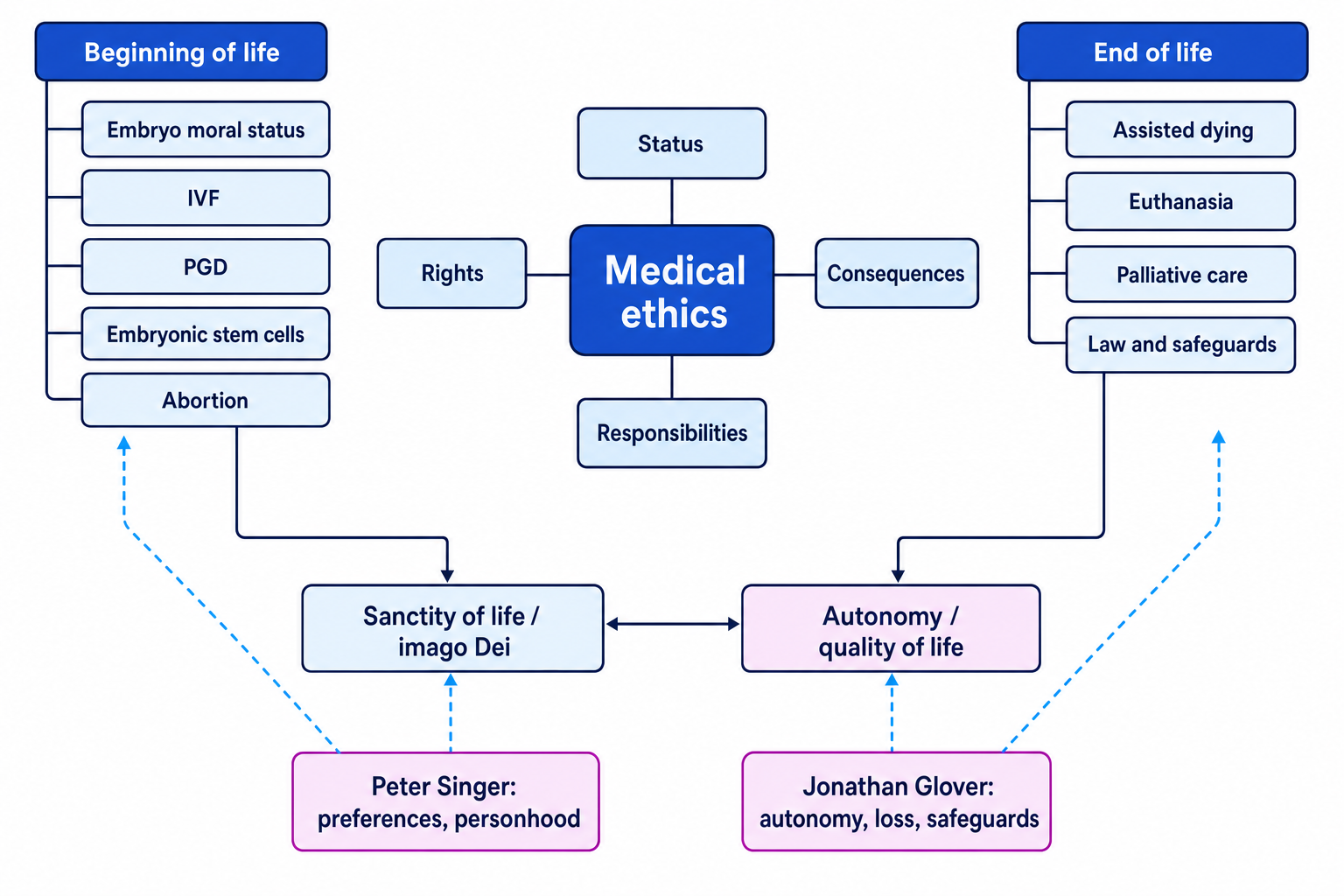
A strong answer separates four questions:
- Status — what kind of being is involved?
- Rights — what claims does that being have?
- Consequences — what good or harm may follow?
- Responsibilities — what duties do doctors, families and society have?
Sanctity and value of life
Sanctity of life means human life has special worth, often because it is created or given by God. Value of life can also be used in secular ways, meaning life matters because it can contain experiences, relationships, preferences and flourishing.
Religious approaches often stress life as a gift from God, the command not to kill, and ideas such as imago Dei — the Christian belief that humans are made “in the image of God”. Secular approaches often stress autonomy — self-rule or the ability to make decisions — and quality of life, meaning the extent to which life contains wellbeing, relationships, consciousness or future possibilities.
The central tension
Beginning and end of life debates often turn on whether life is valuable simply because it is human, or because it has features such as consciousness, interests, relationships and choices.
Beginning of life debates
The status of the embryo
Embryo and moral status
An embryo is an early developing human organism, usually discussed in law and ethics from fertilisation to about eight weeks. Moral status means how much moral consideration a being deserves.
Some religious views give the embryo strong moral status from conception, because a new human life has begun. Roman Catholic teaching, for example, usually opposes deliberate embryo destruction because innocent human life should be protected from its earliest stage.
Other religious and secular views see moral status as gradual. On this view, an early embryo matters, but not in exactly the same way as a conscious pregnant person, a newborn baby, or an adult patient.
Peter Singer rejects a simple “human life is always sacred” argument. He is a preference utilitarian, meaning he judges actions by how far they satisfy or frustrate the preferences of those affected. For Singer, being biologically human is not enough for full personhood. A person, in his technical sense, is self-aware, rational and able to have future-directed preferences.
Jonathan Glover also questions absolute sanctity-of-life reasoning, but he is more cautious and practical. In Causing Death and Saving Lives, he argues that the wrongness of killing is connected to loss of a worthwhile future, violation of autonomy, and effects on others — not simply the bare fact that biological life ends.
Applying embryo-status views to IVF research
-
If an embryo has full moral status from conception, then destroying spare IVF embryos is morally close to killing an innocent human being.
-
If moral status develops gradually, then early embryo research may be allowed where the embryo lacks consciousness and the research aims at serious medical benefit.
-
Singer would ask whether the embryo has preferences that can be frustrated. Since an early embryo has no awareness or future plans, he is likely to permit research if it reduces suffering.
-
Glover would weigh the benefit of research against social risks, such as treating human life too casually, and would support safeguards rather than relying on an absolute ban.
IVF, embryo research, PGD, stem cells and cord blood
IVF, PGD and stem cells
In vitro fertilisation or IVF is fertilisation outside the body, usually in a laboratory. Pre-implantation genetic diagnosis or PGD tests embryos before implantation for genetic conditions. Stem cells are cells that can develop into different specialised cell types.
In the UK, embryo research and fertility treatment are regulated by the Human Fertilisation and Embryology Authority. Research on embryos is permitted only under licence and normally only up to the 14-day rule, before the primitive streak develops. PGD may be licensed for serious genetic conditions.
Supporters argue that IVF helps infertile couples, PGD can prevent serious inherited disease, and stem-cell research may lead to treatments for conditions such as Parkinson’s disease or spinal injury. Cord blood, taken from the umbilical cord after birth, is usually less controversial because it does not require embryo destruction.
Critics worry about the destruction of embryos, “designer babies”, disability discrimination, and the commodification of human life — treating human beings as products to be selected.
Treating all stem cells as equally controversial
Not all stem-cell use is the same. Embryonic stem cells raise embryo-status questions; cord blood stem cells usually do not involve destroying embryos and are therefore less ethically disputed.
Abortion
Abortion
Abortion is the deliberate ending of a pregnancy before birth.
In Great Britain, abortion is regulated mainly by the Abortion Act 1967, as amended. It is legally available when conditions are met, including approval by doctors, with a general 24-week limit for many cases. There are exceptions, such as serious risk to the pregnant person’s life or serious fetal abnormality.
Religious opposition often rests on sanctity of life, the innocence of the unborn, and the belief that humans should not choose to end life. However, religious traditions are not all identical: some give greater weight to the pregnant person’s life, health, circumstances or stage of pregnancy.
Secular defences of abortion often appeal to autonomy, bodily integrity, compassion, and the fact that early fetuses lack developed consciousness. Singer supports abortion more readily than sanctity-of-life thinkers because he does not think a fetus is a person in the full moral sense. Glover tends to ask what is lost, who is harmed, and whether later abortions raise stronger moral concerns because fetal development has progressed.
Useful essay distinction
Do not reduce abortion to “religious people oppose, secular people support”. Strong answers compare reasons: sanctity, personhood, autonomy, suffering, fetal development, law and social consequences.
End of life debates
Assisted dying, euthanasia and palliative care
Assisted dying and euthanasia
Assisted dying usually means helping a terminally ill person to end their own life, often by providing medication. Euthanasia means deliberately ending a person’s life to relieve suffering. It may be voluntary if requested by the patient, non-voluntary if the patient cannot choose, or involuntary if against the patient’s wishes.
Palliative care
Palliative care is care aimed at relieving pain, distress and symptoms when cure is not possible. It does not aim to kill the patient.
In England and Wales, euthanasia is illegal and assisting suicide is a criminal offence under the Suicide Act 1961. Prosecution policy may consider compassion and circumstances, but it does not make assisted dying legal. Other jurisdictions, such as the Netherlands, Belgium, Canada and some US states, allow forms of assisted dying under safeguards.
Religious objections often appeal to God’s sovereignty over life and death, the duty to care for the vulnerable, and fears that legalisation would pressure elderly, disabled or seriously ill people. Religious support for palliative care is often strong because it expresses compassion without intending death.
Secular arguments for assisted dying stress autonomy, relief of unbearable suffering, dignity, and consistency: if patients may refuse life-sustaining treatment, why may they not choose a quicker death? Opponents reply that choice may be distorted by depression, poor care, family pressure or lack of support.
Singer is generally sympathetic to voluntary euthanasia where it satisfies a competent person’s preferences and reduces suffering. Glover also gives serious weight to autonomy and suffering, but he pays attention to safeguards and wider social effects.
Distinguishing palliative care from euthanasia
-
Ask about intention: palliative care intends to relieve pain; euthanasia intends to bring about death as the means of ending suffering.
-
Ask about method: high-dose pain relief may foreseeably shorten life, while lethal injection directly aims at death.
-
Apply ethical evaluation: a sanctity-of-life thinker may accept pain relief under the doctrine of double effect, while rejecting euthanasia; Singer may focus less on intention and more on whether preferences and suffering are best addressed.
Rights, responsibilities, personhood and human nature
End-of-life debates involve competing rights: a right to life, a possible right to die, and a right not to be pressured into death. They also involve responsibilities: doctors must preserve trust, relieve suffering and protect vulnerable patients; families must not treat someone as a burden; society must provide real options, including good palliative care.
Ideas of human nature matter here. A religious view may see humans as dependent creatures whose lives belong ultimately to God. A secular liberal view may see humans as autonomous agents whose choices should be respected. A relational view stresses that people are shaped by families, communities and care networks, so “choice” is never completely isolated.
Autonomy is not magic
Saying “it is their choice” is not enough. You must ask whether the choice is informed, stable, free from pressure, and supported by proper medical and social care.
Evaluating disagreement and social change
Social attitudes in the UK have generally become more permissive about IVF, embryo research, abortion and assisted dying, though all remain contested. Legal change often follows public debate, medical developments and high-profile cases such as Diane Pretty, Tony Nicklinson and Noel Conway, who challenged restrictions on assisted dying.
Religious perspectives remain valuable because they ask society to protect the vulnerable, resist reducing worth to usefulness, and remember duties as well as rights. However, critics argue that law in a plural society should not simply enforce one religious doctrine, especially when citizens reasonably disagree.
Singer’s strength is clarity: he exposes weak arguments based only on species membership and forces a serious discussion of suffering and preferences. His weakness is that his personhood criteria can seem too narrow, especially for infants, people with severe cognitive disabilities, or patients with dementia.
Glover’s strength is balance: he rejects simplistic absolutes but takes consequences, social trust and safeguards seriously. His weakness is that a flexible approach may lack firm boundaries when pressure, cost or social prejudice affect medical choices.
Balanced judgement
The best essays usually argue that neither “life at all costs” nor “choice without limits” is fully adequate. Medical ethics needs protection for life, compassion for suffering, respect for autonomy and serious safeguards for the vulnerable.
In the exam
-
Define the issue precisely before evaluating it: embryo research, PGD, abortion, assisted dying and euthanasia are not interchangeable.
-
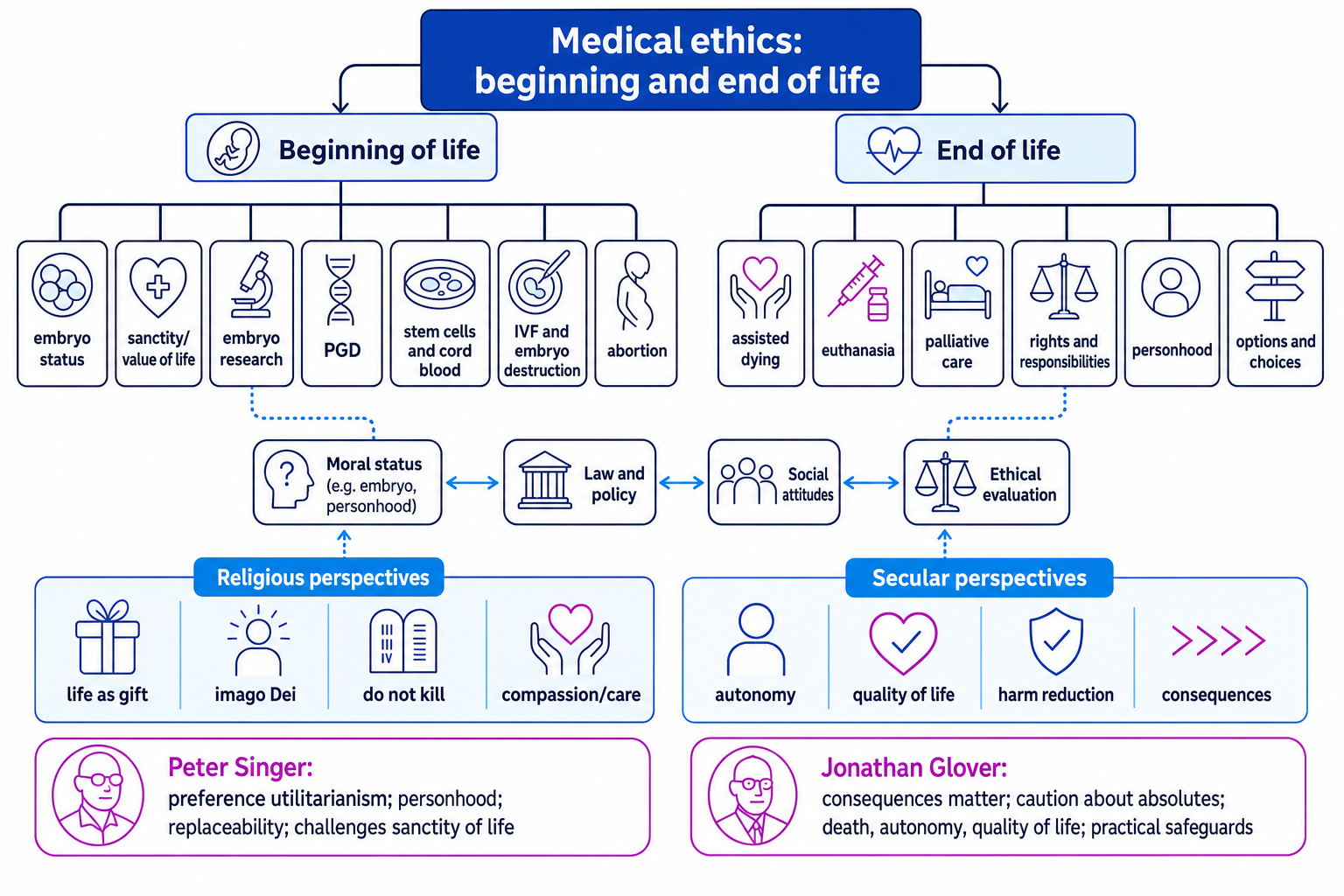
Compare Singer and Glover directly: Singer stresses preferences and personhood; Glover stresses consequences, autonomy, loss and safeguards.
-
Reach a justified judgement by weighing law, religious perspectives, secular ethics, social attitudes and the protection of vulnerable people.
Check yourself
- Why might an embryo have moral status without having the same status as an adult person?
- How do Singer and Glover challenge a simple sanctity-of-life approach?
- What is the ethical difference between palliative care and euthanasia?