What you'll learn
- How to turn a broad topic into a focused aim and research question.
- How to write alternative, directional, non-directional and null hypotheses.
- How to identify and operationalise independent variables, dependent variables and co-variables.
- How to spot extraneous and confounding variables before they weaken your study.
Why research questions matter
In Component 2, you are expected to think like a researcher. Before you collect any data, you need a clear idea of exactly what you are investigating, how you will measure it, and what result would support or fail to support your prediction.
A good research question is focused, testable and ethical. It should be narrow enough that another researcher could understand what you did and repeat it.
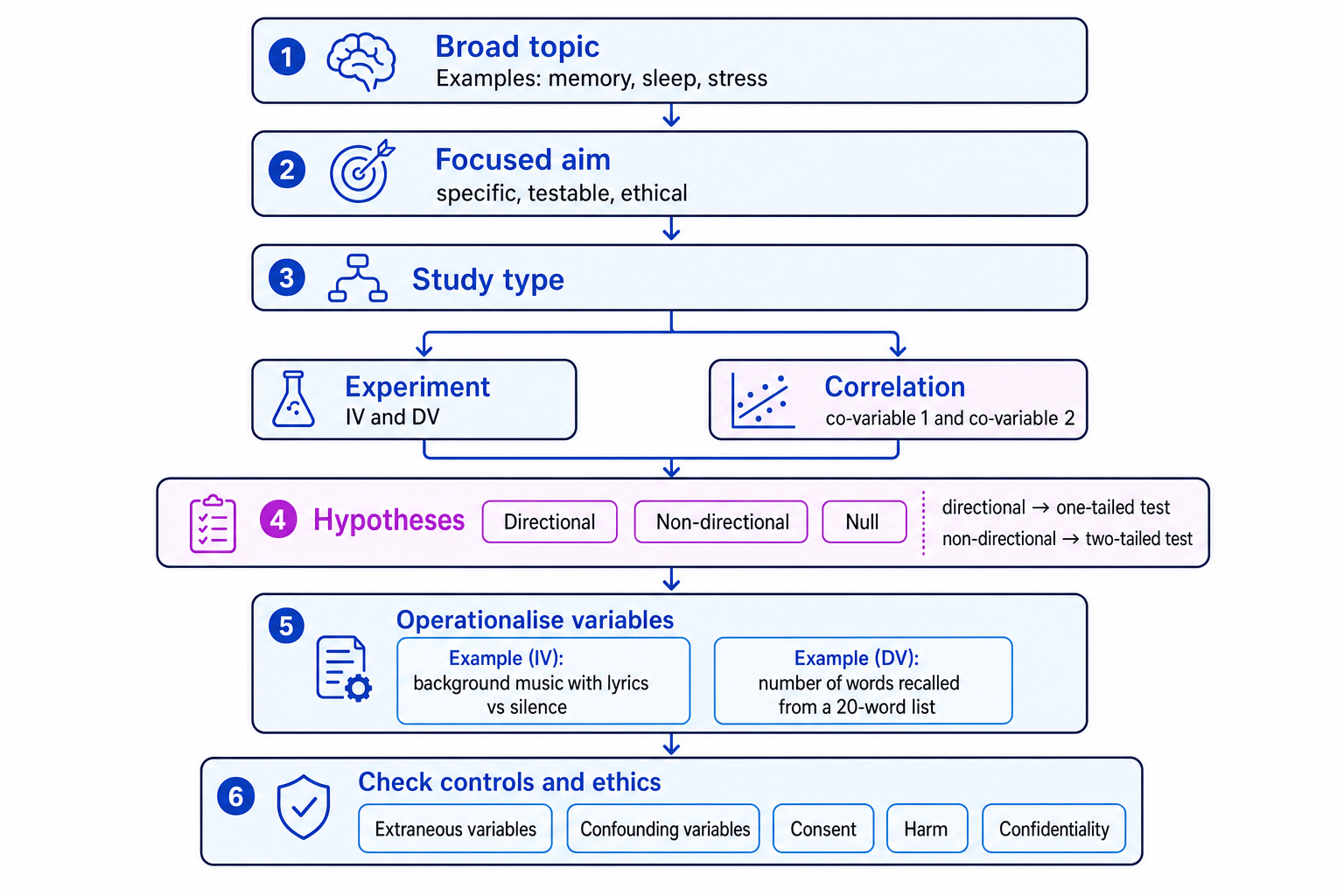
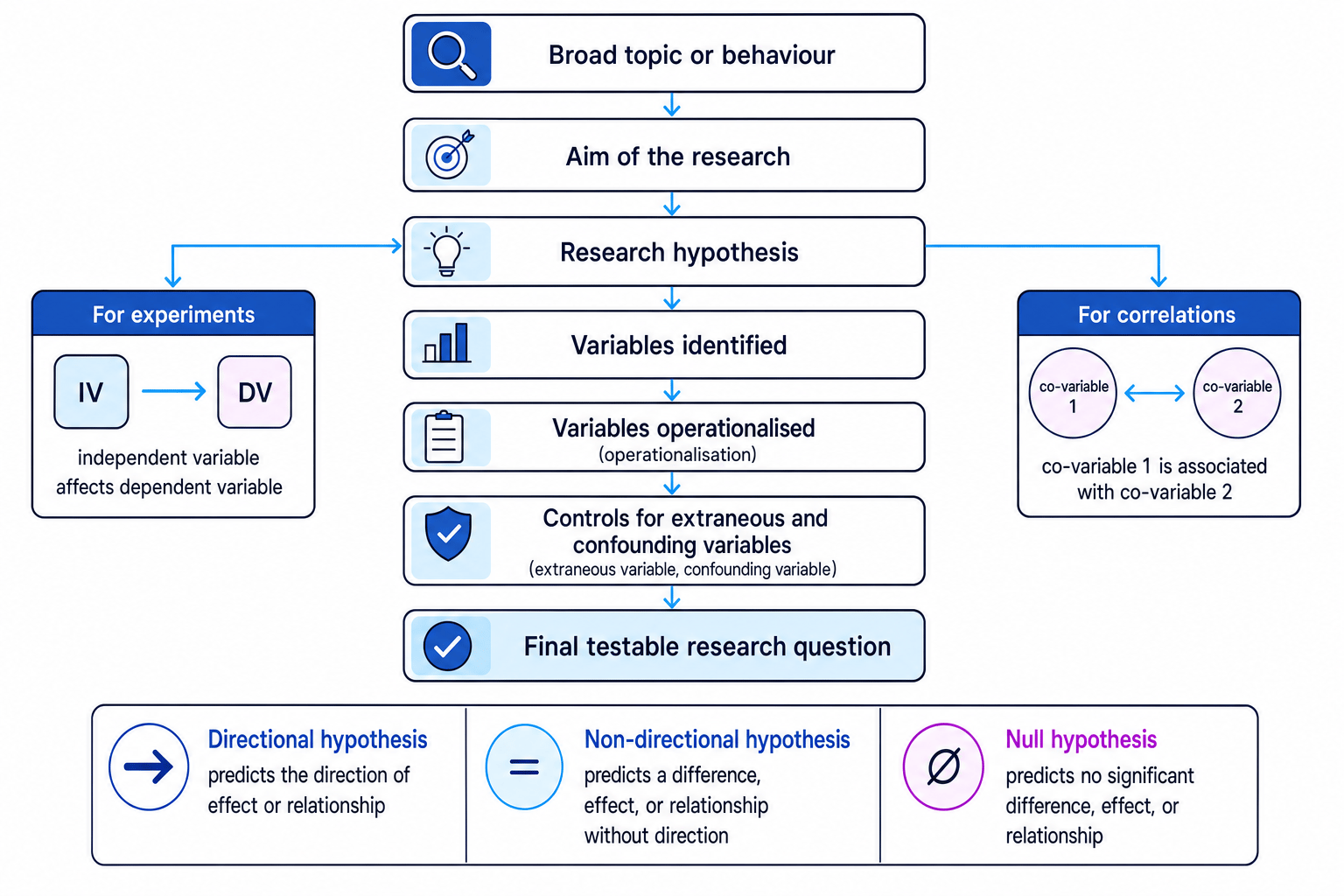
The basic journey is: start with a broad topic, narrow it into an aim, turn the aim into a hypothesis, then define the variables precisely.
From topic to aim
A topic is a broad area of interest, such as memory, obedience, stress, attachment or wellbeing. A topic is not yet a research question because it does not say exactly what will be investigated.
Aim of the research
An aim is a general statement of what the researcher intends to investigate. It usually names the behaviour being studied and the main variables or groups involved.
For example, “memory” is too broad. “To investigate whether background music affects the number of words recalled by A-Level students” is much clearer.
A strong aim usually includes:
- the behaviour or mental process being studied
- the people or animals being studied
- whether the study is looking for a difference, effect or relationship
- the variables that will be measured or manipulated
Turning a broad topic into an aim
-
Start with the broad topic: music and memory. This is too vague because it does not say what kind of music, what kind of memory, or who is being studied.
-
Decide the type of investigation. If the researcher wants to test whether music causes a change in recall, an experiment is suitable because one condition can involve music and another can involve silence.
-
Make the variables clearer. The music condition could be “background music with lyrics”, and memory could be measured as “number of words correctly recalled from a 20-word list”.
-
Write the aim: To investigate whether background music with lyrics affects the number of words correctly recalled from a 20-word list by A-Level Psychology students.
Aims are broad, hypotheses are testable
An aim says what the study is about. A hypothesis makes a specific prediction about what the researcher expects to find.
Research hypotheses
Research hypothesis
A research hypothesis is a testable prediction about the outcome of a study.
The hypothesis should be written before the data is collected. This matters because changing the hypothesis after seeing the results is poor scientific practice and can increase the chance of claiming a false finding.
Alternative or experimental hypotheses
Alternative hypothesis
An alternative hypothesis predicts that there will be a significant difference, effect or relationship between variables.
In an experiment, this is often called an experimental hypothesis because it predicts the effect of the independent variable on the dependent variable. In a correlation, it is usually called an alternative hypothesis because the researcher is predicting a relationship between two co-variables, not manipulating a cause.
In psychology, “significant” usually means the result is unlikely to have occurred by chance at the chosen significance level. The common default is p≤0.05p \leq 0.05p≤0.05, meaning the researcher accepts a 5% risk of a Type I error.
Type I and Type II errors
A Type I error is a false positive: concluding there is a significant effect or relationship when there is not. A Type II error is a false negative: failing to find a significant effect or relationship when one really exists.
Directional hypotheses
Directional hypothesis
A directional hypothesis predicts the specific direction of a difference, effect or relationship.
Examples:
- “Students who revise in silence will recall more words than students who revise with background music.”
- “There will be a positive relationship between hours of sleep and concentration score.”
Use a directional hypothesis when previous theory or research gives a clear reason to predict the direction. For example, if previous memory research suggests distraction reduces recall, you may predict poorer recall in the music condition.
Non-directional hypotheses
Non-directional hypothesis
A non-directional hypothesis predicts that there will be a difference, effect or relationship, but does not state the direction.
Examples:
- “There will be a difference in the number of words recalled by students who revise in silence and students who revise with background music.”
- “There will be a relationship between hours of sleep and concentration score.”
Use a non-directional hypothesis when there is not enough evidence to justify predicting which way the result will go.
Null hypotheses
Null hypothesis
A null hypothesis predicts that there will be no significant difference, effect or relationship between variables, and that any observed result is due to chance.
Examples:
- “There will be no significant difference in the number of words recalled by students who revise in silence and students who revise with background music.”
- “There will be no significant relationship between hours of sleep and concentration score.”
Writing hypotheses for an experiment
-
Identify the comparison being tested: one group recalls words in silence, and another group recalls words with background music.
-
Decide whether the prediction has a direction. If previous research suggests music distracts attention, the researcher can justify a directional hypothesis.
-
Write the directional alternative hypothesis: Students who recall words in silence will correctly recall more words from a 20-word list than students who recall words with background music.
-
Write the null hypothesis using the same operationalised variables: There will be no significant difference in the number of words correctly recalled from a 20-word list between students who recall words in silence and students who recall words with background music.
Link hypotheses to statistical tests
A directional hypothesis leads to a one-tailed test. A non-directional hypothesis leads to a two-tailed test. This affects the critical value used later when deciding whether the observed value is significant.
Variables in experiments
Independent variable
The independent variable, or IV, is the variable that is changed or used to create conditions in an experiment.
The IV usually has at least two levels or conditions. For example, in a study on music and memory, the IV could be revision environment, with two conditions: silence and background music.
Dependent variable
The dependent variable, or DV, is the outcome that is measured in an experiment.
The DV should show whether the IV has had an effect. In the music and memory example, the DV could be the number of words correctly recalled.
IV and DV
In an experiment, the IV is what changes between conditions. The DV is what is measured to see whether that change made a difference.
Co-variables in correlations
Not every study has an IV and a DV. If the researcher measures two naturally occurring variables and checks whether they are associated, the study is a correlation.
Co-variables
Co-variables are the two variables measured in a correlational study. Neither variable is manipulated by the researcher.
For example, a researcher might investigate whether hours of sleep is related to concentration score. The two co-variables are:
- hours of sleep the previous night
- score on a concentration task
Calling co-variables IVs and DVs
In a correlation, do not call one variable the IV and the other the DV. The researcher is not manipulating a cause, so the safer term is co-variable.
Identifying variables in a correlation
-
Decide whether the researcher manipulates anything. If students simply report their sleep and complete a concentration task, nothing has been manipulated.
-
Name the two co-variables: hours of sleep the previous night and concentration task score.
-
Write a directional alternative hypothesis if justified: There will be a positive relationship between hours of sleep the previous night and concentration task score.
-
Write the null hypothesis: There will be no significant relationship between hours of sleep the previous night and concentration task score.
Operationalisation of variables
Operationalisation
Operationalisation means defining variables precisely so they can be measured, manipulated and replicated.
A vague variable is difficult to test. “Stress” could mean self-reported anxiety, heart rate, cortisol level, number of stressful life events, or exam pressure. Operationalising stress means stating exactly how it will be measured.
Good operationalisation improves:
- reliability, because the procedure can be repeated consistently
- validity, because the measure is more likely to assess what it claims to assess
- replicability, because another researcher can copy the study
Examples of operationalised variables:
- Memory: number of words correctly recalled from a 20-word list after a delay.
- Aggression: number of aggressive acts recorded during a 10-minute observation.
- Wellbeing: score on a named wellbeing questionnaire.
- Sleep: self-reported hours slept the previous night.
Operationalisation also affects the level of measurement:
- Nominal data: categories, such as “passed” or “failed”.
- Ordinal data: ordered scores or ranks, such as rating stress from 1 to 10.
- Interval data: equal units between values, such as a test score out of 50.
This matters later when choosing inferential tests. For example, Spearman’s rho is used for correlations with ordinal/ranked data, chi-square is used with nominal categories, Mann-Whitney U is used for unrelated groups with ordinal data, Wilcoxon signed-ranks is used for related data, and related or unrelated t-tests are used with interval data when assumptions are met.
Operationalise using the measurement
If you cannot say exactly how the variable is measured or manipulated, it is probably not operationalised clearly enough.
Extraneous and confounding variables
In psychology, behaviour is affected by many factors. A study needs to reduce unwanted influences so the researcher can be more confident about what caused the result.
Extraneous variable
An extraneous variable is any variable other than the IV that could affect the DV.
Examples in a memory experiment include tiredness, caffeine intake, previous familiarity with the word list, noise in the room, or motivation.
Extraneous variables are not always fatal, but they can make the results less clear. They add “noise” to the data and reduce confidence in the findings.
Confounding variable
A confounding variable is an extraneous variable that varies systematically with the IV, so it provides an alternative explanation for the effect on the DV.
A confounding variable is more serious than a general extraneous variable because it is mixed up with the IV.
Spotting a confounding variable
-
Compare the two conditions: the silence group is tested in the morning, while the music group is tested after lunch.
-
Check whether another factor changes systematically with the IV. Time of day changes alongside the music condition, so it is not equally spread across both groups.
-
Decide whether that factor could affect the DV. Time of day could affect alertness and therefore word recall.
-
Classify it as a confounding variable because any difference in recall could be due to music, time of day, or both.
Confounding is not just ‘anything unwanted’
An extraneous variable becomes a confounding variable when it is linked to one condition more than another and could explain the result.
Ethics when choosing a research question
Before finalising a research question, ask whether the study can be carried out ethically. The British Psychological Society’s Code of Ethics and Conduct highlights issues such as:
- informed consent
- deception
- right to withdraw
- protection from physical and psychological harm
- confidentiality
- debriefing
For example, a study investigating stress should not deliberately create extreme distress just to produce measurable data. If deception is used, it must be justified and followed by a full debrief.
If animal research is involved, there are additional responsibilities: the research must be strongly justified, suffering must be minimised, housing and care must be appropriate, and researchers should follow the principles of replacement, reduction and refinement.
AO1, AO2 and AO3 in this topic
For AO1, be ready to define terms accurately: aim, hypothesis, IV, DV, co-variable, operationalisation, extraneous variable and confounding variable.
For AO2, practise applying these terms to unfamiliar scenarios. If a question describes a practical investigation, identify what is manipulated, what is measured, and how the variables could be operationalised.
For AO3, comment on whether the research question is clear, testable, ethical and valid. You can evaluate whether variables are poorly operationalised or whether confounding variables reduce confidence in the findings.
In the exam
-
Start by deciding the study type: experiment means IV and DV; correlation means two co-variables.
-
When writing hypotheses, include the fully operationalised variables and match the wording of the alternative hypothesis to the null hypothesis.
-
For evaluation, focus on validity: ask whether extraneous or confounding variables could provide an alternative explanation.
-
Link directional hypotheses to one-tailed tests and non-directional hypotheses to two-tailed tests, especially when discussing significance and critical values.
Check yourself
-
What is the difference between an aim and a hypothesis?
-
Why should you avoid calling co-variables “independent” and “dependent” variables?
-
How can you tell whether an extraneous variable has become a confounding variable?