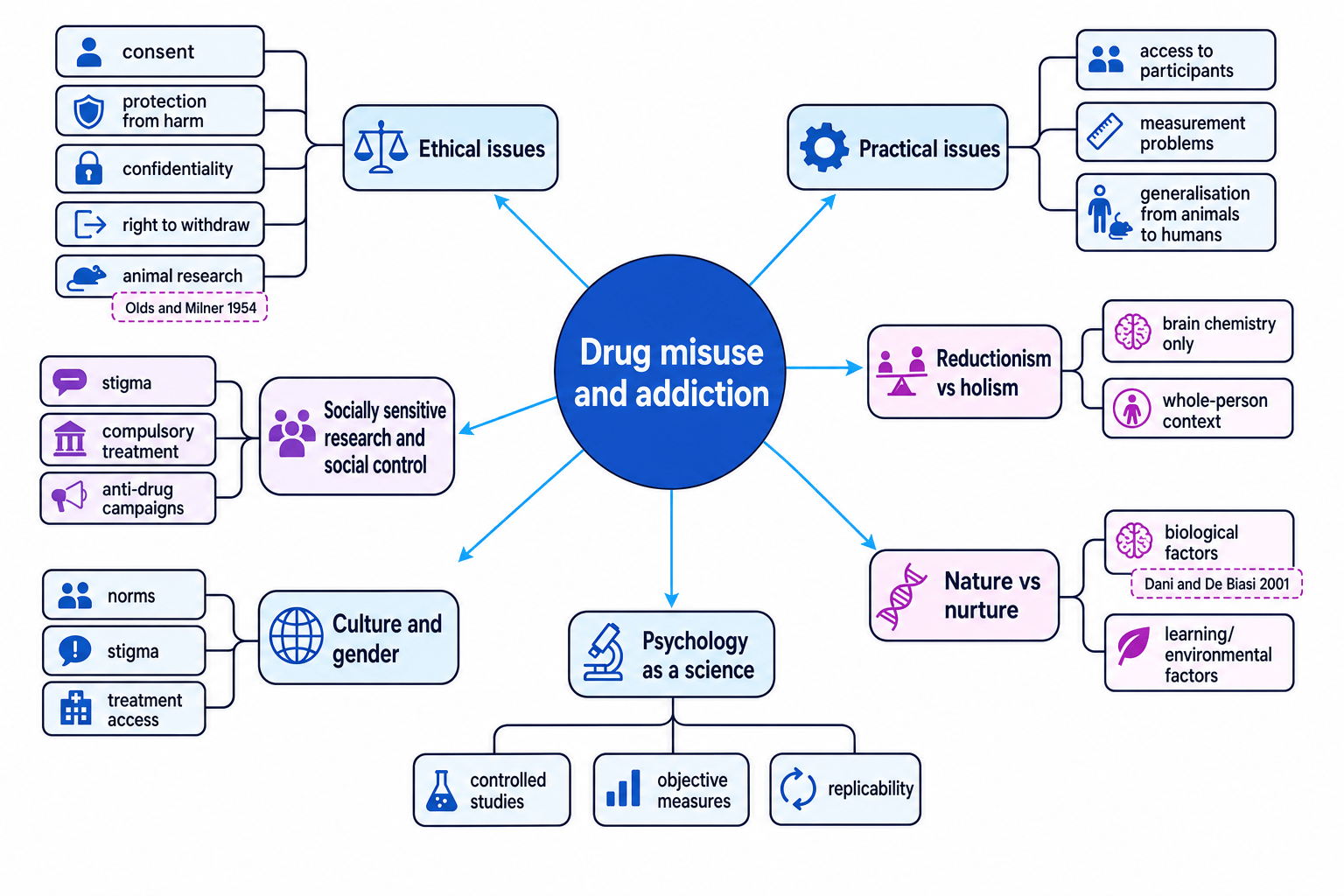
What you'll learn
- How to use issues and debates as AO3 evaluation points in Health Psychology.
- How drug misuse research raises ethical, practical and scientific questions.
- How to compare biological and learning explanations using debates like reductionism and nature-nurture.
- How to apply these debates to treatments, anti-drug campaigns and socially sensitive research.
The big picture: why issues and debates matter
In Edexcel Health Psychology, the main context for issues and debates is drug misuse: why people begin using drugs, why addiction develops, and how treatments or campaigns might reduce harm.
Drug misuse
Drug misuse means using a substance in a way that causes harm to the person or others. Addiction or dependence involves compulsive use, craving, tolerance, withdrawal symptoms, and difficulty stopping despite negative consequences.
An issue is a problem or question raised by psychological research, such as whether it is ethical to use animals. A debate is a broader argument with two or more sides, such as whether behaviour is better explained by nature or nurture.
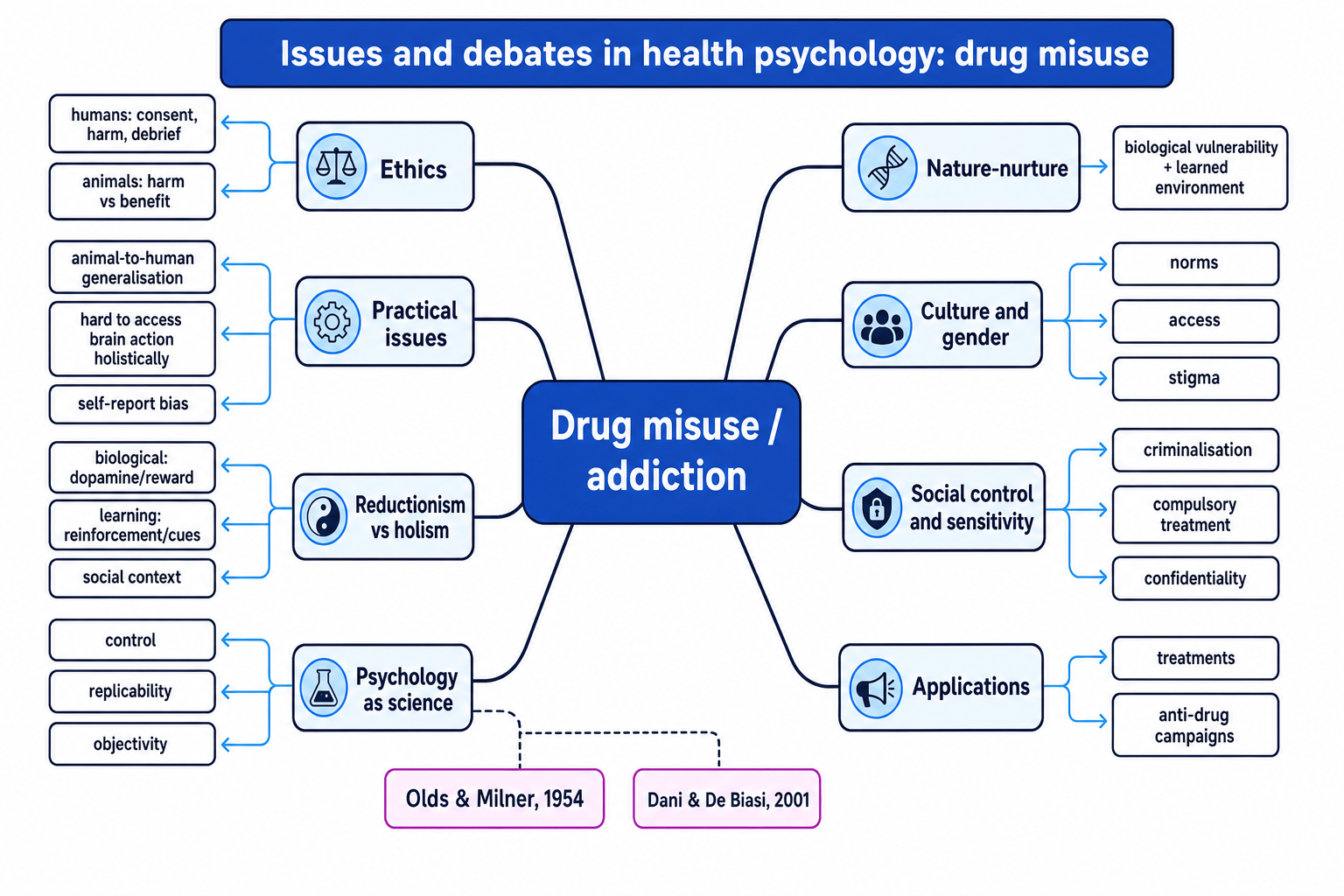
Use debates as evaluation lenses
For essays, do not just name a debate. Link it to Health Psychology content: drug misuse, biological explanations, learning explanations, treatments such as aversion therapy, and studies such as Olds and Milner (1954) and Dani and De Biasi (2001).
Ethical issues
Ethics
Ethics refers to moral principles that guide research and treatment. In psychology, the BPS Code of Ethics and Conduct (2009) highlights consent, deception, right to withdraw, protection from harm, confidentiality and debriefing.
Health Psychology can create ethical problems because drug misuse often involves vulnerable people, illegal behaviour, stigma and risk of harm.
For human participants, researchers must be especially careful when asking about drug habits. Participants may fear legal consequences, judgement, or loss of confidentiality. They may also be experiencing withdrawal, mental health difficulties or social pressure.
Treatments can raise ethical issues too. Aversion therapy is a behavioural treatment where a drug-related stimulus is paired with an unpleasant stimulus, such as nausea, to create a learned aversion. It may reduce misuse, but it can also cause distress.
Animal research is another key issue. Olds and Milner (1954) implanted electrodes into rats’ brains and found that rats repeatedly pressed a lever to stimulate reward-related areas. This helped psychology understand reward pathways, but it involved invasive procedures and raises questions about animal harm versus scientific benefit.
Applying ethical principles to aversion therapy
A client with alcohol dependence is offered aversion therapy involving nausea-inducing medication paired with alcohol cues.
- Identify the possible harm. The therapy deliberately creates unpleasant physical and emotional reactions, so protection from harm is a major concern.
- Check consent and withdrawal. The client must understand what the treatment involves and be able to stop without punishment, especially because addiction can make people feel pressured into treatment.
- Balance benefit against cost. If the treatment reduces serious alcohol-related harm, it may be justified, but only if safer alternatives have been considered and support is provided afterwards.
Ethics is not just consent
Consent matters, but in Health Psychology you should also discuss vulnerability, confidentiality, harm, debriefing and whether treatment is genuinely voluntary.
Practical issues in research design
Practical issues
Practical issues are real-world difficulties in designing, carrying out or applying research, such as access to participants, measurement problems and generalisation.
Drug misuse is difficult to study because researchers often cannot ethically make people take harmful substances. This means psychologists may rely on animal studies, natural experiments, questionnaires, interviews, brain scans or existing groups of users.
Animal studies have high control. For example, Olds and Milner could isolate brain areas and measure lever-pressing objectively. However, generalisation is a problem: findings from rats may not fully explain human addiction, which involves language, culture, personal meaning, social pressure and conscious decision-making.
Studying drug action in the brain is also difficult because addiction is not just one brain event. Brain chemistry, memory, stress, peer influence, availability and expectations may all interact. A brain scan can show activity patterns, but it cannot capture the whole lived experience of addiction.
Generalisation
Generalisation means applying findings from one group, setting or species to another. In Health Psychology, a common issue is whether animal findings can be applied to human drug misuse.
A strong practical-issues sentence
Try this structure: “A practical strength is…, because… However, this creates a limitation because…, so the findings may not…”
Reductionism versus holism
Reductionism
Reductionism means explaining complex behaviour by breaking it down into simpler parts, such as genes, neurotransmitters or stimulus-response learning.
Biological explanations of drug misuse can be reductionist. For example, Dani and De Biasi (2001) explained nicotine addiction through cellular mechanisms, including nicotine’s effects on nicotinic acetylcholine receptors and dopamine activity in reward pathways. This is useful because it can lead to drug treatments, but it may underplay social and psychological factors.
Learning explanations can also be reductionist. Operant conditioning explains drug taking through reinforcement: pleasure acts as positive reinforcement, while avoiding withdrawal acts as negative reinforcement. Classical conditioning explains how cues, such as places or friends, become associated with drug effects and trigger cravings. These explanations are useful, but they may ignore biology, personality, poverty, trauma or culture.
Holism
Holism means explaining behaviour by considering the whole person and their wider context, including biology, learning, cognition, relationships and culture.
A holistic explanation of drug misuse might combine biological vulnerability, reinforcement, learned cues, peer influence, stress and social norms.
Building a reductionism evaluation point
You are evaluating a biological explanation of nicotine addiction.
- Start with the reduced level of explanation. The explanation focuses on brain chemistry, such as nicotine’s effect on receptor systems and dopamine reward.
- Show why that is useful. This allows objective scientific research and can help develop biological treatments, such as medication targeting withdrawal or craving.
- Show what is missed. It may not explain why two people with similar biology respond differently depending on peers, culture, stress or access to cigarettes.
Nature-nurture and comparing explanations
Nature-nurture debate
The nature-nurture debate asks whether behaviour is mainly caused by biological factors, such as genes and brain chemistry, or environmental factors, such as learning, culture and experience.
In Health Psychology, biological explanations of drug misuse lean towards nature. They focus on the brain’s reward system, neurotransmitters and possible inherited vulnerability.
Learning explanations lean towards nurture. They focus on reinforcement, imitation, peer groups, media influence and associations between drug cues and drug effects.
The strongest answers are often interactionist, meaning they argue that nature and nurture work together. For example, someone may have a biological sensitivity to reward, but whether they misuse drugs may depend on availability, stress, peer modelling and cultural norms.
Best comparison point
Biological explanations are strong for explaining physical dependence and withdrawal, while learning explanations are strong for explaining initiation, cue-triggered craving and relapse.
Psychology as a science
Psychology as a science
Psychology as a science means using systematic, objective and controlled methods to test explanations of behaviour.
Health Psychology often looks scientific because it uses experiments, brain-based evidence, controlled animal studies and measurable outcomes. Olds and Milner’s lever-pressing study is a good example: behaviour was observable, controlled and replicable.
This is a strength because scientific research can produce reliable evidence and practical applications. For example, biological research into nicotine addiction has influenced treatments designed to reduce craving and withdrawal.
However, a scientific approach can become too narrow. If research only measures brain activity or lever pressing, it may ignore subjective experiences such as shame, motivation, trauma or identity. Drug misuse is both biological and social, so purely laboratory-based evidence may not be enough.
Scientific does not automatically mean better
A lab experiment may have high control, but you still need to evaluate ecological validity, ethics and whether the task represents real drug misuse.
Culture and gender
Culture
Culture refers to shared norms, values, beliefs and practices within a group or society.
Drug taking is influenced by cultural norms. Some substances may be accepted in one culture but heavily condemned in another. This affects initiation, reporting, treatment-seeking and how addiction is labelled.
Cross-cultural research can show whether explanations of drug misuse are universal or culturally specific. However, it can be difficult to compare cultures fairly because drug laws, stigma, religion, poverty and healthcare systems vary.
Gender is not a central named focus in this topic, but it can still be considered. Patterns of drug taking, stigma and access to treatment may differ between men and women. For example, women may face additional judgement around pregnancy or parenting, which could affect self-report data and willingness to seek help.
Development over time
Psychological understanding of drug misuse has developed over time. Earlier views often treated drug misuse mainly as a moral failing or criminal behaviour. Later research increasingly explained addiction through brain reward systems, learning processes and social influences.
Olds and Milner (1954) contributed to early biological understanding of reward. Dani and De Biasi (2001) reflected a more detailed modern understanding of nicotine addiction at the cellular level. Over time, this has supported more evidence-based treatments and anti-drug campaigns.
Anti-drug campaigns have also changed. Rather than simply telling people “drugs are bad”, campaigns may now use social norms, fear appeals, information about consequences, or attempts to change attitudes and intentions. However, campaigns must be carefully designed because exaggerated messages can reduce credibility or even increase curiosity.
Social control and socially sensitive research
Social control
Social control means using rules, institutions or psychological knowledge to influence how people behave.
Health Psychology can be used to help people, but it can also be used to control them. Treating drug misuse as criminal may protect society, but it can also increase stigma and discourage people from seeking help. Requiring treatment may reduce harm, but compulsory treatment raises questions about autonomy and consent.
Socially sensitive research
Socially sensitive research is research that may have consequences for participants or social groups, especially if findings could increase stigma, discrimination or control.
Drug misuse research is socially sensitive because asking about drug habits can expose illegal or embarrassing behaviour. Researchers must protect confidentiality, anonymise data, avoid judgemental language and give participants support information.
Confidentiality has limits
Researchers should normally protect confidentiality, but they may need to act if there is serious risk of harm to the participant or others. This should be explained during consent wherever possible.
Using psychological knowledge in society
A major strength of Health Psychology is practical application. Biological research can inform medication-based treatments. Learning theory can inform aversion therapy, cue exposure and relapse prevention. Social and cognitive ideas can inform anti-drug campaigns.
The risk is oversimplification. If society treats addiction only as a brain disease, it may ignore poverty, trauma and social inequality. If it treats addiction only as personal choice, it may blame vulnerable people and reduce support.
Balanced conclusion
The best Health Psychology conclusions are balanced: psychological knowledge can reduce harm, but it must be used ethically, with awareness of social sensitivity, culture and individual rights.
In the exam
- Name the issue or debate, then apply it directly to drug misuse, treatment, Olds and Milner (1954), Dani and De Biasi (2001), or anti-drug campaigns.
- Use both sides of the argument: for example, animal experiments are controlled and useful, but raise ethical and generalisation problems.
- Make AO3 evaluative, not descriptive by explaining why the issue affects credibility, usefulness, ethics or real-world application.
Check yourself
- How could Olds and Milner (1954) be used to discuss both science and ethics?
- Why is an interactionist explanation of drug misuse often stronger than a purely biological or learning explanation?
- What makes research into drug habits socially sensitive?