What you'll learn
- Why Burger (2009) carried out a partial replication of Milgram’s obedience research.
- How the study was designed, including its procedure, sample, controls and ethical safeguards.
- What Burger found about obedience in modern participants.
- How to evaluate the study for AO3: methodology, ethics, validity and real-world relevance.
Big picture: why Burger replicated Milgram
Burger (2009) built on Milgram’s classic obedience research from the 1960s. Milgram found that many ordinary people would obey an authority figure and give what they believed were dangerous electric shocks to another person.
Burger’s question was simple but important: would people still obey today? He wanted to test this using a procedure close enough to Milgram’s to allow comparison, but safer and more ethical.
Obedience
Obedience is a form of social influence where a person follows a direct order from someone perceived to have authority.
Replication
A replication is when a researcher repeats a study to see whether similar results are found again. A partial replication repeats important features of the original study but changes some parts, often for ethical or practical reasons.
The core idea
Burger’s study matters because it suggests that obedience to authority was not just a historical finding from Milgram’s era; similar obedience could still be shown decades later, even with stronger ethical controls.
Aim of Burger (2009)
Burger’s full study was called “Replicating Milgram: Would People Still Obey Today?”
The main aims were to:
- see whether modern participants would obey an authority figure in a Milgram-style situation
- compare obedience rates with Milgram’s original findings
- test whether seeing another person refuse to obey would reduce obedience
- examine whether gender or personality factors were linked to obedience
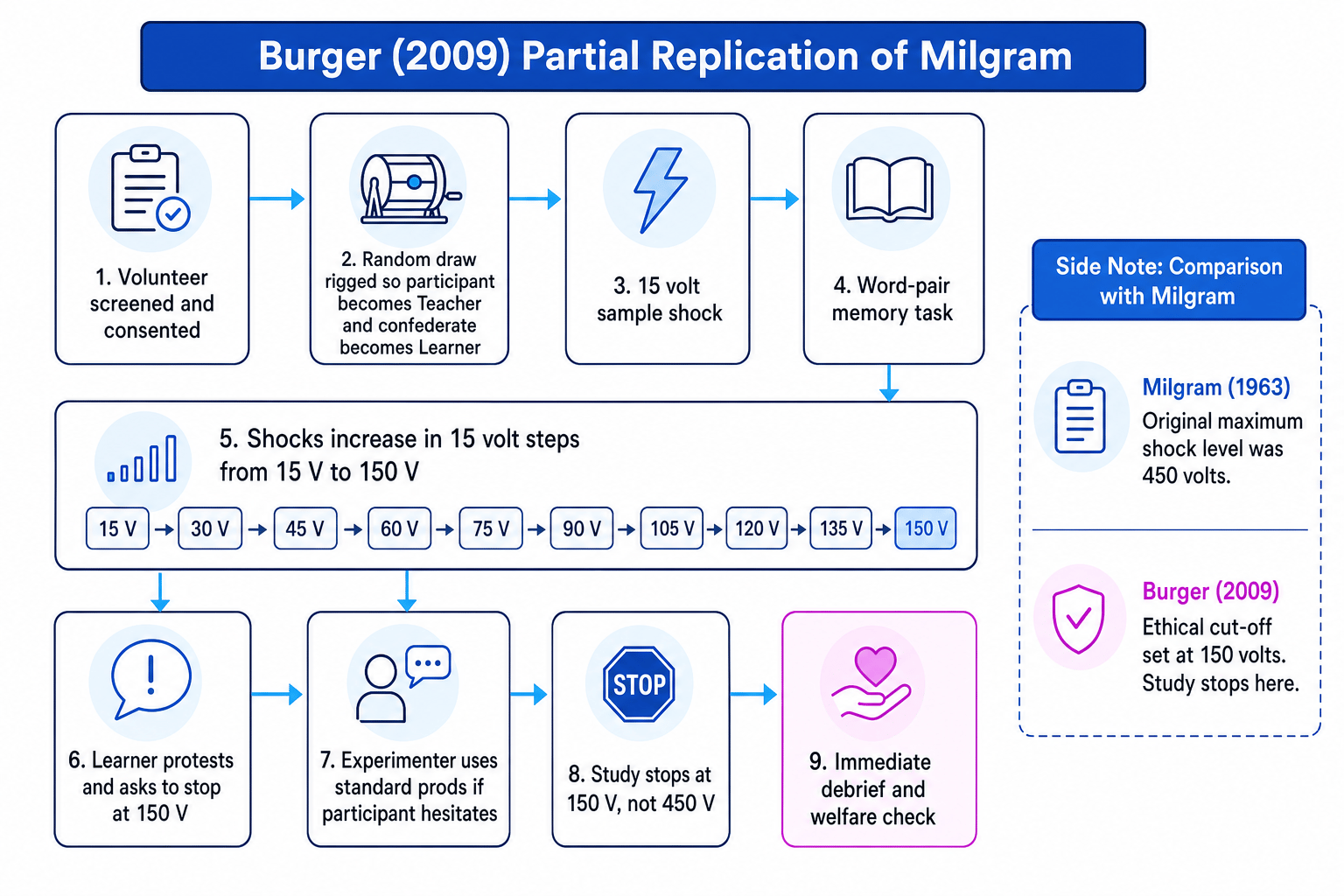
Burger did not take participants all the way to Milgram’s maximum 450 volts. Instead, he stopped the study at 150 volts, because Milgram’s data suggested that if people passed this point, most would continue to the end.
Method: what kind of study was it?
Burger used a laboratory experiment. This means the study took place in a controlled setting where the researcher could standardise the procedure.
Laboratory experiment
A laboratory experiment is a study conducted in a controlled environment where researchers manipulate an independent variable and measure its effect on a dependent variable.
Burger used two main conditions:
- Baseline condition: the participant was placed in the teacher role and was asked to continue giving shocks up to 150 volts.
- Modelled refusal condition: the participant saw another “teacher” refuse to continue before they took over.
Independent and dependent variables
An independent variable is what the researcher changes. A dependent variable is what the researcher measures.
In Burger’s study, one independent variable was whether the participant saw a model refuse. The dependent variable was whether the participant was willing to continue beyond 150 volts.
Classifying Burger’s variables
- Identify what changed between conditions: some participants saw a confederate refuse to continue, while others did not.
- Decide whether this is an independent variable: yes, because the researcher controlled this difference between groups.
- Identify the measured behaviour: Burger measured whether each participant obeyed the experimenter and agreed to continue after 150 volts.
Participants and sampling
Burger used a volunteer sample of adults from the local community in the United States. Participants were paid for taking part. The final sample included 70 participants, with both men and women, and a wide adult age range.
Volunteer sample
A volunteer sample is made up of people who choose to take part after seeing an advert or invitation.
This sampling method helped Burger recruit adults outside a student-only sample. However, volunteers may be different from the wider population. For example, they may be more curious, more confident, or more motivated by payment.
Assuming the sample represents everyone
Do not write that Burger’s findings automatically apply to all people. The sample was American, self-selected and screened, so generalisability is limited.
Procedure: what happened?
Participants were told the study was about learning and memory. In reality, the focus was obedience.
Each participant met another person who appeared to be another volunteer, but was actually a confederate. A confederate is an actor working with the researcher while pretending to be a real participant.
The participant was always assigned the role of teacher, while the confederate became the learner. The teacher had to test the learner on word pairs and give increasingly strong electric shocks for incorrect answers. The shocks were fake, but the participant believed they were real.
Burger’s procedure stopped at 150 volts, when the learner gave a strong protest and asked to stop. If the participant hesitated, the experimenter used standardised verbal prompts, similar to Milgram’s.
Standardised procedure
A standardised procedure means each participant experiences the same instructions, setting and sequence of events as far as possible. This improves reliability because differences in behaviour are less likely to be caused by inconsistent treatment.
Ethical safeguards
Burger’s study was still deceptive and potentially stressful, but it included major safeguards compared with Milgram.
Burger used:
- screening to exclude people who might be especially vulnerable to distress
- a clear statement that participants could withdraw and still receive payment
- a 150-volt stopping point rather than continuing to 450 volts
- a clinical psychologist available during the procedure
- an immediate debrief, where participants were told the shocks were not real and the learner was unharmed
Debrief
A debrief happens after a study, when participants are told the true aims, any deception is explained, and their wellbeing is checked.
The study is useful for discussing the BPS Code of Ethics and Conduct (2009). Relevant principles include consent, deception, right to withdraw, protection from harm, confidentiality and debrief.
Calling Burger completely ethical
Burger was more ethical than Milgram, but not free from ethical issues. Participants were still deceived and some may still have experienced stress because they believed they were harming another person.
Findings
In the baseline condition, about 70% of participants were willing to continue beyond 150 volts. This was lower than Milgram’s comparable figure, but still showed a high level of obedience.
In the modelled refusal condition, obedience was slightly lower, but not dramatically so. Seeing another person refuse did not prevent most participants from obeying.
Burger also found no strong gender difference. Men and women showed similar levels of obedience.
Main result
The majority of Burger’s participants were still willing to obey the experimenter after the learner strongly protested at 150 volts.
Using Burger’s findings to make a conclusion
- Compare the key percentage with the research question: if 70% of baseline participants were willing to continue, the majority still obeyed authority.
- Compare this with Milgram: the level of obedience was not identical, but it was similar enough to suggest obedience had not disappeared in modern society.
- Add a limitation to the conclusion: Burger did not test whether participants would actually continue to 450 volts, so the conclusion must be cautious.
Interpreting the statistics
Burger’s study mainly gives you percentages and comparisons between conditions. In exam answers, you do not need to calculate an inferential test for Burger, but you should understand what “significant” means.
Statistical significance
A result is statistically significant if it is unlikely to have happened by chance. In A-Level Psychology, the usual convention is p≤.05p \le .05p≤.05, meaning there is a 5% or lower probability that the result is due to chance.
For Edexcel research methods more broadly:
- Mann-Whitney U is used for a difference between two independent groups.
- Wilcoxon signed-ranks is used for a difference between two related conditions.
- Spearman’s rho is used for a correlation.
- Chi-square is used for an association between categories.
Burger’s baseline and modelled refusal conditions involved different participants, so if you were testing the difference between those two conditions, the logic would fit an independent-groups comparison.
Linking methods to Burger
If an exam asks about Burger’s design, focus on the independent-groups comparison between baseline and modelled refusal, and the behavioural measure of obedience: willingness to continue after 150 volts.
AO3 evaluation: strengths
Strong control and standardisation
Burger used a controlled laboratory setting. The learner’s protests, the shock sequence and the experimenter’s prompts were standardised. This improves reliability, meaning the study could be repeated in a similar way.
It also improves internal validity, because the researcher can be more confident that obedience was influenced by the authority situation rather than random differences in procedure.
Ethical improvements over Milgram
Burger’s screening, 150-volt stopping point and immediate debrief reduced the risk of harm. This makes the study more acceptable under modern ethical standards.
This is a strong evaluation point because it shows Burger learned from criticisms of Milgram while still investigating an important social behaviour.
Real-world relevance
The study helps explain why ordinary people may follow harmful orders in organisations, workplaces, military settings or institutions. It suggests that authority can powerfully affect behaviour even in modern society.
AO3 evaluation: weaknesses
It was only a partial replication
Burger did not allow the procedure to continue to 450 volts. This was ethical, but it creates a validity issue: we cannot know for certain that participants who agreed to continue after 150 volts would have gone all the way.
The 150-volt assumption
Burger relied on Milgram’s finding that 150 volts was a “point of no return” for many participants. However, agreeing to continue after 150 volts is not exactly the same as delivering shocks up to 450 volts.
Deception and distress remained
Participants were deceived about the true aim and believed the learner was receiving shocks. This challenges fully informed consent. Even with safeguards, participants may have experienced guilt, anxiety or embarrassment.
Generalisability is limited
The sample was American, volunteer-based and screened. People who were excluded for ethical reasons may have behaved differently. Therefore, the findings may not generalise to all cultures, age groups or personality types.
Demand characteristics may have affected behaviour
Demand characteristics
Demand characteristics are cues in a study that may lead participants to guess the aim and change their behaviour.
Some participants might have suspected that the shocks were fake or that the study was really about obedience. If so, their behaviour may not reflect genuine obedience.
However, the emotional reactions of many participants suggest the situation still felt real to them. This is called experimental realism, where a task feels psychologically involving even if the setting is artificial.
How to use Burger in essays
For AO1, describe the aim, procedure, sample, findings and conclusion. Keep it precise: Burger tested whether people would still obey today using an ethical partial replication of Milgram.
For AO2, apply the study to scenarios involving authority. Look for:
- a clear authority figure giving instructions
- pressure to continue despite discomfort
- gradual commitment, where small steps build into more serious actions
- whether other people obey or refuse
For AO3, balance the answer. Burger is strong because it is controlled, standardised and ethically improved. But it is limited because it is a partial replication, uses deception, and may not generalise widely.
In the exam
- For AO1, include the key numbers: Burger stopped at 150 volts and around 70% of baseline participants were willing to continue.
- For AO3, do not just say “ethical”; explain both sides — Burger reduced harm, but deception and distress still existed.
- Compare with Milgram carefully: Burger supports Milgram’s obedience findings, but it was not a full 450-volt replication.
Check yourself
- Why did Burger stop the procedure at 150 volts rather than 450 volts?
- What is one strength and one weakness of using a laboratory experiment in this study?
- How could you use the BPS ethical principles to evaluate Burger’s research?
