How do groups of peaceful, well-adjusted people turn on one another? And once hostility is ignited, how can it be extinguished? These were the central questions addressed by Muzafer Sherif and his colleagues in their famous 1954/1961 field study, the Robbers Cave experiment.
This study is a cornerstone of the Social Psychology section of your Edexcel A-Level. It provides the empirical backing for Realistic Conflict Theory (RCT), which explains how prejudice and discrimination arise from competition over scarce resources.
What you'll learn
- How Sherif created and then resolved conflict between two groups of boys.
- The three distinct stages of the Robbers Cave experiment.
- How to evaluate the study's methodological strengths, weaknesses, and significant ethical issues.
- How to perform quantitative calculations on the study's friendship data.
Background and Context
Before Sherif's study, many psychologists believed that prejudice was simply a product of individual personality traits (such as an authoritarian personality). Sherif wanted to prove a different theory: that prejudice is a normal, predictable response to situational factors—specifically, intergroup competition.
To investigate this, Sherif conducted a field experiment in the controlled, isolated environment of a summer camp at Robbers Cave State Park, Oklahoma.
In-group and Out-group
An in-group is a social group to which an individual feels they belong and identify with (the "us"). An out-group is any social group with which an individual does not identify (the "them").
Methodology and Sample
Sherif selected 22 boys aged 11 to 12 years old. To ensure that existing psychological difficulties or unstable family backgrounds did not confound the results, the researchers carefully screened the boys.
All participants were:
- White, middle-class, and Protestant.
- From stable, two-parent homes in Oklahoma.
- Psychologically well-adjusted with no history of behavioral problems.
The boys did not know each other prior to the study. They were randomly allocated into two matched groups of 11, ensuring an even distribution of athletic ability, academic performance, and physical strength.
The Illusion of a Camp
Neither the boys nor their parents knew they were taking part in an experiment on prejudice. The parents paid a nominal fee, and the boys believed they were simply attending a standard two-week summer camp. This raises massive ethical issues regarding deception and informed consent.
The Three Stages of the Study
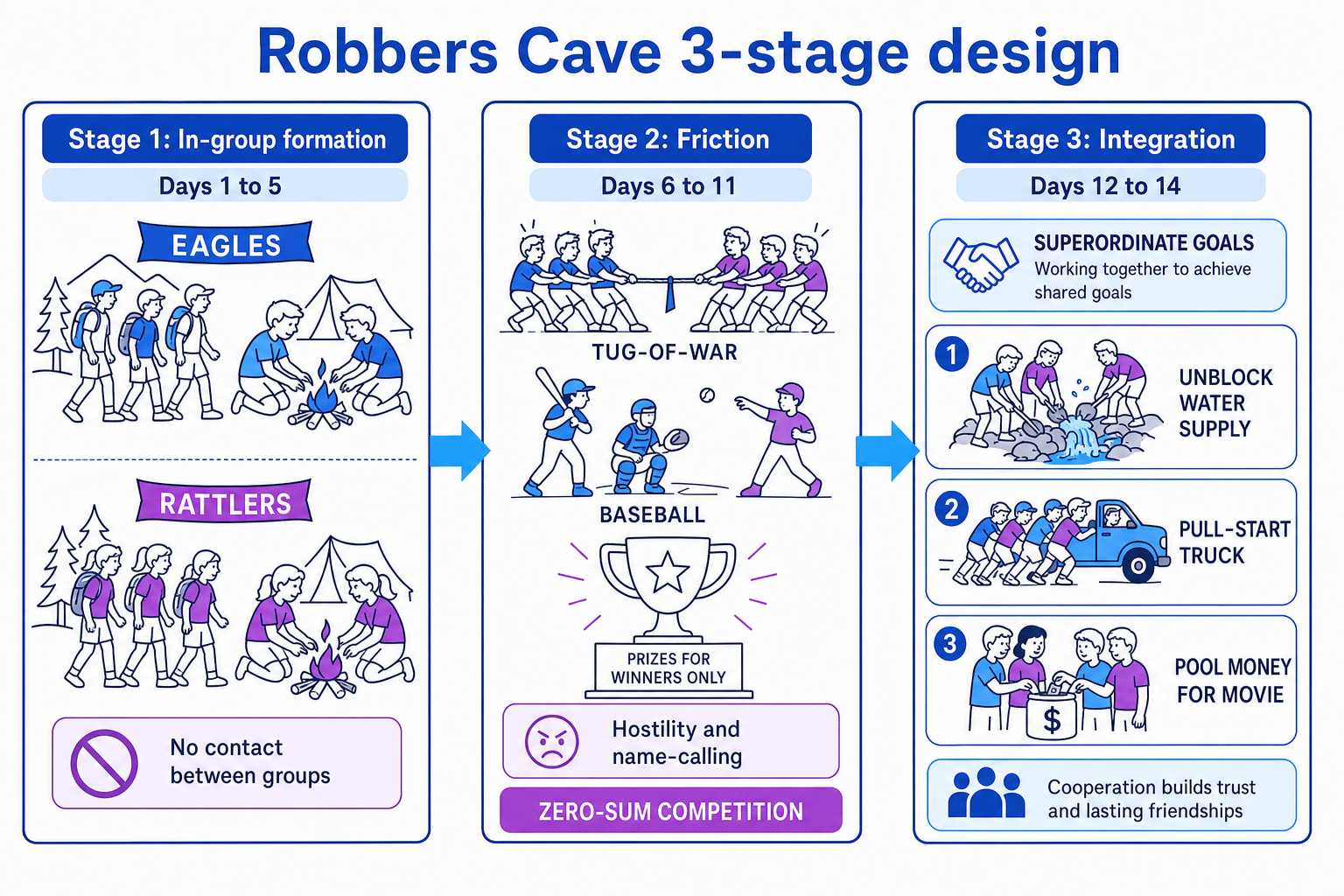
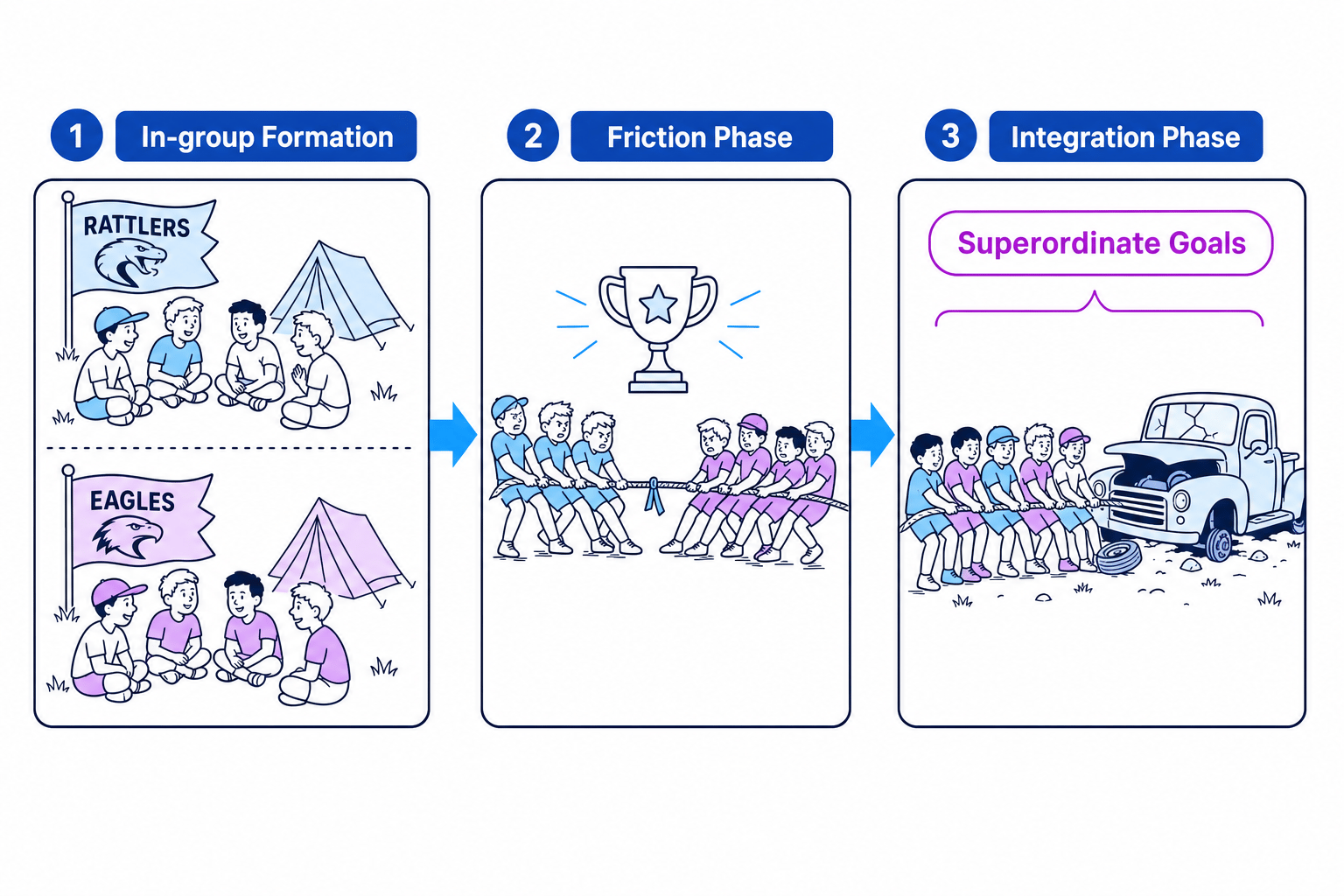
The study took place over three distinct, consecutive stages, designed to first build groups, then create conflict, and finally attempt to resolve it.
Stage 1: In-group Formation (Days 1–5)
The two groups were kept completely separate in different areas of the park. They had no knowledge of each other’s existence.
To encourage in-group cohesion (bonding), the boys took part in cooperative activities such as hiking, swimming, and building campfires. Within days, both groups naturally developed their own cultures, rules, and hierarchies. They also chose names for themselves: one group became the Rattlers, and the other became the Eagles.
Stage 2: Friction Phase (Days 6–11)
The researchers introduced the two groups to each other and announced a tournament of competitive games, including baseball, tug-of-war, and tent pitching.
To spark conflict, a zero-sum situation was created:
- The winners of the tournament would receive a highly desirable trophy and shiny medals/pocket knives.
- The losers would receive absolutely nothing.
This competition over scarce, non-shareable resources quickly turned the boys against each other. What started as lighthearted teasing rapidly deteriorated into intense hostility.
Stage 3: Integration Phase (Days 12–14)
Sherif wanted to see if he could reverse the hostility he had created.
- Mere Contact: First, the groups were brought together for non-competitive social activities, like eating meals together or watching movies. This failed completely; the contact only provided further opportunities for food fights, name-calling, and physical altercations.
- Superordinate Goals: Next, the researchers artificially engineered situations where the two groups had to work together to solve a mutual problem.
Superordinate Goals
Superordinate goals are shared objectives that cannot be achieved by any single group acting alone; they require the cooperative efforts of two or more groups to succeed.
Sherif introduced three superordinate goals:
- The disrupted water supply: The camp's water system was blocked (deliberately sabotaged by the staff), and the boys had to work together to clear the blockage.
- The broken-down truck: The camp truck, which was supposed to go get food, "failed" to start. Both groups had to use a tug-of-war rope to pull-start the vehicle together.
- Paying for a movie: The boys wanted to watch a movie, but the camp could not afford it. The boys agreed to pool their money to pay for it together.
Findings and Results
The results of the study painted a vivid picture of how quickly hostility can be manufactured and dismantled.
Stage 2 (Friction) Results
Hostility was immediate and severe. The boys engaged in:
- Verbal abuse: Mutual name-calling ("sissies", "sneaks").
- Physical aggression: Cabin raids, stealing the other group's belongings, and burning the Eagles' flag.
- In-group favoritism: The boys rated their own group members as "brave" and "tough" while characterizing the out-group as "stuck-up" or "cowardly."
At this stage, friendship choices were highly ethnocentric (restricted to the in-group). Only 6.4%6.4\%6.4% of the Rattlers' friendship choices were Eagles, and only 7.5%7.5\%7.5% of the Eagles' friendship choices were Rattlers.
Stage 3 (Integration) Results
The introduction of superordinate goals successfully dissolved the hostility.
- After pulling the camp truck together, the boys made dinner together without fighting.
- By the final day, the boys insisted on riding home on the same bus.
- When they stopped for milkshakes on the way home, the Rattlers used the $5 prize money they had won in the Stage 2 tournament to buy drinks for all the boys.
Out-group friendship choices rose dramatically, as detailed in the worked example below.
Calculating percentage increase in out-group friendships
At the end of Stage 2 (Friction), only 7.5%7.5\%7.5% of the Eagles' friendship choices were boys from the Rattlers (the out-group). By the end of Stage 3 (Integration), this figure rose to 36.4%36.4\%36.4%.
Let's calculate the percentage increase in out-group friendship choices for the Eagles.
-
Identify the original and new values:
- Original Value (V1V_1V1) = 7.5%7.5\%7.5%
- New Value (V2V_2V2) = 36.4%36.4\%36.4%
-
Calculate the absolute change: Subtract the original value from the new value:
Change=36.4−7.5=28.9 \text{Change} = 36.4 - 7.5 = 28.9 Change=36.4−7.5=28.9 -
Divide the change by the original value:
Relative Change=28.97.5≈3.8533 \text{Relative Change} = \frac{28.9}{7.5} \approx 3.8533 Relative Change=7.528.9≈3.8533 -
Multiply by 100 to get the percentage increase:
Percentage Increase=3.8533×100≈385.3% \text{Percentage Increase} = 3.8533 \times 100 \approx 385.3\% Percentage Increase=3.8533×100≈385.3%
Answer: The percentage of out-group friendships among the Eagles increased by 385.3%385.3\%385.3% following the introduction of superordinate goals.
The Core Takeaway of Robbers Cave
Prejudice is not inevitable, nor is it purely an individual personality flaw. It is a predictable response to competition over scarce resources (zero-sum situations). However, prejudice can be actively reversed by fostering intergroup cooperation through shared, superordinate goals.
AO3: Evaluation of Sherif et al. (1954/1961)
When evaluating Sherif's study for an essay, you must balance its excellent real-world validity against its serious methodological and ethical flaws.
Methodological Strengths
- High Ecological Validity: The study was a field experiment conducted in a real-life summer camp setting. The boys behaved naturally because they did not know they were in a psychological study, meaning demand characteristics were virtually non-existent.
- Methodological Triangulation: Sherif used multiple methods to collect data, including covert observation, audio recordings, and sociometric questionnaires (friendship ratings). This increases the reliability and validity of the findings.
- Careful Participant Matching: The researchers spent up to 300 hours screening participants to ensure they were matched on athletic and intellectual ability. This minimized individual differences (participant variables) as confounding variables.
Methodological Weaknesses
- Sample Bias (Generalizability): The sample consisted entirely of 22 white, middle-class, American, Protestant, 11-12-year-old boys. This is an androcentric (male-only) and ethnocentric (culture-specific) sample, making it difficult to generalise the findings to girls, adults, or collectivist cultures.
- Lack of Standardisation: As a field study, extraneous variables (such as weather, minor injuries, or individual staff temperaments) could not be fully controlled. This reduces the study's internal reliability and makes it difficult to replicate exactly.
- Observer Bias / Active Manipulation: Some critics (such as Gina Perry, 2012) have argued that the camp counselors (who were actually researchers) actively steered the boys toward conflict. In an earlier, unpublished pilot study by Sherif, the boys united against the researchers instead of fighting each other, suggesting that the conflict at Robbers Cave was heavily stage-managed.
Ethical Issues
- Deception: The boys and their parents were actively deceived. They did not know they were part of an experiment on intergroup hostility.
- Lack of Fully Informed Consent: Neither the boys nor their parents could give truly informed consent because the true nature and hostile conditions of the study were withheld.
- Protection from Harm: The boys were exposed to physical danger (fights, cabin raids, burning flags) and significant psychological distress (feeling rejected, angry, and fearful).
- Right to Withdraw: Because the boys did not know they were in an experiment, they did not have a clear, accessible way to withdraw from the research.
Confusing RCT with SIT
Students often confuse Realistic Conflict Theory (RCT) with Social Identity Theory (SIT).
- SIT (Tajfel) states that prejudice can occur solely from the act of categorising people into groups, even without competition.
- RCT (supported by Sherif) states that categorisation is not enough; there must be competition over scarce resources for active conflict to erupt. Make sure you use Sherif to support RCT, not SIT!
In the exam
- Acknowledge the year: Always refer to the study as "Sherif et al. (1954/1961)" or simply "Sherif (1954/1961)" to show examiners you know your timeline.
- Be precise with the sample size: State clearly that there were 22 boys, split into two groups of 11. Do not estimate.
- Structure your 8- or 12-mark essay carefully: Use the PEEL structure (Point, Evidence, Explanation, Link). Ensure you balance AO1 (describing the stages, sample, and results) with AO3 (critiquing the ethics, ecological validity, and sample bias).
- Use correct terminology: Always use the terms in-group cohesion, zero-sum competition, and superordinate goals. These are the key terms examiners look for.
Check yourself
- Why did the introduction of simple contact (such as eating together) fail to reduce prejudice in Stage 3?
- What are the main limitations of using an all-male, white, middle-class sample when trying to explain real-world prejudice?
- How does the concept of a "zero-sum situation" apply to the tournaments in Stage 2 of the study?