What you'll learn
- The difference between a population and a sample.
- How to describe five sampling methods: random, systematic, stratified, opportunity and volunteer.
- How sampling choices affect bias, representativeness and generalisation.
- How to apply sampling methods to research scenarios and evaluate them for AO3.
Why sampling matters
Psychologists usually cannot study every person they are interested in. Instead, they study a smaller group and use the findings to make cautious claims about a wider group.
For example, if a researcher wants to know whether sleep affects memory in A-level students, they cannot test every A-level student in the UK. They might test 80 students and use that group as evidence.
Population and sample
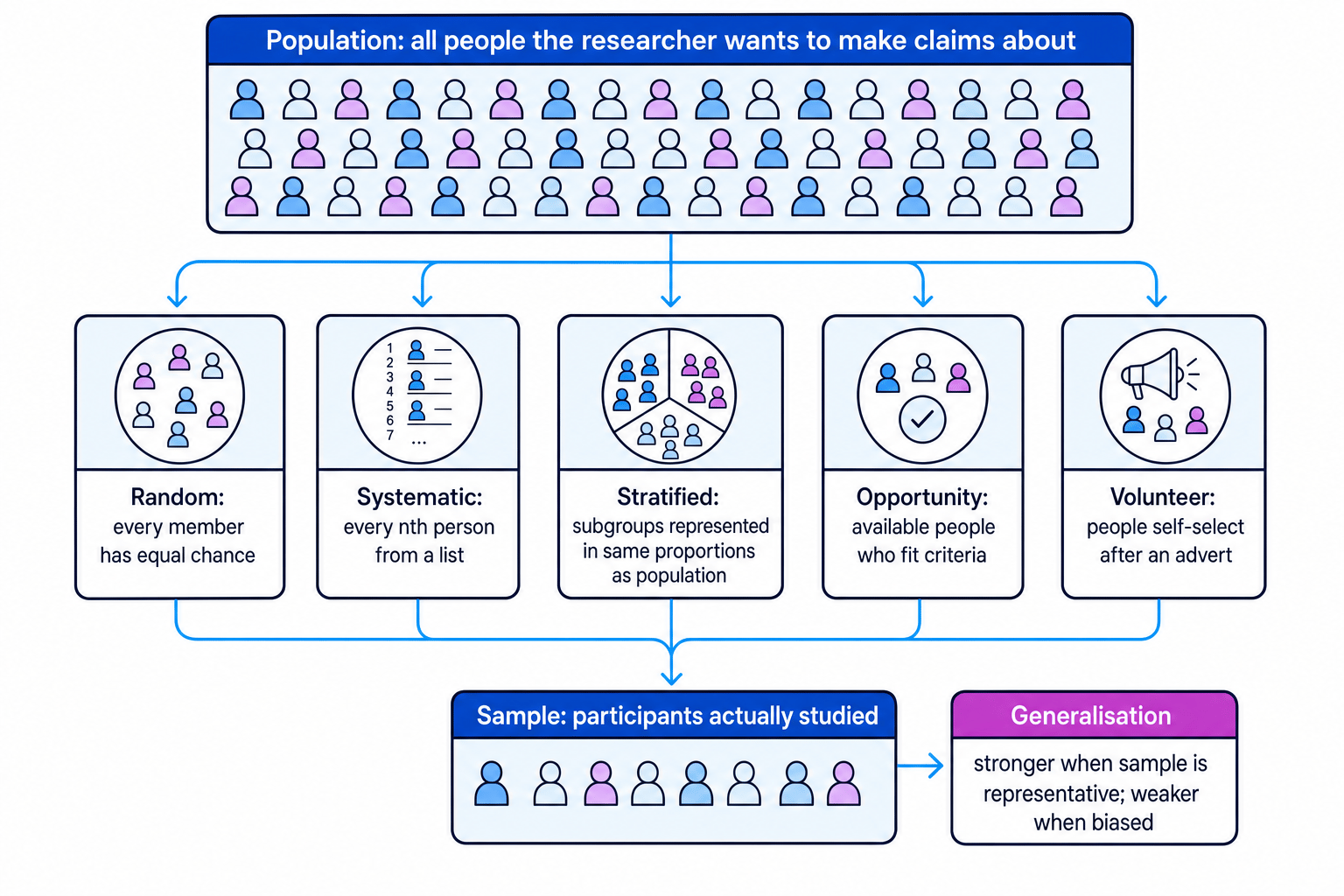
A population is the whole group of people the researcher wants to draw conclusions about. A sample is the smaller group of participants actually studied.
A population does not always mean “everyone in the world”. It might mean “UK A-level Psychology students”, “children aged 3–5 in one nursery chain”, or “adults diagnosed with OCD”.
Sampling frame
A sampling frame is a list of all members of the target population from which a sample can be selected, such as a school register or staff database.
The key question is: does the sample fairly reflect the population?
Representativeness, bias and generalisation
Representativeness
A sample is representative if it reflects the important characteristics of the population, such as age, gender, education, culture or diagnosis, depending on the research question.
Generalisation
Generalisation means applying findings from the sample to the wider population.
If a sample is representative, generalisation is stronger. If it is biased, generalisation is weaker.
Sampling bias
Sampling bias occurs when the sampling method makes some types of people more likely to be selected than others, creating an unrepresentative sample.
For example, if a study on stress only uses volunteers from a gym, the sample may under-represent people who are less health-conscious, less confident, or too busy to volunteer.
The big idea
Sampling is not just an administrative detail. It affects the external validity of research: whether findings can reasonably apply beyond the participants studied.
Probability and non-probability sampling
Sampling methods are often divided into two broad types.
Probability sampling
In probability sampling, members of the population have a known chance of being selected. This includes:
- Random sampling
- Systematic sampling
- Stratified sampling
These methods usually require a sampling frame.
Non-probability sampling
In non-probability sampling, the chance of selection is not known. This includes:
- Opportunity sampling
- Volunteer sampling
These are often easier to carry out but usually create more sampling bias.
Random sampling
Random sampling
Random sampling is when every member of the target population has an equal chance of being selected.
A researcher might put all names from a school register into a random number generator and select the first 50 names produced.
Strengths of random sampling
Random sampling reduces researcher bias, because the researcher is not personally choosing participants. If the sampling frame is complete and the sample is large enough, it can improve representativeness and generalisation.
Weaknesses of random sampling
It can be time-consuming and may require access to a complete list of the population. It can also produce an unrepresentative sample by chance, especially if the sample is small.
Random does not mean convenient
Do not describe asking “whoever is nearby” as random sampling. That is opportunity sampling. Random sampling requires a genuine random selection process, such as a random number generator.
Systematic sampling
Systematic sampling
Systematic sampling is when every nth person is selected from a list, usually after choosing a random starting point.
For example, a researcher may choose every 10th student from a college register.
The sampling interval can be worked out like this:
sampling interval=population sizedesired sample size\text{sampling interval} = \frac{\text{population size}}{\text{desired sample size}}sampling interval=desired sample sizepopulation sizeUsing systematic sampling
A researcher has a list of 200 students and wants a sample of 20.
- Work out the interval: 200÷20=10200 \div 20 = 10200÷20=10, so the researcher should select every 10th student.
- Choose a random starting point between 1 and 10, for example 4.
- Select student 4, then 14, then 24, and continue adding 10 until the sample contains 20 students.
Strengths of systematic sampling
It is simpler than pure random sampling and can spread participants evenly across a list. It is also fairly objective because the researcher follows a fixed rule.
Weaknesses of systematic sampling
It can be biased if the list has a hidden pattern. For example, if a school register is organised by form groups and every 10th student is from the same form, the sample may be distorted.
Hidden list patterns
Systematic sampling works best when the list order is not linked to the variable being studied. If the list has a pattern, selecting every nth person can accidentally over-sample one type of participant.
Stratified sampling
Stratified sampling
Stratified sampling involves dividing the population into important subgroups, called strata, and selecting participants from each stratum in the same proportions as they exist in the population.
A stratum is a subgroup, such as gender, age group, year group, diagnosis category or ethnicity, depending on what matters for the research.
For example, if 60% of a school population is in Year 12 and 40% is in Year 13, a stratified sample should also be 60% Year 12 and 40% Year 13.
Calculating a stratified sample
A researcher wants a sample of 50 students from a sixth form. The population has 240 Year 12 students and 160 Year 13 students.
- Find the total population: 240+160=400240 + 160 = 400240+160=400 students.
- Work out the Year 12 proportion: 240400=0.6\frac{240}{400} = 0.6400240=0.6, so 60% of the sample should be Year 12.
- Apply that proportion to the sample size: 0.6×50=300.6 \times 50 = 300.6×50=30, so select 30 Year 12 students.
- Work out the Year 13 number: 50−30=2050 - 30 = 2050−30=20, so select 20 Year 13 students.
Strengths of stratified sampling
Stratified sampling is often the most representative method because it deliberately mirrors the population on key characteristics. This can improve generalisation and reduce sampling bias.
Weaknesses of stratified sampling
It requires detailed and accurate population information. It is also more time-consuming than opportunity or volunteer sampling. It only controls for the strata chosen; the sample could still be biased in other ways.
Best method for representativeness
If an exam question asks which method is most likely to produce a representative sample, stratified sampling is usually the strongest answer, provided the researcher has accurate population data.
Opportunity sampling
Opportunity sampling
Opportunity sampling involves selecting people who are available and willing at the time.
For example, a researcher studying memory might ask the first 30 students they find in the college café.
Strengths of opportunity sampling
It is quick, cheap and practical. This is useful when researchers have limited time or need participants for a small-scale study or pilot study.
Weaknesses of opportunity sampling
It is highly vulnerable to sampling bias. People in one location at one time may share characteristics. For example, students in the library at 8:30am may be more conscientious than students elsewhere.
Opportunity sampling can also involve subtle pressure. If a teacher asks students in their own class to take part, students may feel they cannot really refuse.
Forgetting ethics in sampling
Even if participants are easy to access, researchers still need informed consent, the right to withdraw, confidentiality, protection from harm and debriefing where appropriate.
Volunteer sampling
Volunteer sampling
Volunteer sampling is when participants self-select by responding to an advert, email, poster or online request.
For example, a researcher might post an online advert asking people who experience exam anxiety to complete a questionnaire.
Strengths of volunteer sampling
Volunteers may be more motivated, reliable and willing to provide detailed data. This can be useful for sensitive topics, because people choose to take part rather than being approached directly.
Weaknesses of volunteer sampling
Volunteer samples often suffer from volunteer bias. People who volunteer may be more confident, more opinionated, more interested in psychology, or more affected by the topic than non-volunteers.
This limits generalisation because the sample may not reflect the wider population.
Applying sampling to research scenarios
In exams, you may be given a short scenario and asked to identify the sampling method or explain one limitation.
Judging generalisation from a scenario
A psychologist posts an advert on a Psychology department noticeboard asking for students to take part in a study about social media use. Thirty students volunteer. The psychologist concludes that the findings apply to all UK teenagers.
- Identify the sampling method: participants responded to an advert and chose to take part, so this is volunteer sampling.
- Consider likely bias: Psychology students may be unusually interested in behaviour research and may not represent teenagers who do not study Psychology.
- Judge the generalisation: the conclusion is too broad because a small volunteer sample from one department cannot confidently represent all UK teenagers.
Comparing the five sampling methods
| Method | Basic idea | Main strength | Main weakness |
|---|---|---|---|
| Random | Everyone has an equal chance | Reduces researcher bias | Needs a complete sampling frame |
| Systematic | Every nth person from a list | Simple and objective | Biased if the list has a pattern |
| Stratified | Subgroups represented proportionally | Usually most representative | Time-consuming and needs population data |
| Opportunity | Available people are used | Quick and practical | Often unrepresentative |
| Volunteer | People self-select | Participants are willing | Volunteer bias |
Implications for AO3 evaluation
When evaluating a study, sampling is often a strong AO3 point because it affects external validity.
A study can have excellent controls and still be limited if the sample is narrow. For example, a laboratory study using only university students may not generalise to children, older adults, people from different cultures, or people outside education.
However, a biased sample does not always make a study useless. Sometimes a researcher deliberately studies a specific population. If the aim is to investigate anxiety in A-level students, then using A-level students is appropriate. The problem comes when the researcher makes claims beyond that target population.
Match sample to aim
A sample is not “bad” just because it is small or specific. It becomes a problem when it does not match the population the researcher wants to generalise to.
Sample size also matters, but it does not fix everything. A large biased sample can still be unrepresentative. For example, thousands of online volunteers may still exclude people without internet access or people who avoid surveys.
Also, statistical significance is not the same as generalisability. A result may be significant at p<0.05p < 0.05p<0.05, but if the sample is biased, you should still be cautious about applying it to the wider population.
In the exam
- When identifying a sampling method, focus on how participants were selected, not just who they were.
- For evaluation, link the method to bias and then to generalisation: “This may mean the sample is unrepresentative, so findings may not apply to…”
- In scenario questions, name the specific population the researcher is claiming to study, then judge whether the sample matches it.
Check yourself
- What is the difference between a population and a sample?
- Why is stratified sampling often more representative than opportunity sampling?
- How could volunteer bias reduce the generalisability of a psychological study?

