What you'll learn
- The purpose of a scientific report in psychology.
- What belongs in the abstract, introduction, method, results, discussion and referencing sections.
- How to apply report sections to a scenario in AO2 questions.
- How to evaluate reporting as part of the wider scientific process.
Why psychologists write scientific reports
Psychology aims to produce evidence that other researchers can understand, check and build on. A report is not just a “write-up”; it is part of the scientific process because it makes the investigation transparent.
Scientific report
A scientific report is a structured account of an investigation, written so that readers can see why the study was done, how it was carried out, what was found and what the findings mean.
A key aim is replicability, which means another researcher should have enough detail to repeat the study in the same way. Good reporting also supports peer review, where other psychologists judge whether the research is valid, ethical and useful.
The purpose of report sections
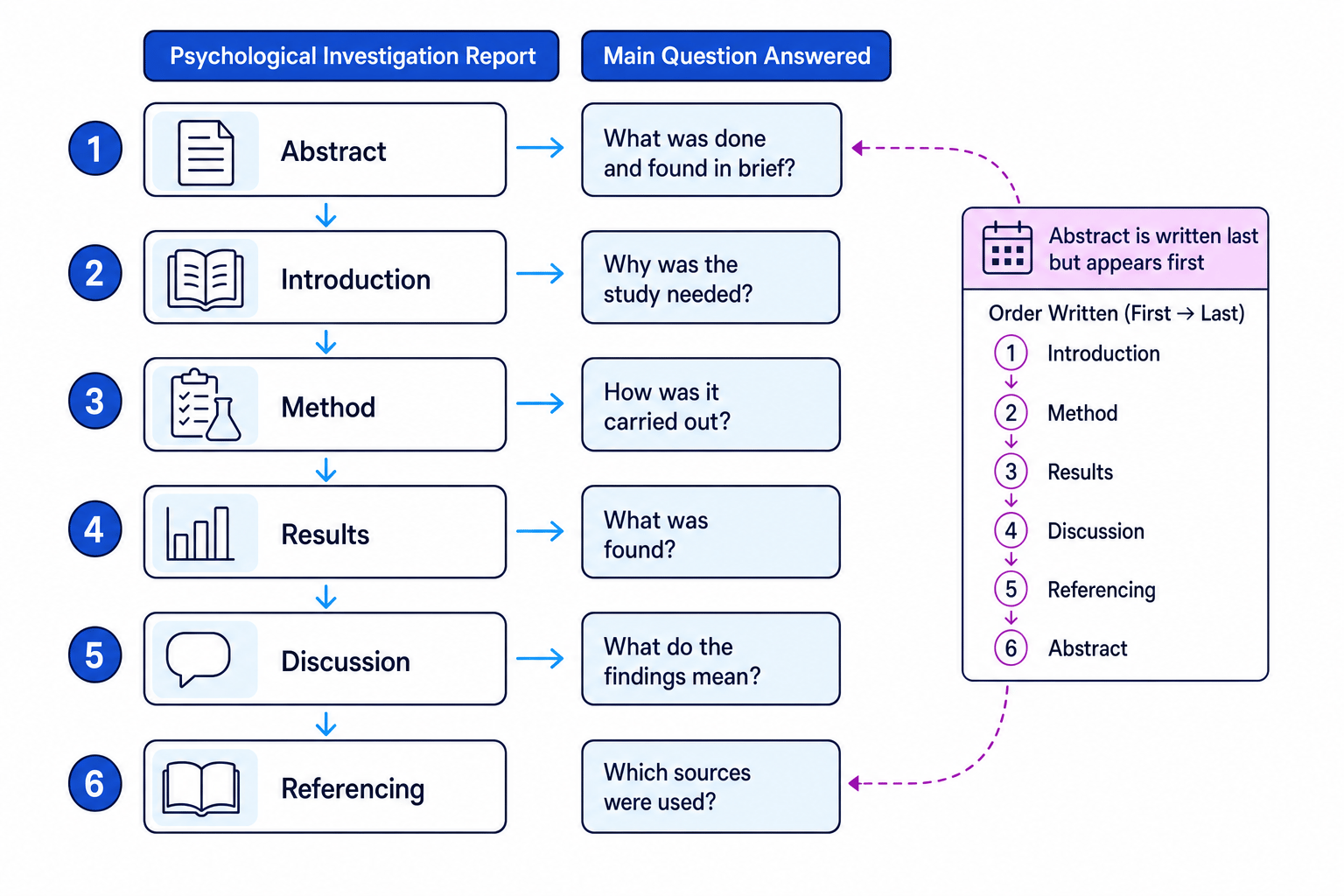
Each section answers a different question: why, how, what, and so what? If you know which question is being answered, you can usually identify the correct section.
This flowchart shows the standard order of a psychological investigation report, and the important point that the abstract appears first but is usually written last.
The standard report structure
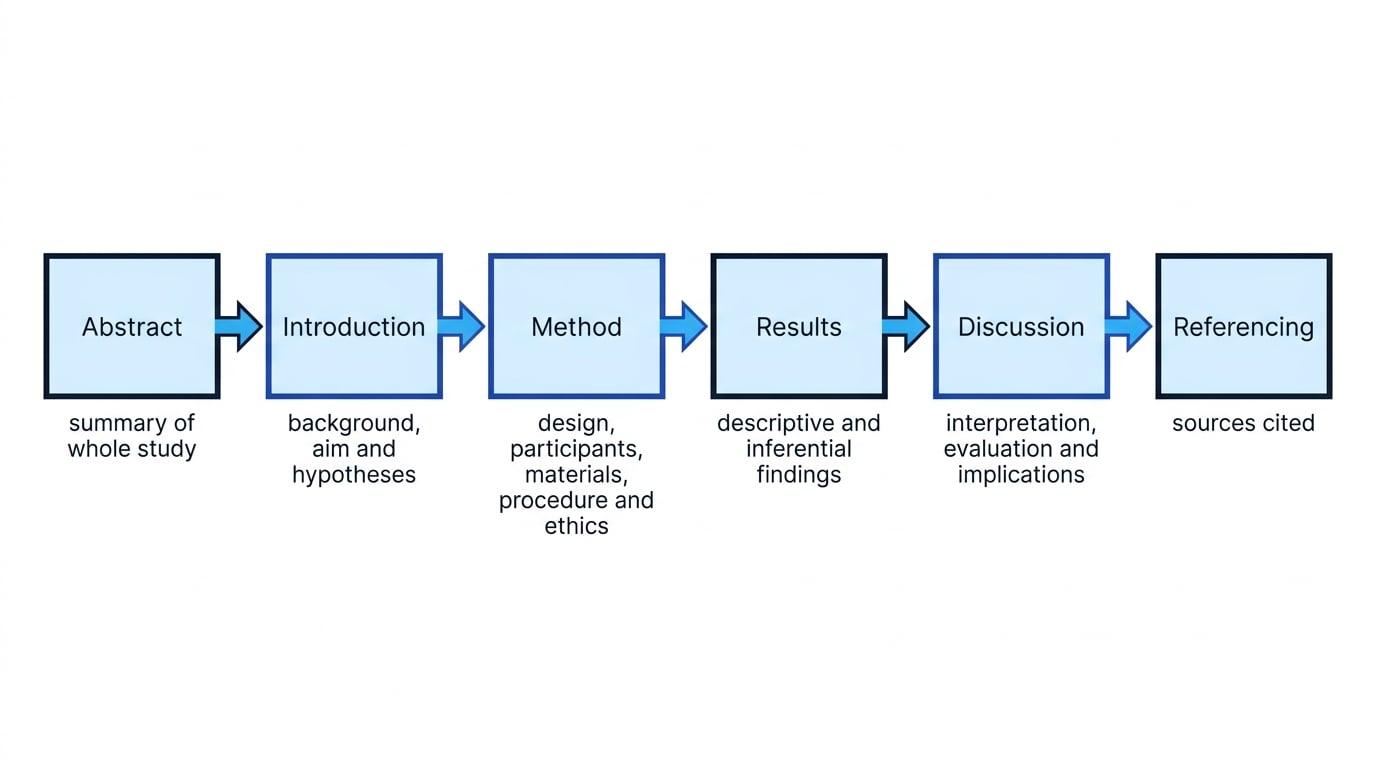
Psychological reports usually follow a structure similar to IMRaD: Introduction, Method, Results and Discussion, with an abstract at the start and referencing at the end.
| Section | Main purpose | Typical content |
|---|---|---|
| Abstract | Summarises the whole report | Aim, method, key result, conclusion |
| Introduction | Explains why the study was needed | Background research, rationale, aims, hypotheses |
| Method | Explains how the study was carried out | Design, participants, materials, procedure, ethics |
| Results | Presents what was found | Descriptive statistics, graphs/tables, statistical test outcome |
| Discussion | Explains what the findings mean | Interpretation, limitations, improvements, implications |
| Referencing | Shows which sources were used | In-text citations and full reference list |
Abstract
Abstract
An abstract is a brief summary of the whole investigation, placed at the beginning of the report but usually written after the other sections are finished.
A strong abstract normally includes the aim of the study, a short description of the method, the main results, and the overall conclusion. It should give the reader enough information to understand the study’s purpose and outcome without reading the full report.
The abstract should be concise. It should not contain long explanations, detailed raw data, or a full evaluation.
Writing the abstract like an introduction
The abstract is not just background information. It should summarise the entire investigation, including what was found.
Introduction
The introduction explains the background and reasoning behind the investigation. It usually begins with broader psychological theory or research, then narrows down to the specific aim of the study.
Rationale
A rationale is the reason why the study is worth doing, based on gaps, problems or disagreements in existing research.
In a psychology report, the introduction often includes:
- relevant theories or previous studies
- strengths or limitations of earlier research
- the reason the current study is needed
- the aim, meaning what the study intends to investigate
- the hypothesis, meaning a testable prediction about the outcome
A hypothesis may predict a difference between conditions or a relationship between variables. A null hypothesis predicts no significant difference or relationship.
For AO3, a good introduction should not cherry-pick only supportive research. It should acknowledge contradictory evidence where relevant, because this makes the rationale more balanced and scientific.
Introduction shortcut
Think: “What does the reader need to know before the study makes sense?” That belongs in the introduction.
Method
The method section explains exactly how the investigation was conducted. Its main job is to make the study replicable.
A method section usually includes several smaller parts.
Design
The design describes how the investigation was organised. For example, an experiment might use an independent groups design, where different participants take part in different conditions, or a repeated measures design, where the same participants take part in all conditions.
It should also identify key variables. The independent variable is what the researcher changes, and the dependent variable is what the researcher measures.
Participants
The participants section describes who took part and how they were selected. This may include sample size, age range, gender distribution, sampling method and relevant inclusion or exclusion criteria.
This matters for AO3 because the sample affects generalisability, which means how far the findings can be applied beyond the people actually studied.
Materials or apparatus
Materials are the items used in the study, such as word lists, questionnaires, consent forms, standardised instructions or rating scales. Apparatus refers to equipment, such as computers, timers or recording devices.
Procedure
The procedure is a step-by-step account of what participants did. It should be detailed enough for another researcher to repeat the investigation.
Good procedure writing includes controls, such as standardised instructions. Standardisation means keeping procedures the same for all participants so that extraneous variables are less likely to affect the results.
Ethical considerations
Psychological reports should make clear how ethical issues were handled. The main ethical considerations include:
- consent: participants agree to take part after receiving relevant information
- deception: participants are misled or not told the full purpose of the study
- right to withdraw: participants can leave the study and withdraw their data
- protection from harm: researchers avoid physical or psychological risk
- confidentiality: personal data is kept private
- debrief: participants are told the true aims and given support after the study
Method equals replicability
If another researcher could not repeat the study from your method section, it is probably not detailed enough.
Results
The results section presents the findings without giving a full interpretation. It answers: what was found?
Results may include descriptive statistics, which summarise the data, such as means, medians, ranges or standard deviations. They may also include inferential statistics, which test whether the findings are likely to be due to chance.
Statistical significance
A result is statistically significant if it is unlikely to have occurred by chance, usually judged against the default psychology threshold of p<0.05p < 0.05p<0.05.
A p-value is the probability of getting the observed result, or a more extreme result, if the null hypothesis is true. An effect size describes the strength or size of a difference or relationship, rather than just whether it is statistically significant.
In the results section, you might include:
- a clearly labelled table or graph
- summary statistics
- the statistical test used
- the calculated test statistic
- whether the result is significant
- whether the null hypothesis is rejected or retained
Interpreting in the results section
Do not use the results section to explain why the findings happened. Save interpretation, limitations and implications for the discussion.
Reporting a results decision
A researcher investigates whether revision time is positively correlated with recall score. Ten students are ranked for revision time and ranked for recall score. The researcher uses Spearman’s rho and obtains rs=0.62r_s = 0.62rs=0.62.
-
Identify the correct test context: this is a correlational design using ranked/ordinal data, so Spearman’s rho is suitable.
-
Identify the decision rule: for N=10N = 10N=10, a one-tailed test at p<0.05p < 0.05p<0.05 has a critical value from the table. Suppose the critical value is 0.564. For a predicted positive correlation, reject the null hypothesis if the observed value is equal to or greater than the critical value.
-
Compare the values: rs=0.62r_s = 0.62rs=0.62, and 0.62≥0.5640.62 \ge 0.5640.62≥0.564, so the result is statistically significant.
-
Report it appropriately: “There was a significant positive correlation between revision time and recall score, so the null hypothesis was rejected.” Do not claim that revision time definitely caused better recall, because correlation does not prove causation.
Discussion
The discussion explains what the findings mean. It links the results back to the aim, hypothesis and previous research.
A strong discussion usually includes:
- whether the findings support or fail to support the hypothesis
- how the findings compare with previous research
- possible explanations for the results
- methodological strengths and weaknesses
- ethical issues that may have affected the study
- suggestions for future research
- real-world applications or implications
For AO3, this is where you evaluate. A limitation is a weakness that affects the study’s credibility, such as a small sample, low ecological validity or uncontrolled extraneous variables. Ecological validity means how far a study reflects real-life behaviour.
A discussion should be balanced. For example, a study might have strong control of variables, improving internal validity, but low ecological validity if the task was artificial.
Discussion shortcut
Think: “So what?” What do the results mean, how trustworthy are they, and what should happen next?
Referencing
Referencing
Referencing means acknowledging the sources used in a report, both in the text and in a full reference list at the end.
A citation is a brief mention of a source within the report, usually including the author and year. A reference list gives the full details of every source cited, so the reader can find it.
Referencing matters because it:
- shows where ideas and evidence came from
- allows readers to check the original research
- avoids plagiarism, which means presenting someone else’s work as your own
- shows that the study is part of a wider body of psychological evidence
The reference section is usually organised alphabetically by author surname. Every source cited in the report should appear in the reference list, and every source in the reference list should have been cited in the report.
Bibliography versus reference list
A reference list contains sources you actually cited. A bibliography may include wider reading. In psychological reports, you normally need a reference list.
Applying the sections to a scenario
In AO2 questions, you may be given pieces of information and asked which section they belong in. Focus on the job each section is doing.
Placing material in the right section
A student investigates whether background music affects memory for a word list. Twenty participants are split into a music condition and a silent condition. The student reports mean recall scores, uses a Mann-Whitney U test, compares the findings with previous research, and notes that the sample was small.
-
Put the background research and comparison studies in the introduction if they explain why the study was needed. If the comparison is made after the results, it belongs in the discussion.
-
Put the participant details, music/silent conditions, word list, instructions and ethical procedures in the method, because these explain how the study was carried out.
-
Put the mean recall scores, graph and Mann-Whitney U outcome in the results, because these describe what was found.
-
Put the small sample size in the discussion, because it is an evaluation point about generalisability.
-
Put the full details of any studies or sources used in referencing, because readers need to locate the evidence.
Evaluating scientific reporting
The standard report format is useful because it improves transparency. Researchers can judge the quality of the method, check whether conclusions follow from results, and replicate the study if needed.
It also supports ethical accountability. For example, if a report clearly explains consent, deception, confidentiality and debriefing, readers can evaluate whether participants were treated appropriately.
However, reporting is only as good as the researcher’s honesty and clarity. Poor reports may hide important details, overstate conclusions, or ignore contradictory findings. Publication bias can also be a problem; this is when studies with significant or interesting results are more likely to be published than studies with non-significant findings.
AO3 view
Scientific reporting is a strength of psychology because it promotes transparency, replication and peer review, but reports can still be affected by selective reporting, unclear methods or biased interpretation.
In the exam
-
If asked to identify a report section, ask which question the information answers: why, how, what, or so what.
-
Keep results and discussion separate: results present findings; discussion interprets and evaluates them.
-
When describing the method, include enough detail for replication and mention relevant ethics, especially consent, withdrawal, protection from harm, confidentiality and debrief.
Check yourself
- What is the difference between the abstract and the introduction?
- Which section should include participant details, procedure and ethical safeguards?
- Why is referencing important in a psychological investigation report?