When you study AQA Psychology, you are not just learning about human mind and behavior; you are learning how to study them scientifically. But what actually makes a subject a "science"?
Philosophers and researchers have established clear criteria that a discipline must meet to be considered a science. In this topic, you will learn these features and explore the ongoing debate about where psychology fits on this spectrum.
What you'll learn
- The core features of scientific inquiry: objectivity, the empirical method, replicability, and falsifiability.
- How scientific theories are built and tested using inductive and deductive loops.
- What paradigms and paradigm shifts are, and whether psychology has them.
1. Objectivity and the Empirical Method
For a discipline to be scientific, its findings must not be based on opinions, personal beliefs, or subjective feelings. Instead, they must be based on hard, observable evidence.
Objectivity
Objectivity is the practice of minimizing all personal biases, expectations, and subjective feelings during the research process to ensure that the findings are not influenced by the person gathering them.
To remain objective, researchers must maintain a "critical distance." They must not let their own values or expectations affect the design of a study, the behavior of the participants, or the interpretation of the data.
- High objectivity: Laboratory experiments with highly controlled conditions and automated data collection (e.g., measuring reaction times in milliseconds or using fMRI brain scans).
- Low objectivity: Unstructured interviews or subjective clinical case studies where the researcher's interpretation of a participant's words could be highly biased.
Empirical Method
The empirical method refers to the collection of data through direct, sensory observation and experience rather than through logical argument, hearsay, or speculation.
You cannot simply sit in an armchair and theorize how memory works; you must design an experiment, observe how many words people recall, and collect raw data. Early pioneers like John B. Watson argued that psychology could only become a science if it abandoned introspection and focused solely on observable, measurable behavior (the behaviorist approach).
2. Replicability and Falsifiability
Getting a fascinating result in a study once is not enough to make it scientific. It must be consistently reproducible.
Replicability
Replicability is the ability to repeat a scientific procedure and obtain the exact same or highly consistent findings.
To make replication possible, psychologists must write up their research reports with extreme precision, documenting their standardized procedures, exact instructions, stimuli used, and sample characteristics.
Why is replicability so important?
- Checks reliability: It ensures that findings are not just a "one-off" fluke or a result of a biased sample.
- Validates findings: If a study can be repeated across different cultures, time periods, and genders with the same results, we can generalize the findings widely.
Confusing replicability with reliability
While closely related, do not confuse them in exam answers. Reliability is the consistency of a measuring tool (e.g., a questionnaire or a scale). Replicability refers to the ability to repeat an entire research study to see if the overall findings are consistent.
Falsifiability
In the mid-20th century, philosopher of science Karl Popper (1959) argued that the key hallmark of a scientific theory is not whether it can be proven true, but whether it is capable of being proven false.
Falsifiability
Falsifiability is the principle that a scientific theory must be constructed in a way that allows it to be empirically tested and potentially proven wrong (falsified).
Popper famously used the analogy of swans: even if you observe one thousand white swans, you have not "proven" the theory that "all swans are white." However, finding just one black swan completely disproves (falsifies) it.
Therefore, a strong theory must make specific, testable predictions. Theories that cannot be tested and potentially proven wrong are classified as pseudoscience (fake science).
The Freud example
The psychodynamic approach is the ultimate example of an unfalsifiable theory. For instance, if Freud claims a boy has an unconscious "Oedipus complex," and the boy exhibits behavior matching this, the theory is "supported." If the boy shows no such behavior, Freudians claim it is because the memory is "deeply repressed." Because there is no possible evidence that could prove the theory wrong, it is unfalsifiable and therefore unscientific.
3. Theory Construction and Hypothesis Testing
Science is a continuous cycle of building explanations and putting them to the test.
Theory Construction
Theory construction is the process of formulating a systematic explanation for a behavior or phenomenon by gathering empirical evidence and organizing it into a cohesive framework of laws or principles.
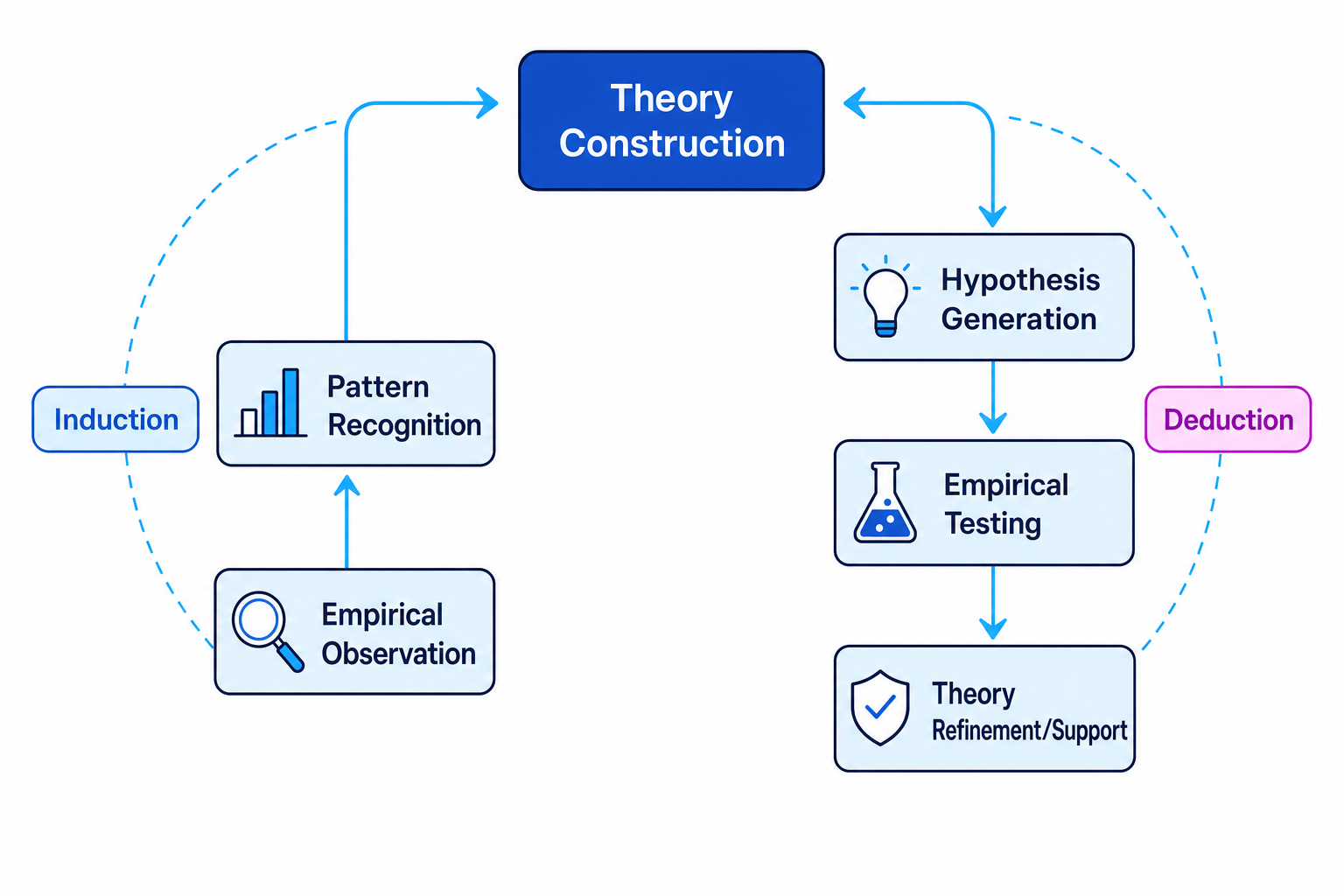
There are two primary ways a theory can be constructed:
- Induction (Bottom-Up): A researcher observes a behavior first, notices a consistent pattern, and then constructs a theory to explain it.
- Deduction (Top-Down): A researcher starts with an existing theory, derives specific hypotheses from it, and then conducts empirical testing to see if the predictions hold true.
Hypothesis Testing
Hypothesis testing is the process of empirically evaluating specific, testable predictions derived from a theory.
If the empirical data supports the hypothesis, the theory is strengthened. If the data refutes the hypothesis, the theory must be modified, refined, or abandoned entirely. In psychological research, hypothesis testing involves running statistical tests (such as a Wilcoxon or Chi-Square test) to determine if findings are statistically significant, typically using a significance level of p<0.05p < 0.05p<0.05 (meaning there is a less than 5% probability that the results occurred by chance).
Evaluating a Theory's Falsifiability
A psychologist claims: "All human beings possess an unconscious 'protective shield' that completely blocks out traumatic childhood memories. However, if a person does remember a childhood trauma, it is because their conscious ego temporarily lowered the shield."
Let's walk through how to evaluate this claim against the criterion of falsifiability.
- Identify the core prediction: The theory predicts that traumatic memories are blocked by an unconscious shield, unless the shield is lowered, in which case they are remembered.
- Examine the logical outcomes of an empirical test:
- Outcome A: A patient cannot remember childhood trauma. This is explained as the shield working perfectly.
- Outcome B: A patient can remember childhood trauma. This is explained as the shield temporarily lowering.
- Determine if any outcome can disprove the theory: No matter what the empirical data shows (the patient remembers or does not remember), the theory is able to explain it away. There is no possible observation that could disprove the existence of this "shield."
- Draw a scientific conclusion: Because there is no empirical evidence that could possibly falsify the claim, the "Protective Shield Theory" is unscientific.
4. Paradigms and Paradigm Shifts
How does science actually progress over time? The philosopher Thomas Kuhn (1962) suggested that science does not develop in a slow, steady, linear path. Instead, it undergoes dramatic revolutions.
Paradigm
A paradigm is a shared set of unified assumptions, theories, methods, and terminology that is accepted by the vast majority of scientists working within a particular discipline.
Kuhn argued that what truly distinguishes a mature science (like physics or chemistry) from a non-science is the presence of a single, dominant paradigm.
The Stages of Scientific Progress
Kuhn outlined three distinct stages in the history of any scientific discipline:
- Pre-science: No single paradigm exists. Instead, there are numerous competing schools of thought, each with different assumptions and methods.
- Normal science: A dominant paradigm is established. Researchers work within this framework, conducting "puzzle-solving" research that supports the accepted paradigm.
- Revolution (Paradigm Shift): Over time, researchers encounter contradictory evidence (anomalies) that the current paradigm cannot explain. As these anomalies accumulate, the paradigm enters a state of crisis. Eventually, a scientific revolution occurs: a new paradigm is proposed, accepted, and replaces the old one.
Paradigm Shift
A paradigm shift is a fundamental change in the basic concepts and experimental practices of a scientific discipline, resulting in a scientific revolution.
The Copernicus Paradigm Shift
In astronomy, the dominant paradigm for centuries was that the Earth was the center of the universe (geocentric model). As astronomical tools improved, scientists observed anomalies (planetary movements) that this model could not explain. Nicolaus Copernicus proposed that the Sun was the center (heliocentric model). Despite initial resistance, this caused a massive paradigm shift that revolutionized astronomy.
5. The Great Debate: Is Psychology a Science?
Now that we know the features of science, we can evaluate whether psychology meets these criteria. This is excellent material for high-scoring AO3 evaluation essays.
Arguments that Psychology is NOT a Science
- Lack of a single paradigm (Pre-science): Kuhn argued that psychology is a "pre-science" because it has no single, universally agreed-upon paradigm. Instead, it is split into competing approaches (e.g., biological, cognitive, behaviorist, psychodynamic, humanist) that disagree on the very cause of human behavior and how to study it.
- Unfalsifiable concepts: Many core psychological concepts (such as the id, self-actualization, or internal working models) cannot be directly observed or proven false.
- Lack of absolute objectivity: Because psychologists study human beings, they are vulnerable to investigator effects and demand characteristics. Total objectivity is virtually impossible when the observer and the observed are the same species.
Arguments that Psychology IS a Science
- Shared scientific methods: Despite having different approaches, almost all modern psychologists agree on the methods used to establish truths (e.g., empirical testing, using quantitative data, and statistical significance tests at p<0.05p < 0.05p<0.05).
- Evidence of paradigm shifts: Some psychologists argue that psychology has experienced paradigm shifts. It began as the study of the mind (Wundt's introspection), shifted to the study of observable behavior (the behaviorist paradigm of Watson and Skinner), and then shifted again to the study of mental processes (the cognitive revolution of the 1960s). Today, we may be transitioning into a biological/neuroscience paradigm.
- Highly scientific sub-disciplines: Fields like neuropsychology, biological psychology, and cognitive neuroscience use extremely objective methods, including EEG, fMRI, and genetic mapping, which are fully falsifiable and replicable.
In the exam
- Be precise with key terms: Make sure you can write down the exact definitions of falsifiability, replicability, objectivity, and empirical methods. Examiners frequently ask short, high-mark recall questions on these.
- Use specific psychological examples: When discussing these features, always back them up. For example, if discussing falsifiability, contrast Freud's psychodynamic theory (unfalsifiable) with Pavlov's classical conditioning (highly falsifiable).
- Structure "Is psychology a science?" essays clearly: If asked to evaluate the scientific status of psychology, dedicate one paragraph to paradigms/Kuhn, one to falsifiability/Popper, and one to objectivity/the empirical method. Ensure you present balanced arguments for both sides before concluding.
Check yourself
- Why did Karl Popper argue that proving a theory "true" is an scientific impossibility?
- What is the difference between an inductive and a deductive approach to theory construction?
- Why did Thomas Kuhn classify psychology as a "pre-science" rather than a mature science?
