What you'll learn
- What a psychological aim is and how to state one clearly.
- How an aim is different from a hypothesis.
- How aims connect to variables, operationalisation, ethics, and study design.
- How to avoid common exam mistakes when writing or identifying aims.
Why aims matter in psychological research
Before psychologists collect data, they need to be clear about what they are trying to find out. This is part of the wider AQA topic of scientific processes: psychology should be systematic, transparent, and based on evidence rather than guesswork.
An aim is usually one of the first parts of a study or practical report. It guides decisions about the method, participants, materials, ethical safeguards, and analysis.
Aim
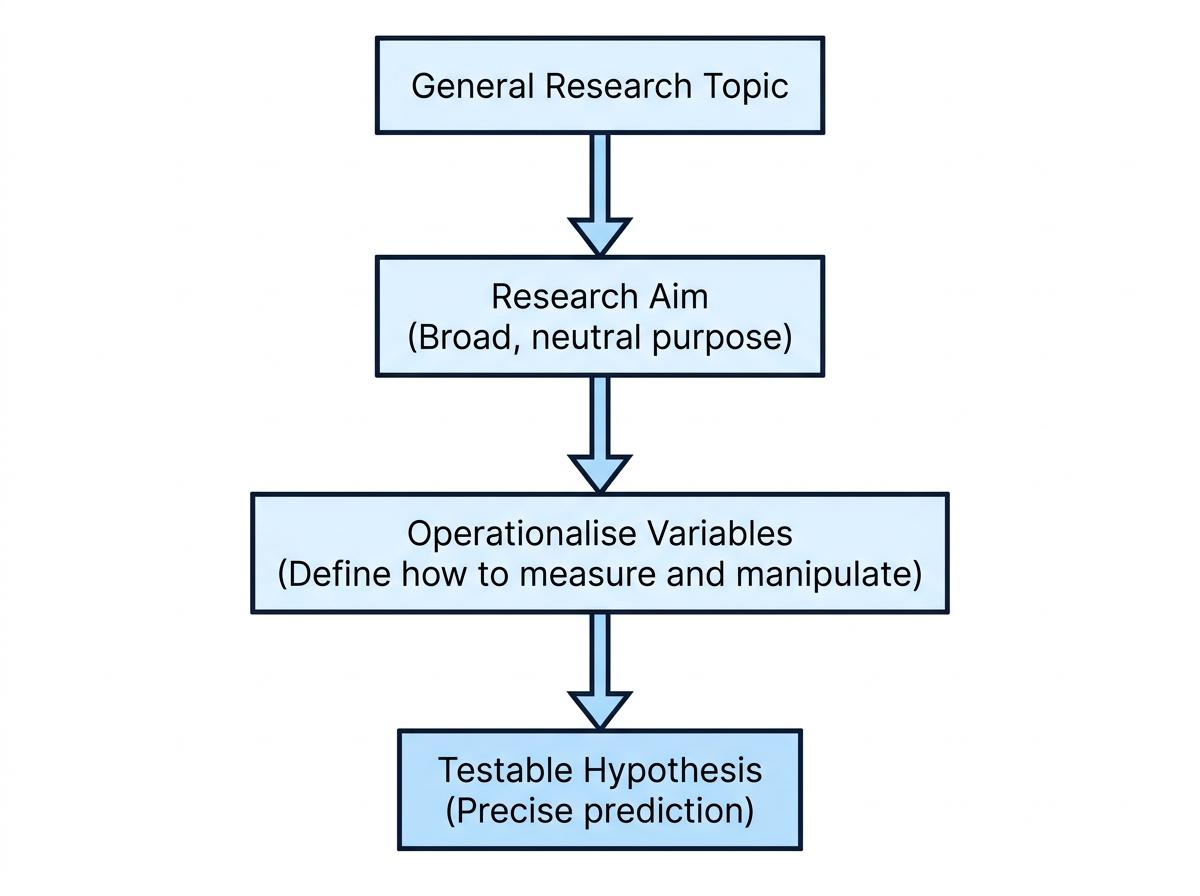
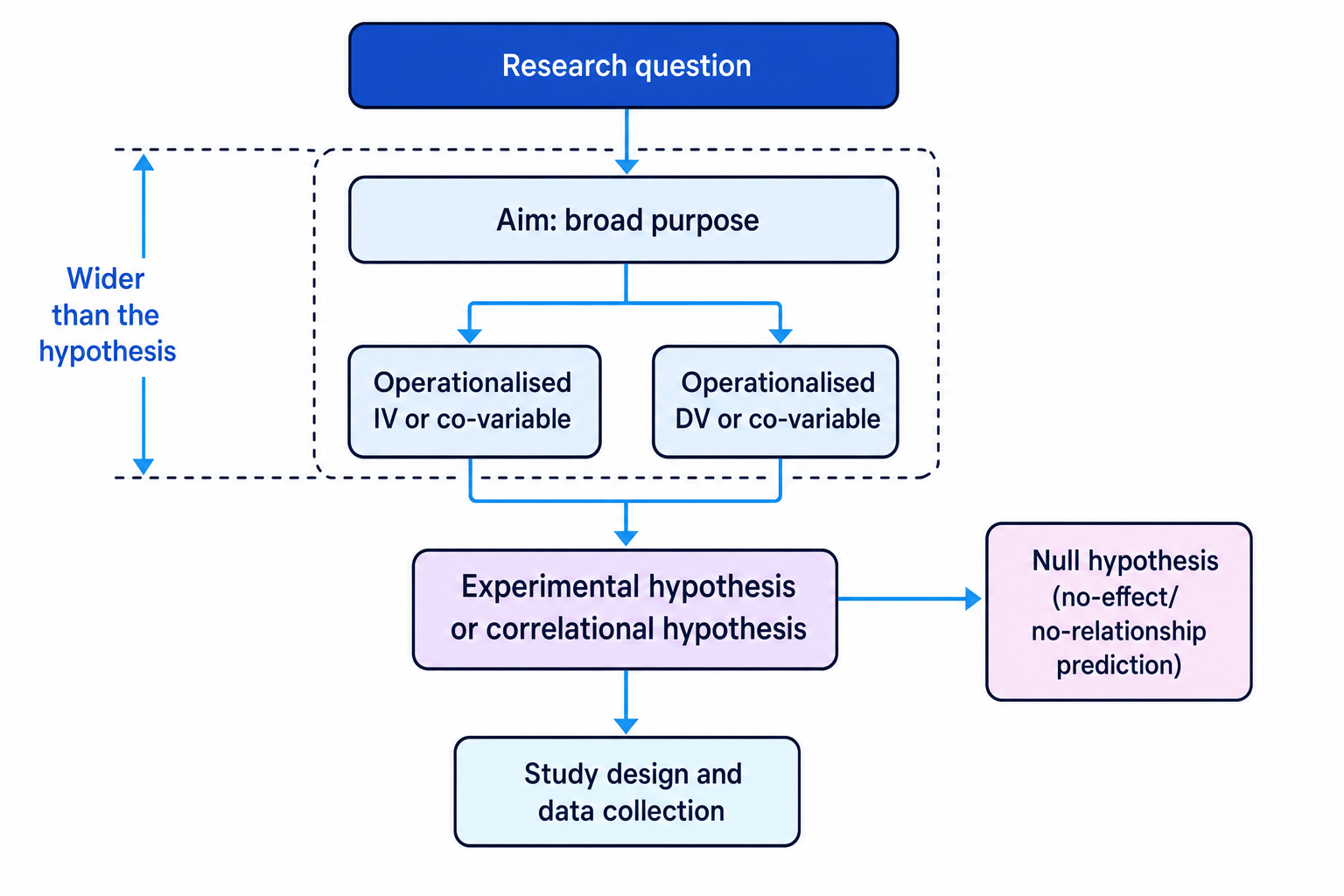
An aim is a general statement of the purpose of a study: what the researcher intends to investigate.
For example, in Loftus and Palmer’s study into eyewitness testimony, the broad aim was to investigate whether the wording of a question could affect participants’ estimates of the speed of cars. That aim tells us the topic and focus, but it does not yet give a fully testable prediction.
Stating aims clearly
A good aim is clear, focused, and neutral. It normally begins with wording such as:
- “To investigate whether…”
- “To examine the relationship between…”
- “To find out if…”
- “To compare…”
A clear aim should usually include:
- the general topic or behaviour being studied
- the key variable or variables involved
- the group or context, if this matters
- no unnecessary detail about exact results
Aims are broad but focused
An aim should tell the reader what the study is about, but it should not sound like a prediction of exactly what will happen.
Examples of aims
A weak aim might be:
“To study memory.”
This is too vague. It does not say what aspect of memory is being studied or how.
A stronger aim would be:
“To investigate whether the wording of a question affects eyewitness estimates of speed.”
This is much clearer because it identifies the issue: question wording and eyewitness speed estimates.
Another example:
“To examine the relationship between daily screen time and self-reported sleep quality in sixth-form students.”
This tells us the two things being related: screen time and sleep quality.
Writing a clear aim from a vague idea
A researcher is interested in whether listening to music affects students’ ability to revise.
-
Identify the general topic: the researcher is interested in music and revision performance, not just “students” or “revision” in general.
-
Decide whether the study is looking for an effect or a relationship. If the researcher plays music to one group and no music to another, this suggests an experiment investigating the effect of music.
-
State the aim without predicting the result: “To investigate whether listening to music affects students’ performance on a revision test.”
Variables: the building blocks behind aims
To understand the difference between aims and hypotheses, you need to understand variables.
Variable
A variable is anything that can change or vary in a study.
In an experiment, you usually have:
- an independent variable, which is what the researcher changes or manipulates
- a dependent variable, which is what the researcher measures
Independent variable and dependent variable
The independent variable, or IV, is the factor deliberately changed by the researcher. The dependent variable, or DV, is the outcome measured to see whether the IV has had an effect.
For example, in a study on music and revision:
- IV: whether students revise with music or in silence
- DV: score on a revision test
In a correlation, the researcher does not manipulate an IV. Instead, they measure two co-variables.
Co-variable
A co-variable is one of two measured variables in a correlational study, where the researcher is looking for a relationship rather than causing a change.
For example, in a correlation between screen time and sleep quality:
- co-variable 1: hours of screen time per day
- co-variable 2: sleep quality score
Do not use causal language for correlations
If a study only measures two co-variables, avoid saying one variable “affects” or “causes” the other. Use wording such as “relationship between” or “association between”.
Operationalisation: making the aim measurable
Aims are broad, but scientific research needs precision. This is where operationalisation comes in.
Operationalisation
Operationalisation means defining variables clearly and specifically so they can be measured or manipulated.
A vague variable would be “memory”. An operationalised version would be “the number of correctly recalled words from a list of 20 after two minutes”.
A vague variable would be “screen time”. An operationalised version would be “the average number of hours spent using a smartphone per day, measured using a seven-day screen-time report”.
Operationalisation is especially important when moving from an aim to a hypothesis.
Operationalising an aim
A study has the aim: “To investigate whether caffeine affects concentration.”
-
Identify the IV: caffeine. To make this measurable, define it as “drinking one cup of coffee containing caffeine” compared with “drinking one cup of decaffeinated coffee”.
-
Identify the DV: concentration. To make this measurable, define it as “number of correct answers on a 30-item attention task completed in five minutes”.
-
Use the operationalised variables to make the study more scientific: the researcher is no longer studying “caffeine” and “concentration” in a vague way, but a specific dose and a specific concentration score.
Hypotheses: the testable prediction
Once the aim is clear, the researcher can write a hypothesis.
Hypothesis
A hypothesis is a precise, testable prediction about the expected outcome of a study.
A hypothesis is more specific than an aim. It should normally state exactly what difference, effect, or relationship is expected.
For example:
- Aim: “To investigate whether question wording affects eyewitness estimates of speed.”
- Hypothesis: “Participants asked how fast the cars were going when they ‘smashed’ into each other will give higher speed estimates than participants asked how fast the cars were going when they ‘hit’ each other.”
The hypothesis is much more precise. It identifies the two conditions and the expected direction of the difference.
Aims vs hypotheses
This distinction is very important in AQA exam questions.
| Feature | Aim | Hypothesis |
|---|---|---|
| Purpose | Says what the study intends to investigate | Predicts what the study expects to find |
| Level of detail | Broad and general | Precise and testable |
| Direction | Usually neutral | May predict a direction |
| Variables | May mention variables generally | Should use clearly operationalised variables |
| Example wording | “To investigate whether…” | “Participants who… will…” |
The key difference
An aim is the purpose of the research. A hypothesis is the prediction that can be tested using data.
Writing a hypothesis when asked for an aim
If the question asks for an aim, do not write “participants will score higher…” or “there will be a difference…”. That is prediction language, so it belongs in a hypothesis.
Different types of hypotheses
Although this sub-topic focuses on aims, you need to know what a hypothesis is in order to explain the difference properly.
Experimental hypothesis
An experimental hypothesis predicts a difference between conditions or an effect of the IV on the DV.
Example:
“Participants who revise in silence will score higher on a revision test than participants who revise while listening to music.”
Correlational hypothesis
A correlational hypothesis predicts a relationship between two co-variables.
Example:
“There will be a positive correlation between hours of daily screen time and self-reported tiredness score.”
Null hypothesis
A null hypothesis predicts no significant difference or no significant relationship.
Null hypothesis
A null hypothesis states that there will be no significant difference, effect, or relationship, and that any observed pattern is due to chance.
Example:
“There will be no significant difference in revision test scores between participants who revise in silence and participants who revise while listening to music.”
Directional and non-directional hypotheses
A directional hypothesis predicts the direction of the effect or relationship.
Example:
“Participants who sleep for eight hours will recall more words than participants who sleep for four hours.”
A non-directional hypothesis predicts that there will be a difference or relationship, but does not say which way it will go.
Example:
“There will be a difference in word recall between participants who sleep for eight hours and participants who sleep for four hours.”
Directional or non-directional?
Use a directional hypothesis when previous research strongly suggests what will happen. Use a non-directional hypothesis when there is limited or mixed evidence.
Turning an aim into a hypothesis
A researcher’s aim is: “To investigate whether sleep duration affects recall of word lists.”
-
Identify the IV and DV. The IV is sleep duration, and the DV is recall performance.
-
Operationalise both variables. Sleep duration could be “four hours or eight hours of sleep”, and recall could be “number of words correctly recalled from a list of 20”.
-
Decide whether the prediction is directional. If previous research suggests more sleep improves memory, a directional hypothesis is appropriate.
-
Write the hypothesis precisely: “Participants who sleep for eight hours will correctly recall more words from a list of 20 than participants who sleep for four hours.”
Why aims are important for scientific processes
Aims support good science because they make the purpose of the research transparent. This helps other researchers understand what was being tested and why.
Clear aims also help with replication, which means repeating a study to check whether similar results are found again. If the aim is vague, it is harder to judge whether a replication is really testing the same idea.
Aims also connect to validity, which refers to whether a study measures what it claims to measure. A clear aim makes it easier to check whether the method actually fits the research purpose.
For example, if the aim is to investigate obedience, as in Milgram’s 1963 research, the procedure needs to create a situation where obedience to authority can genuinely be observed. However, researchers must also consider ethics, including informed consent, deception, right to withdraw, protection from harm, confidentiality, and debriefing. In Milgram’s study, deception and psychological distress were major ethical concerns, even though the research aim was socially important.
AO3: evaluating the role of aims
Strengths of clear aims
Clear aims improve the scientific quality of research because they guide the whole study. They help the researcher choose an appropriate design, decide what data to collect, and avoid drifting away from the original purpose.
They also make research easier to evaluate. If you know the aim, you can judge whether the procedure, sample, materials, and analysis are suitable.
Clear aims are also useful for ethical review. An ethics committee needs to know what the researcher is trying to investigate before deciding whether any deception, stress, or invasion of privacy can be justified.
Limitations and issues
An aim alone is not enough to make a study scientific. A study can have a clear aim but still use a biased sample, poorly operationalised variables, unethical procedures, or an invalid measure.
Aims can also be worded in a biased way. For example, “To prove that social media damages teenagers’ mental health” is not neutral. It assumes the conclusion before data have been collected. A better aim would be: “To investigate the relationship between daily social media use and self-reported mental health scores in teenagers.”
Using the word prove
Avoid saying a study aims to “prove” something. Psychological research usually provides evidence that supports or challenges a claim; it rarely proves it beyond all doubt.
Applying this to classic studies
In Loftus and Palmer’s 1974 study, a suitable aim would be:
“To investigate whether leading questions affect eyewitness memory.”
A hypothesis would be more specific:
“Participants asked the ‘smashed’ question will give higher speed estimates than participants asked the ‘hit’ question.”
This study involved ethical issues because participants were deceived about the exact purpose of the research. However, the task was relatively low risk, and participants could be debriefed afterwards. Confidentiality should also be maintained because individual responses do not need to be publicly identifiable.
In Asch’s 1956 conformity research, a broad aim would be:
“To investigate whether people conform to a majority group in an unambiguous judgement task.”
Again, the hypothesis would predict a specific outcome, such as participants giving more incorrect answers when surrounded by confederates giving the same wrong answer. Ethical issues included deception and possible embarrassment, so debriefing and protection from harm were important.
Mini checklist for writing aims
A strong aim should be:
- clear
- neutral
- linked to the research topic
- broad enough to describe the purpose
- focused enough to guide the method
- not written as a prediction
A strong hypothesis should be:
- precise
- testable
- operationalised
- linked directly to the aim
- written as a predicted difference, effect, or relationship
In the exam
-
If asked for an aim, write a neutral “To investigate…” statement and avoid predicting the result.
-
If asked for a hypothesis, include the variables clearly and make it testable, ideally with operationalised detail.
-
Check the design before choosing your wording: use “effect of” for experiments, but “relationship between” for correlations.
Check yourself
-
What is the difference between an aim and a hypothesis?
-
Why is “To prove that anxiety causes poor memory” a weak aim?
-
How could you turn the aim “To investigate whether noise affects recall” into an operationalised hypothesis?