What you'll learn
- How to describe the behavioural, emotional and cognitive characteristics of phobias, depression and OCD.
- How to apply these characteristics to short scenario questions.
- How to avoid common mistakes, such as treating any fear as a phobia.
- How to add brief AO3 evaluation about diagnosis, overlap and stigma.
First: what are “characteristics”?
In A-Level Psychology, a characteristic means a recognisable feature or symptom of a mental disorder. A symptom is something a person experiences or shows that may indicate a disorder.
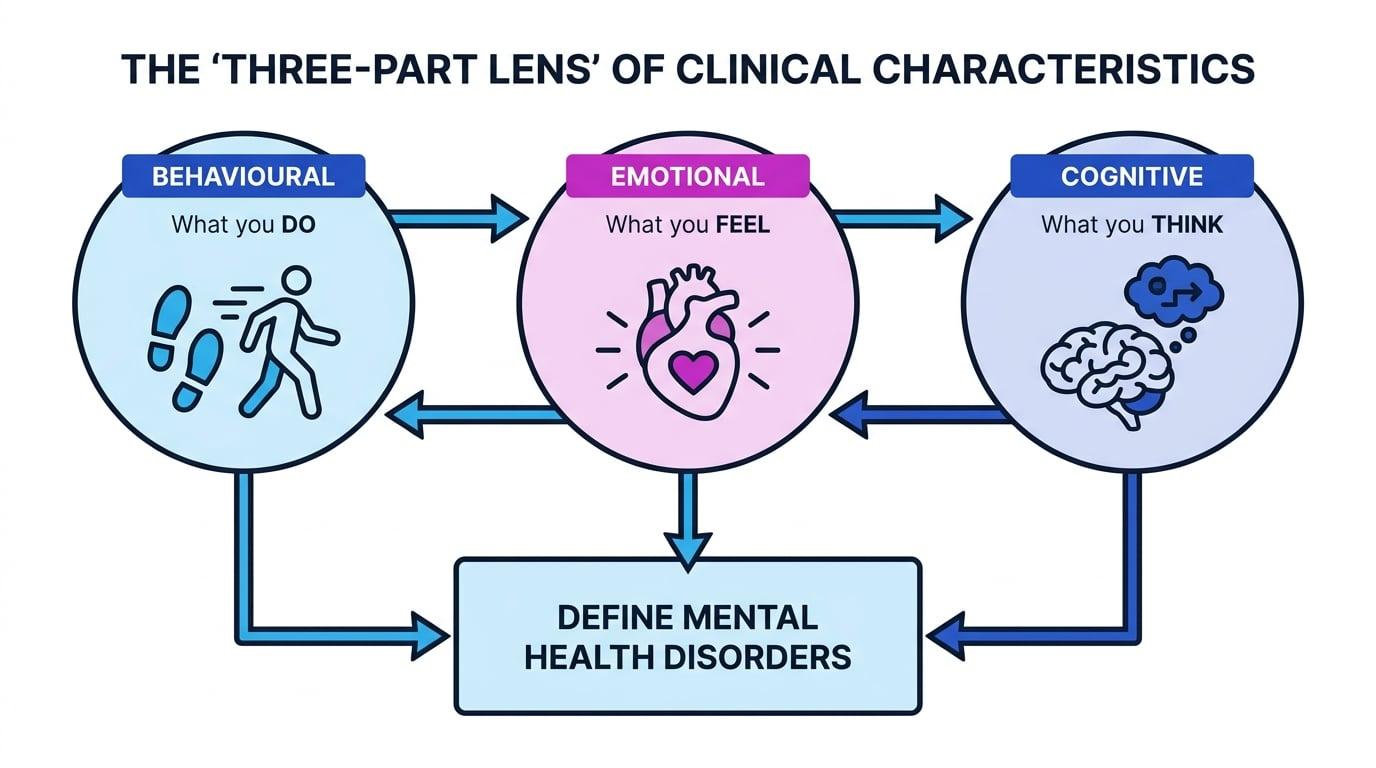
For this topic, AQA wants you to organise symptoms into three categories: what a person does, what they feel, and what they think.
Behavioural, emotional and cognitive characteristics
- Behavioural characteristics are observable actions, such as avoiding a situation, staying in bed, or repeatedly checking a door.
- Emotional characteristics are feelings or moods, such as fear, sadness, guilt or anxiety.
- Cognitive characteristics are thoughts, beliefs, attention patterns or interpretations, such as “I am in danger” or “I am worthless”.
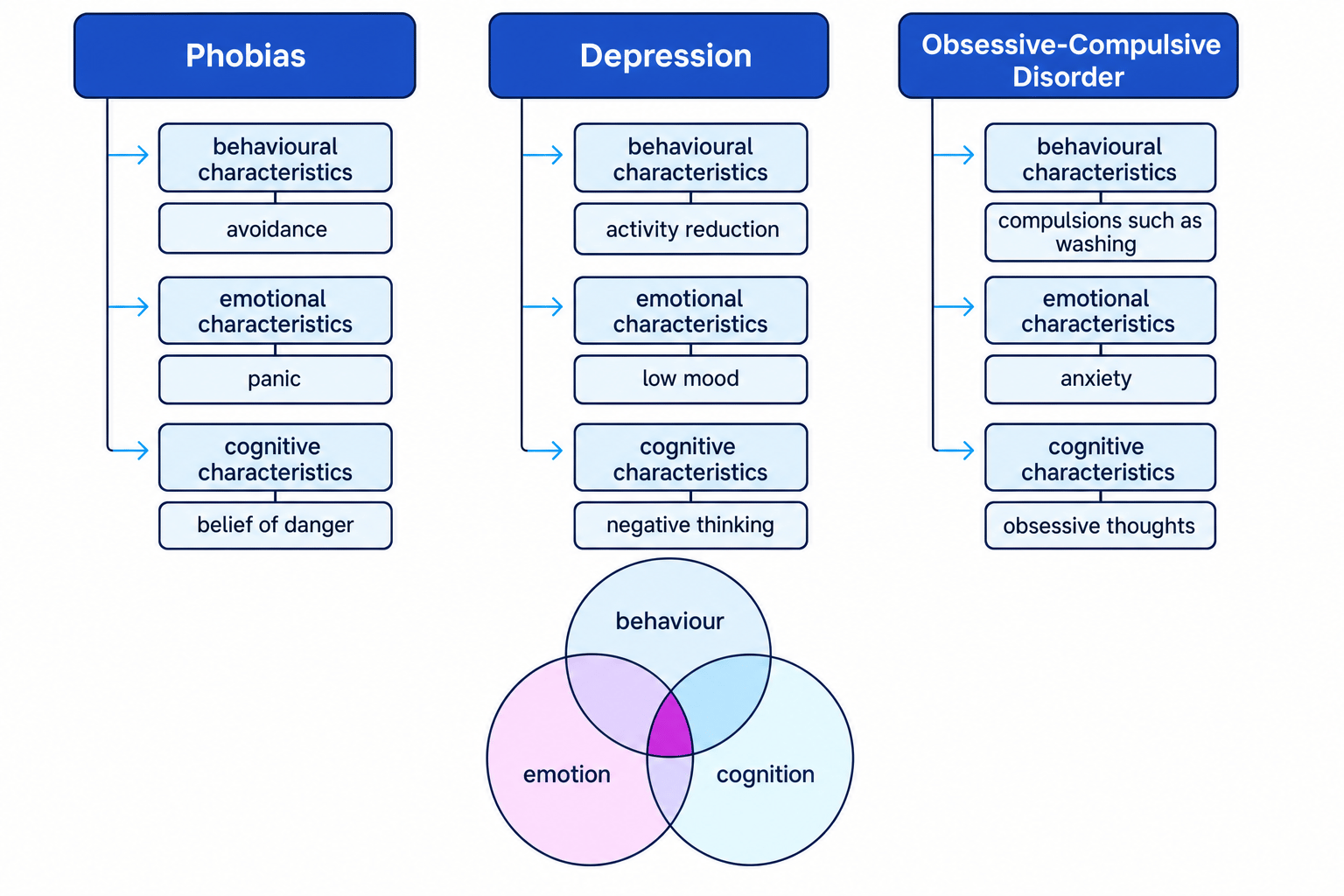
This diagram gives you the big picture: each disorder can be described through behaviour, emotion and cognition, but real symptoms often overlap.
The three-part lens
When you answer a question on characteristics, sort the evidence into behaviour, emotion and cognition. This helps you write clear AO1 descriptions and apply them accurately to scenarios.
Classifying symptoms by type
A student says: “When I see a dog, I run across the road, feel terrified, and think it will bite me.”
- Classify the action: running across the road is something the person does, so it is a behavioural characteristic.
- Classify the feeling: feeling terrified is an emotional response, so it is an emotional characteristic.
- Classify the thought: believing the dog will bite them is a judgement about danger, so it is a cognitive characteristic.
- Link the categories: the thought “it will bite me” may increase fear, which then leads to avoidance behaviour.
Phobias
Phobia
A phobia is an extreme, persistent and irrational fear of an object, activity or situation. The feared object or situation is called the phobic stimulus. The fear is usually disproportionate to the real danger and can interfere with everyday life.
A person can have a phobia of specific objects, such as spiders, or situations, such as flying, social interaction or open spaces. The key point is not simply “being scared”; the fear must be intense enough to affect behaviour and wellbeing.
Behavioural characteristics of phobias
The main behavioural characteristics are avoidance, panic and endurance.
Avoidance means keeping away from the phobic stimulus. For example, someone with a dog phobia may avoid parks, friends’ houses or streets where dogs are common.
Panic refers to the visible behavioural signs of extreme fear. This might include crying, screaming, running away, freezing, shaking or clinging to another person.
Endurance means remaining in the presence of the phobic stimulus but experiencing high distress. For example, someone afraid of lifts may force themselves to use one but grip the handrail, tremble and feel trapped.
Emotional characteristics of phobias
The main emotional characteristics are fear and anxiety. Fear is an immediate emotional response to a perceived threat. Anxiety is a more general state of unease or worry, often about a possible future threat.
In phobias, the emotional response is often seen as unreasonable or disproportionate. For example, a harmless house spider may trigger intense fear as if the person were in serious danger.
Cognitive characteristics of phobias
Cognitive characteristics include irrational beliefs, cognitive distortions and selective attention.
A cognitive distortion is an inaccurate or exaggerated way of thinking. For example, someone with a flying phobia may believe, “The plane will definitely crash,” despite flying being statistically very safe.
Selective attention means focusing strongly on the phobic stimulus. A person with a spider phobia may scan rooms for spiders and find it hard to concentrate on anything else once one is noticed.
Calling any fear a phobia
Not every fear is a phobia. A fear becomes a phobia when it is extreme, persistent, disproportionate and interferes with normal life.
Identifying phobia characteristics
Maya refuses to visit her cousin because the cousin owns a cat. If she sees a cat, she cries, feels intense fear, and thinks, “It will scratch my face.”
- Identify behavioural evidence: refusing to visit her cousin is avoidance, and crying is a panic response.
- Identify emotional evidence: intense fear is the emotional characteristic.
- Identify cognitive evidence: believing the cat will scratch her face shows an irrational belief about danger.
- Make the judgement: because the fear changes Maya’s normal behaviour and seems disproportionate, the scenario is consistent with a phobia.
Depression
Depression
Depression is a mood disorder involving persistent low mood and/or loss of interest or pleasure in usual activities. A mood disorder is a mental health condition where a person’s emotional state is significantly disturbed.
Depression is more than ordinary sadness. It tends to be persistent, affects daily functioning, and can influence behaviour, emotions and thinking patterns.
Behavioural characteristics of depression
A common behavioural characteristic is reduced activity level. The person may stop socialising, neglect hobbies, miss school or work, or spend long periods in bed.
Some people show the opposite: psychomotor agitation, meaning restless movement such as pacing, fidgeting or being unable to sit still. Depression can also involve disruption to sleep and eating patterns, such as insomnia, oversleeping, loss of appetite or overeating.
Other behavioural signs can include social withdrawal, tearfulness, aggression, or self-harm in more severe cases.
Self-harm is a serious risk sign
Self-harm or suicidal thoughts are not present in every case of depression, but they are serious symptoms. In real life, they require immediate support from a trusted adult, GP, crisis service or emergency service.
Emotional characteristics of depression
The most obvious emotional characteristic is lowered mood, such as sadness, emptiness or hopelessness.
Another key emotional feature is anhedonia, which means loss of pleasure in activities the person used to enjoy. Depression may also involve anger, irritability, guilt, shame and low self-esteem.
Cognitive characteristics of depression
Cognitive characteristics include poor concentration, negative thinking and pessimistic beliefs.
A depressed person may repeatedly focus on negative aspects of themselves, the world and the future. This can include thoughts such as “I am useless,” “Nothing ever goes right,” or “Things will never improve.”
AQA also refers to absolutist thinking, where someone thinks in all-or-nothing terms, such as “I always fail” or “Nobody cares about me.”
Separating depression from ordinary sadness
After failing an exam, Leo feels sad for one evening. Nia has felt hopeless for weeks, stopped seeing friends, sleeps most of the day and thinks she is “a complete failure.”
- Compare persistence: Leo’s sadness is brief, while Nia’s symptoms have lasted for weeks, making depression more likely in Nia’s case.
- Compare impact on behaviour: Nia’s social withdrawal and excessive sleep show disruption to normal functioning.
- Apply the three categories: hopelessness is emotional, stopping seeing friends is behavioural, and “I am a complete failure” is cognitive.
- Reach a cautious conclusion: Nia’s pattern is consistent with depression, whereas Leo’s response may be a normal reaction to disappointment.
Obsessive-compulsive disorder
Obsessive-compulsive disorder
Obsessive-compulsive disorder, or OCD, is a mental disorder involving obsessions and/or compulsions that cause distress and interfere with everyday life.
Obsessions and compulsions
- An obsession is a repeated, unwanted and intrusive thought, image or urge that causes anxiety or distress.
- A compulsion is a repetitive behaviour or mental act that a person feels driven to perform, often to reduce anxiety or prevent a feared outcome.
- Intrusive means the thought enters the mind unwanted and is difficult to dismiss.
Behavioural characteristics of OCD
The key behavioural characteristic is compulsive behaviour. Common compulsions include checking, cleaning, counting, ordering, repeating phrases or seeking reassurance.
Compulsions are not simply habits or preferences. They are repetitive, difficult to resist, and usually performed to reduce anxiety. For example, a person might check the front door twenty times because they feel responsible for preventing a burglary.
Avoidance is also common. Someone with contamination obsessions may avoid public transport, toilets or touching door handles.
Emotional characteristics of OCD
The main emotional characteristic is anxiety. The obsession creates distress, and the compulsion temporarily reduces it.
OCD can also involve guilt, shame and disgust. For example, a person may feel guilty for having an intrusive thought even though they do not want the thought and would not act on it. Depression can also occur alongside OCD because the condition can be exhausting and limiting.
Cognitive characteristics of OCD
The main cognitive characteristic is obsessive thinking. Obsessions may involve contamination, harm, order, religion, sex, aggression or responsibility.
People with OCD often experience inflated responsibility, meaning they believe they have more power or duty to prevent harm than is realistic. They may also catastrophise, meaning they imagine the worst possible outcome.
Importantly, many people with OCD have insight, meaning they recognise that their obsessions or compulsions are excessive or irrational, even though they still feel unable to stop.
Quick OCD distinction
An obsession is the thought: “My hands are contaminated.” A compulsion is the action: washing hands repeatedly to reduce the anxiety.
Recognising obsessions and compulsions
Sam repeatedly thinks, “If I don’t check the cooker, my family will die in a fire.” Sam checks the cooker again and again before leaving the house and feels anxious if interrupted.
- Identify the obsession: the repeated thought about the family dying is intrusive and distressing, so it is an obsession.
- Identify the compulsion: checking the cooker again and again is a repetitive behaviour intended to reduce anxiety.
- Identify the emotion: anxiety when interrupted shows the emotional characteristic of OCD.
- Link cognition to behaviour: the belief that checking prevents disaster drives the checking behaviour.
Quick AO1 summary
| Disorder | Behavioural characteristics | Emotional characteristics | Cognitive characteristics |
|---|---|---|---|
| Phobias | Avoidance, panic, endurance | Fear, anxiety, unreasonable emotional response | Irrational beliefs, selective attention, cognitive distortions |
| Depression | Reduced activity, sleep/eating disruption, withdrawal, possible agitation | Low mood, anger, low self-esteem, anhedonia | Poor concentration, negative thinking, absolutist thinking |
| OCD | Compulsions, avoidance, checking, washing, ordering | Anxiety, distress, guilt, disgust, possible depression | Obsessions, intrusive thoughts, inflated responsibility, catastrophising |
AO3: evaluating the use of characteristics
The behavioural-emotional-cognitive structure is useful because it gives psychologists and clinicians a clear way to describe symptoms. It also helps in real-world assessment: for example, a clinician can ask what the person does, how they feel, and what thoughts they experience.
However, characteristics can overlap between disorders. Anxiety appears in phobias and OCD. Avoidance appears in phobias and OCD. Low mood may occur in depression, but it can also develop as a consequence of living with OCD or a severe phobia.
Comorbidity
Comorbidity means having two or more disorders at the same time, such as OCD and depression occurring together.
This makes diagnosis more complicated. A person may not fit neatly into one category, and symptoms may change over time.
There is also an ethical issue around labelling. A diagnosis can help someone access support, but it can also lead to stigma if used carelessly. Psychologists must protect confidentiality, avoid harmful assumptions, and remember that a person is more than their symptoms.
Writing a list without application
In scenario questions, do not just list symptoms. Use the person’s exact behaviour, feeling or thought from the scenario, then label it as behavioural, emotional or cognitive.
In the exam
- For AO1, organise your answer by disorder and by the three categories: behavioural, emotional and cognitive.
- For AO2, quote or paraphrase details from the scenario, then label them accurately, such as “checking the lock is a compulsion.”
- For AO3, add a brief evaluation point about overlap, comorbidity, impairment, cultural context or the risks of diagnostic labelling.
Check yourself
- What is the difference between an obsession and a compulsion?
- Give one behavioural, one emotional and one cognitive characteristic of depression.
- Why is it a mistake to call every strong fear a phobia?