What you'll learn
- How the two-process model explains the acquisition and maintenance of phobias.
- The role of classical and operant conditioning in learning fear.
- How Systematic Desensitisation (SD) uses an anxiety hierarchy and relaxation to treat phobias.
- How Flooding uses immediate, intense exposure to extinguish fear.
- How to evaluate these explanations and treatments using key studies and ethical considerations.
Explaining phobias: The two-process model
The behavioural approach assumes that all behaviour, including abnormal behaviour like phobias, is learned from our environment. Orval Hobart Mowrer (1960) proposed the two-process model to explain exactly how this learning happens.
He argued that phobias are:
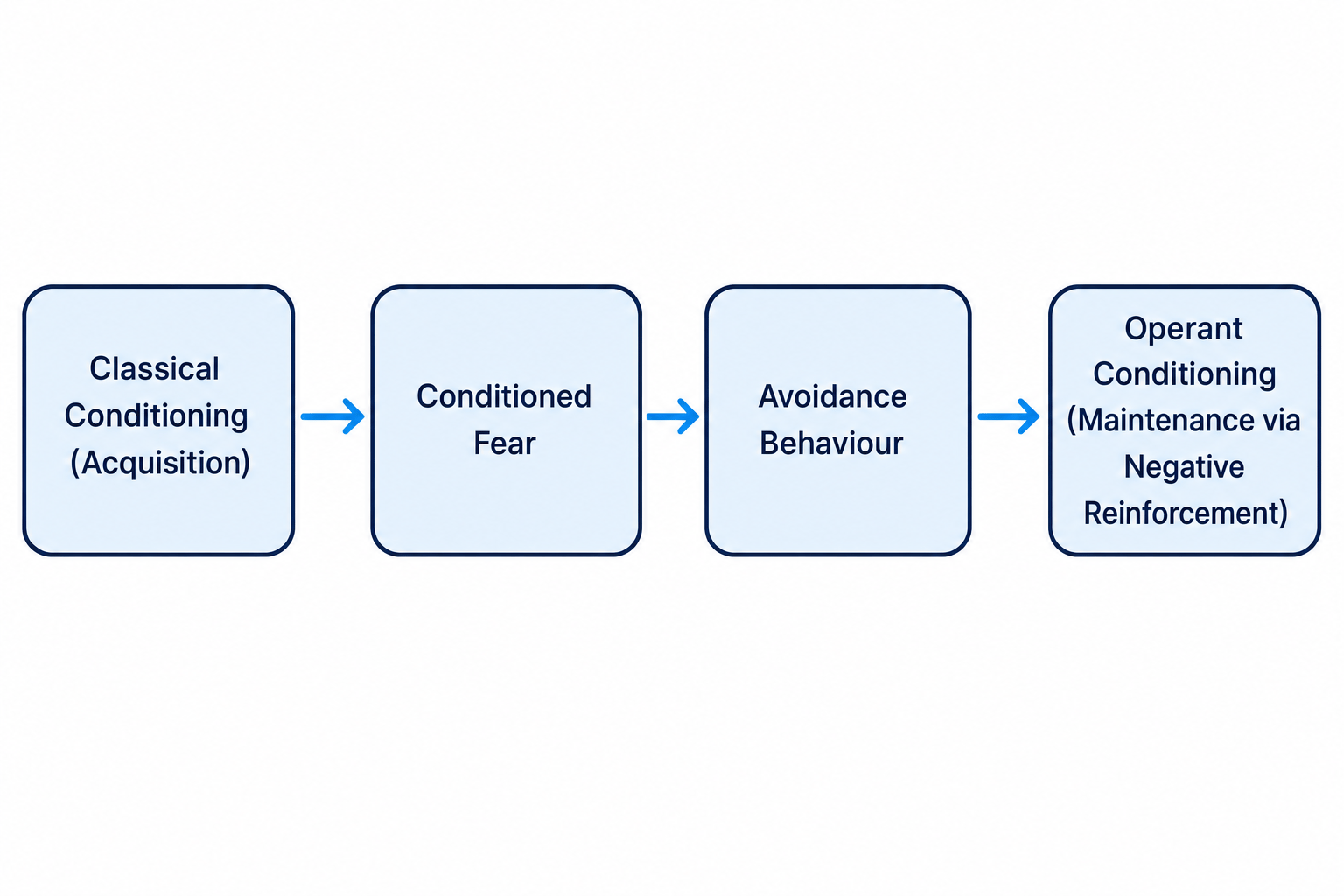
- Acquired (started) by classical conditioning.
- Maintained (kept going) by operant conditioning.
The Two-Process Model
A behavioural explanation for phobias which suggests they are acquired through classical conditioning (learning by association) and maintained through operant conditioning (learning by consequence).
Process 1: Acquisition by classical conditioning
Classical conditioning involves learning to associate something of which we initially have no fear (a neutral stimulus) with something that naturally triggers a fear response (an unconditioned stimulus).
The most famous demonstration of this is the study of Little Albert by Watson & Rayner (1920).
- Albert was a 9-month-old baby who initially showed no fear of a white rat (Neutral Stimulus, NS).
- The researchers struck a steel bar with a hammer behind his head, creating a loud noise (Unconditioned Stimulus, US) which naturally caused Albert to cry in fear (Unconditioned Response, UR).
- Whenever Albert reached for the rat, the loud noise was made. The NS and the US were paired together repeatedly.
- Eventually, Albert showed fear simply at the sight of the rat. The rat had become a Conditioned Stimulus (CS) producing a Conditioned Response (CR) of fear.
- This fear even generalised to other furry objects, like a rabbit and a Santa Claus beard.
Process 2: Maintenance by operant conditioning
If classical conditioning explains how a phobia starts, why doesn't the fear just fade away over time? Mowrer explained this using operant conditioning.
When you have a phobia, you naturally avoid the thing you fear. When you avoid the phobic stimulus, you escape the anxiety you would have felt. This relief is a pleasant consequence. In behavioural terms, the avoidance behaviour is negatively reinforced.
Because the avoidance reduces anxiety, you are more likely to repeat the avoidance behaviour in the future. Therefore, the phobia is maintained because the avoidance prevents you from ever learning that the phobic stimulus is actually harmless.
Applying the two-process model to a dog phobia
Imagine a scenario where a person, Sam, develops a phobia of dogs after being bitten as a child, and now refuses to walk through the local park. To apply the two-process model to Sam's behaviour, we break it down into acquisition and maintenance:
- Identify the unconditioned response (UR): The natural, unlearned reaction to pain. When Sam was bitten, the bite (Unconditioned Stimulus, US) caused natural fear and pain (UR).
- Identify the association (Acquisition): Sam associated the previously harmless dog (Neutral Stimulus, NS) with the painful bite (US). The dog became a Conditioned Stimulus (CS), triggering a Conditioned Response (CR) of fear.
- Identify the negative reinforcement (Maintenance): By refusing to walk through the local park, Sam successfully avoids encountering dogs. This avoidance relieves Sam's anxiety. This relief acts as negative reinforcement, ensuring Sam continues to avoid parks and maintaining the phobia over time.
Evaluating the two-process model (AO3)
Strength: Real-world application The two-process model was a huge step forward because it went beyond classical conditioning. By explaining that avoidance maintains the phobia, it showed exactly what therapies need to do: prevent avoidance. This led directly to highly successful treatments like systematic desensitisation and flooding.
Weakness: Incomplete explanation (Biological preparedness) The behavioural approach cannot easily explain why we are far more likely to develop phobias of snakes, heights, and spiders than we are of modern dangers like cars or guns, even though cars are statistically much more dangerous. Martin Seligman (1971) proposed biological preparedness — an evolutionary explanation suggesting we are genetically hardwired to learn associations with ancient, life-threatening stimuli very quickly to aid survival. The two-process model ignores these evolutionary factors.
Weakness: Ignores cognitive factors The behavioural approach focuses entirely on observable behaviour (avoidance) and ignores conscious thought. However, phobias clearly have a cognitive element, such as irrational thinking (e.g., someone with a flying phobia thinking "this plane will definitely crash"). The two-process model does not account for these cognitive distortions.
Summary of Explanations
Phobias are acquired through classical conditioning (associating a neutral stimulus with fear) and maintained through operant conditioning (negatively reinforcing avoidance behaviour by escaping anxiety).
Treating phobias
If phobias are learned, the behavioural approach assumes they can be unlearned. The goal of behavioural therapy is to replace the faulty association (fear) with a new, healthy association (relaxation).
1. Systematic Desensitisation (SD)
Developed by Joseph Wolpe (1958), Systematic Desensitisation is a therapy designed to gradually reduce phobic anxiety through classical conditioning. The aim is to cure the patient by teaching them to relax in the presence of the phobic stimulus. This new learning is called counterconditioning.
Because it is biologically impossible to be deeply relaxed and terrified at the exact same time (one emotion prevents the other), this process relies on reciprocal inhibition.
SD involves three key steps:
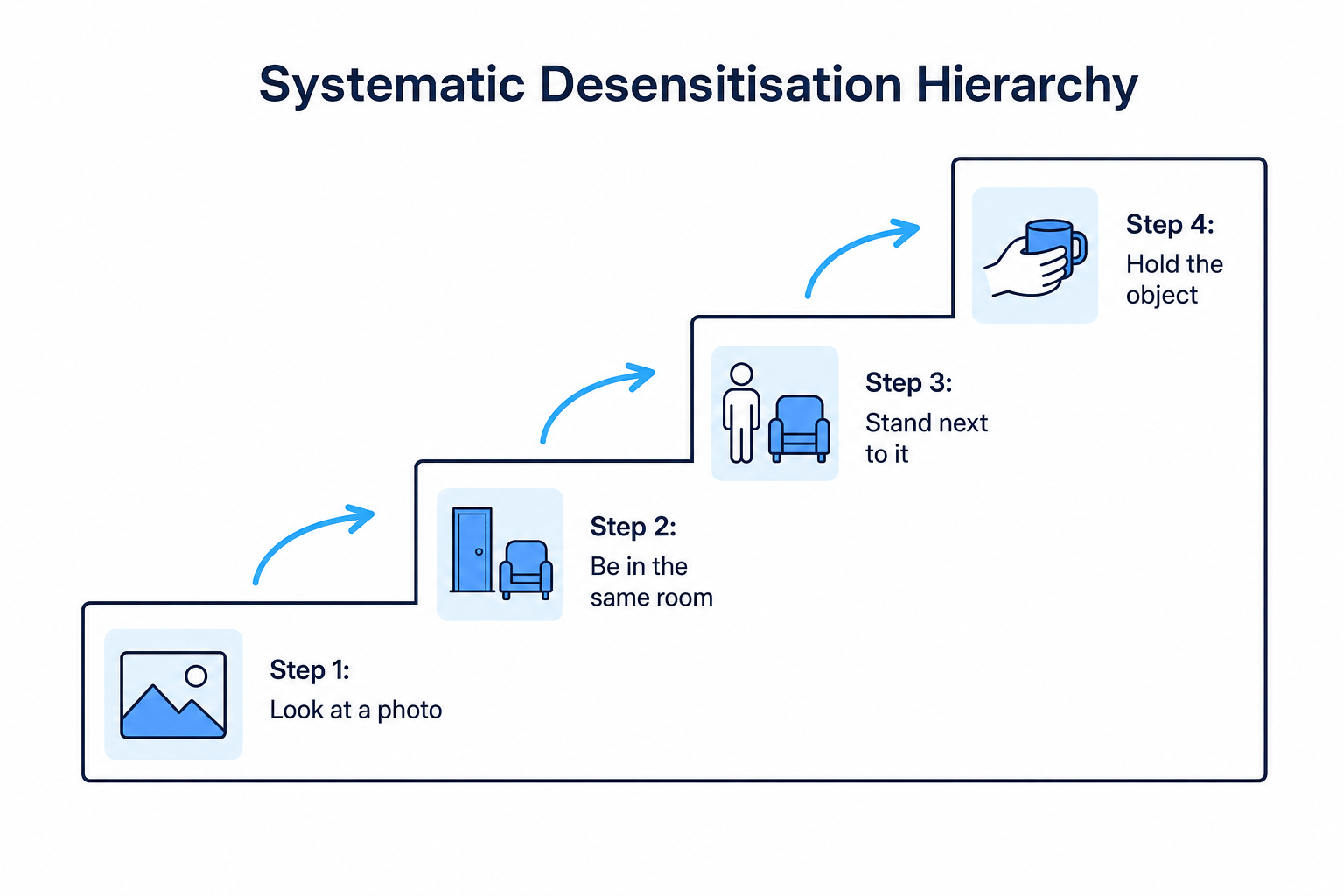
- The Anxiety Hierarchy: The patient and therapist work together to create a list of situations related to the phobic stimulus. They rank these from least frightening (at the bottom) to most frightening (at the top).
- Relaxation: The therapist teaches the patient deep relaxation techniques. This might involve breathing exercises, progressive muscle relaxation, or mental imagery (e.g., imagining a peaceful beach).
- Exposure: The patient is finally exposed to the phobic stimulus while in a relaxed state. This happens across several sessions, starting at the very bottom of the hierarchy. They only move up to the next step once they can stay completely relaxed at the current level.
Confusing the hierarchy with the whole therapy
Students often describe the "anxiety hierarchy" as if it is the entirety of Systematic Desensitisation. Remember that the hierarchy is just one of the three components! Without teaching the patient relaxation techniques and carrying out the actual gradual exposure, the hierarchy is just a scary list.
Evaluating Systematic Desensitisation (AO3)
Strength: It is effective There is strong evidence that SD works. Gilroy et al. (2003) followed up 42 patients who had been treated for spider phobia using three 45-minute sessions of SD. At both 3 months and 33 months after treatment, the SD group was significantly less fearful than a control group treated with relaxation alone.
Strength: Acceptable to patients When given the choice between SD and flooding, most patients choose SD. It does not cause the same degree of psychological trauma as flooding, and the relaxation procedures are often reported as pleasant. This is reflected in the low refusal rates and low attrition (dropout) rates for SD compared to flooding.
2. Flooding
Flooding is an alternative behavioural therapy that involves exposing the patient to their phobic stimulus immediately, rather than building up gradually. For example, a person with a severe fear of enclosed spaces (claustrophobia) might be locked in a small closet for several hours.
How does flooding work? Without the option of avoidance, the patient quickly experiences peak anxiety. However, a panic response can only be sustained by the body for a limited time before exhaustion sets in. Eventually, the patient's anxiety drops, and they realise the phobic stimulus is harmless.
In classical conditioning terms, this process is called extinction. The conditioned stimulus (e.g., the closet) is encountered without the unconditioned stimulus (e.g., a feeling of suffocation), so the conditioned stimulus loses its power to produce the conditioned response (fear).
Extinction vs. Counterconditioning
In Flooding, the fear is removed through extinction (the association simply dies out because the conditioned stimulus is presented safely without harm). In SD, the fear is removed through counterconditioning (the fear response is actively replaced with a relaxation response).
Evaluating Flooding (AO3)
Strength: Cost-effective Flooding is highly effective and significantly quicker than other therapies. A patient might only need one heavily extended session (e.g., 2–3 hours) rather than months of weekly SD sessions. This makes it much cheaper for health providers like the NHS.
Weakness: Highly traumatic The most serious issue with flooding is that it is a highly traumatic experience. While it is not strictly unethical—patients give fully informed consent beforehand—it causes extreme distress. As a result, attrition rates are very high. Patients often drop out before the fear is extinguished, which can sometimes make the phobia worse because they end the session on a high note of anxiety, unintentionally reinforcing the avoidance.
Ethics and Informed Consent
Because flooding deliberately induces severe psychological distress (violating the ethical guideline of protection from harm), obtaining truly informed consent is paramount. The patient must be fully briefed on exactly how traumatic the session will be, and they must agree to see it through to the end.
In the exam
- Be precise with terminology: Use "neutral stimulus", "unconditioned response", "acquisition", and "maintenance" rather than vague phrases like "they got scared by the thing".
- Differentiate treatments: If a scenario question asks you to suggest a suitable therapy for a patient with heart problems or a child, justify SD over Flooding due to the physical toll and trauma of a panic response.
- Link AO3 to the prompt: If asked to evaluate the behavioural approach to explaining phobias, do not waste time evaluating SD and flooding unless you explicitly frame them as evidence for the theory (e.g., "The success of SD proves that phobias are based on associations").
Check yourself
- Can you name the two processes in Mowrer's model and the type of conditioning associated with each?
- Why does a phobic person's avoidance behaviour make it impossible for their phobia to fade naturally?
- What is meant by 'reciprocal inhibition' in the context of Systematic Desensitisation?
- Why might a therapist recommend Systematic Desensitisation over Flooding for a highly anxious patient?
