When psychologists want to understand the complexities of human behaviour, they often rely on large-scale experiments that average out individual differences. However, some of the most groundbreaking discoveries in psychology have come from looking closely at just one person.
This guide explores the case study method—a powerful, idiographic research tool used to investigate rare, unique, or highly specific phenomena in depth.
What you'll learn
- How to define a case study and identify its core characteristics.
- The concept of triangulation and how it is used to build a comprehensive case profile.
- Real-world examples of famous case studies that shaped psychological theory.
- How to evaluate the strengths and limitations of case studies for your exams.
What is a case study?
Unlike large-scale experiments, a case study does not look for broad, average patterns across a population. Instead, it is an in-depth, detailed, and holistic investigation of a single individual, group, institution, or event.
Case study
An in-depth, detailed, and longitudinal investigation of a single individual, group, institution, or event, typically focusing on unusual or rare phenomena.
Case studies are deeply idiographic—they focus on the unique experience of the individual rather than trying to establish general laws of behaviour (which is the nomothetic approach). They are typically longitudinal, meaning they take place over a long period of time (weeks, months, or even years), allowing researchers to track changes and development.
The myth of "only qualitative data"
A common misconception is that case studies only produce qualitative (word-based) data. In reality, modern case studies are highly rigorous and gather both qualitative and quantitative data. To achieve this, researchers use a process called triangulation.
Triangulation
The use of multiple research methods and data sources to investigate a single phenomenon, enhancing the validity and reliability of the findings.
To build a complete profile of a participant, a researcher might combine several methods:
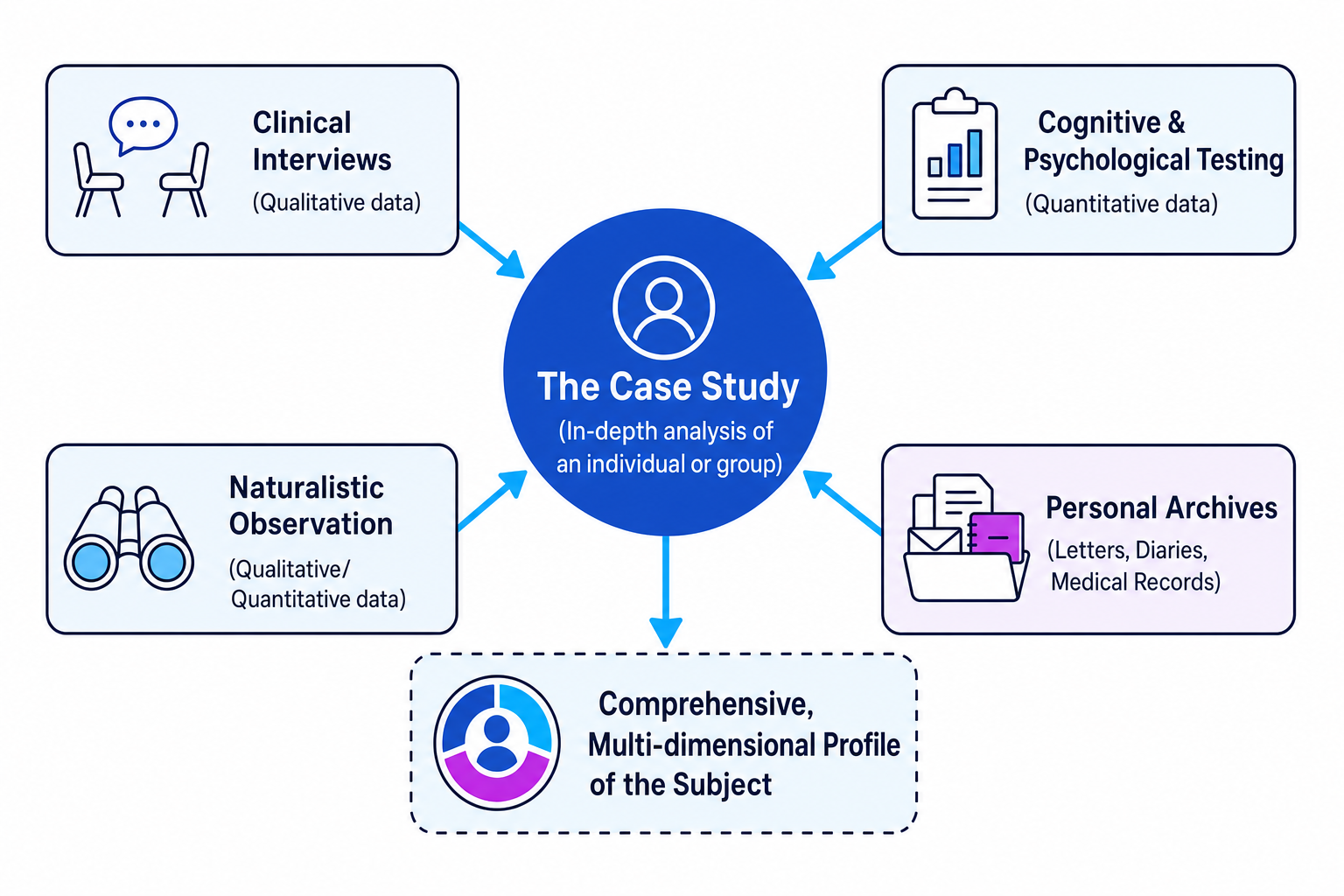
- Qualitative sources: Semi-structured clinical interviews with the patient, naturalistic observations of their daily life, and personal archives (like diaries, letters, or school reports).
- Quantitative sources: Cognitive testing (such as memory span tests or IQ tests), questionnaires, and physiological measures (such as fMRI or EEG brain scans).
Triangulation is key
Never describe a case study as a single method. It is an approach that acts as an umbrella for many different research methods combined.
Famous psychological case studies
To appreciate the value of case studies, you need to know how they have directly advanced psychological theory. Here are three key examples you can use as evidence in your exam answers:
1. Patient HM (Henry Molaison)
Following surgery to treat severe epilepsy, Henry Molaison (studied extensively by Brenda Milner and colleagues from 1957 onwards) had his hippocampus removed. While his short-term memory (STM) remained intact, he could no longer form new long-term memories (LTM).
- Theoretical Impact: HM provided crucial evidence for the Multi-Store Model of Memory (Atkinson & Shiffrin). His case proved that STM and LTM are anatomically and functionally distinct, separate stores.
2. Patient KF (Shallice & Warrington, 1970)
Patient KF suffered brain damage in a motorcycle accident. His visual short-term memory was perfectly normal, but his auditory short-term memory was severely damaged (he could only recall one or two digits read aloud to him).
- Theoretical Impact: KF challenged the Multi-Store Model, which claimed STM was a single, unitary store. His case helped inspire the Working Memory Model (Baddeley & Hitch), proving that STM has separate visual and auditory processors.
3. Little Hans (Freud, 1909)
Freud conducted an analysis of a five-year-old boy who had developed an intense phobia of horses. Freud interpreted Hans's fear of the dark blinkers and large black nosebands on horses as a symbolic displacement of his unconscious fear of his father (castration anxiety).
- Theoretical Impact: Freud used this single case study to support his theory of the Oedipus complex during the phallic stage of psychosexual development.
Confusing the researcher and the participant
Ensure you write clearly about who did what. For example, do not say "KF conducted a study on brain damage". KF was the patient (represented by initials to protect their identity); the researchers were Shallice and Warrington (1970).
Worked example: Applying case study design
Designing a clinical case study
Scenario: A researcher wants to investigate the cognitive and emotional impact of a rare localized brain injury in a 19-year-old patient, "Patient X", who has lost the ability to recognize familiar faces (prosopagnosia) following a sporting accident.
Design a case study approach for Patient X, justifying your design choices in three logical steps.
-
Select a battery of triangulated methods to capture both cognitive and emotional effects. To investigate the cognitive impact of prosopagnosia, we will administer standardized face-matching computer tasks (yielding quantitative accuracy rates). To capture the emotional impact, we will conduct semi-structured interviews with Patient X and their family, alongside asking Patient X to keep a daily diary of their social experiences (yielding rich qualitative data).
-
Establish a longitudinal baseline and tracking system. Because recovery or adaptation to brain trauma happens over time, we will test and interview Patient X at 3-month intervals over a 2-year period. This allows us to track whether compensatory strategies (such as identifying family members by their voices or hairstyles) improve their daily functioning.
-
Address specific ethical safeguards for this unique individual. Given Patient X's rare and recognizable condition, standard anonymity is highly vulnerable. We must secure fully informed consent, use the pseudonym "Patient X", store all data securely, and carefully omit specific biographical details (e.g., the exact sports team they played for) in any published reports to protect their confidentiality.
Evaluating case studies (AO3)
When writing an essay or a short-answer evaluation on case studies, you must weigh up their unique advantages against their scientific limitations.
Strengths
- Provides rich, detailed qualitative insights: Unlike sterile laboratory experiments, case studies capture the complexity of real human experience. They offer a holistic portrait of behaviour, which can lead to a deeper understanding of clinical disorders.
- Allows study of otherwise unethical or impossible scenarios: We cannot ethically damage a human's hippocampus or lock a child in a room for 13 years (as in the case of Genie, the feral child) to study deprivation. Case studies allow researchers to investigate these rare, naturally occurring tragedies.
- Can challenge or falsify established psychological theories: As Karl Popper noted, you can observe thousands of white swans and believe "all swans are white", but it only takes seeing one black swan to disprove your theory. Similarly, Patient KF's intact visual STM but damaged auditory STM single-handedly disproved the theory that STM is a single unitary store.
The 'Black Swan' analogy
Use the "Black Swan" analogy in your exam essays to explain how a single case study (like KF) has the power to dismantle or force revisions to a widely accepted psychological model.
Weaknesses
- Very low generalisability (population validity): Because case studies focus on a single individual with unique characteristics (such as specific brain damage or a unique upbringing), we cannot confidently generalize the findings to the wider population.
- Subjective researcher bias: Researchers often spend months or years working closely with the participant. This close relationship can lead to a loss of objectivity. The researcher may interpret the patient's behaviour in a way that fits their pre-existing hypothesis (a major criticism of Freud's study of Little Hans).
- Reliance on retrospective data: Case studies often require the participant or their family to recall past events (e.g., childhood milestones or the nature of the accident). Human memory is reconstructive and prone to distortion, meaning this retrospective data may lack accuracy.
- Ethical complications: Protecting confidentiality is extremely difficult when a patient’s condition is highly unique (e.g., Clive Wearing's musical background made him easily identifiable). Furthermore, putting vulnerable brain-damaged patients through hours of rigorous cognitive testing can risk psychological harm and physical fatigue.
In the exam
- Define it fully: If asked to outline the case study method (typically a 2-4 mark question), make sure you mention that it is an in-depth study of a single individual/group, it is longitudinal, and it uses triangulation (multiple sources of data).
- Use case studies as AO3 evidence elsewhere: You don't just need this topic for research methods questions! You can use HM and KF as powerful evaluation points in your Memory essays, and Little Hans in your Approaches essays.
- Be specific about ethics: If a question asks about the ethical issues of case studies, don't just write generic points like "informed consent". Explain why it is hard to maintain confidentiality when the individual has an incredibly rare and famous brain injury, or how protection from harm is threatened by constant cognitive testing.
Check yourself
- Can you explain the difference between a qualitative and quantitative method that might be used under the "umbrella" of a single case study?
- Why does the idiographic nature of a case study limit its nomothetic value?
- How did the case of KF (Shallice & Warrington 1970) modify our understanding of the Multi-Store Model of memory?
