

What you'll learn
- Why an object moving at constant speed in a circle is still accelerating.
- How period, frequency and angular velocity describe circular motion.
- How to use a=v2ra = \frac{v^2}{r}a=rv2 and F=mv2rF = \frac{mv^2}{r}F=rmv2.
- How to identify the real force providing the centripetal force in different situations.
Before circular motion: velocity and acceleration
You already know that speed is a scalar quantity: it only has a magnitude. Velocity is a vector quantity: it has magnitude and direction.
This matters because an object can have constant speed but changing velocity if its direction is changing.
Acceleration
Acceleration is the rate of change of velocity. Since velocity is a vector, acceleration can happen because the speed changes, the direction changes, or both.
In circular motion, direction changes continuously. So even if the object moves around the circle at constant speed, it is still accelerating.
Uniform circular motion
Uniform circular motion means motion in a circle at constant speed.
The velocity is always tangential to the circle, meaning it points along the tangent to the path at that instant. The acceleration points towards the centre of the circle.
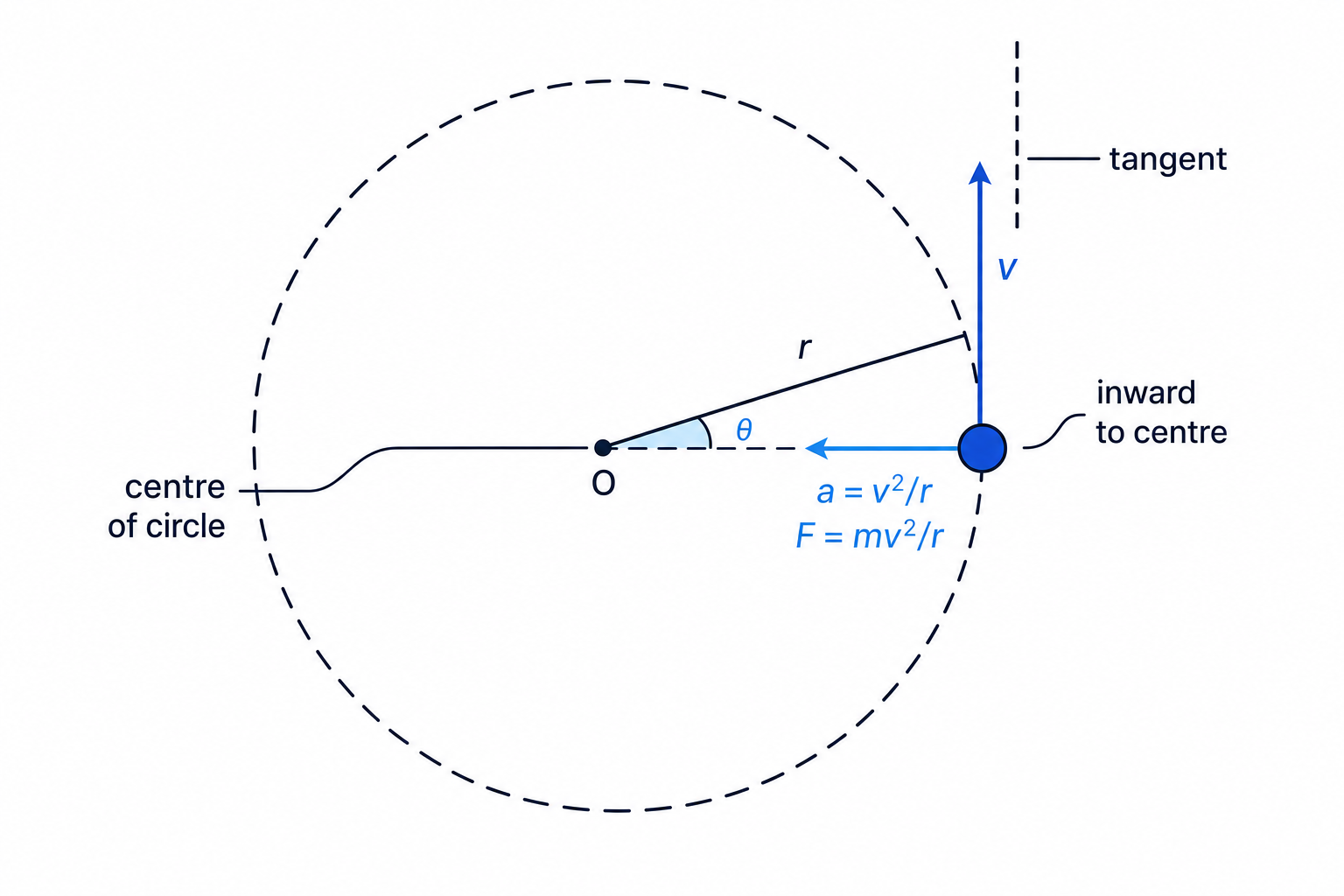
The big idea
In uniform circular motion, the speed is constant, but the velocity changes because its direction changes. Therefore there must be an acceleration towards the centre of the circle.
Period, frequency and speed
For circular motion, it is useful to describe how quickly the object completes revolutions.
Period and frequency
The period, TTT, is the time taken for one complete revolution, measured in seconds. The frequency, fff, is the number of revolutions per second, measured in hertz, Hz.
They are linked by:
f=1Tf = \frac{1}{T}f=T1For one complete revolution, the distance travelled is the circumference of the circle:
2πr2\pi r2πrSo the speed is:
v=2πrTv = \frac{2\pi r}{T}v=T2πrSince f=1Tf = \frac{1}{T}f=T1, you can also write:
v=2πrfv = 2\pi rfv=2πrfFinding speed from period
A toy car moves in a circle of radius 0.80 m. It completes one lap every 2.5 s. Calculate its speed.
-
Use the circular speed equation because the motion is one complete circumference per period:
v=2πrTv = \frac{2\pi r}{T}v=T2πr -
Substitute the radius and period:
v=2π(0.80 m)2.5 sv = \frac{2\pi \left(0.80 \ \text{m}\right)}{2.5 \ \text{s}}v=2.5 s2π(0.80 m) -
Calculate the value and include units:
v=2.0 m s−1v = 2.0 \ \text{m s}^{-1}v=2.0 m s−1
Using diameter instead of radius
In v=2πrTv = \frac{2\pi r}{T}v=T2πr, rrr is the radius, not the diameter. If the question gives diameter, halve it first.
Angular velocity
Sometimes circular motion is described using the angle swept out per second.
Angular velocity
Angular velocity, ω\omegaω, is the rate of change of angular displacement. It is measured in radians per second, rad s−1^{-1}−1.
One full revolution is an angle of 2π2\pi2π radians, so:
ω=2πT\omega = \frac{2\pi}{T}ω=T2πSince f=1Tf = \frac{1}{T}f=T1:
ω=2πf\omega = 2\pi fω=2πfLinear speed and angular velocity are linked by:
v=ωrv = \omega rv=ωrRadians are the natural angle unit
In circular motion equations, angles must be in radians. The formulae involving ω\omegaω are built around one full turn being 2π2\pi2π radians.
Calculating angular velocity
A rotating platform completes 12 revolutions in 6.0 s. Calculate its angular velocity.
-
Find the frequency from revolutions per second:
f=126.0 s=2.0 Hzf = \frac{12}{6.0 \ \text{s}} = 2.0 \ \text{Hz}f=6.0 s12=2.0 Hz -
Use the link between angular velocity and frequency:
ω=2πf\omega = 2\pi fω=2πf -
Substitute and calculate:
ω=2π(2.0 Hz)=12.6 rad s−1\omega = 2\pi \left(2.0 \ \text{Hz}\right) = 12.6 \ \text{rad s}^{-1}ω=2π(2.0 Hz)=12.6 rad s−1
Centripetal acceleration
The inward acceleration in circular motion is called centripetal acceleration.
Centripetal acceleration
Centripetal acceleration is the acceleration of an object moving in a circular path, directed towards the centre of the circle.
For uniform circular motion:
a=v2ra = \frac{v^2}{r}a=rv2Using v=ωrv = \omega rv=ωr, you can also write:
a=ω2ra = \omega^2 ra=ω2rBoth are useful. Use the one that matches the information given.
Direction matters
Centripetal acceleration is always directed towards the centre of the circle, not in the direction of motion.
Calculating centripetal acceleration
A student whirls a rubber bung in a horizontal circle of radius 0.65 m at a speed of 3.2 m s−1^{-1}−1. Calculate its centripetal acceleration.
-
Choose the equation using speed and radius:
a=v2ra = \frac{v^2}{r}a=rv2 -
Substitute the values:
a=(3.2 m s−1)20.65 ma = \frac{\left(3.2 \ \text{m s}^{-1}\right)^2}{0.65 \ \text{m}}a=0.65 m(3.2 m s−1)2 -
Calculate and check the unit is acceleration:
a=15.8 m s−2a = 15.8 \ \text{m s}^{-2}a=15.8 m s−2To two significant figures, this is 16 m s−2^{-2}−2.
Centripetal force
From Newton’s second law:
F=maF = maF=maIf the acceleration is centripetal, then the resultant force must also be towards the centre. This inward resultant force is called the centripetal force.
Centripetal force
Centripetal force is the resultant force acting towards the centre of a circular path, causing centripetal acceleration.
Combining F=maF = maF=ma with a=v2ra = \frac{v^2}{r}a=rv2 gives:
F=mv2rF = \frac{mv^2}{r}F=rmv2You may also use:
F=mω2rF = m\omega^2 rF=mω2rCentripetal force is not a new type of force
“Centripetal force” means the resultant inward force required for circular motion. It is provided by real forces such as tension, friction, gravity, or a normal contact force.
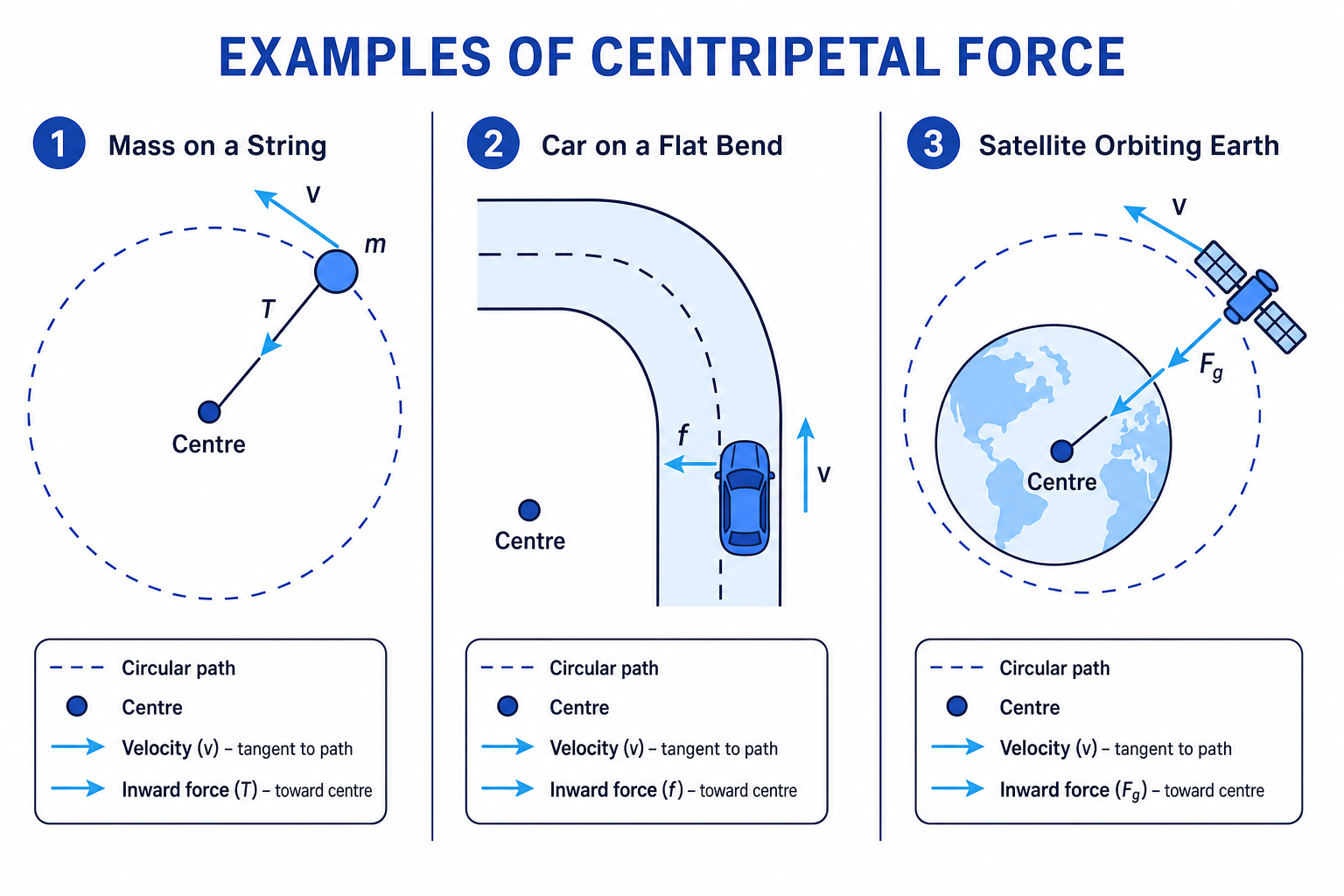
For example:
- For a mass on a string, tension provides the centripetal force.
- For a car turning on a flat road, friction provides the centripetal force.
- For a satellite in orbit, gravity provides the centripetal force.
Finding the force needed for circular motion
A 0.150 kg ball is moving in a horizontal circle of radius 0.90 m at a speed of 4.0 m s−1^{-1}−1. Calculate the centripetal force.
-
Use the centripetal force equation:
F=mv2rF = \frac{mv^2}{r}F=rmv2 -
Substitute the mass, speed and radius:
F=(0.150 kg)(4.0 m s−1)20.90 mF = \frac{\left(0.150 \ \text{kg}\right)\left(4.0 \ \text{m s}^{-1}\right)^2}{0.90 \ \text{m}}F=0.90 m(0.150 kg)(4.0 m s−1)2 -
Calculate:
F=2.7 NF = 2.7 \ \text{N}F=2.7 N
Resultant force: the free-body diagram approach
Circular motion questions often become much easier if you draw a free-body diagram, meaning a diagram showing the forces acting on the object.
The key question is:
Which forces have components towards or away from the centre of the circle?
Then apply Newton’s second law towards the centre:
Fresultant towards centre=mv2rF_{\text{resultant towards centre}} = \frac{mv^2}{r}Fresultant towards centre=rmv2For a horizontal circle, weight often acts vertically downwards and may be balanced by an upward force. The horizontal inward force is then the centripetal force.
Adding a fake extra force
Do not draw a separate force labelled “centripetal force” in addition to tension, friction or gravity. The centripetal force is the resultant inward force, not an extra force.
Cars going round bends
For a car on a flat circular bend, the centripetal force is usually provided by friction between the tyres and the road.
If the required centripetal force is too large, the tyres cannot provide enough friction and the car skids outwards. The car does not skid because there is an outward force; it skids because there is not enough inward force to keep it on the circular path.
Maximum speed on a bend
A 900 kg car goes around a flat bend of radius 35 m. The maximum frictional force available is 5200 N. Calculate the maximum speed before skidding.
-
At the maximum safe speed, friction provides the required centripetal force:
F=mv2rF = \frac{mv^2}{r}F=rmv2 -
Rearrange for speed:
v=Frmv = \sqrt{\frac{Fr}{m}}v=mFr -
Substitute the values:
v=(5200 N)(35 m)900 kgv = \sqrt{\frac{\left(5200 \ \text{N}\right)\left(35 \ \text{m}\right)}{900 \ \text{kg}}}v=900 kg(5200 N)(35 m) -
Calculate:
v=14.2 m s−1v = 14.2 \ \text{m s}^{-1}v=14.2 m s−1So the maximum speed is about 14 m s−1^{-1}−1.
Sanity check
A smaller radius or a larger speed means a larger centripetal acceleration. Tight corners at high speeds need a lot of inward force.
Vertical circular motion
In vertical circular motion, such as a rollercoaster loop or a ball on a string moving in a vertical circle, weight changes how the forces combine at different points.
At the top of a vertical circle, weight acts towards the centre. At the bottom, weight acts away from the centre.
For a mass on a string:
- At the top, tension and weight may both act towards the centre.
- At the bottom, tension acts towards the centre but weight acts away from the centre.
So the resultant force towards the centre changes around the circle.
Do not assume constant tension
Even if the speed were constant, the tension in a string during vertical circular motion would not usually be constant, because the weight has different components relative to the centre at different positions.
Practical skills: investigating circular motion
A common practical setup uses a rubber bung attached to a string and whirled in a horizontal circle. The radius can be measured, and the period can be found by timing several revolutions and dividing by the number of revolutions.
Good practical habits include:
- Time many revolutions to reduce percentage uncertainty in the period.
- Keep the radius as constant as possible.
- Repeat readings and calculate a mean period.
- Use v=2πrTv = \frac{2\pi r}{T}v=T2πr, then test whether the centripetal force matches mv2r\frac{mv^2}{r}rmv2.
If a graph is used, choose axes that give a straight line. For example, if mass and radius are constant, FFF is proportional to v2v^2v2, so a graph of FFF against v2v^2v2 should be a straight line through the origin.
Choosing the right equation
The main circular motion equations are:
v=2πrTv = \frac{2\pi r}{T}v=T2πr ω=2πT=2πf\omega = \frac{2\pi}{T} = 2\pi fω=T2π=2πf v=ωrv = \omega rv=ωr a=v2r=ω2ra = \frac{v^2}{r} = \omega^2 ra=rv2=ω2r F=mv2r=mω2rF = \frac{mv^2}{r} = m\omega^2 rF=rmv2=mω2rA reliable method is:
- Identify the radius of the circular path.
- Find speed or angular velocity.
- Find centripetal acceleration if needed.
- Use Newton’s second law to connect the required inward resultant force to the real forces acting.
In the exam
- Always state the direction: centripetal acceleration and centripetal resultant force act towards the centre of the circle.
- Draw a free-body diagram and identify which real force provides the inward resultant force.
- Check whether the question gives period, frequency, speed or angular velocity, then choose the matching equation before substituting numbers.
Check yourself
- Why can an object moving at constant speed in a circle still be accelerating?
- A satellite is in circular orbit around Earth. What real force provides its centripetal force?
- If the speed of an object doubles while the radius stays the same, what happens to the required centripetal force?
