Revision notes for Edexcel A Level Physics Nuclear atom and alpha scattering. Open the guide for explanations and worked examples. Written against the Edexcel A Level Physics (9PH0) specification, so the content matches what's examinable rather than general Physics background.
Nuclear atom and alpha scattering
What you'll learn
- What the nuclear model of the atom says about charge, mass and empty space.
- How the Rutherford alpha scattering experiment was set up.
- How the observations lead to the conclusion that atoms contain a tiny, positive nucleus.
- How to estimate a distance of closest approach using energy and electrostatic repulsion.
The basic picture of the atom
Before Rutherford’s experiment, scientists knew that atoms contained electrons, which are negatively charged particles. But they did not yet know how the positive charge and mass were arranged inside the atom.
A modern atom has:
- a tiny central nucleus
- electrons around the nucleus
- mostly empty space between the nucleus and the electrons
Definition
Nucleus
The nucleus is the small, dense, positively charged centre of an atom. It contains protons, which are positively charged, and neutrons, which have no charge.
A neutral atom has the same number of protons and electrons, so the total positive charge balances the total negative charge.
Key Idea
Scale of the atom
The nucleus is tiny compared with the whole atom, but it contains almost all of the atom’s mass.
Typical sizes are roughly:
- atom radius: about 10−10 m10^{-10}\ \text{m}10−10 m
- nucleus radius: about 10−1510^{-15}10−15 to 10−14 m10^{-14}\ \text{m}10−14 m
So an atom is not like a solid ball. It is mostly empty space.
The alpha particle
Rutherford’s experiment used alpha particles as projectiles fired at thin metal foil.
Definition
Alpha particle
An alpha particle is a helium nucleus. It contains two protons and two neutrons, so it has charge +2e+2e+2e, where e=1.60×10⁻¹⁹ Ce = 1.60 \times 10^{-19}\ \text{C}e=1.60×10⁻¹⁹ C.
Alpha particles are useful for probing atoms because they are:
- positively charged, so they are repelled by positive nuclei
- relatively massive compared with electrons
- emitted with high kinetic energy by radioactive sources
Because alpha particles are positive, any strong deflection must be caused by repulsion from positive charge.
Common Mistake
Electrons do not cause the large deflections
Alpha particles are much more massive than electrons, so collisions with electrons cannot explain large-angle scattering. The large deflections are evidence for a concentrated positive nucleus.
The older model: plum pudding
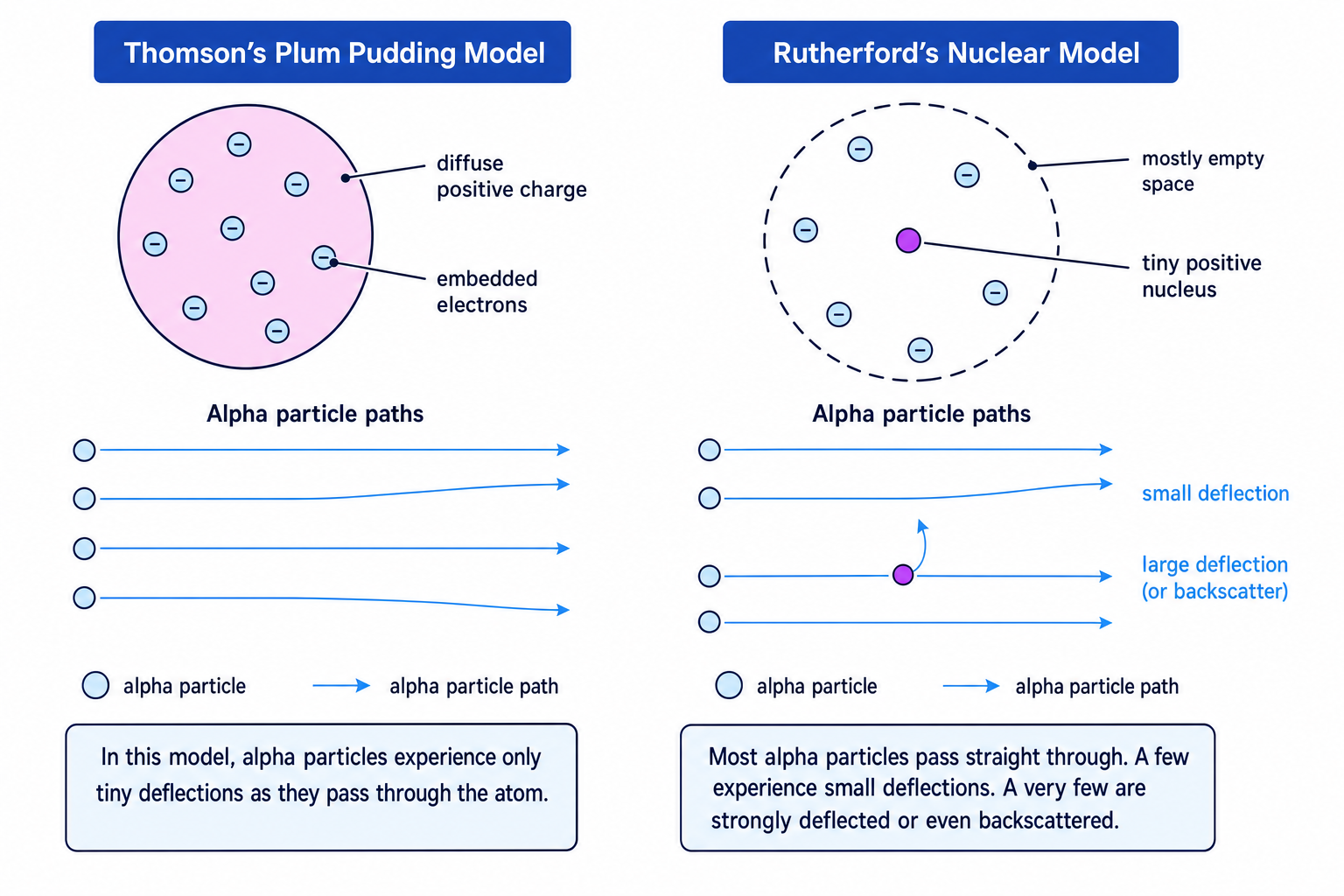
Before the nuclear model, J. J. Thomson’s plum pudding model described the atom as a diffuse ball of positive charge with negative electrons embedded inside it.
In that model, the positive charge is spread out across the whole atom. An alpha particle passing through would only feel weak forces in different directions, so you would expect only tiny deflections.
The diagram shows why the Rutherford results were so surprising.
The Rutherford alpha scattering experiment
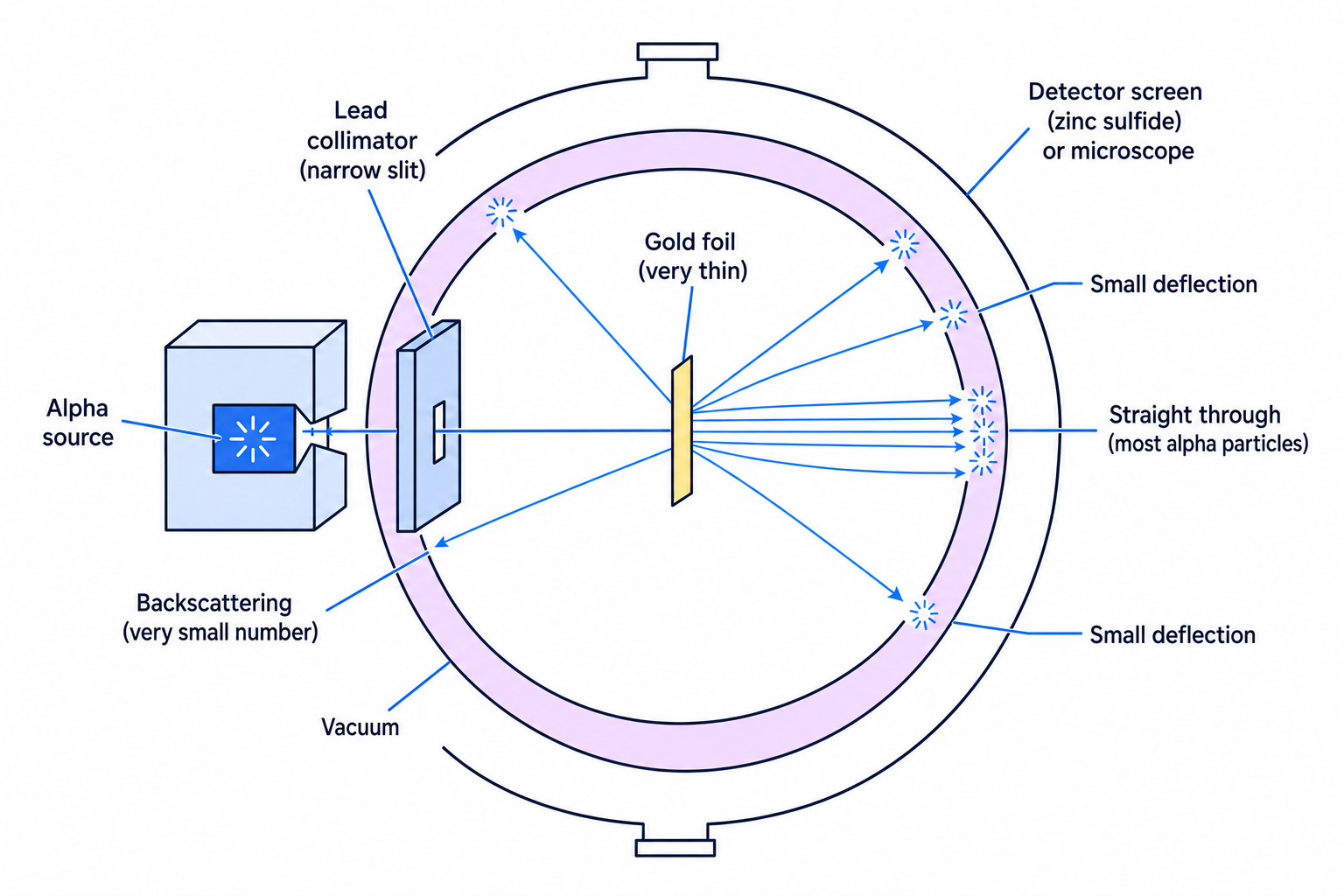
The experiment was carried out by Geiger and Marsden under Rutherford’s direction. A beam of alpha particles was fired at a very thin sheet of gold foil.
The main parts of the apparatus were:
- an alpha source, usually a radioactive material
- a lead block with a narrow slit to produce a narrow beam
- a very thin gold foil target
- a zinc sulfide screen, which gave tiny flashes called scintillations when hit by alpha particles
- a microscope or detector that could be moved around to detect alpha particles at different angles
- a vacuum, to stop alpha particles being scattered by air molecules
Tip
Why gold foil?
Gold can be beaten into an extremely thin foil, so alpha particles have a good chance of passing through only a small number of atomic layers. Gold also has a large nuclear charge, making deflections easier to observe.
The observations
The experiment found three key results.
Most alpha particles passed straight through
This means most alpha particles did not come close to anything that exerted a large force on them.
Therefore, most of the atom must be empty space.
Some alpha particles were deflected through small angles
This means alpha particles sometimes experienced a repulsive force.
Since alpha particles are positive, the force must have come from positive charge inside the atom.
A very small number were deflected through large angles or backscattered
This was the most surprising observation. Some alpha particles bounced back almost the way they came.
That can only happen if the atom’s positive charge and mass are concentrated in a tiny region, so that an alpha particle can occasionally pass very close and feel a very large repulsive force.
Key Idea
Rutherford’s conclusion
Alpha scattering showed that the atom has a tiny, dense, positively charged nucleus, with electrons outside it and mostly empty space in between.
Example
Linking observations to the nuclear model
A student observes that almost all alpha particles pass through a gold foil, but about 1 in several thousand is scattered through a very large angle. Explain what this shows about atomic structure.
-
The fact that almost all alpha particles pass through means they usually meet no large force, so most of the atom must be empty space.
-
The large-angle scattering shows that a few alpha particles experience a very strong repulsive force, so positive charge cannot be spread evenly through the atom.
-
Because only a tiny fraction are scattered strongly, the positive charge must occupy a very small volume: a tiny nucleus.
-
Since alpha particles are relatively massive and can be turned around, the nucleus must also contain most of the atom’s mass.
Why deflection depends on distance from the nucleus
An alpha particle and a nucleus are both positively charged, so they repel each other.
The closer the alpha particle passes to the nucleus, the stronger the repulsive force becomes. This is due to Coulomb’s law, which says the electrostatic force between two point charges is:
F=14πε0Q1Q2r2F = \frac{1}{4\pi\varepsilon_0}\frac{Q_1Q_2}{r^2}F=4πε01r2Q1Q2where:
- FFF is the electrostatic force in newtons, N
- Q1Q_1Q1 and Q2Q_2Q2 are the charges in coulombs, C
- rrr is the separation in metres, m
- ε0\varepsilon_0ε0 is the permittivity of free space
If the alpha particle passes far from the nucleus, rrr is large, so the force is small and the deflection is tiny.
If it passes very close, rrr is small, so the force is large and the deflection can be large.
Definition
Impact parameter
The impact parameter is the perpendicular distance between the initial path of the incoming particle and the centre of the target nucleus, assuming the particle continued in a straight line.
A small impact parameter means the alpha particle is heading close to the nucleus, so it is more likely to be strongly deflected.
Estimating closest approach
For a head-on approach, an alpha particle moves directly towards a nucleus. It slows down because its kinetic energy is transferred into electrostatic potential energy.
At the closest approach, the alpha particle is momentarily stationary before being repelled backwards.
For a head-on alpha particle approaching a nucleus of charge +Ze+Ze+Ze:
Ek=14πε0(2e)(Ze)rE_k = \frac{1}{4\pi\varepsilon_0}\frac{(2e)(Ze)}{r}Ek=4πε01r(2e)(Ze)Rearranging:
r=14πε02Ze2Ekr = \frac{1}{4\pi\varepsilon_0}\frac{2Ze^2}{E_k}r=4πε01Ek2Ze2This value of rrr is an estimate of the distance of closest approach, not necessarily the actual nuclear radius.
Example
Estimating closest approach to a gold nucleus
An alpha particle with kinetic energy 5.0 MeV is fired directly at a gold nucleus. Gold has proton number 79. Estimate the distance of closest approach.
Use e=1.60×10⁻¹⁹ Ce = 1.60 \times 10^{-19}\ \text{C}e=1.60×10⁻¹⁹ C and 14πε0=8.99×10⁹ N m2C−2\frac{1}{4\pi\varepsilon_0} = 8.99 \times 10^9\ \text{N m}^2\text{C}^{-2}4πε01=8.99×10⁹ N m2C−2.
-
Convert the alpha particle energy into joules.
Ek=5.0×106×1.60×10−19=8.0×10⁻¹³ JE_k = 5.0 \times 10^6 \times 1.60 \times 10^{-19} = 8.0 \times 10^{-13}\ \text{J}Ek=5.0×106×1.60×10−19=8.0×10⁻¹³ J -
Identify the two charges. The alpha particle has charge +2e+2e+2e, and the gold nucleus has charge +79e+79e+79e.
Qα=2e=3.20×10⁻¹⁹ CQ_\alpha = 2e = 3.20 \times 10^{-19}\ \text{C}Qα=2e=3.20×10⁻¹⁹ C QAu=79e=1.26×10⁻¹⁷ CQ_\text{Au} = 79e = 1.26 \times 10^{-17}\ \text{C}QAu=79e=1.26×10⁻¹⁷ C -
Use energy conservation at closest approach.
Ek=14πε0QαQAurE_k = \frac{1}{4\pi\varepsilon_0}\frac{Q_\alpha Q_\text{Au}}{r}Ek=4πε01rQαQAuso
r=8.99×109×3.20×10−19×1.26×10−178.0×10⁻¹³r = \frac{8.99 \times 10^9 \times 3.20 \times 10^{-19} \times 1.26 \times 10^{-17}}{8.0 \times 10^{-13}}r=8.0×10−138.99×109×3.20×10−19×1.26×10−17 -
Calculate the distance.
r≈4.5×10⁻¹⁴ mr \approx 4.5 \times 10^{-14}\ \text{m}r≈4.5×10⁻¹⁴ mSo the alpha particle gets to about 4.5×10⁻¹⁴ m4.5 \times 10^{-14}\ \text{m}4.5×10⁻¹⁴ m from the centre of the gold nucleus.
Common Mistake
Closest approach is an upper limit
This calculation assumes a head-on approach and treats the nucleus as a point charge. The alpha particle turns around before reaching the nuclear surface, so the result is not the exact nuclear radius.
What the experiment did and did not show
The alpha scattering experiment provided strong evidence that:
- positive charge is concentrated in the nucleus
- most of the atom’s mass is concentrated in the nucleus
- the nucleus is much smaller than the atom
- most of the atom is empty space
It did not directly show the detailed arrangement of electrons, and Rutherford’s original model did not include neutrons because they had not yet been discovered.
Common Mistake
Do not say the foil has large gaps
Most alpha particles pass through because atoms are mostly empty space, not because there are visible gaps between atoms in the gold foil.
Exam technique
In the exam
-
When explaining Rutherford scattering, always link each observation to a conclusion: “most pass through” means empty space; “some deflect” means positive charge; “few backscatter” means tiny dense nucleus.
-
Use the word repulsion when discussing alpha particles and nuclei, because both are positively charged.
-
If doing a closest-approach calculation, convert MeV to joules before substituting into an energy equation.
Self review
Check yourself
- Why did the plum pudding model fail to explain large-angle alpha scattering?
- What does the fact that most alpha particles pass straight through tell you about the atom?
- In a closest-approach calculation, why is the alpha particle’s kinetic energy converted into electrostatic potential energy?
You've reached the end
Test yourself on this topic, or move on to the next guide.
How was this guide?