Revision notes for Edexcel A Level Physics Accelerators, detectors and particle tracks. Open the guide for explanations and worked examples. Written against the Edexcel A Level Physics (9PH0) specification, so the content matches what's examinable rather than general Physics background.
Accelerators, detectors and particle tracks
What you'll learn
- How electric and magnetic fields are used to accelerate and steer charged particles.
- How detectors make invisible particles leave visible or electronic evidence.
- How to interpret particle tracks: charge, momentum, neutral particles, and decay vertices.
- How to use Ek=qVE_k = qVEk=qV and p=Bqrp = Bqrp=Bqr in typical A-Level calculations.
Why accelerators are needed
In particle physics, many particles are too small and short-lived to study directly. We often investigate them by firing high-energy particles at a target or colliding two particle beams.
Higher-energy particles are useful for two linked reasons:
- they can create new particles, because energy can be converted into mass;
- they have shorter de Broglie wavelengths, so they can probe smaller distances.
Definition
Particle accelerator
A particle accelerator is a machine that increases the kinetic energy of charged particles, such as protons or electrons, using electric fields.
Key Idea
Only charged particles can be directly accelerated
Electric and magnetic fields exert forces on charged particles. Neutral particles are not directly accelerated by these fields, although they can be produced in collisions or decays.
Accelerating particles with a potential difference
A charged particle gains energy when it moves through a potential difference. If a particle with charge qqq moves through a potential difference VVV, the energy transferred is:
ΔE=qV\Delta E = qVΔE=qVFor a particle starting from rest, this energy becomes kinetic energy:
Ek=qVE_k = qVEk=qVThe charge on a proton is +e+e+e and the charge on an electron is −e-e−e, where:
e=1.60×10⁻¹⁹ Ce = 1.60 \times 10^{-19}\ \text{C}e=1.60×10⁻¹⁹ CThe electronvolt is a useful energy unit in particle physics.
Definition
Electronvolt
One electronvolt, written eV, is the energy transferred to an electron when it moves through a potential difference of 1 V: 1 eV=1.60×10⁻¹⁹ J1\ \text{eV} = 1.60 \times 10^{-19}\ \text{J}1 eV=1.60×10⁻¹⁹ J.
Example
Energy and speed from an accelerating voltage
A proton starts from rest and is accelerated through a potential difference of 2.0 kV. Calculate its kinetic energy and its speed. Use mp=1.67×10⁻²⁷ kgm_p = 1.67 \times 10^{-27}\ \text{kg}mp=1.67×10⁻²⁷ kg.
-
Use the proton charge and convert the potential difference: q=1.60×10⁻¹⁹ Cq = 1.60 \times 10^{-19}\ \text{C}q=1.60×10⁻¹⁹ C and V=2.0×10³ VV = 2.0 \times 10^3\ \text{V}V=2.0×10³ V.
-
Calculate the energy gained:
Ek=qV=(1.60×10⁻¹⁹)(2.0×10³)=3.2×10⁻¹⁶ JE_k = qV = (1.60 \times 10^{-19})(2.0 \times 10^3) = 3.2 \times 10^{-16}\ \text{J}Ek=qV=(1.60×10⁻¹⁹)(2.0×10³)=3.2×10⁻¹⁶ J -
Since the proton starts from rest, set this equal to the classical kinetic energy:
Ek=12mv2E_k = \frac{1}{2}mv^2Ek=21mv2 -
Rearrange and substitute:
v=2Ekm=2(3.2×10⁻¹⁶)1.67×10⁻²⁷v = \sqrt{\frac{2E_k}{m}} = \sqrt{\frac{2(3.2 \times 10^{-16})}{1.67 \times 10^{-27}}}v=m2Ek=1.67×10−272(3.2×10⁻¹⁶) v=6.2×10⁵ m s−1v = 6.2 \times 10^5\ \text{m s}^{-1}v=6.2×10⁵ m s−1
Common Mistake
High-speed particles
At very high speeds, particles become relativistic, so Ek=12mv2E_k = \frac{1}{2}mv^2Ek=21mv2 is no longer valid. However, the energy gained from a potential difference is still given by ΔE=qV\Delta E = qVΔE=qV.
The basic accelerator designs
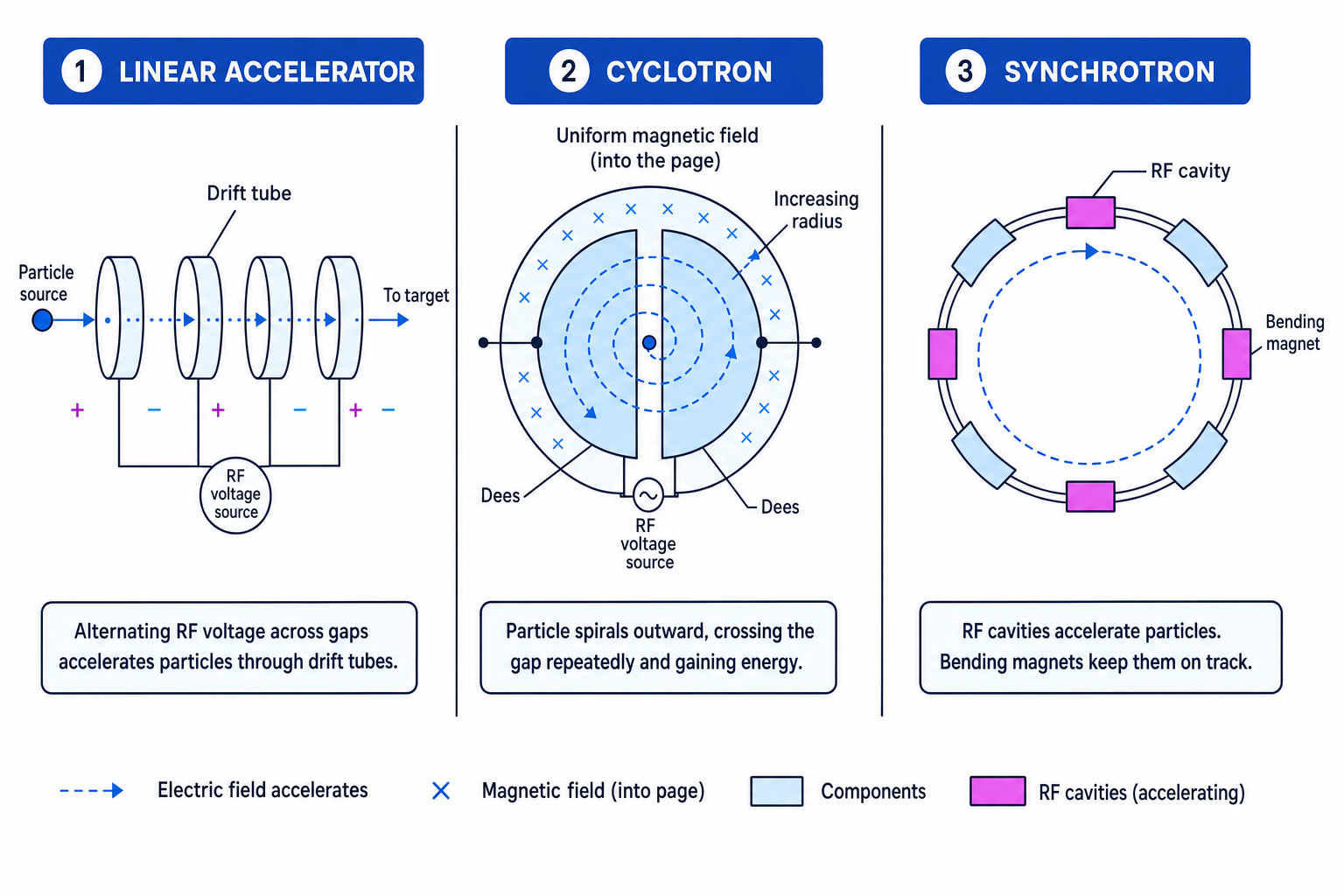
Accelerators repeatedly transfer energy to particles. The electric field does the accelerating; magnetic fields are usually used to bend or focus the beam.
The diagram compares three common accelerator ideas: a linear accelerator, a cyclotron, and a synchrotron.
Linear accelerator
A linear accelerator, or linac, accelerates particles in a straight line. It uses alternating potential differences across gaps between drift tubes.
The particles are accelerated mainly in the gaps. Inside the drift tubes, the electric field is small, so the particle is shielded while the voltage reverses.
Cyclotron
A cyclotron uses two D-shaped electrodes called dees. A magnetic field bends the charged particles into circular paths, while an alternating potential difference accelerates them each time they cross the gap between the dees.
For a charged particle moving perpendicular to a magnetic field:
F=BqvF = BqvF=BqvThis magnetic force provides the centripetal force:
Bqv=mv2rBqv = \frac{mv^2}{r}Bqv=rmv2Using v=2πrfv = 2\pi r fv=2πrf, the cyclotron frequency is:
f=Bq2πmf = \frac{Bq}{2\pi m}f=2πmBqExample
Cyclotron frequency
A proton moves in a cyclotron where the magnetic flux density is 0.80 T. Calculate the required frequency of the accelerating voltage.
-
For a cyclotron, match the radio-frequency voltage to the particle’s orbital frequency:
f=Bq2πmf = \frac{Bq}{2\pi m}f=2πmBq -
Substitute B=0.80 TB = 0.80\ \text{T}B=0.80 T, q=1.60×10⁻¹⁹ Cq = 1.60 \times 10^{-19}\ \text{C}q=1.60×10⁻¹⁹ C, and m=1.67×10⁻²⁷ kgm = 1.67 \times 10^{-27}\ \text{kg}m=1.67×10⁻²⁷ kg:
f=(0.80)(1.60×10⁻¹⁹)2π(1.67×10⁻²⁷)f = \frac{(0.80)(1.60 \times 10^{-19})}{2\pi(1.67 \times 10^{-27})}f=2π(1.67×10⁻²⁷)(0.80)(1.60×10⁻¹⁹) -
Calculate the frequency:
f=1.2×10⁷ Hzf = 1.2 \times 10^7\ \text{Hz}f=1.2×10⁷ HzSo the required frequency is about 12 MHz.
Synchrotron
A synchrotron accelerates particles around a fixed circular ring. Radio-frequency cavities increase the particles’ energy, and bending magnets keep them on the same circular path.
As the particles gain momentum, the magnetic field strength must be adjusted so that the beam remains in the ring.
Key Idea
Fields have different jobs
Electric fields transfer energy to charged particles. Magnetic fields change the direction of motion, so they steer particles, but do no work because the magnetic force is perpendicular to the velocity.
Detecting particles
Most particles are invisible to the eye. A detector records evidence of a particle’s path, energy, charge, or interactions.
Definition
Ionisation
Ionisation is the removal or addition of electrons from atoms, forming ions. Charged particles can ionise atoms as they pass through matter, leaving a detectable trail.
Common detector ideas include:
- Cloud chambers: charged particles ionise supersaturated vapour, causing droplets to form along the path.
- Bubble chambers: charged particles ionise a superheated liquid, causing bubbles along the path.
- Spark chambers and wire chambers: ionisation produces electrical signals, giving accurate track positions.
- Calorimeters: particles are stopped and their energy is measured from the shower of particles and energy deposited.
Neutral particles do not usually leave direct tracks, because they do not ionise strongly. Instead, you infer them from missing momentum or from charged particles produced when they decay or interact.
Particle tracks in magnetic fields
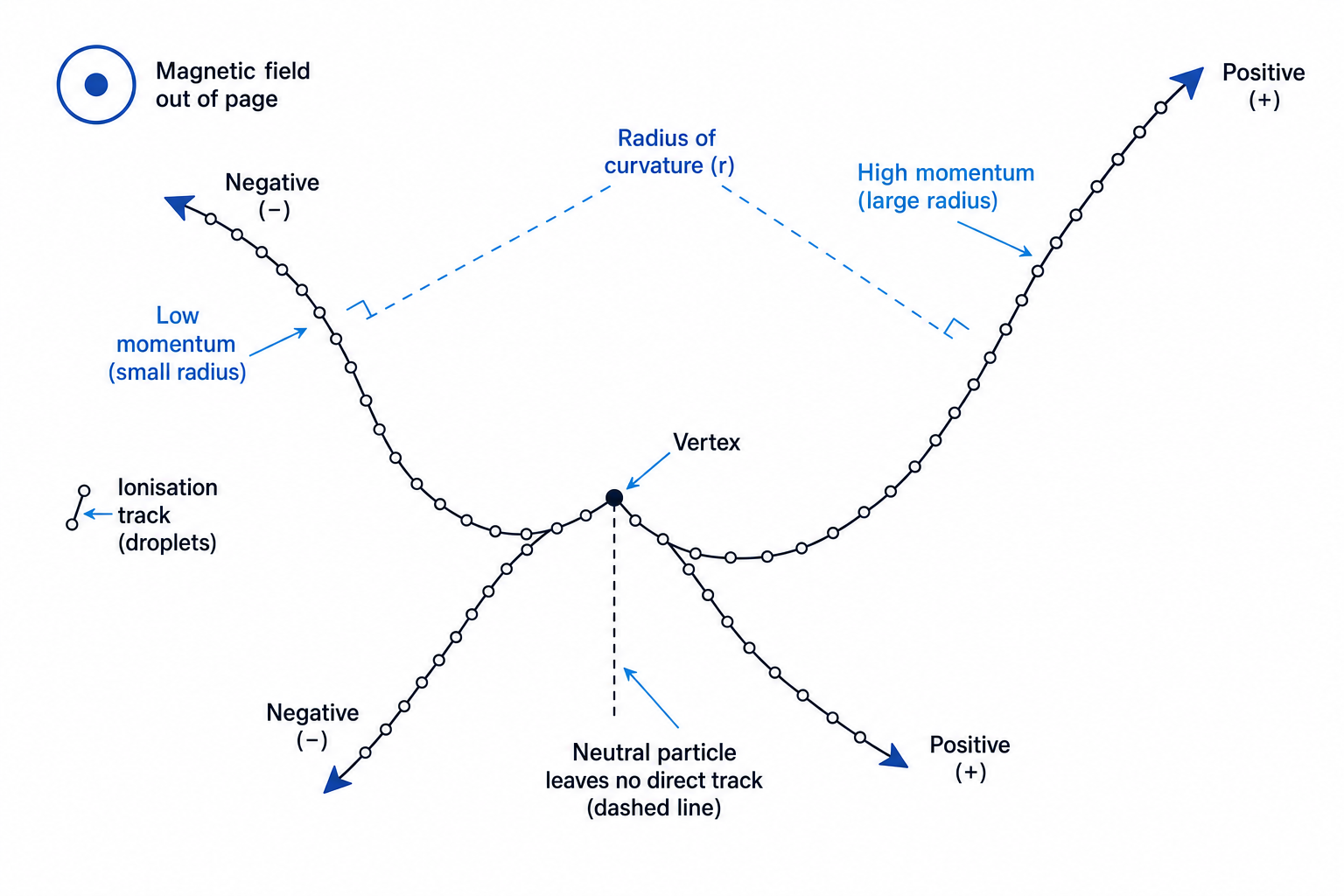
A particle track is the recorded path of a particle through a detector. In a magnetic field, charged particles follow curved paths because the magnetic force acts towards the centre of the curve.
The detector image below shows the main clues you use when interpreting tracks.
For motion perpendicular to the magnetic field:
Bqv=mv2rBqv = \frac{mv^2}{r}Bqv=rmv2Since momentum is p=mvp = mvp=mv:
p=Bqrp = Bqrp=BqrSo, in the same magnetic field, a larger radius means a larger momentum for particles with the same charge magnitude.
Example
Momentum from track radius
A singly charged particle moves in a detector where the magnetic flux density is 0.45 T. Its track has a radius of curvature of 0.120 m. Calculate its momentum.
-
For a singly charged particle, use q=e=1.60×10⁻¹⁹ Cq = e = 1.60 \times 10^{-19}\ \text{C}q=e=1.60×10⁻¹⁹ C.
-
Apply the track momentum equation:
p=Bqrp = Bqrp=Bqr -
Substitute the values:
p=(0.45)(1.60×10⁻¹⁹)(0.120)p = (0.45)(1.60 \times 10^{-19})(0.120)p=(0.45)(1.60×10⁻¹⁹)(0.120) -
Calculate:
p=8.6×10⁻²¹ kg m s−1p = 8.6 \times 10^{-21}\ \text{kg m s}^{-1}p=8.6×10⁻²¹ kg m s−1
Common Mistake
Tighter curve means lower momentum
In the same magnetic field, a smaller radius means a smaller momentum, not a larger one. The magnetic field bends low-momentum particles more easily.
Interpreting charge, direction and decay vertices
The direction of curvature tells you the sign of the charge, but only if you know the direction of the magnetic field and the direction of motion.
Use Fleming’s left-hand rule for a positive charge, or use F=BqvF = BqvF=Bqv and remember that a negative charge experiences the opposite force.
Tip
Track direction clues
If a particle loses energy as it travels, its momentum decreases, so its radius of curvature may get smaller. That can help you identify which end of the track came first.
A vertex is a point where tracks meet or split. It often marks a collision, decay, or particle interaction.
Example
Interpreting a neutral decay
A detector photograph shows no incoming charged track, then suddenly two tracks curve away from one vertex. One track is positive and one is negative, and their radii are equal in the same magnetic field.
-
The absence of an incoming track suggests the original particle may have been neutral, because neutral particles do not leave direct ionisation tracks.
-
The two outgoing tracks have opposite charges, so their total charge is zero. This is consistent with a neutral parent particle decaying.
-
The radii are equal and the charge magnitudes are equal, so from p=Bqrp = Bqrp=Bqr the two outgoing particles have equal momentum magnitudes.
Common Mistake
When needs care
The equation p=Bqrp = Bqrp=Bqr uses the component of momentum perpendicular to the magnetic field. If the particle has velocity along the field as well, the full path is helical.
What track appearance can tell you
Track photographs contain more information than just curvature:
- Thick or dense tracks usually mean stronger ionisation, often from slower or more highly charged particles.
- Thin, long tracks are often made by lighter particles with weaker ionisation.
- Sudden kinks may indicate a decay into an unseen neutral particle plus a charged particle.
- No direct track does not mean no particle; neutral particles can still be inferred from their products.
Exam technique
In the exam
- Identify the field direction first, then use the curvature to decide the sign of the charge.
- For momentum questions, go straight to p=Bqrp = Bqrp=Bqr and check that the charge is in coulombs and the radius is in metres.
- Compare radii only when the particles are in the same magnetic field; if their charge magnitudes differ, include qqq in the comparison.
- Be cautious about track direction: a static photograph may not show which way the particle was moving unless energy loss or a vertex gives a clue.
Self review
Check yourself
- Why does a magnetic field bend a charged particle but not increase its kinetic energy?
- In the same detector field, what does a larger radius of curvature tell you about a singly charged particle?
- How can a neutral particle be detected if it leaves no direct ionisation track?
You've reached the end
Test yourself on this topic, or move on to the next guide.
How was this guide?