Revision notes for Edexcel A Level Physics Magnetic forces. Open the guide for explanations and worked examples. Written against the Edexcel A Level Physics (9PH0) specification, so the content matches what's examinable rather than general Physics background.
Magnetic forces
What you'll learn
- How a magnetic field can exert a force on a current-carrying wire.
- How to use F=BILsinθF = BIL\sin\thetaF=BILsinθ and define magnetic flux density.
- How moving charged particles experience magnetic forces using F=BQvsinθF = BQv\sin\thetaF=BQvsinθ.
- Why charged particles can move in circular paths in uniform magnetic fields.
Prerequisites: forces, current and field direction
A force is a vector quantity: it has a magnitude and a direction. Magnetic forces are especially direction-sensitive, so diagrams matter.
A current is the rate of flow of charge. In circuit diagrams and magnetic-force questions, current means conventional current, the direction positive charge would move.
A magnetic field is represented by field lines. The closer together the lines, the stronger the field. In diagrams, you will often see:
- dots: field coming out of the page
- crosses: field going into the page
Definition
Magnetic field
A magnetic field is a region where a magnet, current-carrying conductor, or moving charge can experience a magnetic force.
Tip
Dots and crosses
Think of an arrow: a dot is the arrow tip coming towards you, while a cross is the arrow tail moving away from you.
The motor effect: force on a current-carrying wire
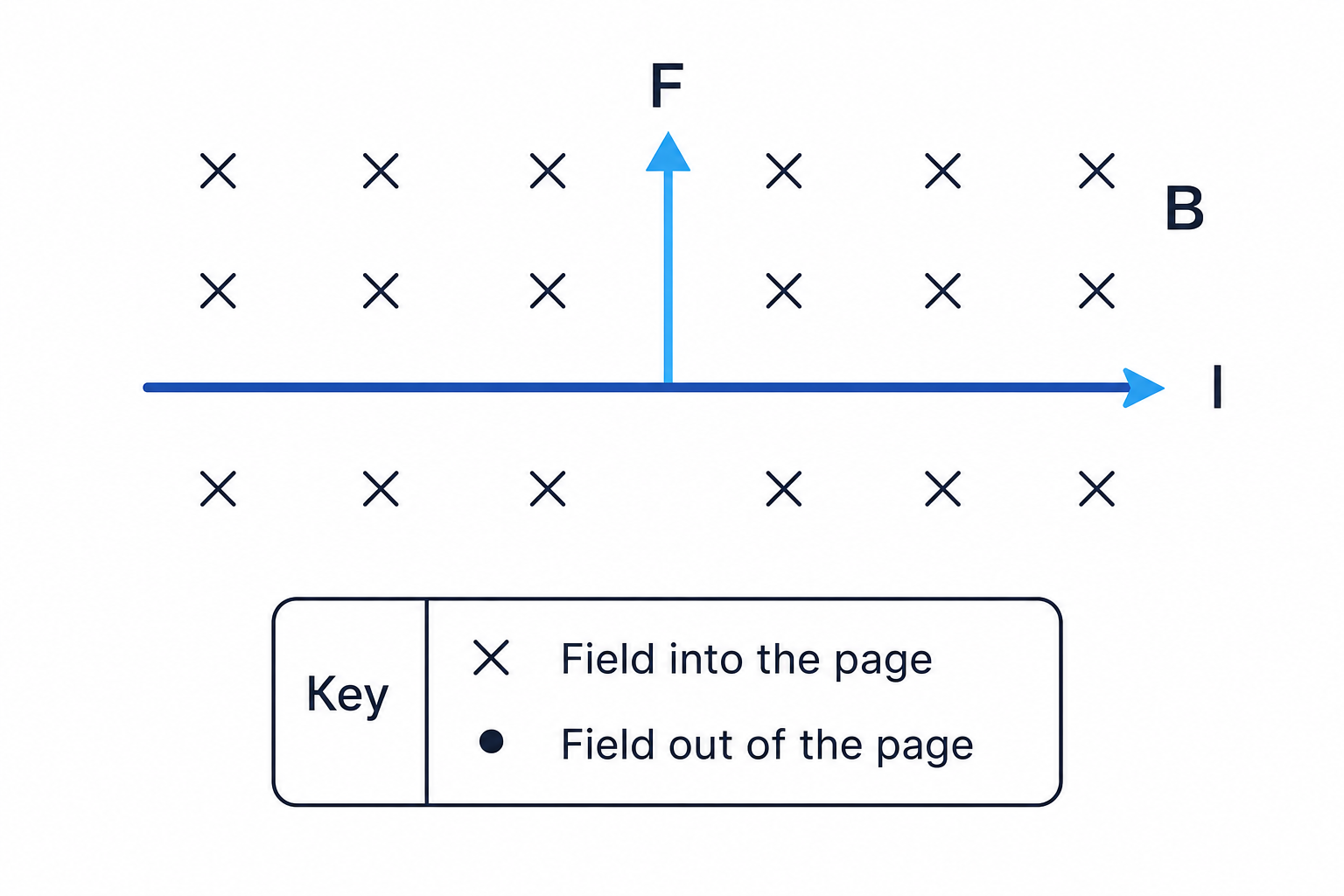
When a wire carrying current is placed in a magnetic field, the wire can experience a force. This is called the motor effect.
The force is largest when the wire is at right angles to the magnetic field.
The equation
For a straight wire in a magnetic field:
F=BILsinθF = BIL\sin\thetaF=BILsinθwhere:
- FFF is the magnetic force in newtons, N
- BBB is the magnetic flux density in tesla, T
- III is the current in amperes, A
- LLL is the length of wire inside the magnetic field in metres, m
- θ\thetaθ is the angle between the current direction and the magnetic field direction
If the wire is perpendicular to the field, θ=90∘\theta = 90^\circθ=90∘, so sinθ=1\sin\theta = 1sinθ=1 and:
F=BILF = BILF=BILDefinition
Magnetic flux density
Magnetic flux density, BBB, is the force per unit current per unit length on a wire placed at right angles to a magnetic field. One tesla is equivalent to one newton per ampere per metre.
Key Idea
Perpendicular gives maximum force
The magnetic force depends on the component of current that is perpendicular to the magnetic field. Parallel to the field gives no force.
Example
Calculating the force on a wire
A wire of length 2.0 cm carries a current of 3.0 A at right angles to a magnetic field of flux density 0.80 T. Calculate the force on the wire.
-
Convert the length into metres, because the equation uses SI units:
L=2.0 cm=2.0×10⁻² mL = 2.0\ \text{cm} = 2.0 \times 10^{-2}\ \text{m}L=2.0 cm=2.0×10⁻² m -
The wire is at right angles to the field, so use F=BILF = BILF=BIL:
F=(0.80 T)(3.0 A)(2.0×10⁻² m)F = (0.80\ \text{T})(3.0\ \text{A})(2.0 \times 10^{-2}\ \text{m})F=(0.80 T)(3.0 A)(2.0×10⁻² m) -
Calculate the force and quote a sensible number of significant figures:
F=4.8×10⁻² NF = 4.8 \times 10^{-2}\ \text{N}F=4.8×10⁻² N
Common Mistake
Using the wrong length
LLL is the length of wire inside the magnetic field, not necessarily the total length of the wire.
Finding the direction of the force
The force is at right angles to both the current and the magnetic field. Use Fleming’s left-hand rule for the motor effect:
- First finger: magnetic field
- seCond finger: conventional current
- Thumb: force or motion
You rotate your left hand until the first finger points in the field direction and the second finger points in the current direction. Your thumb then gives the force direction.
Example
Finding the force direction
A wire carries conventional current to the right. The magnetic field is into the page. Find the direction of the force.
-
Point your first finger into the page, because the magnetic field is into the page.
-
Point your second finger to the right, because that is the conventional current direction.
-
Your thumb points upwards, so the force on the wire is upwards.
Common Mistake
Using electron flow instead of conventional current
For a metal wire, electrons drift opposite to conventional current. In Fleming’s left-hand rule, use conventional current, unless the question is explicitly about an individual electron.
What if the wire is not perpendicular?
The full equation is:
F=BILsinθF = BIL\sin\thetaF=BILsinθThe sine factor handles the angle.
If the current is parallel to the magnetic field, θ=0∘\theta = 0^\circθ=0∘ and sinθ=0\sin\theta = 0sinθ=0, so the force is zero.
If the current is perpendicular to the magnetic field, θ=90∘\theta = 90^\circθ=90∘ and the force is maximum.
Example
Using the angle in the motor-effect equation
A 0.15 m length of wire carries a current of 4.0 A in a magnetic field of flux density 0.25 T. The wire makes an angle of 30 degrees with the field. Calculate the force.
-
Choose the full equation because the wire is not perpendicular to the field:
F=BILsinθF = BIL\sin\thetaF=BILsinθ -
Substitute the values:
F=(0.25 T)(4.0 A)(0.15 m)sin30∘F = (0.25\ \text{T})(4.0\ \text{A})(0.15\ \text{m})\sin 30^\circF=(0.25 T)(4.0 A)(0.15 m)sin30∘ -
Evaluate the result:
F=7.5×10⁻² NF = 7.5 \times 10^{-2}\ \text{N}F=7.5×10⁻² N
Measuring magnetic flux density in practice
A common practical method is to place a straight conductor in a uniform magnetic field and measure the force as the current changes.
If the wire is perpendicular to the field:
F=BILF = BILF=BILIf BBB and LLL are constant, then FFF is directly proportional to III.
So a graph of force against current should be a straight line through the origin, with gradient:
gradient=BL\text{gradient} = BLgradient=BLThis means:
B=gradientLB = \frac{\text{gradient}}{L}B=LgradientTip
Graph check
If you double the current, the magnetic force should double. If your force-current graph does not look linear, check for zero errors, poor contact, or the wire not staying fully in the field.
Force on a moving charged particle
A single moving charge also experiences a force in a magnetic field.
For a particle of charge QQQ moving at speed vvv:
F=BQvsinθF = BQv\sin\thetaF=BQvsinθwhere θ\thetaθ is the angle between the velocity and the magnetic field.
If the particle moves perpendicular to the field:
F=BQvF = BQvF=BQvThis is closely linked to the wire equation. A current in a wire is just many moving charges, so the motor effect comes from magnetic forces on the charges inside the conductor.
Key Idea
Magnetic fields act on moving charge
A stationary charged particle does not experience a magnetic force. The charge must be moving, and only the velocity component perpendicular to the field contributes.
Example
Calculating the force on a proton
A proton moves at 3.0×10⁶ m s−13.0 \times 10^6\ \text{m s}^{-1}3.0×10⁶ m s−1 at right angles to a magnetic field of flux density 0.12 T. The charge on a proton is 1.60×10⁻¹⁹ C1.60 \times 10^{-19}\ \text{C}1.60×10⁻¹⁹ C. Calculate the magnetic force.
-
The motion is at right angles to the field, so use F=BQvF = BQvF=BQv:
F=(0.12 T)(1.60×10⁻¹⁹ C)(3.0×10⁶ m s−1)F = (0.12\ \text{T})(1.60 \times 10^{-19}\ \text{C})(3.0 \times 10^6\ \text{m s}^{-1})F=(0.12 T)(1.60×10⁻¹⁹ C)(3.0×10⁶ m s−1) -
Multiply the powers of ten and the numerical factors:
F=5.76×10⁻¹⁴ NF = 5.76 \times 10^{-14}\ \text{N}F=5.76×10⁻¹⁴ N -
Quote the answer to two significant figures:
F=5.8×10⁻¹⁴ NF = 5.8 \times 10^{-14}\ \text{N}F=5.8×10⁻¹⁴ N
Common Mistake
Negative charges reverse direction
For an electron, the force direction is opposite to the direction predicted for a positive charge moving the same way. The magnitude can still be found using the size of the charge.
Circular motion in a magnetic field
If a charged particle enters a uniform magnetic field at right angles, the magnetic force is always perpendicular to its velocity.
That means the force changes the particle’s direction but not its speed. The particle follows a circular path.
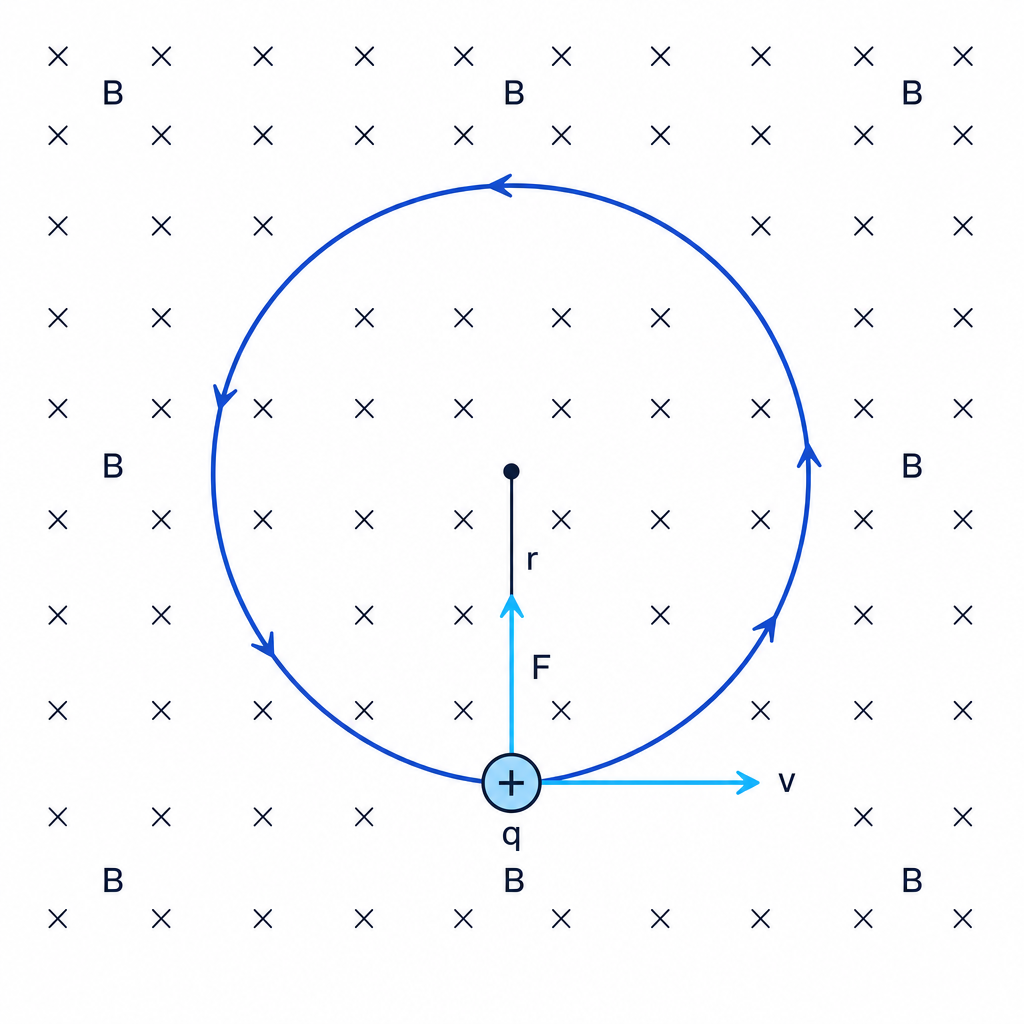
The magnetic force provides the centripetal force:
BQv=mv2rBQv = \frac{mv^2}{r}BQv=rmv2Cancel one factor of vvv:
BQ=mvrBQ = \frac{mv}{r}BQ=rmvRearrange for the radius:
r=mvBQr = \frac{mv}{BQ}r=BQmvwhere:
- mmm is the mass of the particle in kilograms, kg
- rrr is the radius of the circular path in metres, m
Key Idea
Bigger field, tighter circle
A stronger magnetic field gives a larger magnetic force, so the radius of the circular path is smaller.
Example
Finding the radius of a charged particle path
An ion of mass 6.6×10⁻²⁷ kg6.6 \times 10^{-27}\ \text{kg}6.6×10⁻²⁷ kg and charge 3.2×10⁻¹⁹ C3.2 \times 10^{-19}\ \text{C}3.2×10⁻¹⁹ C moves at 2.5×10⁵ m s−12.5 \times 10^5\ \text{m s}^{-1}2.5×10⁵ m s−1 perpendicular to a magnetic field of flux density 0.40 T. Calculate the radius of its circular path.
-
Use the magnetic force as the centripetal force:
BQv=mv2rBQv = \frac{mv^2}{r}BQv=rmv2 -
Rearrange for rrr:
r=mvBQr = \frac{mv}{BQ}r=BQmv -
Substitute the values:
r=(6.6×10⁻²⁷ kg)(2.5×10⁵ m s−1)(0.40 T)(3.2×10⁻¹⁹ C)r = \frac{(6.6 \times 10^{-27}\ \text{kg})(2.5 \times 10^5\ \text{m s}^{-1})}{(0.40\ \text{T})(3.2 \times 10^{-19}\ \text{C})}r=(0.40 T)(3.2×10⁻¹⁹ C)(6.6×10⁻²⁷ kg)(2.5×10⁵ m s−1) -
Calculate the radius:
r=1.3×10⁻² mr = 1.3 \times 10^{-2}\ \text{m}r=1.3×10⁻² m
Bringing the technique together
For most magnetic-force questions, you can use the same structure:
- Decide whether the question is about a wire or a single particle.
- Choose F=BILsinθF = BIL\sin\thetaF=BILsinθ for a current-carrying conductor, or F=BQvsinθF = BQv\sin\thetaF=BQvsinθ for a moving charge.
- Use Fleming’s left-hand rule for direction.
- If the particle moves in a circle, set magnetic force equal to centripetal force.
Exam technique
In the exam
- Check whether the angle is 90 degrees, 0 degrees, or something else before choosing the simplified equation.
- Use conventional current for wires, but reverse the direction for negative particles such as electrons.
- For circular motion, write BQv=mv2/rBQv = mv^2/rBQv=mv2/r first, then rearrange carefully.
Self review
Check yourself
- Why is there no magnetic force when a charged particle moves parallel to a magnetic field?
- A wire carries current to the left in a field out of the page. Which way is the force?
- How would increasing the magnetic flux density affect the radius of a charged particle’s circular path?
You've reached the end
Test yourself on this topic, or move on to the next guide.
How was this guide?