Revision notes for Edexcel A Level Physics EMF and internal resistance. Open the guide for explanations and worked examples. Written against the Edexcel A Level Physics (9PH0) specification, so the content matches what's examinable rather than general Physics background.
EMF and internal resistance
What you'll learn
- What emf really means, and why it is not quite the same as terminal potential difference.
- Why real cells and power supplies have internal resistance.
- How to use the key equation V=ε−IrV = \varepsilon - IrV=ε−Ir.
- How to find emf and internal resistance from a graph of terminal p.d. against current.
Prerequisites: charge, current and potential difference
Before internal resistance makes sense, you need three circuit ideas.
Charge is a property of particles such as electrons. It is measured in coulombs, C.
Current is the rate of flow of charge:
I=ΔQΔtI = \frac{\Delta Q}{\Delta t}I=ΔtΔQwhere III is current in amperes, A, ΔQ\Delta QΔQ is charge in coulombs, C, and Δt\Delta tΔt is time in seconds, s.
Potential difference, often shortened to p.d., is the energy transferred per unit charge between two points in a circuit:
V=WQV = \frac{W}{Q}V=QWwhere VVV is potential difference in volts, V, WWW is energy transferred in joules, J, and QQQ is charge in coulombs, C.
Definition
Potential difference
A potential difference of 1 V means 1 J of energy is transferred for every 1 C of charge passing between two points.
Using potential difference to find energy transfer
Example
Energy transferred by charge through a resistor
A charge of 30 C passes through a lamp connected across a p.d. of 12 V. Find the energy transferred in the lamp.
-
Start with the definition of potential difference:
V=WQV = \frac{W}{Q}V=QW, so W=VQW = VQW=VQ. -
Substitute the values with units:
W=12 V×30 CW = 12\ \text{V} \times 30\ \text{C}W=12 V×30 C. -
Calculate the energy transferred:
W=360 JW = 360\ \text{J}W=360 J.
What is emf?
A cell, battery or power supply is an energy source. It transfers energy from some other form into electrical energy.
For example:
- a chemical cell transfers chemical energy into electrical energy
- a solar cell transfers light energy into electrical energy
- a generator transfers kinetic energy into electrical energy
The electromotive force, usually abbreviated to emf, is not actually a force. It is an energy transfer per unit charge.
Definition
Electromotive force
The emf, symbol ε\varepsilonε, of a source is the energy transferred from other forms into electrical energy per unit charge passing through the source.
ε=WQ\varepsilon = \frac{W}{Q}ε=QWThe unit of emf is the volt, V, because it is also joules per coulomb.
Key Idea
Emf is energy supplied per coulomb
Potential difference is energy transferred from the charges in a component. Emf is energy transferred to the charges by a source.
Calculating emf from energy per charge
Example
Finding emf from energy supplied
A cell transfers 72 J of chemical energy to electrical energy when 48 C of charge passes through it. Find the emf.
-
Use the definition of emf:
ε=WQ\varepsilon = \frac{W}{Q}ε=QW. -
Substitute the energy and charge:
ε=72 J48 C\varepsilon = \frac{72\ \text{J}}{48\ \text{C}}ε=48 C72 J. -
Calculate the energy supplied per coulomb:
ε=1.5 V\varepsilon = 1.5\ \text{V}ε=1.5 V.
Terminal p.d. and the real behaviour of a cell
In an ideal world, the p.d. across a cell’s terminals would always equal its emf.
In a real cell, the cell itself has some resistance. When current flows, some energy is dissipated inside the cell, usually as thermal energy. This means the p.d. available across the external circuit is smaller than the emf.
Definition
Terminal potential difference
The terminal p.d., symbol VVV, is the potential difference across the external terminals of a source. It is the p.d. supplied to the external circuit.
When no current is drawn from a cell, the terminal p.d. is approximately equal to the emf. This is called the open-circuit voltage.
When current flows, the terminal p.d. falls.
Internal resistance
Internal resistance is the resistance inside a source of emf. It is given the symbol rrr and measured in ohms, Ω.
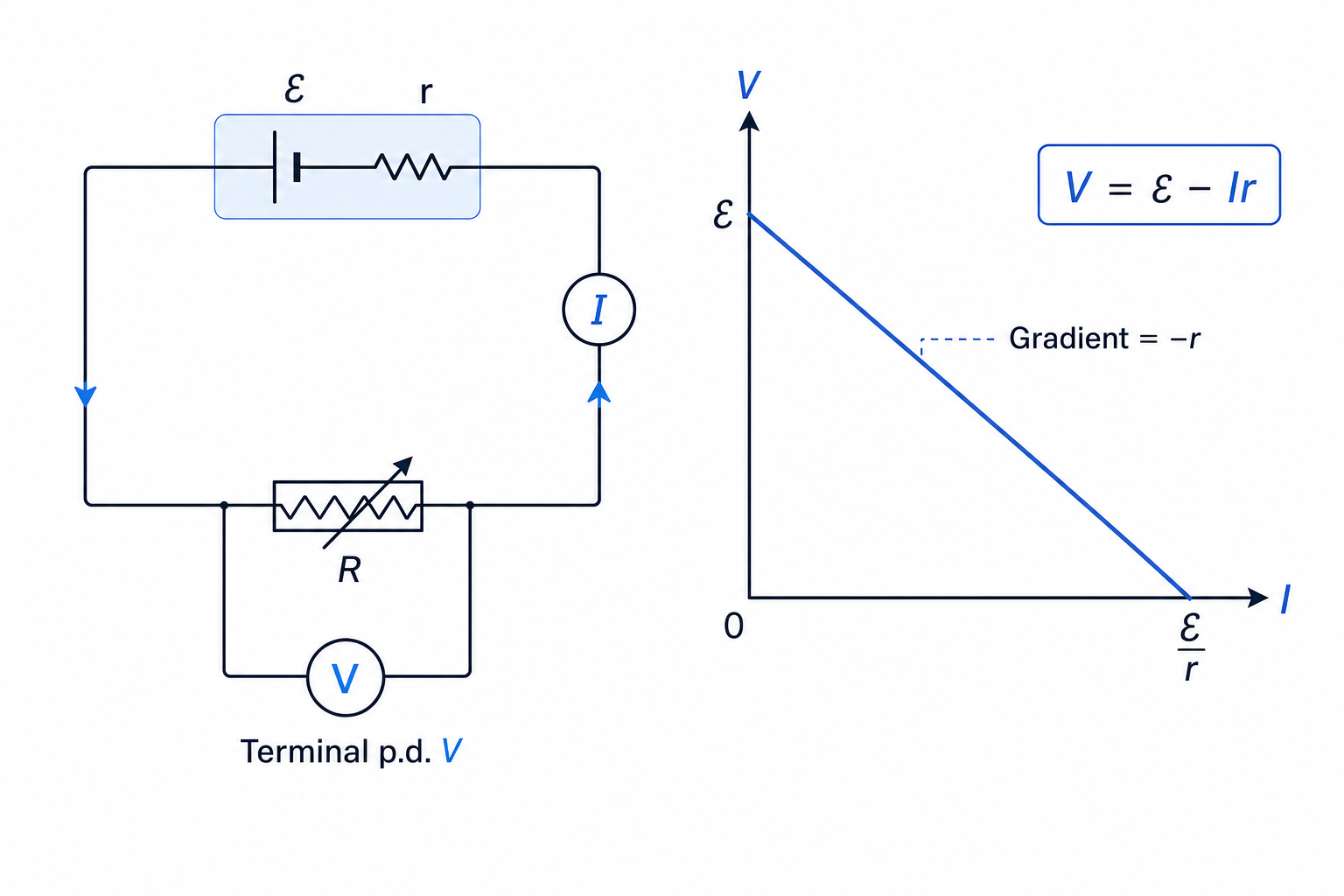
A real cell can be modelled as:
- an ideal emf source, ε\varepsilonε
- in series with a small internal resistor, rrr
The external circuit may have a load resistance RRR.
The diagram shows the standard model and the graph you use to analyse it.
Definition
Internal resistance
Internal resistance is the effective resistance within a source of emf that causes energy to be dissipated inside the source when current flows.
The energy lost per coulomb inside the cell is called the lost volts.
For a current III through internal resistance rrr:
lost volts=Ir\text{lost volts} = Irlost volts=IrSo the emf is split between the external circuit and the internal resistance:
ε=V+Ir\varepsilon = V + Irε=V+IrRearranging gives the most important equation for this topic:
V=ε−IrV = \varepsilon - IrV=ε−IrKey Idea
The cell loses some voltage internally
For a cell supplying current, terminal p.d. is less than emf because some energy per coulomb is dissipated across the internal resistance.
Common Mistake
Treating emf and terminal p.d. as always equal
They are equal only when the current is zero, or when internal resistance is negligible. When current flows through a real source, use V=ε−IrV = \varepsilon - IrV=ε−Ir.
Combining internal and external resistance
If the external load has resistance RRR, the terminal p.d. across the load is:
V=IRV = IRV=IRThe total resistance in the circuit is the external resistance plus the internal resistance:
Rtotal=R+rR_\text{total} = R + rRtotal=R+rSo the current in the circuit is:
I=εR+rI = \frac{\varepsilon}{R + r}I=R+rεYou can also write:
ε=I(R+r)\varepsilon = I(R + r)ε=I(R+r)This is just conservation of energy per unit charge: the emf is shared between the external load and the internal resistance.
Calculating current and terminal p.d.
Example
Finding terminal p.d. with internal resistance
A battery has emf 6.0 V and internal resistance 0.50 Ω. It is connected to an external resistor of resistance 5.5 Ω. Find the current and the terminal p.d.
-
Add the external and internal resistances because they are in series:
R+r=5.5 Ω+0.50 Ω=6.0 ΩR + r = 5.5\ \Omega + 0.50\ \Omega = 6.0\ \OmegaR+r=5.5 Ω+0.50 Ω=6.0 Ω. -
Use the total circuit resistance to find the current:
I=εR+r=6.0 V6.0 Ω=1.0 AI = \frac{\varepsilon}{R + r} = \frac{6.0\ \text{V}}{6.0\ \Omega} = 1.0\ \text{A}I=R+rε=6.0 Ω6.0 V=1.0 A. -
Find the terminal p.d. across the external resistor:
V=IR=1.0 A×5.5 Ω=5.5 VV = IR = 1.0\ \text{A} \times 5.5\ \Omega = 5.5\ \text{V}V=IR=1.0 A×5.5 Ω=5.5 V. -
Check using lost volts:
Ir=1.0 A×0.50 Ω=0.50 VIr = 1.0\ \text{A} \times 0.50\ \Omega = 0.50\ \text{V}Ir=1.0 A×0.50 Ω=0.50 V, so V=6.0 V−0.50 V=5.5 VV = 6.0\ \text{V} - 0.50\ \text{V} = 5.5\ \text{V}V=6.0 V−0.50 V=5.5 V.
Tip
Sanity check
For a discharging cell, your terminal p.d. should be smaller than the emf. If it comes out larger, check the sign of the IrIrIr term.
The graph method
A very common A-Level method is to measure the terminal p.d. VVV for different values of current III, then plot a graph of VVV against III.
The equation is:
V=ε−IrV = \varepsilon - IrV=ε−IrThis has the same form as a straight-line graph:
y=c+mxy = c + mxy=c+mxComparing the two:
- vertical axis: VVV
- horizontal axis: III
- y-intercept: ε\varepsilonε
- gradient: −r-r−r
So the internal resistance is the negative of the gradient.
Key Idea
Graph interpretation
On a graph of terminal p.d. against current, the y-intercept gives the emf and the magnitude of the gradient gives the internal resistance.
Finding emf and internal resistance from a graph
Example
Using a V-I graph for a cell
A graph of terminal p.d. VVV against current III is a straight line. Two points on the best-fit line are 0.20 A, 1.50 V and 1.20 A, 1.05 V. Find the internal resistance. Then find the emf.
-
Calculate the gradient of the graph using two well-spaced points:
m=1.05 V−1.50 V1.20 A−0.20 Am = \frac{1.05\ \text{V} - 1.50\ \text{V}}{1.20\ \text{A} - 0.20\ \text{A}}m=1.20 A−0.20 A1.05 V−1.50 V. -
Evaluate the gradient:
m=−0.45 V1.00 A=−0.45 Ωm = \frac{-0.45\ \text{V}}{1.00\ \text{A}} = -0.45\ \Omegam=1.00 A−0.45 V=−0.45 Ω. -
Use the relationship between gradient and internal resistance:
m=−rm = -rm=−r, so r=0.45 Ωr = 0.45\ \Omegar=0.45 Ω. -
Use one point and the equation V=ε−IrV = \varepsilon - IrV=ε−Ir:
1.50 V=ε−(0.20 A×0.45 Ω)1.50\ \text{V} = \varepsilon - (0.20\ \text{A} \times 0.45\ \Omega)1.50 V=ε−(0.20 A×0.45 Ω). -
Rearrange and calculate the emf:
ε=1.50 V+0.090 V=1.59 V\varepsilon = 1.50\ \text{V} + 0.090\ \text{V} = 1.59\ \text{V}ε=1.50 V+0.090 V=1.59 V, so the emf is about 1.6 V.
Common Mistake
Forgetting the negative gradient
The graph slopes downwards, so its gradient is negative. The internal resistance is positive, so use r=−gradientr = -\text{gradient}r=−gradient.
Practical measurement of emf and internal resistance
To investigate a cell experimentally, you can connect:
- an ammeter in series to measure current
- a variable resistor or resistance box to change current
- a voltmeter across the cell terminals to measure terminal p.d.
For each setting of the variable resistor, record III and VVV. Then plot VVV on the y-axis against III on the x-axis.
Good practical technique matters here:
- switch off between readings to reduce heating
- avoid very high currents, which can damage the cell and change its internal resistance
- use a best-fit line rather than joining points dot-to-dot
- calculate the gradient using a large triangle on the best-fit line
- do not force the graph through the origin
Tip
Choosing axes
Plot terminal p.d. on the y-axis and current on the x-axis. Then the intercept is directly the emf and the gradient is directly −r-r−r.
Common Mistake
When the equation changes sign
The equation V=ε−IrV = \varepsilon - IrV=ε−Ir assumes the source is supplying current to the circuit. If a rechargeable cell is being charged, the terminal p.d. can be greater than the emf.
What internal resistance means physically
Internal resistance is not usually a neat little resistor hidden inside the cell. It is a model for several effects inside the source, including energy dissipation as charges move through the electrolyte, electrodes or internal connections.
As current increases, more energy is dissipated per second inside the source. The source may warm up, and the terminal p.d. may fall further.
This also explains why old batteries often perform badly: their internal resistance has increased. Even if the emf is still fairly close to its normal value when measured with a high-resistance voltmeter, the terminal p.d. can drop sharply when the battery is asked to supply a large current.
Analogy
A useful picture
Think of emf as the energy budget per coulomb. Some of that budget is spent usefully in the external circuit, and some is wasted inside the cell due to internal resistance.
Exam technique
In the exam
- Start by deciding whether you need emf, terminal p.d. or lost volts: ε\varepsilonε is supplied per coulomb, VVV is delivered to the external circuit, and IrIrIr is lost internally.
- For a discharging cell, use V=ε−IrV = \varepsilon - IrV=ε−Ir and check that your terminal p.d. is less than the emf.
- For graph questions, identify the axes first: on a VVV against III graph, y-intercept gives ε\varepsilonε and gradient gives −r-r−r.
Self review
Check yourself
- Why is emf measured in volts even though it is not a potential difference across a component?
- A cell has emf 12 V and internal resistance 1.0 Ω. What happens to its terminal p.d. as current increases?
- On a graph of terminal p.d. against current, how would you find the internal resistance?