Revision notes for Edexcel A Level Physics Electron diffraction and de Broglie wavelength. Open the guide for explanations and worked examples. Written against the Edexcel A Level Physics (9PH0) specification, so the content matches what's examinable rather than general Physics background.
Electron diffraction and de Broglie wavelength
What you'll learn
- Why diffraction is strong evidence that electrons can behave like waves.
- How to use the de Broglie equation λ=hp\lambda = \frac{h}{p}λ=ph.
- How accelerating voltage affects an electron’s wavelength.
- How electron diffraction patterns are produced and interpreted.
Starting point: what diffraction tells you
You already know that diffraction is the spreading of waves when they pass through a gap or around an obstacle. Diffraction effects are most noticeable when the wavelength is similar in size to the gap, obstacle, or spacing between scattering centres.
For visible light, diffraction by a grating or slit shows that light has wave behaviour. The surprising discovery in this topic is that electrons, which we often treat as particles, can also diffract.
Definition
Diffraction
Diffraction is the spreading or bending of waves when they pass through an aperture or around an obstacle. A clear diffraction pattern is evidence of wave behaviour.
Key Idea
The big idea
If electrons produce a diffraction pattern, they must have a wave-like property: a wavelength.
Wave-particle duality
In earlier work on the photoelectric effect, you saw that light sometimes behaves like particles called photons. Here, the direction of the surprise is reversed: electrons are usually introduced as particles, but they can show wave behaviour.
Definition
Wave-particle duality
Wave-particle duality is the idea that objects such as light and electrons can show both wave-like and particle-like behaviour, depending on the experiment.
Electrons are still detected as individual particles. For example, an electron hits a fluorescent screen at one point. But the overall pattern built up by many electrons can be a diffraction pattern, which is a wave effect.
Common Mistake
Thinking the electron becomes a wave instead of a particle
An electron is not “just a wave” or “just a particle”. In this topic, you use a particle property, momentum, to calculate a wave property, wavelength.
de Broglie wavelength
Louis de Broglie proposed that any moving particle has an associated wavelength. This is called the de Broglie wavelength.
Definition
de Broglie wavelength
The de Broglie wavelength of a particle is the wavelength associated with its motion:
λ=hp\lambda = \frac{h}{p}λ=phwhere λ\lambdaλ is wavelength in metres, hhh is the Planck constant, and ppp is momentum in kilogram metres per second.
The Planck constant is:
h=6.63×10⁻³⁴ J sh = 6.63 \times 10^{-34}\ \text{J s}h=6.63×10⁻³⁴ J sSince momentum is p=mvp = mvp=mv for a non-relativistic particle, you can also write:
λ=hmv\lambda = \frac{h}{mv}λ=mvhThis means a particle with greater momentum has a smaller de Broglie wavelength.
Key Idea
Momentum and wavelength are inversely related
For matter waves, increasing momentum decreases wavelength: λ∝1p\lambda \propto \frac{1}{p}λ∝p1.
Example
Finding the de Broglie wavelength of an electron
An electron travels at 2.0×10⁶ m s−12.0 \times 10^6\ \text{m s}^{-1}2.0×10⁶ m s−1. Calculate its de Broglie wavelength. Use me=9.11×10⁻³¹ kgm_e = 9.11 \times 10^{-31}\ \text{kg}me=9.11×10⁻³¹ kg.
-
Calculate the electron’s momentum using p=mvp = mvp=mv:
p=(9.11×10⁻³¹)(2.0×10⁶)p = \left(9.11 \times 10^{-31}\right)\left(2.0 \times 10^6\right)p=(9.11×10⁻³¹)(2.0×10⁶) p=1.82×10⁻²⁴ kg m s−1p = 1.82 \times 10^{-24}\ \text{kg m s}^{-1}p=1.82×10⁻²⁴ kg m s−1 -
Substitute into λ=hp\lambda = \frac{h}{p}λ=ph:
λ=6.63×10−341.82×10⁻²⁴\lambda = \frac{6.63 \times 10^{-34}}{1.82 \times 10^{-24}}λ=1.82×10−246.63×10⁻³⁴ -
Calculate the wavelength:
λ=3.64×10⁻¹⁰ m\lambda = 3.64 \times 10^{-10}\ \text{m}λ=3.64×10⁻¹⁰ mSo the electron’s de Broglie wavelength is about 3.6×10⁻¹⁰ m3.6 \times 10^{-10}\ \text{m}3.6×10⁻¹⁰ m.
Why electron diffraction needs tiny spacings
Electron wavelengths in typical A-Level calculations are often around 10−10 m10^{-10}\ \text{m}10−10 m. This is about the same size as the spacing between atoms in a crystal.
That is why crystals are useful for electron diffraction: their atoms act like a very closely spaced diffraction structure.
Tip
Useful scale comparison
Atomic spacings in crystals are around 10−10 m10^{-10}\ \text{m}10−10 m, so electrons with wavelengths of this order can diffract strongly from crystal planes.
Electron diffraction apparatus
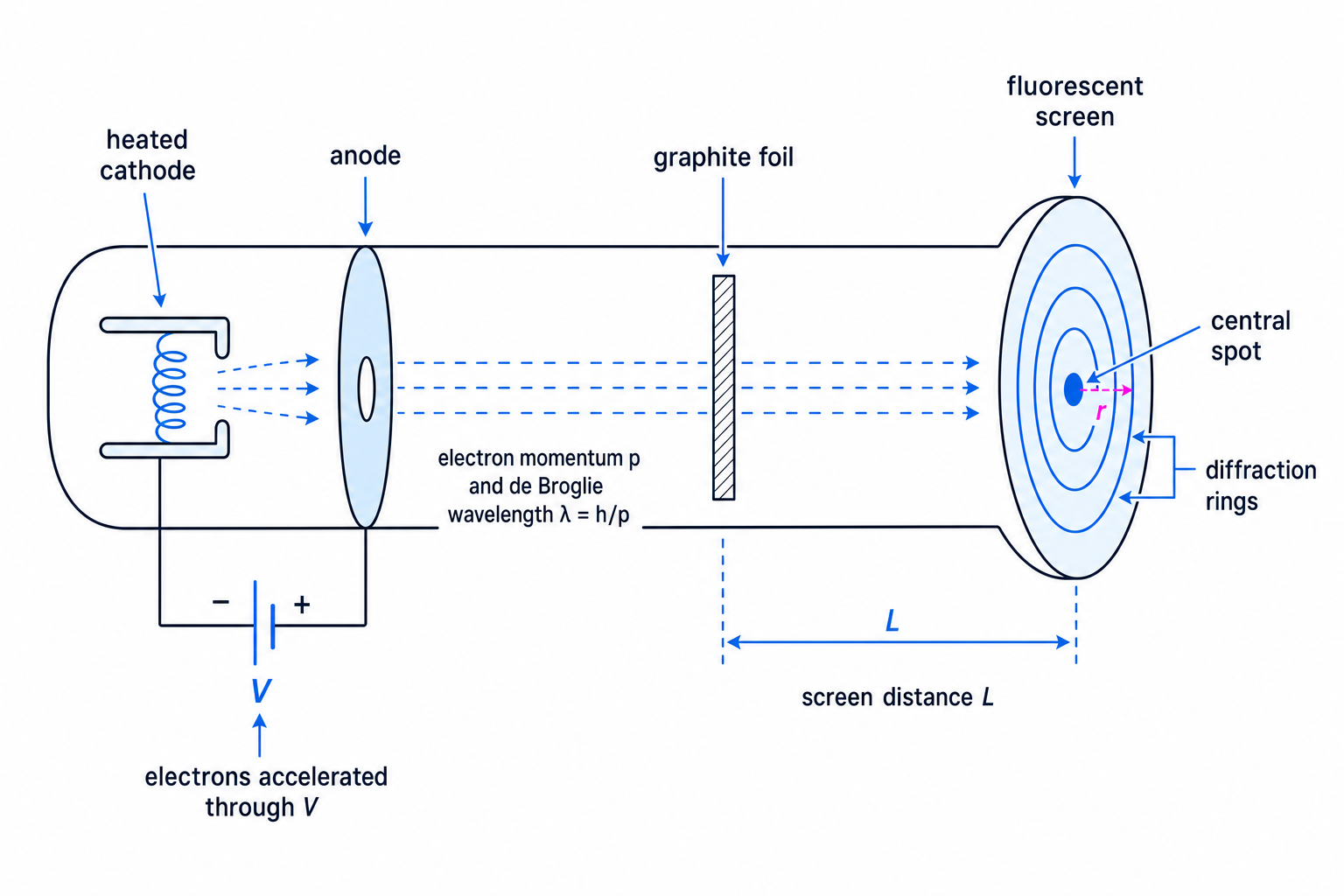
A common demonstration uses an electron diffraction tube. Electrons are emitted by a heated cathode, accelerated through a potential difference, pass through a thin graphite foil, and hit a fluorescent screen.
The graphite is polycrystalline, meaning it contains many tiny crystal regions at different orientations. This produces circular diffraction rings rather than just a few spots.
Definition
Fluorescent screen
A fluorescent screen emits visible light when struck by energetic electrons, allowing the electron impact positions to be seen.
How the electron gains kinetic energy
An electron accelerated through a potential difference VVV gains energy from the electric field.
The energy gained by a charge moving through a potential difference is:
E=QVE = QVE=QVFor an electron, the magnitude of the charge is the elementary charge:
e=1.60×10⁻¹⁹ Ce = 1.60 \times 10^{-19}\ \text{C}e=1.60×10⁻¹⁹ CSo the electron gains kinetic energy:
Ek=eVE_k = eVEk=eVIf the electron starts from rest and is not moving relativistically, then:
eV=12mev2eV = \frac{1}{2}m_ev^2eV=21mev2This allows you to connect the accelerating voltage to the electron speed, momentum, and wavelength.
Common Mistake
Non-relativistic assumption
At A-Level, you usually use eV=12mev2eV = \frac{1}{2}m_ev^2eV=21mev2 for electron diffraction tube calculations. At very high voltages, relativistic effects become important and this simple equation is no longer accurate.
Combining voltage with de Broglie wavelength
You often want the electron wavelength directly from the accelerating voltage.
Start with:
eV=12mev2eV = \frac{1}{2}m_ev^2eV=21mev2Rearrange to find speed:
v=2eVmev = \sqrt{\frac{2eV}{m_e}}v=me2eVMomentum is:
p=mevp = m_evp=mevSo:
p=2meeVp = \sqrt{2m_eeV}p=2meeVSubstitute into the de Broglie equation:
λ=h2meeV\lambda = \frac{h}{\sqrt{2m_eeV}}λ=2meeVhKey Idea
Voltage controls wavelength
A larger accelerating voltage gives electrons more kinetic energy and momentum, so their de Broglie wavelength becomes smaller.
Example
Calculating wavelength from accelerating voltage
Electrons are accelerated through a potential difference of 2.50×10³ V2.50 \times 10^3\ \text{V}2.50×10³ V. Calculate their de Broglie wavelength.
Use h=6.63×10⁻³⁴ J sh = 6.63 \times 10^{-34}\ \text{J s}h=6.63×10⁻³⁴ J s, me=9.11×10⁻³¹ kgm_e = 9.11 \times 10^{-31}\ \text{kg}me=9.11×10⁻³¹ kg, and e=1.60×10⁻¹⁹ Ce = 1.60 \times 10^{-19}\ \text{C}e=1.60×10⁻¹⁹ C.
-
Use the combined equation:
λ=h2meeV\lambda = \frac{h}{\sqrt{2m_eeV}}λ=2meeVh -
Substitute the values, keeping the voltage in volts:
λ=6.63×10−342(9.11×10⁻³¹)(1.60×10⁻¹⁹)(2.50×10³)\lambda = \frac{6.63 \times 10^{-34}}{\sqrt{2\left(9.11 \times 10^{-31}\right)\left(1.60 \times 10^{-19}\right)\left(2.50 \times 10^3\right)}}λ=2(9.11×10⁻³¹)(1.60×10⁻¹⁹)(2.50×10³)6.63×10⁻³⁴ -
Evaluate the denominator as the electron momentum:
2meeV=2.70×10⁻²³ kg m s−1\sqrt{2m_eeV} = 2.70 \times 10^{-23}\ \text{kg m s}^{-1}2meeV=2.70×10⁻²³ kg m s−1 -
Calculate the wavelength:
λ=6.63×10−342.70×10⁻²³\lambda = \frac{6.63 \times 10^{-34}}{2.70 \times 10^{-23}}λ=2.70×10−236.63×10⁻³⁴ λ=2.46×10⁻¹¹ m\lambda = 2.46 \times 10^{-11}\ \text{m}λ=2.46×10⁻¹¹ mThe electron wavelength is 2.46×10⁻¹¹ m2.46 \times 10^{-11}\ \text{m}2.46×10⁻¹¹ m.
Common Mistake
Forgetting that voltage is not energy
The energy gained is eVeVeV, not just VVV. A volt is a joule per coulomb, so you must multiply by the electron charge to get energy in joules.
Why rings form on the screen
When the electron beam passes through graphite, electrons scatter from regularly spaced atomic planes. For certain angles, waves scattered from different planes arrive in phase and interfere constructively.
Definition
Constructive interference
Constructive interference occurs when waves meet in phase, producing a larger resultant amplitude.
In a polycrystalline graphite foil, there are many tiny crystals pointing in many directions. For each allowed diffraction angle, many crystal orientations contribute, forming a cone of diffracted electrons. Where this cone hits the screen, you see a ring.
A smaller electron wavelength gives a smaller diffraction angle, so the rings move closer to the central spot.
Key Idea
What the rings prove
The diffraction rings show that electrons have wave-like behaviour, because diffraction and interference are wave phenomena.
Linking ring size to accelerating voltage
You are usually expected to know the qualitative relationship:
- increasing VVV increases electron kinetic energy
- increasing kinetic energy increases momentum ppp
- increasing ppp decreases wavelength λ\lambdaλ
- decreasing λ\lambdaλ decreases the diffraction angle
- the diffraction rings become smaller
So:
V↑⇒p↑⇒λ↓⇒ring radius decreasesV \uparrow \Rightarrow p \uparrow \Rightarrow \lambda \downarrow \Rightarrow \text{ring radius decreases}V↑⇒p↑⇒λ↓⇒ring radius decreasesExample
Predicting the effect of increasing voltage
In an electron diffraction tube, the accelerating potential difference is increased. Explain what happens to the diffraction rings.
-
Increasing the potential difference increases the kinetic energy gained by the electrons because Ek=eVE_k = eVEk=eV.
-
Greater kinetic energy means the electrons have greater momentum, since p=mvp = mvp=mv for these non-relativistic speeds.
-
From λ=hp\lambda = \frac{h}{p}λ=ph, greater momentum gives a smaller de Broglie wavelength.
-
A smaller wavelength produces a smaller diffraction angle for the same graphite lattice spacing, so the rings on the screen become closer to the central spot.
Evidence for matter waves
Electron diffraction is important because it provides experimental evidence for de Broglie’s hypothesis. Electrons have measurable momentum, but they also produce interference patterns.
This connects neatly with the bigger theme of the parent section: light and matter cannot always be described using only a simple particle model or only a simple wave model.
Tip
How to phrase the conclusion
A strong exam answer says: “The diffraction pattern shows that electrons have wave-like behaviour, and the measured wavelength agrees with λ=hp\lambda = \frac{h}{p}λ=ph.”
Quick equation summary
-
de Broglie wavelength:
λ=hp\lambda = \frac{h}{p}λ=ph -
momentum of a non-relativistic particle:
p=mvp = mvp=mv -
kinetic energy gained by an electron accelerated through a potential difference:
Ek=eVE_k = eVEk=eV -
non-relativistic kinetic energy:
Ek=12mev2E_k = \frac{1}{2}m_ev^2Ek=21mev2 -
electron wavelength from accelerating voltage:
λ=h2meeV\lambda = \frac{h}{\sqrt{2m_eeV}}λ=2meeVh
Exam technique
In the exam
- If you see an accelerating voltage, start with Ek=eVE_k = eVEk=eV and then connect it to momentum or wavelength.
- If asked what happens when voltage increases, follow the chain: VVV increases, ppp increases, λ\lambdaλ decreases, ring radius decreases.
- If asked why electron diffraction is significant, link the observed diffraction pattern directly to wave behaviour and de Broglie wavelength.
Self review
Check yourself
- Why does a diffraction pattern provide evidence that electrons have wave-like behaviour?
- An electron’s momentum doubles. What happens to its de Broglie wavelength?
- Why is graphite suitable for producing electron diffraction patterns?
You've reached the end
Test yourself on this topic, or move on to the next guide.
How was this guide?