Revision notes for Edexcel A Level Physics Diffraction and polarisation. Open the guide for explanations and worked examples. Written against the Edexcel A Level Physics (9PH0) specification, so the content matches what's examinable rather than general Physics background.
Diffraction and polarisation
What you'll learn
- What diffraction means: waves spreading after passing through a gap or around an obstacle.
- How the size of the gap compared with the wavelength controls how much spreading you see.
- How to use a diffraction grating: a many-slit device used to measure light wavelengths.
- Why polarisation shows that electromagnetic waves are transverse.
Prerequisite wave language
A wavefront is a line joining points on a wave that are in the same phase, meaning they are at the same point in their vibration cycle. For example, a line through several crests is a wavefront.
The wavelength, λ\lambdaλ, is the distance between two adjacent points in phase, such as crest to crest. The frequency, fff, is the number of complete waves passing a point per second, measured in hertz, Hz. For all waves:
v=fλv=f\lambdav=fλA transverse wave has oscillations perpendicular to the direction of energy transfer. A longitudinal wave has oscillations parallel to the direction of energy transfer. Electromagnetic waves, including light, are transverse.
Diffraction: waves spreading out
Definition
Diffraction
Diffraction is the spreading of waves when they pass through a gap or around the edge of an obstacle.
Diffraction happens for all waves: water waves, sound waves, microwaves and light. The key question is not “does diffraction happen?”, but “is the diffraction noticeable?”
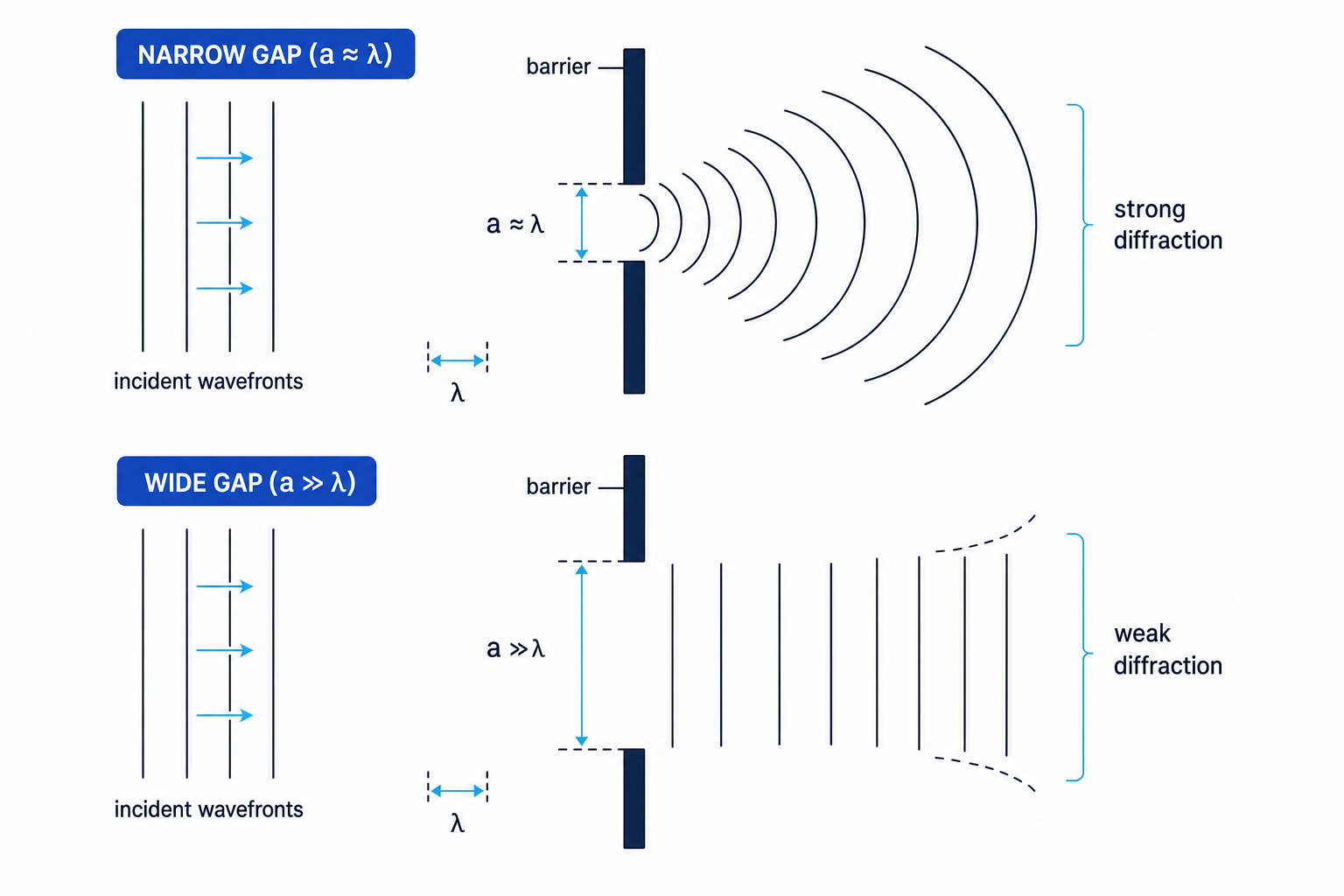
Diffraction is greatest when the gap width is similar to the wavelength. If the gap is much larger than the wavelength, the wave mostly travels straight on, with only slight spreading at the edges.
Key Idea
Gap size compared with wavelength
Diffraction is strongest when the gap width aaa is about the same size as the wavelength λ\lambdaλ. If a≫λa \gg \lambdaa≫λ, diffraction is much less noticeable.
Why sound diffracts more obviously than light
You can often hear someone around a doorway, but you cannot usually see around the doorway. That is because sound wavelengths are often comparable with everyday openings, while visible light wavelengths are tiny.
Visible light has wavelengths of roughly 400 nm to 700 nm, so a doorway is enormous compared with the wavelength of light.
Example
Comparing diffraction through a doorway
A sound wave has wavelength 0.20 m. Visible light has wavelength 5.0×10⁻⁷ m5.0\times10^{-7}\ \text{m}5.0×10⁻⁷ m. Both pass through a doorway of width 0.25 m. Compare the diffraction.
-
Compare the gap width with the wavelength using the ratio aλ\frac{a}{\lambda}λa.
-
For the sound wave:
aλ=0.25 m0.20 m=1.25\frac{a}{\lambda}=\frac{0.25\ \text{m}}{0.20\ \text{m}}=1.25λa=0.20 m0.25 m=1.25The gap is only slightly bigger than the wavelength, so strong diffraction occurs.
-
For the light:
aλ=0.25 m5.0×10−7 m=5.0×10⁵\frac{a}{\lambda}=\frac{0.25\ \text{m}}{5.0\times10^{-7}\ \text{m}}=5.0\times10^{5}λa=5.0×10⁻⁷ m0.25 m=5.0×10⁵The gap is hundreds of thousands of wavelengths wide, so the light diffracts only very slightly.
Common Mistake
Wider gap does not mean more diffraction
A wider gap lets more wave energy through, but it usually gives less spreading. Strong diffraction happens when the gap is narrow compared with everyday objects, but comparable with the wavelength.
Diffraction patterns and evidence for waves
When light passes through a very narrow slit, it produces a diffraction pattern: a bright central region with weaker bright regions either side, separated by dark regions.
A maximum is a bright region where waves arrive in phase and reinforce. A minimum is a dark region where waves arrive out of phase and cancel. This is an example of interference, which means the superposition of waves to produce reinforcement or cancellation.
This is important evidence that light behaves as a wave. A simple particle or ray model predicts a sharp shadow, but diffraction produces spreading and alternating bright and dark regions.
Diffraction gratings
Definition
Diffraction grating
A diffraction grating is an optical component with many equally spaced slits. It diffracts light and produces sharp bright maxima at particular angles.
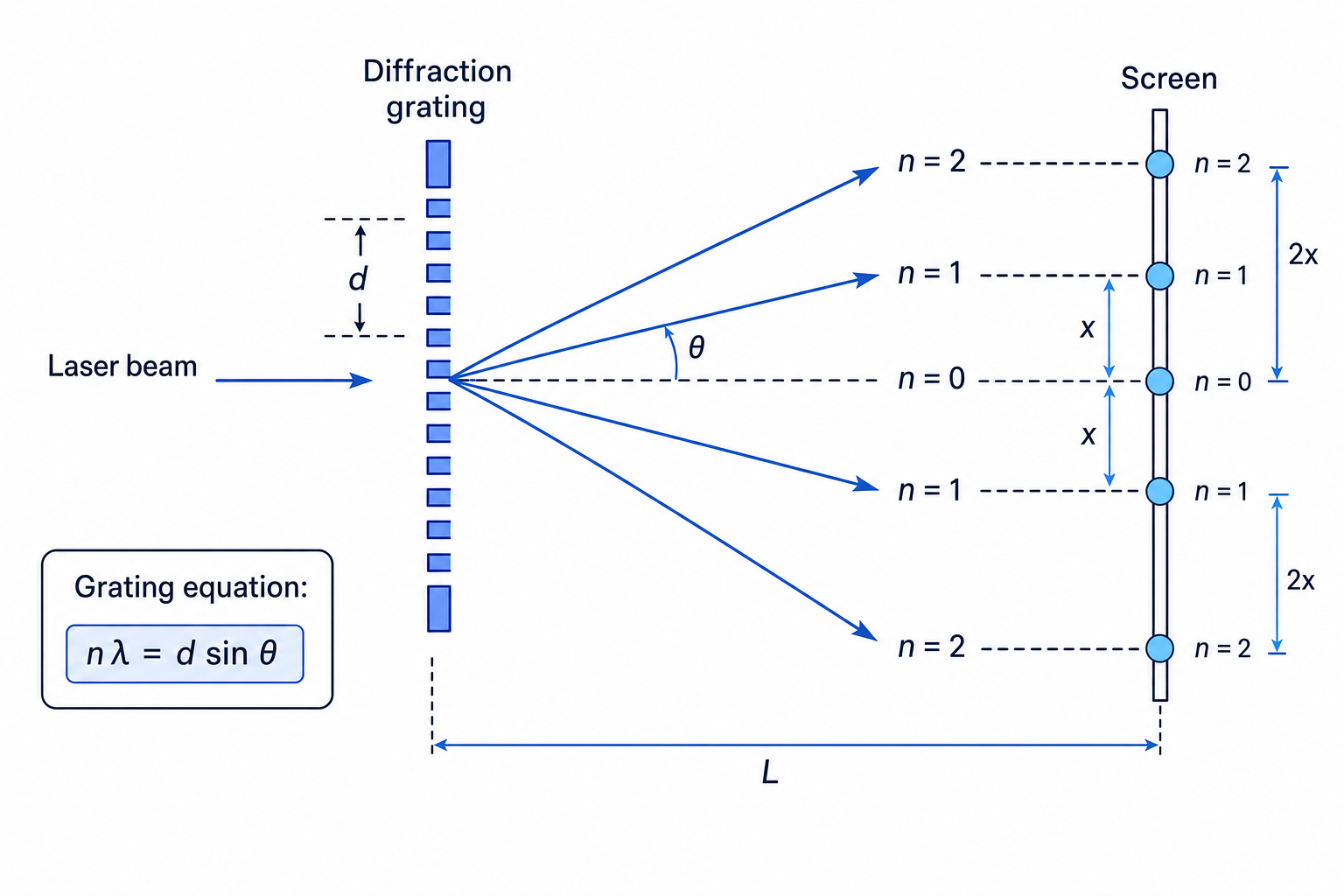
The separation between adjacent slits is called the slit spacing, ddd. The bright spots are labelled by their order, nnn. The central maximum is n=0n=0n=0, the first-order maxima are n=1n=1n=1, the second-order maxima are n=2n=2n=2, and so on.
For a diffraction grating:
nλ=dsinθn\lambda=d\sin\thetanλ=dsinθwhere:
- nnn is the order number, with no unit
- λ\lambdaλ is the wavelength in metres, m
- ddd is the slit spacing in metres, m
- θ\thetaθ is the angle from the central maximum to that order
Where the grating equation comes from
Light from neighbouring slits travels slightly different distances to reach the same point on the screen. The path difference is the extra distance travelled by one wave compared with another.
For a bright maximum, the path difference between adjacent slits must be a whole number of wavelengths:
path difference=nλ\text{path difference}=n\lambdapath difference=nλGeometry gives the path difference as dsinθd\sin\thetadsinθ, so:
nλ=dsinθn\lambda=d\sin\thetanλ=dsinθTip
Converting lines per millimetre
If a grating has 500 lines per millimetre, first convert to lines per metre: 500 mm−1=5.00×10⁵ m−1500\ \text{mm}^{-1}=5.00\times10^{5}\ \text{m}^{-1}500 mm−1=5.00×10⁵ m−1. Then use d=1Nd=\frac{1}{N}d=N1, where NNN is the number of lines per metre.
Example
Finding a laser wavelength with a grating
A laser shines through a diffraction grating with 500 lines per millimetre. The first-order maximum is 0.310 m from the central maximum on a screen 1.20 m away. Find the wavelength of the laser light.
-
Convert the grating line density into slit spacing:
N=5.00×10⁵ m−1N=5.00\times10^{5}\ \text{m}^{-1}N=5.00×10⁵ m−1 d=1N=15.00×10⁵ m−1=2.00×10⁻⁶ md=\frac{1}{N}=\frac{1}{5.00\times10^{5}\ \text{m}^{-1}}=2.00\times10^{-6}\ \text{m}d=N1=5.00×10⁵ m−11=2.00×10⁻⁶ m -
Use the screen geometry to find the angle:
θ=tan−1(xL)\theta=\tan^{-1}\left(\frac{x}{L}\right)θ=tan−1(Lx) θ=tan−1(0.310 m1.20 m)=14.5∘\theta=\tan^{-1}\left(\frac{0.310\ \text{m}}{1.20\ \text{m}}\right)=14.5^\circθ=tan−1(1.20 m0.310 m)=14.5∘ -
Rearrange the grating equation for λ\lambdaλ using n=1n=1n=1:
λ=dsinθn\lambda=\frac{d\sin\theta}{n}λ=ndsinθ -
Substitute the values:
λ=(2.00×10⁻⁶ m)sin(14.5∘)1\lambda=\frac{\left(2.00\times10^{-6}\ \text{m}\right)\sin\left(14.5^\circ\right)}{1}λ=1(2.00×10⁻⁶ m)sin(14.5∘) λ=5.00×10⁻⁷ m=500 nm\lambda=5.00\times10^{-7}\ \text{m}=500\ \text{nm}λ=5.00×10⁻⁷ m=500 nmThis is in the visible range, so the answer is sensible.
Common Mistake
Using the wrong angle
In nλ=dsinθn\lambda=d\sin\thetanλ=dsinθ, θ\thetaθ is measured from the straight-through central maximum to the chosen order. It is not the angle between the first-order spots on opposite sides.
Maximum possible order
Because sinθ\sin\thetasinθ cannot be greater than 1, not every order is possible. The largest order must satisfy:
nλ≤dn\lambda\le dnλ≤dSo a quick check is:
n≤dλn\le\frac{d}{\lambda}n≤λdThe maximum order is the largest whole number that fits this condition.
Practical notes: using a diffraction grating
A common practical method is to use a low-power laser, a diffraction grating and a screen. The laser light is monochromatic, meaning it has one wavelength, and coherent, meaning the waves have a constant phase relationship.
Measure the distance LLL from grating to screen, then measure the distance xxx from the central maximum to each bright order. Calculate θ\thetaθ using:
tanθ=xL\tan\theta=\frac{x}{L}tanθ=LxThen use nλ=dsinθn\lambda=d\sin\thetanλ=dsinθ.
To improve the measurement, measure distances to matching orders on both sides of the central maximum and average them. You can also plot sinθ\sin\thetasinθ against nnn; since:
sinθ=λdn\sin\theta=\frac{\lambda}{d}nsinθ=dλnthe gradient is λd\frac{\lambda}{d}dλ.
Common Mistake
Laser safety
Never look directly into a laser beam or at strong reflected beams. Keep the beam low, directed away from eyes, and use a screen to view the pattern.
Polarisation
Definition
Polarisation
Polarisation is the restriction of the oscillations of a transverse wave to one plane.
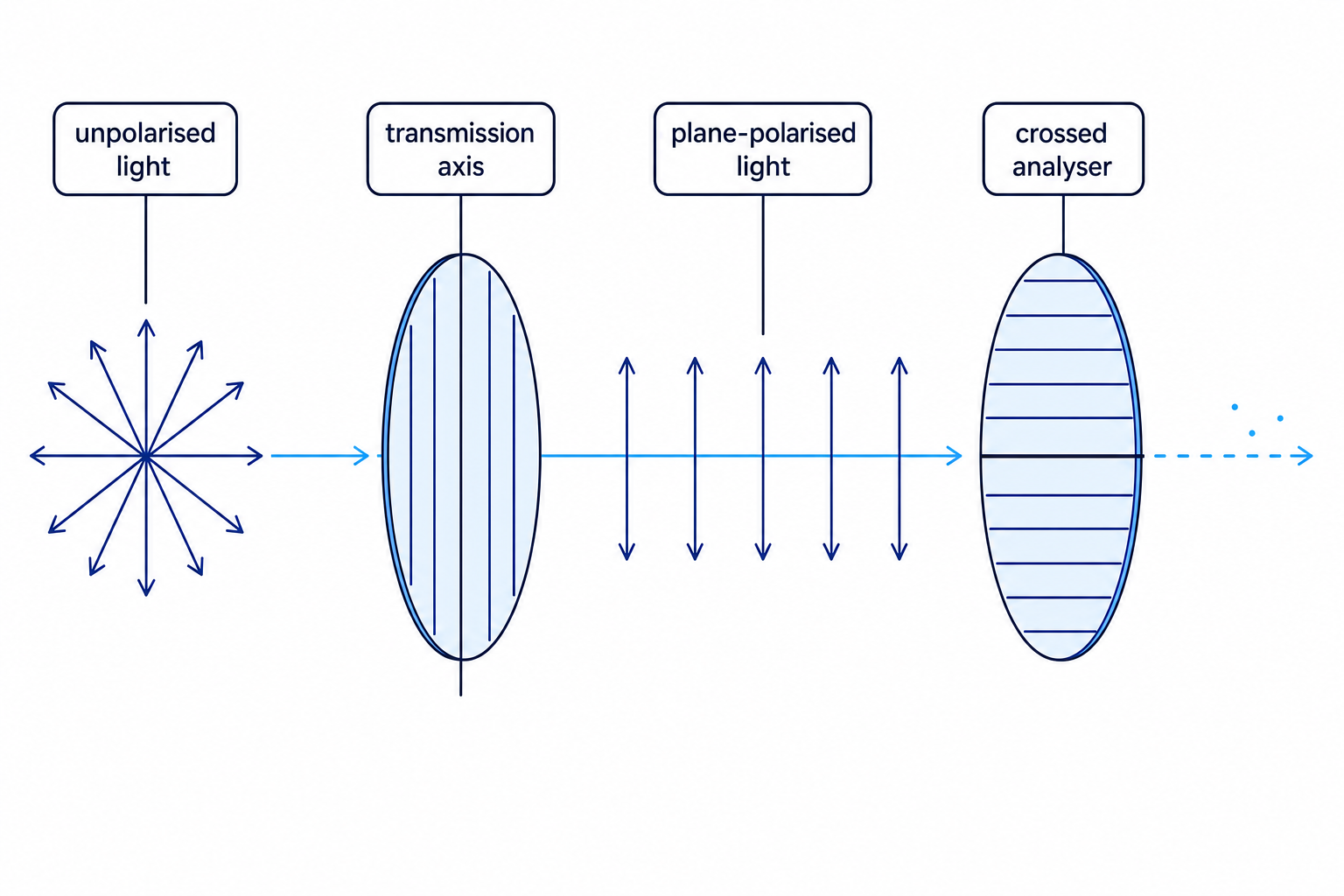
Unpolarised light has electric field oscillations in many different planes perpendicular to the direction of travel. A polarising filter only transmits oscillations parallel to its transmission axis.
The light leaving the filter is plane-polarised, meaning its oscillations are in one plane only. A second polarising filter used to test the polarisation is called an analyser.
Key Idea
Polarisation proves transverse waves
Only transverse waves can be polarised, because their oscillations can occur in different planes. Longitudinal waves cannot be polarised in this way.
Example
Predicting transmission through polarisers
Unpolarised light passes through one polarising filter, then through a second filter acting as an analyser. Describe what happens as the analyser is rotated.
-
After the first filter, the light is plane-polarised along the transmission axis of that filter.
-
If the analyser axis is parallel to the first filter, the transmitted electric field oscillations are parallel to the analyser axis, so light is transmitted strongly.
-
If the analyser is rotated by 90 degrees, the axes are crossed. The polarised light has no component along the analyser axis, so ideally no light is transmitted.
-
At angles between parallel and crossed, only part of the oscillation is transmitted, so the intensity decreases as the analyser is rotated towards 90 degrees.
Polarising sunglasses use this idea. Reflected glare from roads or water is often partially polarised, so a polarising lens can reduce the transmitted glare.
Common Mistake
Polarisation is not caused by longitudinal waves
If a wave can be polarised, it must be transverse. Sound waves in air are longitudinal, so they cannot be polarised by a polarising filter.
Exam technique
In the exam
- For diffraction questions, always compare the wavelength with the gap size: strongest spreading occurs when they are similar.
- For grating calculations, convert line spacing carefully, use θ\thetaθ from the central maximum, and check that sinθ≤1\sin\theta\le1sinθ≤1.
- For polarisation explanations, explicitly say that only transverse waves can be polarised, so polarisation is evidence that light is transverse.
Self review
Check yourself
- Why is sound heard around a doorway more easily than light is seen around a doorway?
- A grating has more lines per millimetre. What happens to the slit spacing ddd?
- What observation with two polarising filters shows that light is transverse?
You've reached the end
Test yourself on this topic, or move on to the next guide.
How was this guide?