Revision notes for Edexcel A Level Physics Alternating currents and rms values. Open the guide for explanations and worked examples. Written against the Edexcel A Level Physics (9PH0) specification, so the content matches what's examinable rather than general Physics background.
Alternating currents and rms values
What you'll learn
- What an alternating current is and how to read AC graphs.
- How peak, period, frequency, and instantaneous values are connected.
- Why we use root mean square values for AC.
- How to calculate power in AC circuits using rms voltage and rms current.
Starting point: direct current and power
Before alternating current, you already know direct current.
A direct current is a current that flows in one direction only. In a simple DC circuit, the current may be steady, so the current-time graph is a horizontal line.
For a resistor, the usual equations are:
V=IRV = IRV=IR P=VI=I2R=V2RP = VI = I^2R = \frac{V^2}{R}P=VI=I2R=RV2where:
- VVV is potential difference in volts, V
- III is current in amperes, A
- RRR is resistance in ohms, Ω\OmegaΩ
- PPP is power in watts, W
These equations still matter for AC circuits, but you must be careful about which value of voltage or current you use.
Key Idea
Power depends on current squared
In a resistor, P=I2RP = I^2RP=I2R. This matters because even when AC current changes direction, the heating effect does not “cancel out”: squaring the current makes the power positive.
What is an alternating current?
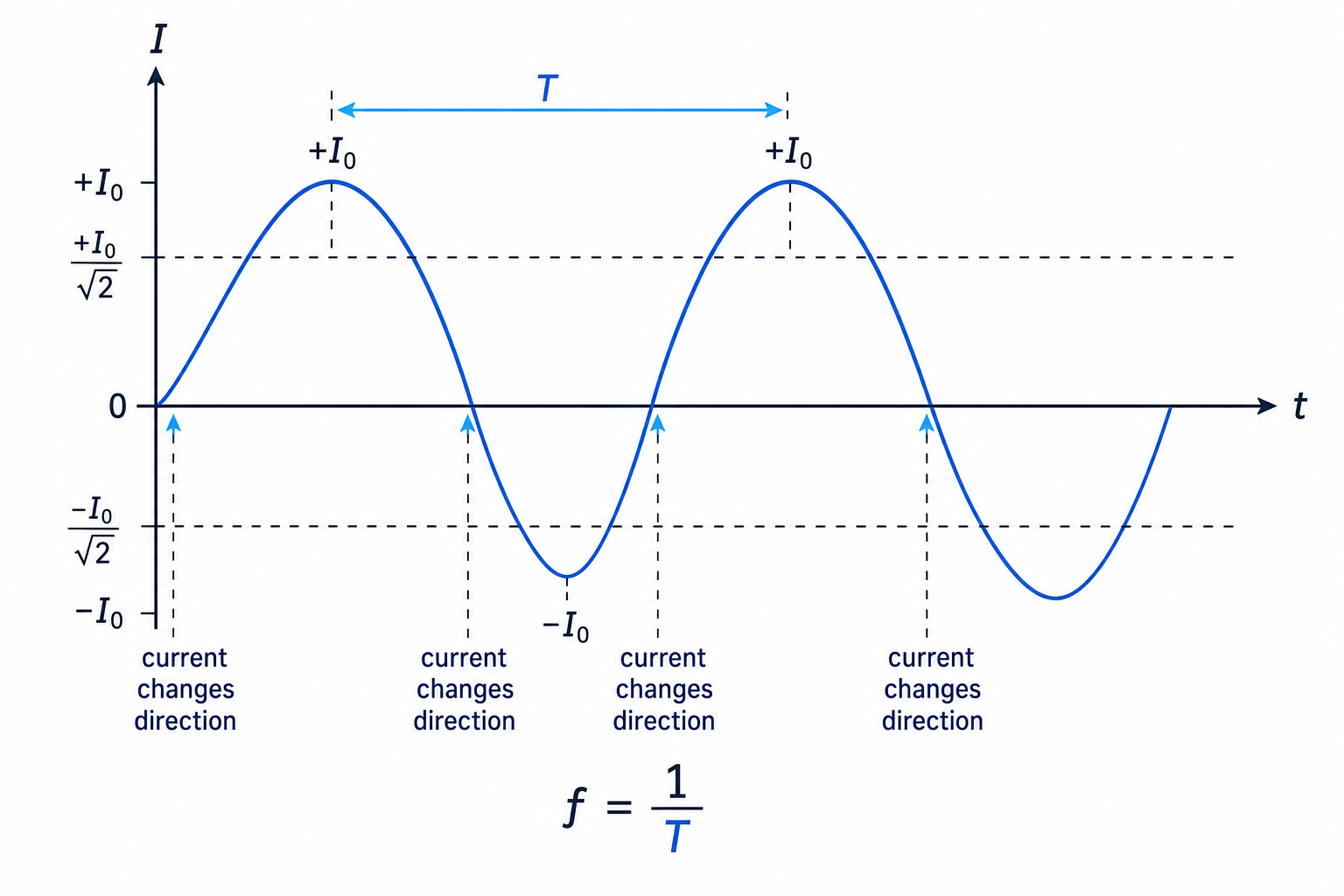
An alternating current, usually shortened to AC, is a current that repeatedly changes direction.
In many A-Level questions, the AC is assumed to be sinusoidal, meaning its graph has the shape of a sine wave.
Definition
Alternating current
An alternating current is an electric current that changes direction periodically.
A sinusoidal alternating current can be written as:
I=I0sin(2πft)I = I_0 \sin(2\pi ft)I=I0sin(2πft)where:
- III is the instantaneous current, the current at one particular time
- I0I_0I0 is the peak current, the maximum value of the current
- fff is frequency in hertz, Hz
- ttt is time in seconds, s
The same idea applies to voltage:
V=V0sin(2πft)V = V_0 \sin(2\pi ft)V=V0sin(2πft)where V0V_0V0 is the peak voltage.
Period and frequency
The period, TTT, is the time taken for one complete cycle of the waveform.
The frequency, fff, is the number of complete cycles per second.
They are linked by:
f=1Tf = \frac{1}{T}f=T1and therefore:
T=1fT = \frac{1}{f}T=f1For UK mains electricity, the frequency is 50 Hz, meaning there are 50 complete cycles every second.
Example
Finding the period of mains electricity
UK mains electricity has frequency 50 Hz. Find its period.
-
Use the relationship between frequency and period:
T=1fT = \frac{1}{f}T=f1 -
Substitute f=50 Hzf = 50\ \text{Hz}f=50 Hz:
T=150T = \frac{1}{50}T=501 -
Calculate the period:
T=0.020 sT = 0.020\ \text{s}T=0.020 sSo one complete cycle takes 0.020 s, or 20 ms.
Common Mistake
Confusing period and half-period
For AC, the current changes direction every half-cycle, but the period is the time for a full cycle. If the current goes from positive peak to negative peak, that is only half a period.
Peak, peak-to-peak, and instantaneous values
The peak value is the maximum magnitude of the voltage or current.
For current, this is usually written I0I_0I0. For voltage, it is usually written V0V_0V0.
The peak-to-peak value is the difference between the maximum positive value and the maximum negative value.
For a symmetrical sine wave:
Ipeak-to-peak=2I0I_{\text{peak-to-peak}} = 2I_0Ipeak-to-peak=2I0and:
Vpeak-to-peak=2V0V_{\text{peak-to-peak}} = 2V_0Vpeak-to-peak=2V0The instantaneous value is the value at a particular instant in time. For example, if:
I=I0sin(2πft)I = I_0 \sin(2\pi ft)I=I0sin(2πft)then III keeps changing as time changes.
Example
Finding an instantaneous current
A sinusoidal AC has peak current 4.0 A and frequency 50 Hz. Find the current at time 5.0 ms after passing through zero in the positive direction.
-
Write the current equation:
I=I0sin(2πft)I = I_0 \sin(2\pi ft)I=I0sin(2πft) -
Convert the time into seconds:
5.0 ms=5.0×10⁻³ s5.0\ \text{ms} = 5.0 \times 10^{-3}\ \text{s}5.0 ms=5.0×10⁻³ s -
Substitute the values:
I=4.0sin(2π×50×5.0×10−3)I = 4.0 \sin(2\pi \times 50 \times 5.0 \times 10^{-3})I=4.0sin(2π×50×5.0×10−3) -
Evaluate the angle:
2π×50×5.0×10−3=π22\pi \times 50 \times 5.0 \times 10^{-3} = \frac{\pi}{2}2π×50×5.0×10−3=2πso:
I=4.0sin(π2)=4.0 AI = 4.0 \sin\left(\frac{\pi}{2}\right) = 4.0\ \text{A}I=4.0sin(2π)=4.0 A
Tip
Calculator mode
For AC calculations using 2πft2\pi ft2πft, your calculator should be in radians if you are using π\piπ directly in the sine function.
Why average current is not enough
Over a complete cycle of a sinusoidal AC, the average current is zero. The positive half-cycle and negative half-cycle cancel.
But a lamp connected to AC still lights up. A resistor still heats up.
So average current is not a useful measure of the heating effect of AC.
The useful quantity is the root mean square, or rms, value.
Definition
Root mean square value
The rms value of an alternating current is the value of the steady direct current that would produce the same mean power in a resistor.
That definition is important: rms values are about equivalent heating effect.
RMS current and voltage for a sinusoidal AC
For a sinusoidal alternating current:
Irms=I02I_{\text{rms}} = \frac{I_0}{\sqrt{2}}Irms=2I0For a sinusoidal alternating voltage:
Vrms=V02V_{\text{rms}} = \frac{V_0}{\sqrt{2}}Vrms=2V0Rearranging:
I0=2IrmsI_0 = \sqrt{2}I_{\text{rms}}I0=2Irmsand:
V0=2VrmsV_0 = \sqrt{2}V_{\text{rms}}V0=2VrmsThese relationships only apply to a sinusoidal waveform.
Key Idea
RMS is the useful AC value
When an AC voltage or current is quoted without saying “peak”, it is usually an rms value. This is especially true for mains electricity.
Example
Converting rms voltage to peak voltage
UK mains voltage is approximately 230 V rms. Find the peak voltage.
-
Choose the rms-to-peak relationship for a sinusoidal voltage:
V0=2VrmsV_0 = \sqrt{2}V_{\text{rms}}V0=2Vrms -
Substitute Vrms=230 VV_{\text{rms}} = 230\ \text{V}Vrms=230 V:
V0=2×230V_0 = \sqrt{2} \times 230V0=2×230 -
Calculate:
V0≈325 VV_0 \approx 325\ \text{V}V0≈325 VSo a 230 V rms supply has a peak voltage of about 325 V.
Common Mistake
Thinking 230 V mains means 230 V peak
The quoted UK mains voltage, 230 V, is an rms value. The peak voltage is larger, about 325 V for a sinusoidal supply.
Where the rms formula comes from
For a resistor:
P=I2RP = I^2RP=I2RIf the current is sinusoidal:
I=I0sin(2πft)I = I_0 \sin(2\pi ft)I=I0sin(2πft)so the instantaneous power is:
P=I02Rsin2(2πft)P = I_0^2R\sin^2(2\pi ft)P=I02Rsin2(2πft)The average value of sin2\sin^2sin2 over a complete cycle is 12\frac{1}{2}21, so the mean power is:
Pmean=I02R2P_{\text{mean}} = \frac{I_0^2R}{2}Pmean=2I02RFor a DC current producing the same heating effect:
P=Irms2RP = I_{\text{rms}}^2RP=Irms2REquating the powers gives:
Irms2R=I02R2I_{\text{rms}}^2R = \frac{I_0^2R}{2}Irms2R=2I02Rso:
Irms=I02I_{\text{rms}} = \frac{I_0}{\sqrt{2}}Irms=2I0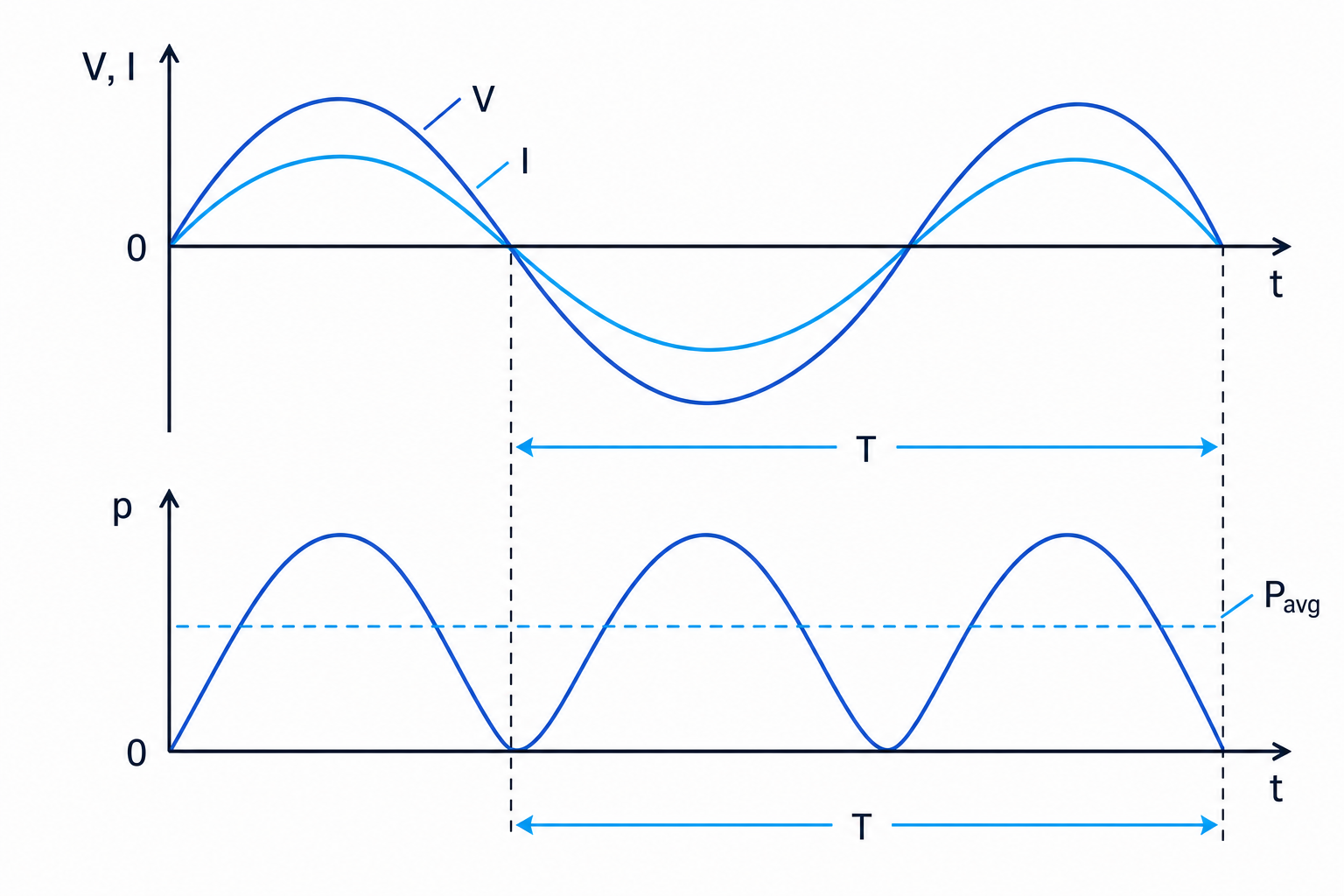
Common Mistake
RMS depends on waveform shape
The result Irms=I02I_{\text{rms}} = \frac{I_0}{\sqrt{2}}Irms=2I0 is for a sinusoidal waveform. A square wave, triangular wave, or irregular waveform has a different rms relationship.
Power calculations using rms values
For AC power calculations in a resistor, use rms values in the familiar power equations:
Pmean=VrmsIrmsP_{\text{mean}} = V_{\text{rms}}I_{\text{rms}}Pmean=VrmsIrms Pmean=Irms2RP_{\text{mean}} = I_{\text{rms}}^2RPmean=Irms2R Pmean=Vrms2RP_{\text{mean}} = \frac{V_{\text{rms}}^2}{R}Pmean=RVrms2These give the mean power, not the instantaneous power.
Example
Calculating mean power in a resistor
A 12 V rms AC supply is connected across a 6.0 Ω\OmegaΩ resistor. Calculate the mean power dissipated.
-
Choose the power equation using voltage and resistance:
Pmean=Vrms2RP_{\text{mean}} = \frac{V_{\text{rms}}^2}{R}Pmean=RVrms2 -
Substitute the values:
Pmean=1226.0P_{\text{mean}} = \frac{12^2}{6.0}Pmean=6.0122 -
Calculate:
Pmean=24 WP_{\text{mean}} = 24\ \text{W}Pmean=24 WThe resistor dissipates a mean power of 24 W.
Common Mistake
Using peak values in DC-style power equations
If you put peak voltage into P=V2RP = \frac{V^2}{R}P=RV2, you calculate the peak instantaneous power, not the mean power. For average heating power, use rms values.
RMS current from peak current
Sometimes the question gives a peak current and asks for power.
The safest route is usually:
- Convert peak current to rms current.
- Use Pmean=Irms2RP_{\text{mean}} = I_{\text{rms}}^2RPmean=Irms2R.
Example
Mean power from peak current
A sinusoidal alternating current has peak current 3.0 A through a 10 Ω\OmegaΩ resistor. Calculate the mean power dissipated.
-
Convert peak current to rms current:
Irms=I02=3.02I_{\text{rms}} = \frac{I_0}{\sqrt{2}} = \frac{3.0}{\sqrt{2}}Irms=2I0=23.0 Irms≈2.12 AI_{\text{rms}} \approx 2.12\ \text{A}Irms≈2.12 A -
Use the mean power equation for a resistor:
Pmean=Irms2RP_{\text{mean}} = I_{\text{rms}}^2RPmean=Irms2R -
Substitute the values:
Pmean=2.122×10P_{\text{mean}} = 2.12^2 \times 10Pmean=2.122×10 -
Calculate:
Pmean≈45 WP_{\text{mean}} \approx 45\ \text{W}Pmean≈45 W
Tip
A quicker route
For a sinusoidal current in a resistor, you can also use Pmean=I02R2P_{\text{mean}} = \frac{I_0^2R}{2}Pmean=2I02R. This works because Irms2=I022I_{\text{rms}}^2 = \frac{I_0^2}{2}Irms2=2I02.
Reading AC graphs
On an AC graph, check carefully what the vertical axis shows.
It could show:
- instantaneous voltage, VVV
- instantaneous current, III
- peak value, V0V_0V0 or I0I_0I0
- rms value, VrmsV_{\text{rms}}Vrms or IrmsI_{\text{rms}}Irms
The graph itself normally shows instantaneous values. RMS values are not usually points on the sine curve; they are equivalent DC values based on power.
Example
Using a graph to find rms current
An AC current graph has a maximum value of 8.0 A. The waveform is sinusoidal. Find the rms current.
-
Identify the maximum value as the peak current:
I0=8.0 AI_0 = 8.0\ \text{A}I0=8.0 A -
Use the rms relationship for a sinusoidal current:
Irms=I02I_{\text{rms}} = \frac{I_0}{\sqrt{2}}Irms=2I0 -
Substitute and calculate:
Irms=8.02≈5.7 AI_{\text{rms}} = \frac{8.0}{\sqrt{2}} \approx 5.7\ \text{A}Irms=28.0≈5.7 A
Exam technique
In the exam
- Decide whether the value given is peak, peak-to-peak, or rms before substituting into equations.
- For mean power in a resistor, use rms values: Pmean=VrmsIrms=Irms2RP_{\text{mean}} = V_{\text{rms}}I_{\text{rms}} = I_{\text{rms}}^2RPmean=VrmsIrms=Irms2R.
- Remember that Vrms=V02V_{\text{rms}} = \frac{V_0}{\sqrt{2}}Vrms=2V0 and Irms=I02I_{\text{rms}} = \frac{I_0}{\sqrt{2}}Irms=2I0 only apply to sinusoidal AC.
- If you see frequency, period, or time on a graph, use f=1Tf = \frac{1}{T}f=T1 and check whether the interval shown is a full cycle or half-cycle.
Self review
Check yourself
- Why is the average current over one complete AC cycle zero, but the average power is not zero?
- A sinusoidal supply has peak voltage 20 V. What equation would you use to find its rms voltage?
- Why should rms values be used when calculating the mean power dissipated in a resistor?
You've reached the end
Test yourself on this topic, or move on to the next guide.
How was this guide?