

What you'll learn
- The SI base units you need for A-Level Physics.
- How derived units such as newtons, joules and watts are built from base units.
- How to use standard form and SI prefixes such as kilo, micro and nano.
- How to convert between energy units such as joules, electronvolts and kilowatt-hours.
Why SI units matter
Physics equations describe relationships between measured quantities. A quantity is something you can measure, such as mass, time, temperature or current.
To make equations work reliably, physicists use the SI system: the International System of Units. Using SI units means you avoid mixing, for example, millimetres with metres or hours with seconds in the same calculation.
Use one unit system
Most A-Level equations are written to work cleanly when quantities are in SI units. Convert prefixes and non-SI units before substituting values unless the question clearly says otherwise.
Fundamental quantities and base units
A fundamental quantity is treated as a starting quantity in the SI system. Its unit is called a base unit.
Fundamental unit
A fundamental, or base, unit is an SI unit that is not formed by combining other SI units.
For AQA A-Level Physics, you should know these base quantities and units:
| Quantity | SI base unit | Unit symbol |
|---|---|---|
| Mass | kilogram | kg |
| Length | metre | m |
| Time | second | s |
| Amount of substance | mole | mol |
| Thermodynamic temperature | kelvin | K |
| Electric current | ampere | A |
The SI system also includes the candela for light intensity, but the candela is excluded from this part of the AQA specification. You are also not expected to recall the formal definitions of the fundamental quantities.
Using grams in SI calculations
The SI base unit for mass is the kilogram, kg, not the gram, g. For example, 250 g should be converted to 0.250 kg before using it in equations such as W=mgW=mgW=mg.
Temperature unit
In many physics equations, temperature must be in kelvin, K. A temperature difference of 1 K has the same size as a difference of 1 degree Celsius, but an absolute temperature such as 20 degrees Celsius should usually be converted to kelvin before substitution.
Derived SI units
A derived unit is made by combining base units according to a physical equation.
Derived unit
A derived SI unit is a unit formed from base units by multiplication, division, or powers.
For example:
- Force is measured in newtons, N, where 1 N=1 kg m s−21\,\text{N}=1\,\text{kg}\,\text{m}\,\text{s}^{-2}1N=1kgms−2.
- Energy and work are measured in joules, J, where 1 J=1 N m=1 kg m2 s−21\,\text{J}=1\,\text{N}\,\text{m}=1\,\text{kg}\,\text{m}^{2}\,\text{s}^{-2}1J=1Nm=1kgm2s−2.
- Power is measured in watts, W, where 1 W=1 J s−11\,\text{W}=1\,\text{J}\,\text{s}^{-1}1W=1Js−1.
- Charge is measured in coulombs, C, where 1 C=1 A s1\,\text{C}=1\,\text{A}\,\text{s}1C=1As.
- Potential difference is measured in volts, V, where 1 V=1 J C−11\,\text{V}=1\,\text{J}\,\text{C}^{-1}1V=1JC−1.
You do not need formal dimensional analysis for this specification point. However, you should be comfortable following the units through an equation.
Finding the SI unit for pressure
Pressure is defined by p=FAp=\frac{F}{A}p=AF. Find the SI unit of pressure in base units.
- Use the equation to combine units: pressure is force divided by area, so 1 Pa=1 N m−21\,\text{Pa}=1\,\text{N}\,\text{m}^{-2}1Pa=1Nm−2.
- Replace the newton using the force equation F=maF=maF=ma: 1 N=1 kg m s−21\,\text{N}=1\,\text{kg}\,\text{m}\,\text{s}^{-2}1N=1kgms−2.
- Combine the metre powers: 1 Pa=1 kg m s−2 m−2=1 kg m−1 s−21\,\text{Pa}=1\,\text{kg}\,\text{m}\,\text{s}^{-2}\,\text{m}^{-2}=1\,\text{kg}\,\text{m}^{-1}\,\text{s}^{-2}1Pa=1kgms−2m−2=1kgm−1s−2.
Standard form
Very large and very small numbers appear constantly in physics. Standard form is a compact way to write them.
Standard form
A number is in standard form when it is written as a×10na \times 10^{n}a×10n, where 1≤a<101 \le a < 101≤a<10 and nnn is an integer.
So instead of writing 0.000000036 A, you write 3.6×10⁻⁸ A3.6 \times 10^{-8}\,\text{A}3.6×10⁻⁸A. Instead of writing 54000000 J, you write 5.4×10⁷ J5.4 \times 10^{7}\,\text{J}5.4×10⁷J.
Writing a measurement in standard form
Write 0.000000036 A in standard form.
- Move the decimal point until the number is between 1 and 10: 0.000000036 becomes 3.6.
- Count the number of places moved. The decimal point moved 8 places to the right, so the original number was smaller than 3.6 and the power is negative.
- Attach the original unit: 0.000000036 A=3.6×10⁻⁸ A0.000000036\,\text{A}=3.6 \times 10^{-8}\,\text{A}0.000000036A=3.6×10⁻⁸A.
SI prefixes
A prefix is a symbol placed before a unit to show a power-of-ten multiplier. For example, kilometre means thousand metres, and millisecond means one-thousandth of a second.
SI prefix
An SI prefix is a short symbol that changes the size of a unit by a fixed power of ten.
The scale below gathers the prefixes you need to know for this specification.
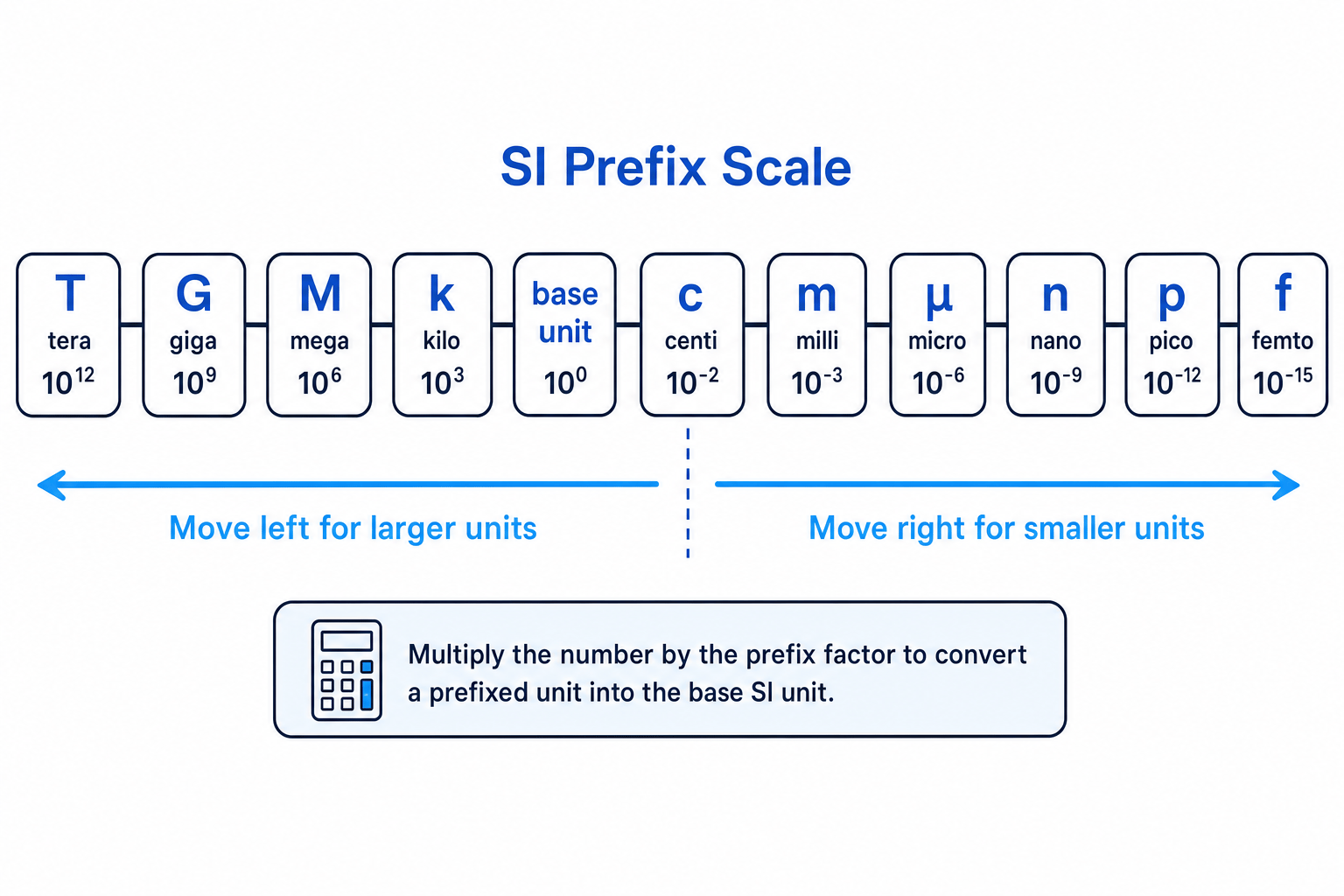
Larger than the base unit:
- tera, T: factor 101210^{12}1012
- giga, G: factor 10910^{9}109
- mega, M: factor 10610^{6}106
- kilo, k: factor 10310^{3}103
Smaller than the base unit:
- centi, c: factor 10−210^{-2}10−2
- milli, m: factor 10−310^{-3}10−3
- micro, μ: factor 10−610^{-6}10−6
- nano, n: factor 10−910^{-9}10−9
- pico, p: factor 10−1210^{-12}10−12
- femto, f: factor 10−1510^{-15}10−15
Prefix means multiplier
A prefixed unit equals the prefix factor multiplied by the unit: 1 km=103 m1\,\text{km}=10^{3}\,\text{m}1km=103m, 1 mA=10−3 A1\,\text{mA}=10^{-3}\,\text{A}1mA=10−3A, and 1 μs=10−6 s1\,\mu\text{s}=10^{-6}\,\text{s}1μs=10−6s.
m is not M
As a prefix, lower-case m means milli, 10−310^{-3}10−3, while upper-case M means mega, 10610^{6}106. Confusing 2 mA with 2 MA changes the current by a factor of 10910^{9}109.
Converting a prefixed time to seconds
Convert 450 μs into seconds.
- Choose the prefix factor: micro means 10−610^{-6}10−6, so 1 μs=10−6 s1\,\mu\text{s}=10^{-6}\,\text{s}1μs=10−6s.
- Multiply the number by the prefix factor: 450 μs=450×10−6 s450\,\mu\text{s}=450 \times 10^{-6}\,\text{s}450μs=450×10−6s.
- Write the result in standard form: 450×10−6=4.50×10−4450 \times 10^{-6}=4.50 \times 10^{-4}450×10−6=4.50×10⁻⁴, so 450 μs=4.50×10⁻⁴ s450\,\mu\text{s}=4.50 \times 10^{-4}\,\text{s}450μs=4.50×10⁻⁴s.
Base unit to prefixed unit
To convert from a base unit into a prefixed unit, divide by the prefix factor. For example, 0.0032 A÷10−3=3.2 mA0.0032\,\text{A} \div 10^{-3}=3.2\,\text{mA}0.0032A÷10−3=3.2mA.
Prefixes inside compound units
A compound unit contains more than one unit, such as metres per second or joules per coulomb. Prefixes in compound units must be handled carefully because the prefix could be in the numerator, the denominator, or both.
For example, millimetres per millisecond is not the same as millimetres per second. The time unit must also be converted.
Converting millimetres per millisecond
A sensor records a speed of 12 millimetres per millisecond. Convert this into metres per second.
- Convert the distance part: 12 mm=12×10−3 m12\,\text{mm}=12 \times 10^{-3}\,\text{m}12mm=12×10−3m.
- Convert the time part: 1 ms=1.0×10⁻³ s1\,\text{ms}=1.0 \times 10^{-3}\,\text{s}1ms=1.0×10⁻³s.
- Divide the converted distance by the converted time: v=12×10−3 m1.0×10−3 s=12 m s−1v=\frac{12 \times 10^{-3}\,\text{m}}{1.0 \times 10^{-3}\,\text{s}}=12\,\text{m}\,\text{s}^{-1}v=1.0×10⁻³s12×10−3m=12ms−1.
Only converting the top of a fraction
In a rate, the denominator matters too. If you convert millimetres to metres but forget to convert milliseconds to seconds, your answer can be wrong by a factor of 1000.
Converting between units of the same quantity
You can only convert directly between units that measure the same physical quantity. Joules, electronvolts and kilowatt-hours are all units of energy, so conversions between them are allowed.
You cannot convert directly between joules and watts without extra information, because joule is a unit of energy while watt is a unit of power.
Joules and electronvolts
The joule, J, is the SI derived unit of energy. The electronvolt, eV, is a much smaller energy unit, useful for particles and photons.
The conversion is:
1 eV=1.60×10⁻¹⁹ J1\,\text{eV}=1.60 \times 10^{-19}\,\text{J}1eV=1.60×10⁻¹⁹J
So:
- to convert eV to J, multiply by 1.60×10−191.60 \times 10^{-19}1.60×10⁻¹⁹
- to convert J to eV, divide by 1.60×10−191.60 \times 10^{-19}1.60×10⁻¹⁹
Joules and kilowatt-hours
A kilowatt-hour, kW h, is the energy transferred when a power of 1 kW is used for 1 hour.
A kilowatt-hour is energy
Despite the watt in its name, kW h is power multiplied by time, so it is an energy unit: 1 kW h=1000 W×3600 s=3.60×10⁶ J1\,\text{kW h}=1000\,\text{W} \times 3600\,\text{s}=3.60 \times 10^{6}\,\text{J}1kW h=1000W×3600s=3.60×10⁶J.
Converting energy units to joules
Convert 2.48 eV and 0.75 kW h into joules.
- For electronvolts, use 1 eV=1.60×10⁻¹⁹ J1\,\text{eV}=1.60 \times 10^{-19}\,\text{J}1eV=1.60×10⁻¹⁹J.
- Multiply by the number of electronvolts: E=2.48×1.60×10−19 J=3.97×10⁻¹⁹ JE=2.48 \times 1.60 \times 10^{-19}\,\text{J}=3.97 \times 10^{-19}\,\text{J}E=2.48×1.60×10−19J=3.97×10⁻¹⁹J.
- For kilowatt-hours, convert kilowatts to watts and hours to seconds: 0.75 kW h=0.75×1000 W×3600 s0.75\,\text{kW h}=0.75 \times 1000\,\text{W} \times 3600\,\text{s}0.75kW h=0.75×1000W×3600s.
- Use 1 W=1 J s−11\,\text{W}=1\,\text{J}\,\text{s}^{-1}1W=1Js−1, so watts multiplied by seconds gives joules: E=2.70×10⁶ JE=2.70 \times 10^{6}\,\text{J}E=2.70×10⁶J.
In the exam
- Convert prefixed quantities into SI units before substituting into equations, especially for mass, length, time and current.
- Treat compound units carefully: convert the numerator and denominator separately before simplifying.
- Remember the key energy conversions: 1 eV=1.60×10⁻¹⁹ J1\,\text{eV}=1.60 \times 10^{-19}\,\text{J}1eV=1.60×10⁻¹⁹J and 1 kW h=3.60×10⁶ J1\,\text{kW h}=3.60 \times 10^{6}\,\text{J}1kW h=3.60×10⁶J.
- Check capital letters in prefixes: m and M mean completely different powers of ten.
Check yourself
- Convert 4.7 μs into seconds in standard form.
- Convert 0.020 A into mA, and explain why the numerical value changes.
- A heater transfers 7.2 MJ of energy. What is this energy in kW h?
