Welcome to the medical applications of fibre optics! In this topic, we will take the optical principles you learned earlier in the course and apply them to a piece of life-saving medical equipment: the flexible endoscope.
Here is what you will learn:
- How optical fibres trap light using Total Internal Reflection (TIR).
- Why an optical fibre must have both a central core and an outer cladding.
- The structure of a flexible endoscope, specifically the difference between coherent and non-coherent fibre bundles.
- The medical advantages of using endoscopy for imaging and surgery.
Optical Fibres and Total Internal Reflection
An optical fibre is essentially a very thin, flexible tube of glass or plastic that can carry light from one end to the other, even if the tube is bent. To understand how they work, we need to revisit refraction.
When light travels from a material with a higher refractive index to one with a lower refractive index, it speeds up and bends away from the normal. If the angle of incidence is large enough, the light cannot escape the first material at all. Instead, it reflects entirely back inside.
Total Internal Reflection (TIR)
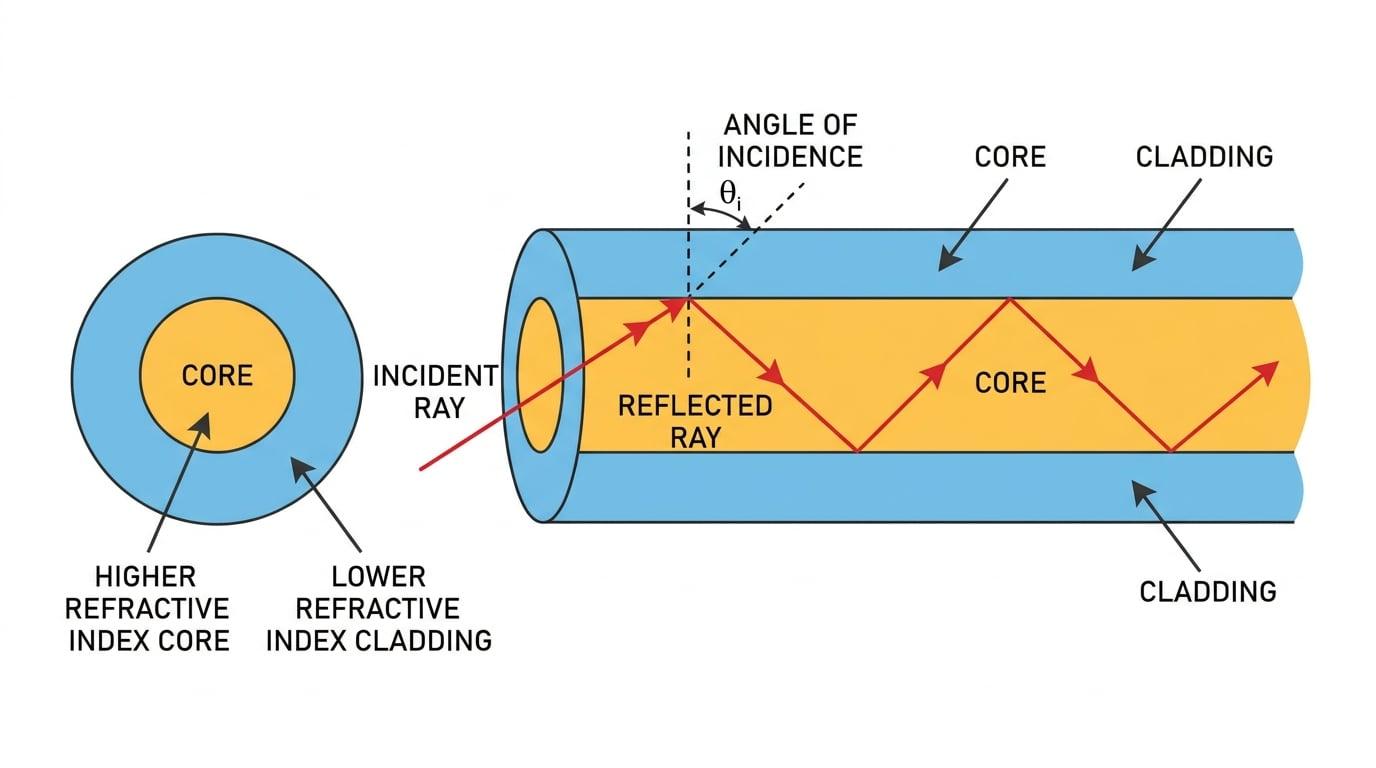
Total Internal Reflection occurs when a light ray travelling in an optically denser medium hits a boundary with a less dense medium at an angle of incidence greater than the critical angle. The ray is completely reflected, with no light refracted through the boundary.
To achieve TIR, an optical fibre is manufactured in two layers:
- The Core: The central part of the fibre. It is made of glass or plastic with a high refractive index.
- The Cladding: An outer layer surrounding the core. It must have a lower refractive index than the core.
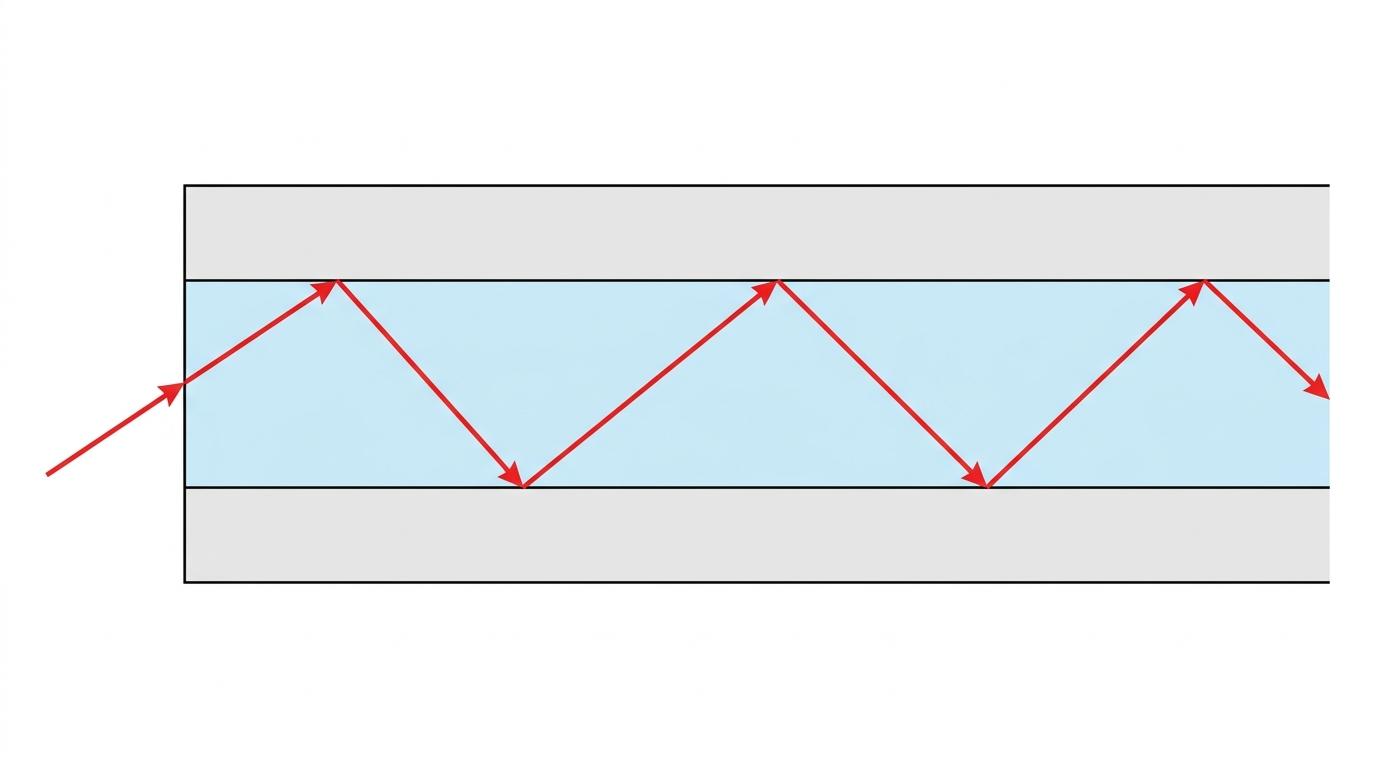
Because the core has a higher refractive index than the cladding, any light ray entering the core at a shallow angle will continually strike the core-cladding boundary at an angle greater than the critical angle. The light undergoes multiple total internal reflections, zig-zagging its way down the fibre without escaping.
Forgetting the cladding's primary purpose
Students often write that the cladding is there "to protect the fibre from scratches". While it does provide physical protection, its primary optical purpose is to provide a boundary with a lower refractive index than the core so that TIR can occur. Without the cladding, adjacent cores in a bundle would touch, light would leak between them (known as cross-talk), and the image would be scrambled.
The Flexible Endoscope
A flexible endoscope is a medical instrument used by doctors to look inside the body (such as the stomach, colon, or airways) without needing to make large surgical incisions.
Because the inside of the human body is completely dark, the endoscope must do two things simultaneously:
- Shine light into the body cavity to illuminate the organs.
- Collect the reflected light and carry it back out to a camera or eyepiece so the doctor can see the image.
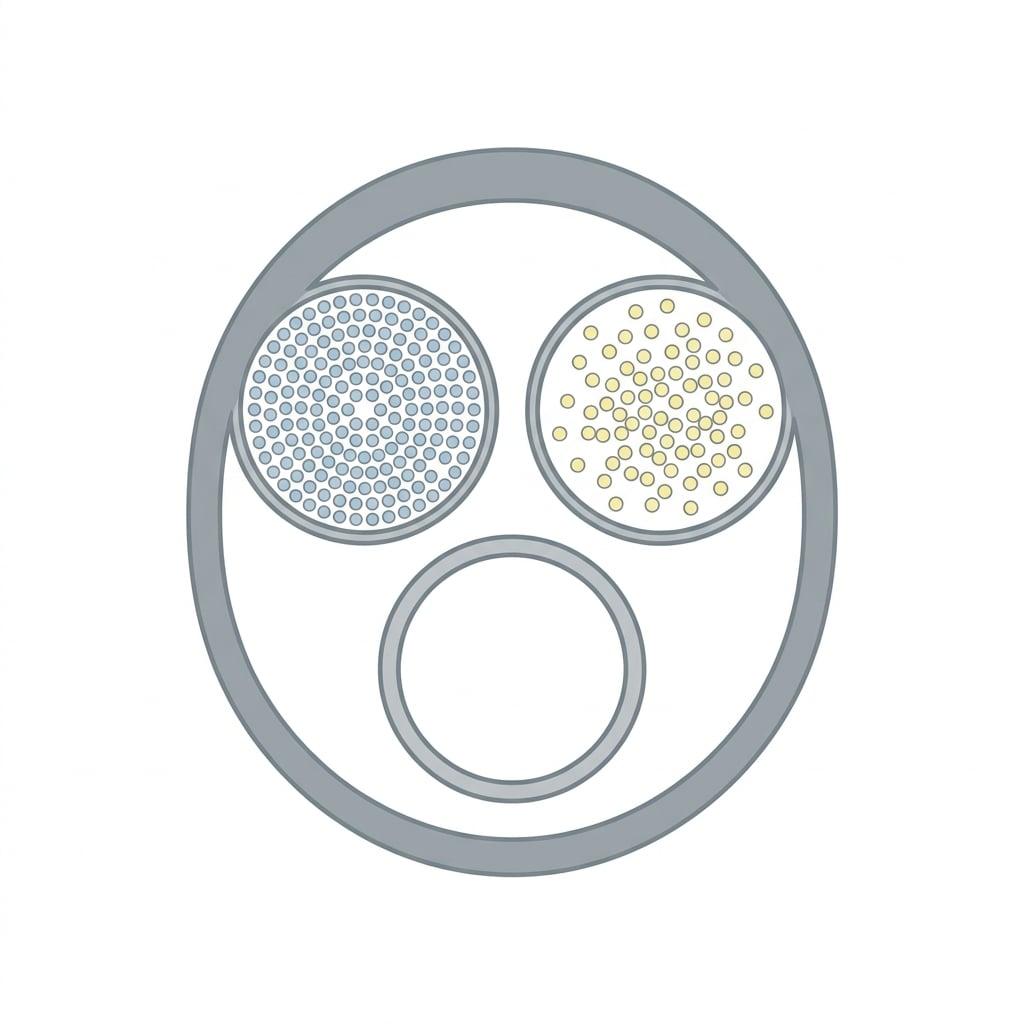
To do this, the main tube of an endoscope contains two distinct bundles of thousands of microscopic optical fibres.
The Light Guide (Illumination)
The endoscope needs to pump a lot of light into the body. To do this, it uses a non-coherent bundle of optical fibres. Because we only care about getting raw light energy into the cavity, it does not matter if the individual fibres are mixed up or out of order at the far end. A non-coherent bundle is cheaper and easier to manufacture.
The Image Guide (Viewing)
The light that reflects off the internal organs must be brought back to the observer. To form an image, the relative positions of the light rays must be perfectly preserved. The fibre taking light from the "top left" of the organ must deliver that light to the "top left" of the camera sensor. Therefore, the image guide must be a coherent bundle.
Coherent vs Non-coherent bundles
- Coherent bundle: The optical fibres are perfectly aligned so that their relative positions at the entrance exactly match their relative positions at the exit. Used for transmitting images.
- Non-coherent bundle: The optical fibres are bundled randomly. Used only for transmitting light for illumination.
Calculating critical angle and explaining TIR
An optical fibre used in an endoscope has a glass core with a refractive index of 1.621.621.62 and a cladding with a refractive index of 1.501.501.50.
Calculate the critical angle at the core-cladding boundary, and state what will happen to a ray of light that strikes this boundary at an angle of incidence of 72∘72^{\circ}72∘.
- First, recall the formula for the critical angle at a boundary between two media.
- Identify the correct values for n1n_1n1 and n2n_2n2. The light is travelling inside the core, so the core is the incident medium (n1=1.62n_1 = 1.62n1=1.62) and the cladding is the second medium (n2=1.50n_2 = 1.50n2=1.50).
- Calculate the ratio.
- Take the inverse sine to find the critical angle.
- Compare the given angle of incidence to the critical angle. The angle of incidence is 72∘72^{\circ}72∘, which is strictly greater than the critical angle of 67.8∘67.8^{\circ}67.8∘.
- Conclude what happens to the ray: Because the angle of incidence is greater than the critical angle, the ray will undergo total internal reflection and stay inside the core.
Medical Applications and Advantages
Endoscopes have revolutionised medicine because they allow doctors to practice minimally invasive surgery (often referred to as "keyhole surgery").
Alongside the optical fibre bundles, modern endoscopes often contain extra channels (as shown in the cross-section diagram above). These hollow channels allow doctors to feed tiny surgical instruments, water, or air down the tube. This means they can take tissue samples (biopsies), remove polyps, or stop internal bleeding right there and then.
Advantages of Endoscopy
Using an endoscope for internal imaging and surgery has massive advantages over traditional "open" surgery:
- Minimally invasive: It only requires a tiny incision (or uses natural body openings), leading to significantly less blood loss and tissue damage.
- Reduced risk of infection: Smaller wounds mean bacteria have a much harder time entering the body.
- Faster recovery: Patients can often go home the same day, freeing up hospital beds and reducing patient discomfort.
Pixels on a screen
Think of a coherent fibre bundle like the pixels on your TV screen. Each individual fibre acts as a single "pixel" of the final image. If the fibres were jumbled up (non-coherent), the pixels would be scrambled, and you would just see a blur of average colours—perfectly fine for a light bulb, but useless for a TV display!
Putting it all together
Understanding endoscopy requires linking the pure physics of waves (refractive index and TIR) to an engineering application (fibre bundles) and finally to a real-world medical outcome. Examiners love questions that span across these different domains, so ensure you are comfortable moving from a calculation of critical angle to an explanation of why keyhole surgery benefits patients.
In the exam
- Be precise with "coherence": In this medical physics context, "coherent" means the physical alignment of the fibres is maintained from one end to the other. Do not confuse this with the wave definition of coherence (constant phase difference), which is totally separate!
- State the core/cladding rule: If asked for the conditions for TIR in a fibre, explicitly state that the core must have a higher refractive index than the cladding.
- Remember cross-talk: If an exam asks why a fibre without cladding cannot be used to transmit an image, mention that light would leak into adjacent touching fibres, causing "cross-talk" and degrading the image.
- Linking terms: Always link the "image guide" to the "coherent bundle", and the "light/illumination guide" to the "non-coherent bundle".
Check yourself
- Can you state the two conditions required for Total Internal Reflection to occur?
- Why must an endoscope contain two separate bundles of optical fibres?
- What would the doctor see if the manufacturer accidentally swapped the coherent and non-coherent bundles during assembly?
- Name two patient benefits of using keyhole surgery over traditional open surgery.