4.2.2 Statistical distributions (A-level only)
Question 23
The random variable D D\,D represents the depth, in cm, of a hole created by an automated drill. It is known that D D\,D follows a normal distribution with mean 18 and standard deviation 5.
a.[2]
Determine the probability that a randomly selected hole has a depth greater than 22 cm.
b.[3]
Find the value of c c\,c such that
P(18−c<D<18+c)=0.90 P(18 - c < D < 18 + c) = 0.90 P(18−c<D<18+c)=0.90c.[4]
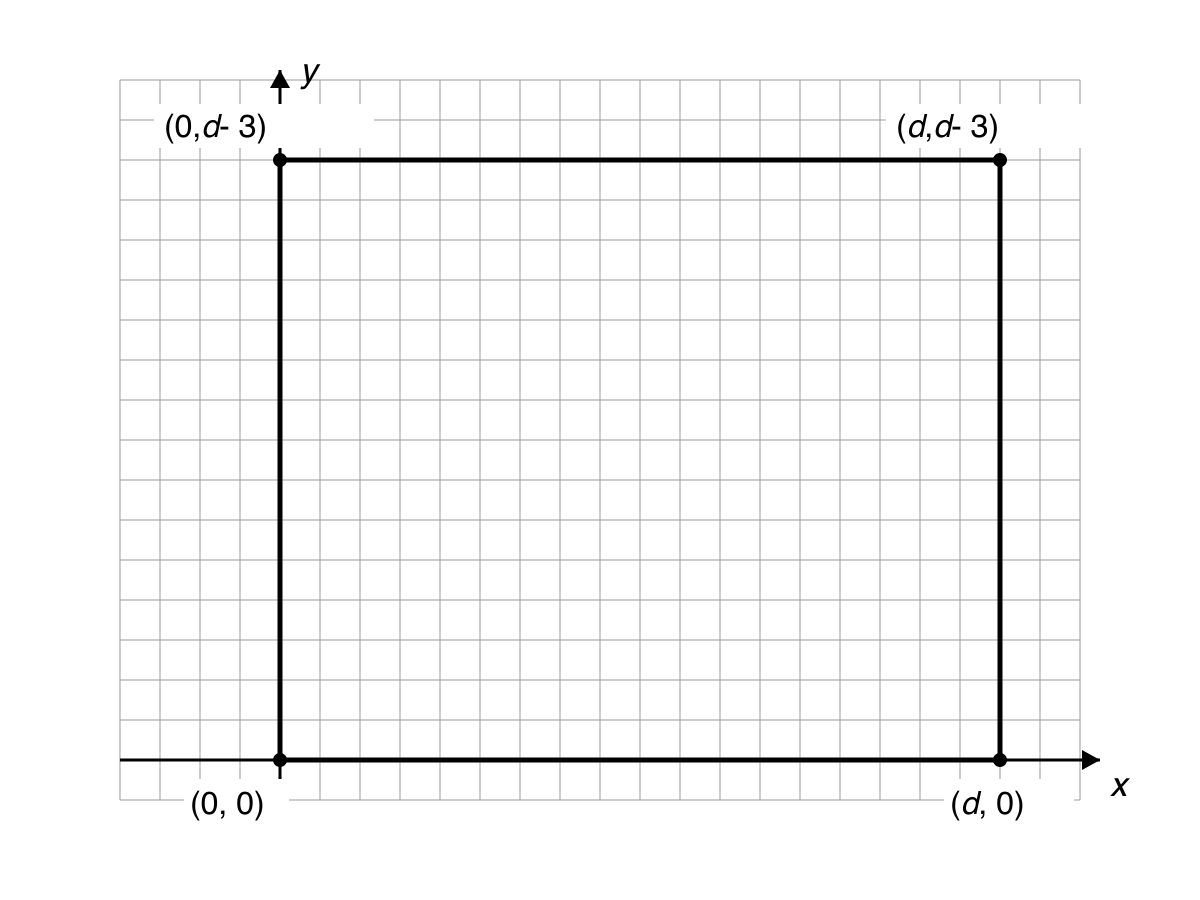
A single observation d d\,d of D D\,D is to be taken. A rectangle is constructed on a coordinate grid with vertices at the points (0,0)(0, 0)(0,0), (d,0)(d, 0)(d,0), (d,d−3)(d, d - 3)(d,d−3), and (0,d−3)(0, d - 3)(0,d−3).
Find the probability that the area of this rectangle is more than 180 cm2^22.
4.2.2 Statistical distributions (A-level only) Questions
292 exam-style questions on WJEC A Level Maths 4.2.2 Statistical distributions (A-level only). Each one has a worked solution and a mark scheme showing where the marks go.