

What you'll learn
- How the fundamental quantities length, time and mass are measured in SI units.
- How units for velocity, acceleration, force, weight and moment are derived.
- How to convert measurements into consistent SI units.
- How units can help you choose formulas and check answers.
Quantities and SI units
A physical quantity is a property that can be measured, such as time, mass or velocity. Every measurement has:
- a numerical value;
- a unit, which identifies the scale being used.
For example, in “12 metres”, 12 is the numerical value and metres is the unit.
The International System of Units, usually called the SI system, provides standard units so that measurements are interpreted consistently.
Fundamental quantity
A fundamental quantity is a basic measurable quantity that is not defined in terms of other physical quantities.
In A-Level mechanics, the three fundamental quantities are:
- length, measured in metres, symbol m;
- time, measured in seconds, symbol s;
- mass, measured in kilograms, symbol kg.
Mass symbol and metre symbol
In an equation, mmm often represents mass. After a numerical value, m is the unit metre. Use the context to distinguish them.
Converting to SI units
Questions may give lengths in centimetres or times in minutes. Before substituting into a mechanics formula, convert all measurements into compatible SI units.
Useful conversions include:
- 1 kilometre = 1000 metres;
- 1 metre = 100 centimetres;
- 1 hour = 3600 seconds;
- 1 tonne = 1000 kilograms.
Converting measurements into SI units
A particle travels 450 cm in 1.5 minutes. Express the distance and time in SI units.
- Convert centimetres to metres by dividing by 100:
- Convert minutes to seconds by multiplying by 60:
- The measurements in SI units are therefore 4.5 m and 90 s.
Use consistent units
A formula only gives a meaningful numerical answer when all the quantities have compatible units. Converting to metres, seconds and kilograms at the start is usually safest.
Derived quantities
A derived quantity is defined using fundamental quantities. Its unit is therefore built from fundamental SI units.
For example, velocity is distance divided by time, so its SI unit is metres per second.
The main unit relationships in this topic are summarised below.
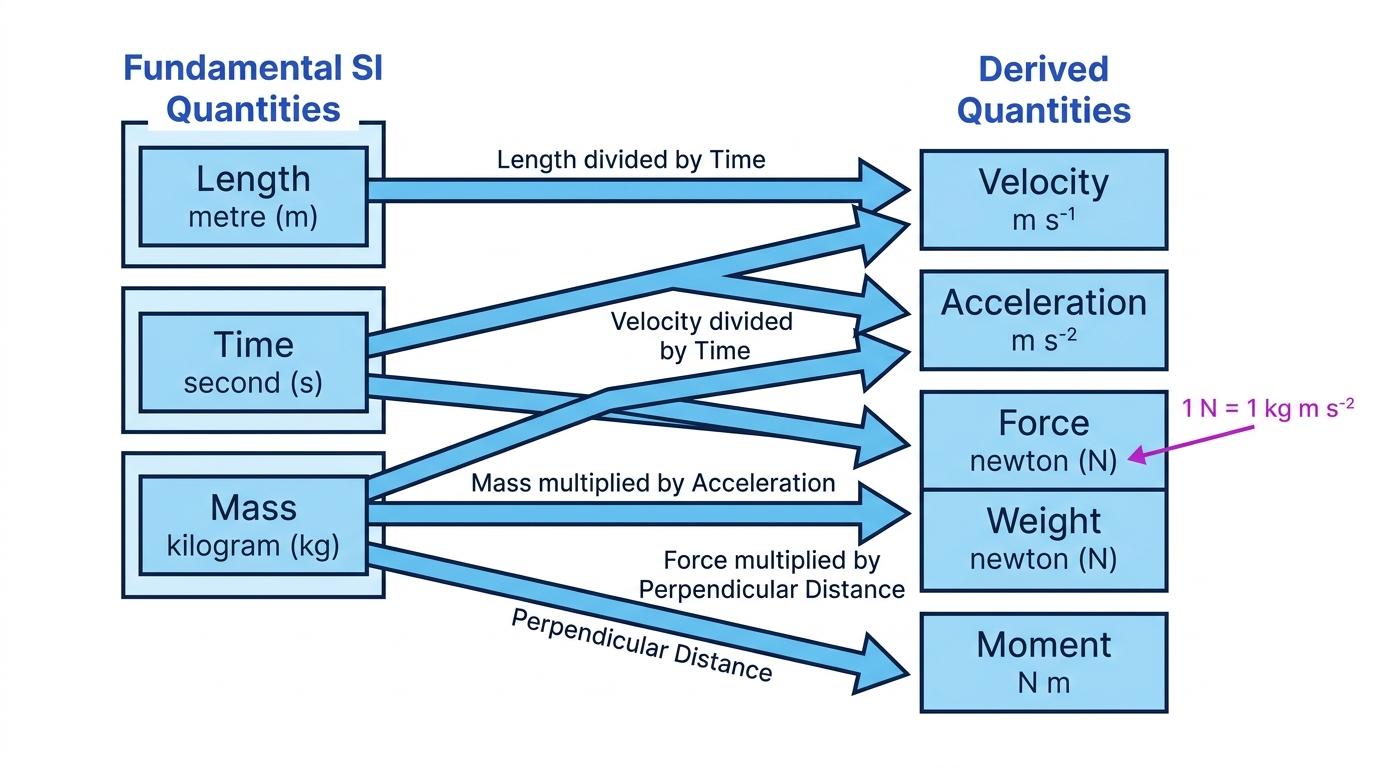
Velocity
Velocity is the rate of change of displacement with respect to time. Displacement includes a direction, so velocity also has a direction.
For constant velocity,
v=st, v=\frac{s}{t}, v=ts,where vvv is velocity, sss is displacement and ttt is time.
Because displacement is measured in metres and time in seconds, the SI unit of velocity is metres per second, written m s⁻¹.
The exponent −1 means “per”, so m s⁻¹ means metres per second.
Calculating velocity with converted units
A cyclist travels 1.8 km east in 4 minutes at constant velocity. Find the cyclist's velocity in m s⁻¹.
- Convert the displacement to metres:
- Convert the time to seconds:
- Divide displacement by time:
- Include the direction because velocity is directional: the cyclist's velocity is 7.5 m s⁻¹ east.
Acceleration
Acceleration is the rate of change of velocity with respect to time.
For constant acceleration,
a=v−ut, a=\frac{v-u}{t}, a=tv−u,where uuu is initial velocity, vvv is final velocity and ttt is the elapsed time.
Velocity has unit m s⁻¹, so dividing it by seconds gives:
m s−1s=m s−2. \frac{\text{m s}^{-1}}{\text{s}}=\text{m s}^{-2}. sm s−1=m s−2.The SI unit of acceleration is therefore metres per second squared, written m s⁻².
Calculating acceleration
A particle's velocity changes from 3 m s⁻¹ to 15 m s⁻¹ in 4 seconds. Find its constant acceleration.
- Find the change in velocity:
- Divide this change by the elapsed time:
- The positive answer means that the change in velocity is in the chosen positive direction.
Acceleration is not always speeding up
Negative acceleration does not automatically mean that an object is slowing down. You must compare the signs of its velocity and acceleration: opposite signs mean its speed is decreasing.
Force
A force is a push or pull that can change an object's motion. The SI unit of force is the newton, symbol N.
For a constant mass, Newton's second law gives
F=ma, F=ma, F=ma,where FFF is the resultant force, mmm is mass and aaa is acceleration.
The unit of force follows from multiplying the units of mass and acceleration:
1 N=1 kg m s−2. 1\text{ N}=1\text{ kg m s}^{-2}. 1 N=1 kg m s−2.“Resultant force” means the overall force after all forces, including their directions, have been combined.
Finding a resultant force
A car of mass 1200 kg accelerates at 2.5 m s⁻². Find the resultant force acting on it.
- Use the relationship between resultant force, mass and acceleration:
- Substitute the values with their SI units:
- Replace kg m s⁻² by its special name, newtons:
Mass and weight
Mass measures the amount of matter in an object. It is measured in kilograms and does not change merely because the object moves to a different location.
Weight is the gravitational force acting on an object. It is measured in newtons because it is a force.
Near the Earth's surface,
W=mg, W=mg, W=mg,where WWW is weight, mmm is mass and ggg is the acceleration due to gravity.
Unless a question states otherwise, use
g=9.8 m s−2. g=9.8\text{ m s}^{-2}. g=9.8 m s−2.Calculating weight
Find the weight of a person whose mass is 65 kg.
-
Use the model W=mgW=mgW=mg with g=9.8 m s−2g=9.8\text{ m s}^{-2}g=9.8 m s−2.
-
Substitute the person's mass:
- The person's weight is 637 N, acting vertically downwards.
Confusing mass and weight
Mass is measured in kilograms; weight is measured in newtons. A statement such as “the weight is 65 kg” uses the wrong quantity and unit.
Moments
The moment of a force about a point measures the force's turning effect about that point.
Its magnitude is
M=Fd, M=Fd, M=Fd,where FFF is the force and ddd is the perpendicular distance from the point to the force's line of action.
The SI unit of moment is newton metre, written N m.
Line of action
The line of action of a force is the straight line extending in the direction in which the force acts. The distance used in a moment must meet this line at a right angle.
Calculating a moment
A downward force of 30 N acts on a horizontal lever. Its line of action is 0.4 m from the pivot. Find the magnitude of its moment about the pivot.
-
Identify the perpendicular distance from the pivot to the line of action: d=0.4 md=0.4\text{ m}d=0.4 m.
-
Apply the moment formula:
- The magnitude of the moment is 12 N m. Its direction is described separately as clockwise or anticlockwise.
Using the wrong distance
Do not automatically use the length of a rod or lever. Use the perpendicular distance from the pivot to the force's line of action.
Check equations using units
The units on both sides of a valid mechanics equation must agree. For example, F=maF=maF=ma gives kg m s⁻² on the right, which is equivalent to N on the left.
In the exam
- Convert measurements into compatible units, normally metres, seconds and kilograms, before substituting.
- Carry units through your working and include the correct unit in the final answer.
- Distinguish carefully between mass in kg, force or weight in N, and moment in N m.
- For moments, identify the perpendicular distance to the force's line of action.
- Use g=9.8 m s−2g=9.8\text{ m s}^{-2}g=9.8 m s−2 unless the question gives a different value.
Check yourself
- Why is the SI unit of acceleration m s⁻² rather than m s⁻¹?
- What is the difference between the mass and the weight of an object?
- A force acts at an angle to a lever. Which distance must you use when calculating its moment?
