

What you'll learn
- Expand expressions like (1+3x)−12(1+3x)^{-\frac{1}{2}}(1+3x)−21 in ascending powers of xxx.
- Factor expressions such as (9+6x)−12(9+6x)^{-\frac{1}{2}}(9+6x)−21 into the standard binomial form.
- State the range of values for which an expansion is valid.
- Use expansions for approximations and coefficient-matching questions.
1. The language of binomial expansion
A binomial is an expression with two terms, such as 1+x1+x1+x or 4+6x4+6x4+6x. A binomial expansion rewrites a power of a binomial as a series, meaning a sum of terms.
You will often need index laws first:
- 1+6x=(1+6x)12\sqrt{1+6x}=(1+6x)^{\frac{1}{2}}1+6x=(1+6x)21
- 19+x=(9+x)−12\frac{1}{\sqrt{9+x}}=(9+x)^{-\frac{1}{2}}9+x1=(9+x)−21
- 1(2+3x)2=(2+3x)−2\frac{1}{(2+3x)^2}=(2+3x)^{-2}(2+3x)21=(2+3x)−2
Key vocabulary
- A term is one part of a sum, such as 6x26x^26x2.
- A coefficient is the number multiplying a power of the variable, so the coefficient of x2x^2x2 in 6x26x^26x2 is 6.
- Ascending powers of xxx means constant term first, then xxx, then x2x^2x2, then x3x^3x3, and so on.
2. Positive integer powers
If the power is a non-negative integer, meaning 0, 1, 2, 3, and so on, the expansion is finite: it stops.
For a positive integer power,

The symbol (nr)\binom{n}{r}(rn) is called a binomial coefficient, read “nnn choose rrr”. It is given by
(nr)=n!r!(n−r)!\binom{n}{r}=\frac{n!}{r!(n-r)!}(rn)=r!(n−r)!n!where n!n!n! means n⋅(n−1)⋅(n−2)⋯1n\cdot(n-1)\cdot(n-2)\cdots 1n⋅(n−1)⋅(n−2)⋯1.
Finding a coefficient
Find the coefficient of x5x^5x5 in the expansion of (3+2x)7(3+2x)^7(3+2x)7.
-
The general term comes from choosing rrr copies of 2x2x2x and 7−r7-r7−r copies of 3.
-
To get x5x^5x5, use r=5r=5r=5.
-
Substitute into the binomial term:
(75)37−5(2x)5\binom{7}{5}3^{7-5}(2x)^5(57)37−5(2x)5 -
Simplify the coefficient:
(75)32⋅25=21⋅9⋅32=6048\binom{7}{5}3^2\cdot 2^5=21\cdot 9\cdot 32=6048(57)32⋅25=21⋅9⋅32=6048 -
So the coefficient of x5x^5x5 is 6048.
3. Fractional and negative powers
For powers such as −12-\frac{1}{2}−21, 13\frac{1}{3}31, or −3-3−3, the expansion usually goes on forever. These are handled using the general binomial expansion:
(1+u)n=1+nu+n(n−1)2u2+n(n−1)(n−2)6u3+⋯(1+u)^n=1+nu+\frac{n(n-1)}{2}u^2+\frac{n(n-1)(n-2)}{6}u^3+\cdots(1+u)n=1+nu+2n(n−1)u2+6n(n−1)(n−2)u3+⋯Here, uuu is the expression inside the bracket after the 1, and nnn is the power.
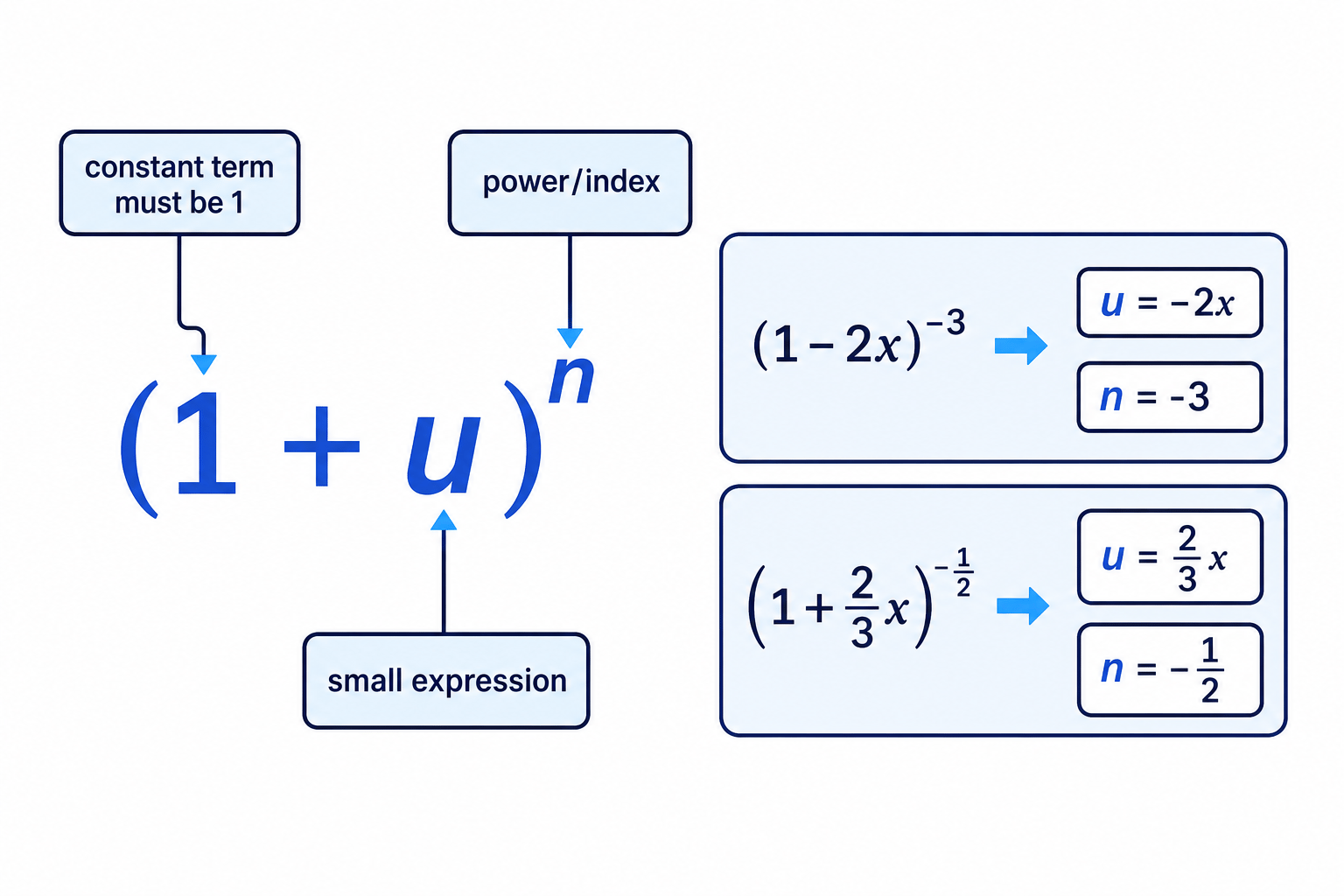
The standard form
The infinite binomial formula is built for (1+u)n(1+u)^n(1+u)n. If your bracket is not in that form, factor it first.
Expanding a negative power
Expand (1−2x)−3(1-2x)^{-3}(1−2x)−3 up to and including the term in x3x^3x3, and state the range of validity.
-
Identify the two key parts: n=−3n=-3n=−3 and u=−2xu=-2xu=−2x.
-
Substitute into the first four terms of the formula:
(1−2x)−3=1+(−3)(−2x)+(−3)(−4)2(−2x)2+(−3)(−4)(−5)6(−2x)3+⋯(1-2x)^{-3}=1+(-3)(-2x)+\frac{(-3)(-4)}{2}(-2x)^2+\frac{(-3)(-4)(-5)}{6}(-2x)^3+\cdots(1−2x)−3=1+(−3)(−2x)+2(−3)(−4)(−2x)2+6(−3)(−4)(−5)(−2x)3+⋯ -
Simplify each term:
(1−2x)−3=1+6x+24x2+80x3+⋯(1-2x)^{-3}=1+6x+24x^2+80x^3+\cdots(1−2x)−3=1+6x+24x2+80x3+⋯ -
For a negative or fractional power, require ∣u∣<1|u|<1∣u∣<1:
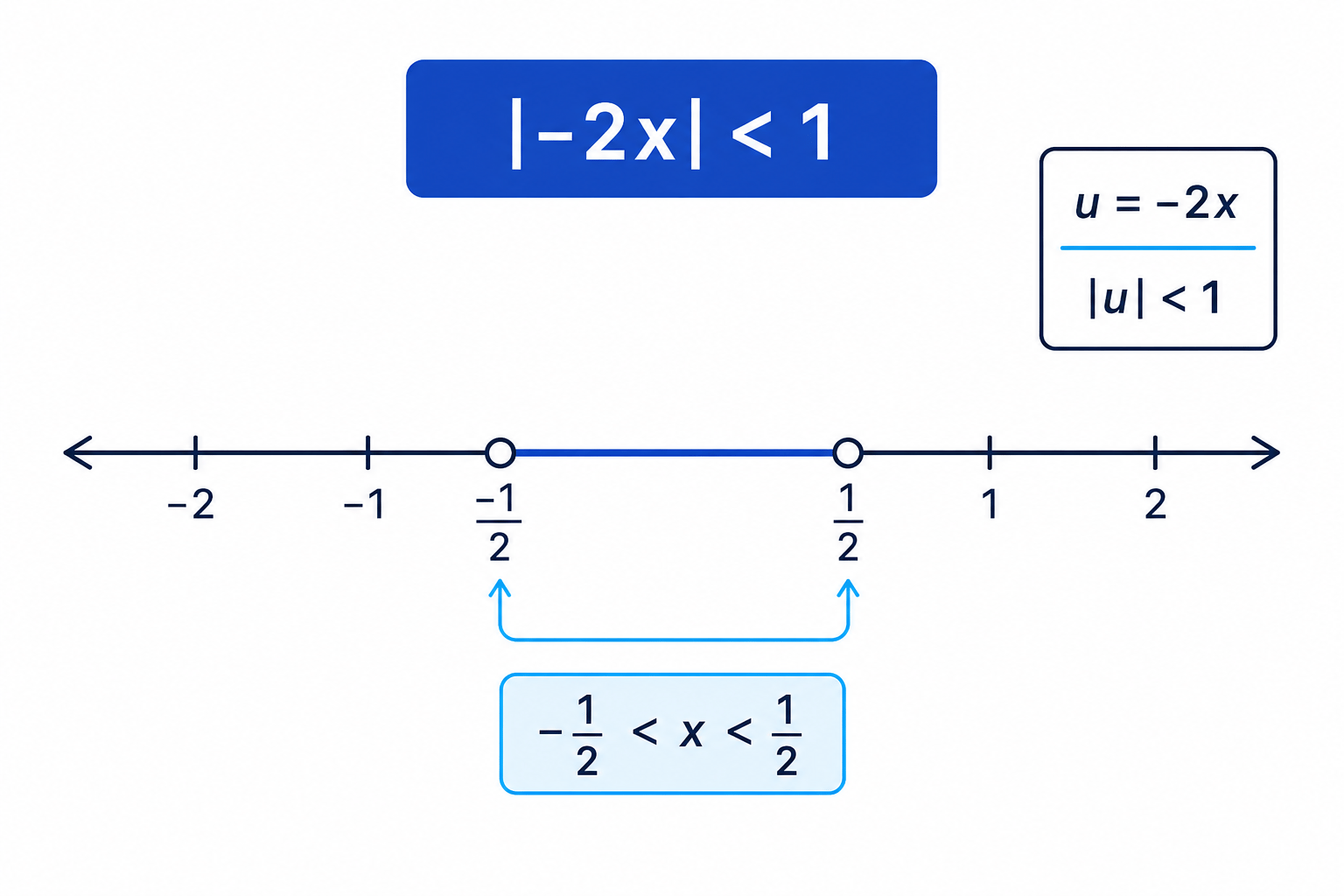
$$
|-2x|<1\Rightarrow |x|<\frac{1}{2}\Rightarrow -\frac{1}{2}<x<\frac{1}{2}
$$
Miscounting the terms
“Up to and including x3x^3x3” means include the constant term, the xxx term, the x2x^2x2 term, and the x3x^3x3 term. Do not stop at x2x^2x2.
4. Factoring first
Many expressions do not start as (1+u)n(1+u)^n(1+u)n. For example, (9+6x)−12(9+6x)^{-\frac{1}{2}}(9+6x)−21 has a 9 at the front, not a 1.
Use this idea:
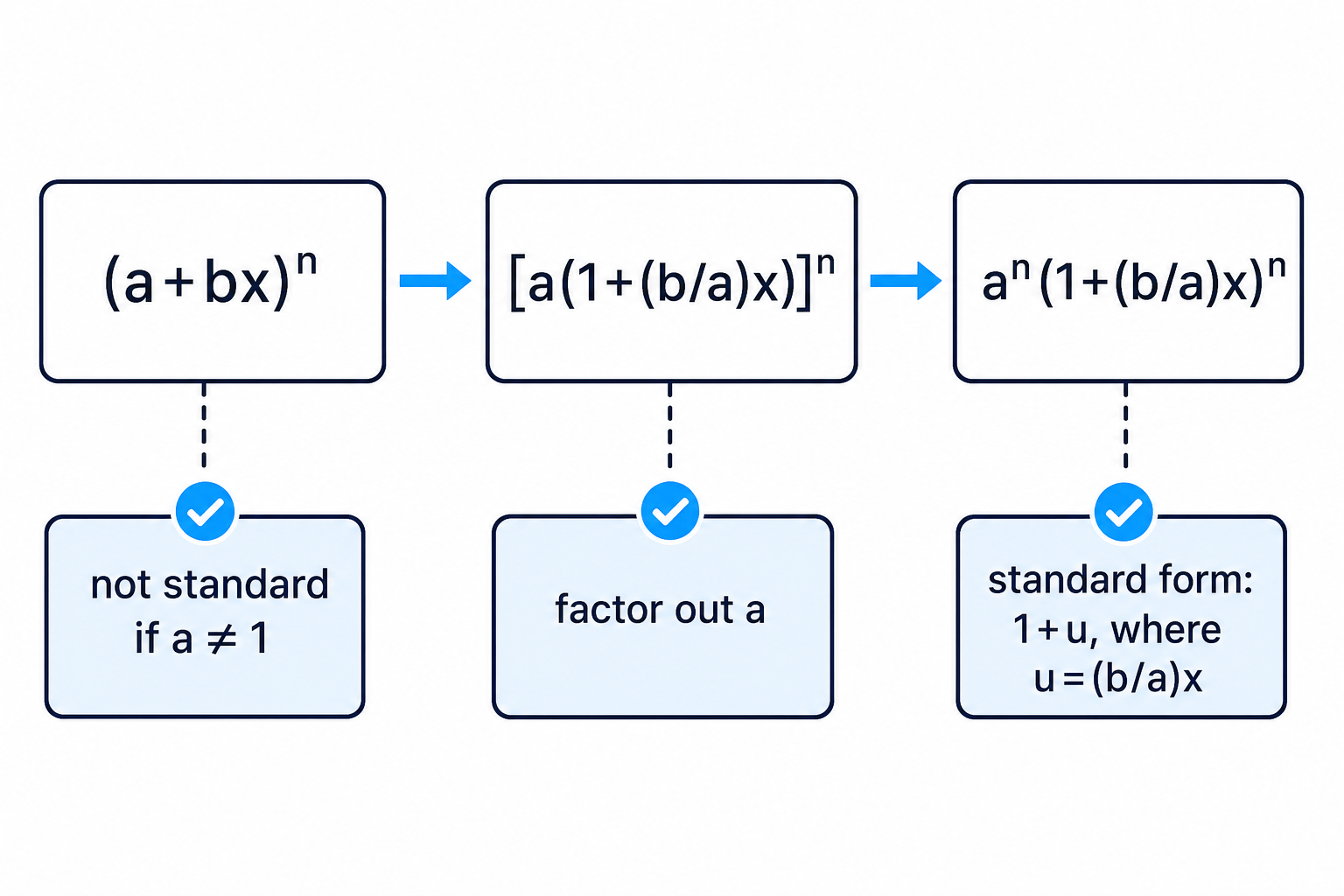
Then use the binomial expansion on the bracket.
Factoring into standard form
Expand (9+6x)−12(9+6x)^{-\frac{1}{2}}(9+6x)−21 up to and including the term in x3x^3x3, and state the range of validity.
-
Factor 9 from the bracket:
(9+6x)−12=9−12(1+23x)−12=13(1+23x)−12(9+6x)^{-\frac{1}{2}}=9^{-\frac{1}{2}}\left(1+\frac{2}{3}x\right)^{-\frac{1}{2}}=\frac{1}{3}\left(1+\frac{2}{3}x\right)^{-\frac{1}{2}}(9+6x)−21=9−21(1+32x)−21=31(1+32x)−21 -
Expand the bracket using n=−12n=-\frac{1}{2}n=−21 and u=23xu=\frac{2}{3}xu=32x:
(1+23x)−12=1−x3+x26−5x354+⋯\left(1+\frac{2}{3}x\right)^{-\frac{1}{2}}=1-\frac{x}{3}+\frac{x^2}{6}-\frac{5x^3}{54}+\cdots(1+32x)−21=1−3x+6x2−545x3+⋯ -
Multiply every term by 13\frac{1}{3}31:
(9+6x)−12=13−x9+x218−5x3162+⋯(9+6x)^{-\frac{1}{2}}=\frac{1}{3}-\frac{x}{9}+\frac{x^2}{18}-\frac{5x^3}{162}+\cdots(9+6x)−21=31−9x+18x2−1625x3+⋯ -
The range comes from ∣23x∣<1\left|\frac{2}{3}x\right|<132x<1:
−32<x<32-\frac{3}{2}<x<\frac{3}{2}−23<x<23
Expanding the wrong bracket
Do not apply the formula directly to 9+6x9+6x9+6x as though it were 1+u1+u1+u. The constant factor must come out first.
5. Validity and accuracy
For fractional or negative powers, the expansion is valid when
∣u∣<1|u|<1∣u∣<1where uuu is the small expression in (1+u)n(1+u)^n(1+u)n.
For example, if you have (1−2x9)12\left(1-\frac{2x}{9}\right)^{\frac{1}{2}}(1−92x)21, then u=−2x9u=-\frac{2x}{9}u=−92x, so the condition is ∣−2x9∣<1\left|-\frac{2x}{9}\right|<1−92x<1.

Validity before accuracy
If ∣u∣≥1|u|\ge 1∣u∣≥1, the expansion should not be used. Even when it is valid, it is usually more accurate when uuu is close to 0.
6. Using expansions for approximations
A binomial expansion is especially useful when the value of xxx is small. Higher powers like x2x^2x2 and x3x^3x3 become much smaller, so the first few terms give a good approximation.
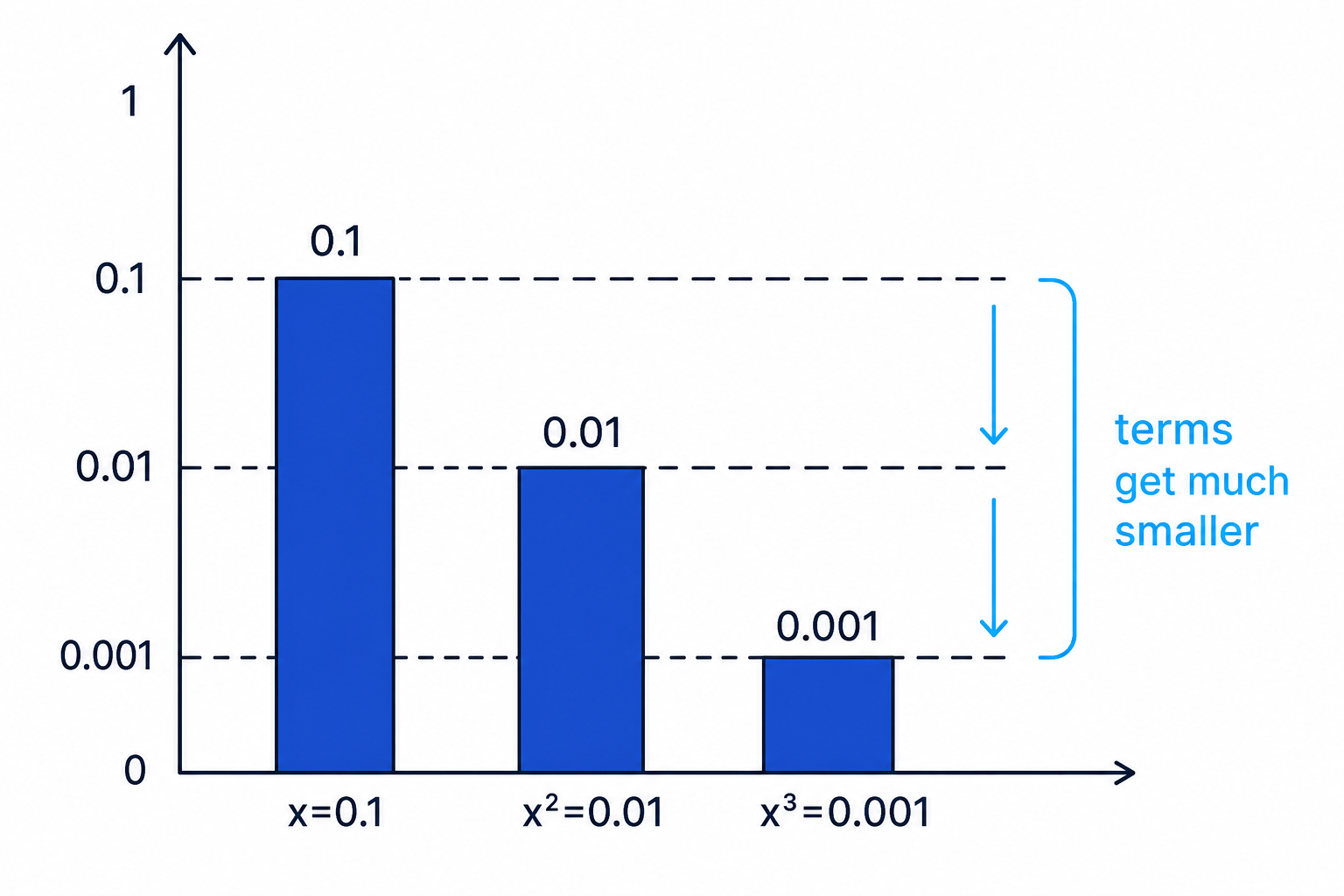
Approximating a square root
Use a binomial expansion to estimate 8.8\sqrt{8.8}8.8 to 5 decimal places.
-
Write 8.8\sqrt{8.8}8.8 as part of (9−2x)12(9-2x)^{\frac{1}{2}}(9−2x)21:
9−2x=8.89-2x=8.89−2x=8.8 -
Solve for the substitution value:
x=0.1x=0.1x=0.1 -
Expand (9−2x)12(9-2x)^{\frac{1}{2}}(9−2x)21:
(9−2x)12=3(1−2x9)12=3−x3−x254−x3486+⋯\begin{aligned} (9-2x)^{\frac{1}{2}} &=3\left(1-\frac{2x}{9}\right)^{\frac{1}{2}}\\ &=3-\frac{x}{3}-\frac{x^2}{54}-\frac{x^3}{486}+\cdots \end{aligned}(9−2x)21=3(1−92x)21=3−3x−54x2−486x3+⋯ -
Substitute x=0.1x=0.1x=0.1:
3−0.13−0.1254−0.13486=2.966479…3-\frac{0.1}{3}-\frac{0.1^2}{54}-\frac{0.1^3}{486}=2.966479\ldots3−30.1−540.12−4860.13=2.966479… -
Therefore, 8.8≈2.96648\sqrt{8.8}\approx 2.966488.8≈2.96648 to 5 decimal places.
7. Combining expansions with other algebra
Sometimes you expand one part first, then multiply by another factor or match coefficients.
Multiplying by another factor
Multiplying after expanding
Find the expansion of 1+x(1−2x)2\frac{1+x}{(1-2x)^2}(1−2x)21+x up to and including x3x^3x3.
-
First expand the denominator part:
(1−2x)−2=1+4x+12x2+32x3+⋯(1-2x)^{-2}=1+4x+12x^2+32x^3+\cdots(1−2x)−2=1+4x+12x2+32x3+⋯ -
Multiply by 1+x1+x1+x, keeping terms only up to x3x^3x3:
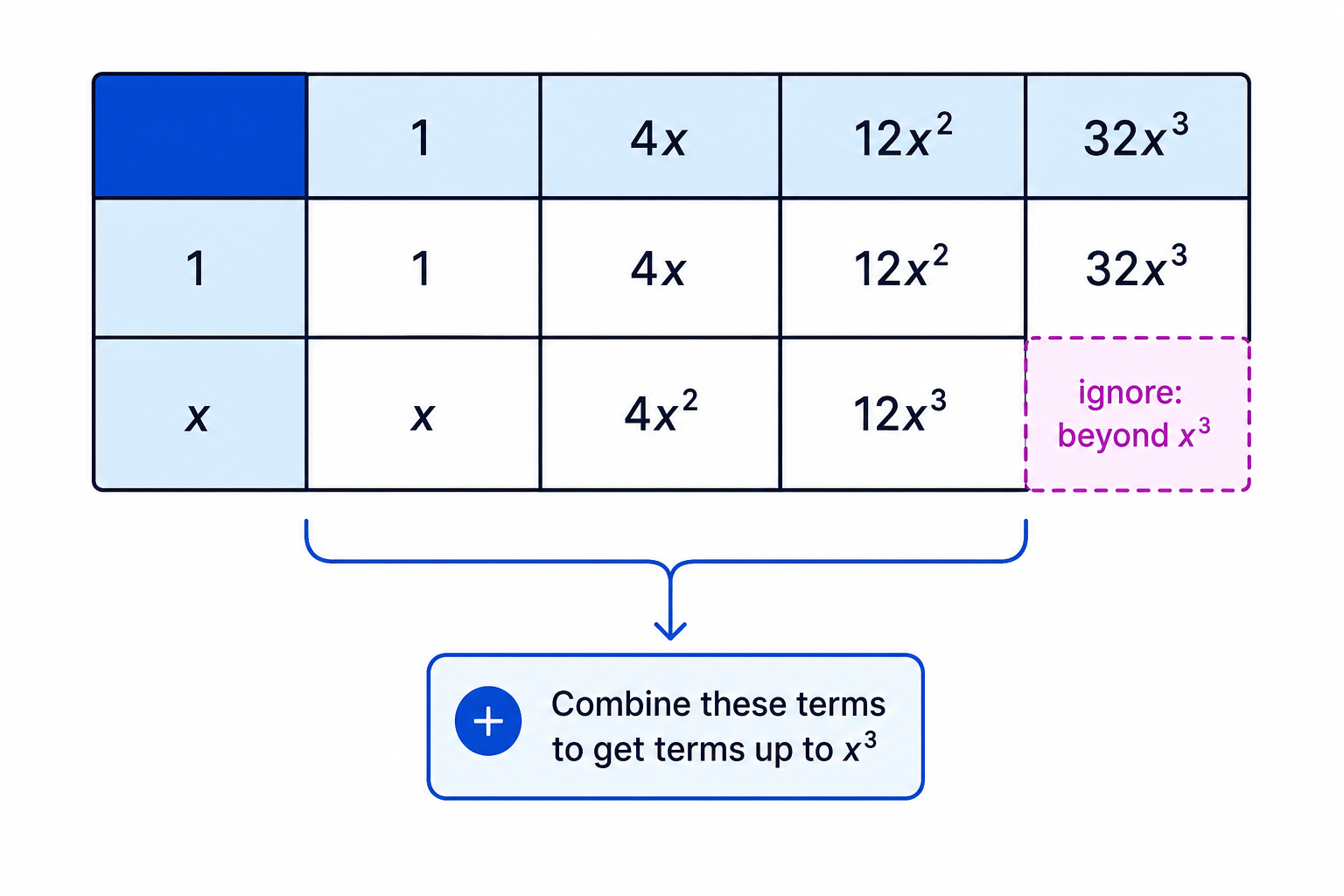
$$
(1+x)(1+4x+12x^2+32x^3)=1+5x+16x^2+44x^3+\cdots
$$
3. Terms like x⋅32x3x\cdot 32x^3x⋅32x3 are in x4x^4x4, so they are not needed.
Only keep what can matter
When multiplying expansions up to x3x^3x3, ignore any product whose powers already add to more than 3.
Matching coefficients
Finding unknown constants
The expansion of a+bx4+x\frac{a+bx}{\sqrt{4+x}}4+xa+bx begins 2+x+⋯2+x+\cdots2+x+⋯. Find aaa and bbb.
-
Begin with the reciprocal square root expansion:
(4+x)−12=12−x16+⋯(4+x)^{-\frac{1}{2}}=\frac{1}{2}-\frac{x}{16}+\cdots(4+x)−21=21−16x+⋯ -
Multiply by a+bxa+bxa+bx and keep the constant and xxx terms:
(a+bx)(12−x16+⋯ )=a2+(b2−a16)x+⋯(a+bx)\left(\frac{1}{2}-\frac{x}{16}+\cdots\right)=\frac{a}{2}+\left(\frac{b}{2}-\frac{a}{16}\right)x+\cdots(a+bx)(21−16x+⋯)=2a+(2b−16a)x+⋯ -
Compare coefficients with 2+x+⋯2+x+\cdots2+x+⋯:
a2=2,b2−a16=1\frac{a}{2}=2,\qquad \frac{b}{2}-\frac{a}{16}=12a=2,2b−16a=1 -
Solve the equations: a=4a=4a=4, then b2−14=1\frac{b}{2}-\frac{1}{4}=12b−41=1, so b=52b=\frac{5}{2}b=25.
In the exam
-
Rewrite roots and fractions as powers before expanding.
-
Factor the bracket into A(1+u)nA(1+u)^nA(1+u)n if the constant term is not 1.
-
For fractional or negative powers, always state the range using ∣u∣<1|u|<1∣u∣<1.
-
In approximation questions, choose the substitution with the smallest valid value of ∣u∣|u|∣u∣.
-
When multiplying expansions, keep only the terms that can contribute to the requested power.
Check yourself
-
Can you expand (1−3x)−12(1-3x)^{-\frac{1}{2}}(1−3x)−21 up to and including x2x^2x2, and state its validity range?
-
Can you rewrite 125+10x\frac{1}{\sqrt{25+10x}}25+10x1 in the form A(1+u)nA(1+u)^nA(1+u)n?
-
If you multiply an expansion by 1+2x1+2x1+2x, which terms can contribute to the coefficient of x3x^3x3?
