

What you'll learn
-
How integration reverses differentiation, including why you need a constant of integration.
-
How to integrate powers, exponentials, logs and trigonometric functions.
-
How substitution, integration by parts and partial fractions help with harder integrals.
-
How integration is used for areas, parametric curves, differential equations and estimates.
1. The big idea: integration reverses differentiation
Integration is the opposite process to differentiation. If differentiating tells you the gradient function, integrating helps you recover the original function.

Indefinite integral
An indefinite integral such as ∫f(x) dx\int f(x)\,dx∫f(x)dx means “find all functions whose derivative is f(x)f(x)f(x)”. The symbol dxdxdx tells you the variable, and +c+c+c is the constant of integration because constants disappear when differentiated.
Reverse the differentiation rules
-
For n≠−1n \neq -1n=−1, ∫xn dx=xn+1n+1+c\int x^n\,dx=\frac{x^{n+1}}{n+1}+c∫xndx=n+1xn+1+c.
-
The special case is ∫1x dx=ln∣x∣+c\int \frac{1}{x}\,dx=\ln|x|+c∫x1dx=ln∣x∣+c.
-
If the expression is a linear bracket like ax+bax+bax+b, divide by the derivative of the bracket, so divide by aaa.
Basic algebraic integrals
-
Find
I1=∫(5x−3+2(4x+1)3) dxI_1=\int \left(\sqrt{5x-3}+\frac{2}{(4x+1)^3}\right)\,dxI1=∫(5x−3+(4x+1)32)dx -
Rewrite using powers, then apply the reverse chain rule:
I1=∫((5x−3)1/2+2(4x+1)−3) dx=215(5x−3)3/2−14(4x+1)−2+c\begin{aligned} I_1 &=\int \left((5x-3)^{1/2}+2(4x+1)^{-3}\right)\,dx \\ &=\frac{2}{15}(5x-3)^{3/2}-\frac{1}{4}(4x+1)^{-2}+c \end{aligned}I1=∫((5x−3)1/2+2(4x+1)−3)dx=152(5x−3)3/2−41(4x+1)−2+c -
For a definite log-style integral, find
I2=∫0163x+2 dxI_2=\int_0^1 \frac{6}{3x+2}\,dxI2=∫013x+26dx -
The derivative of 3x+23x+23x+2 is 3, so the numerator is twice that derivative:
I2=[2ln(3x+2)]01=2ln5−2ln2=2ln(52)I_2=\left[2\ln(3x+2)\right]_0^1=2\ln5-2\ln2=2\ln\left(\frac{5}{2}\right)I2=[2ln(3x+2)]01=2ln5−2ln2=2ln(25)
Forgetting the hidden derivative
If you integrate (5x−3)1/2(5x-3)^{1/2}(5x−3)1/2 as 23(5x−3)3/2\frac{2}{3}(5x-3)^{3/2}32(5x−3)3/2, differentiating gives five times too much. Always divide by the derivative of the bracket.
2. Trigonometric integrals and identities
For A-Level calculus, trigonometric angles are in radians unless told otherwise. You need to know the derivative facts so that you can reverse them confidently.
Useful identities include:
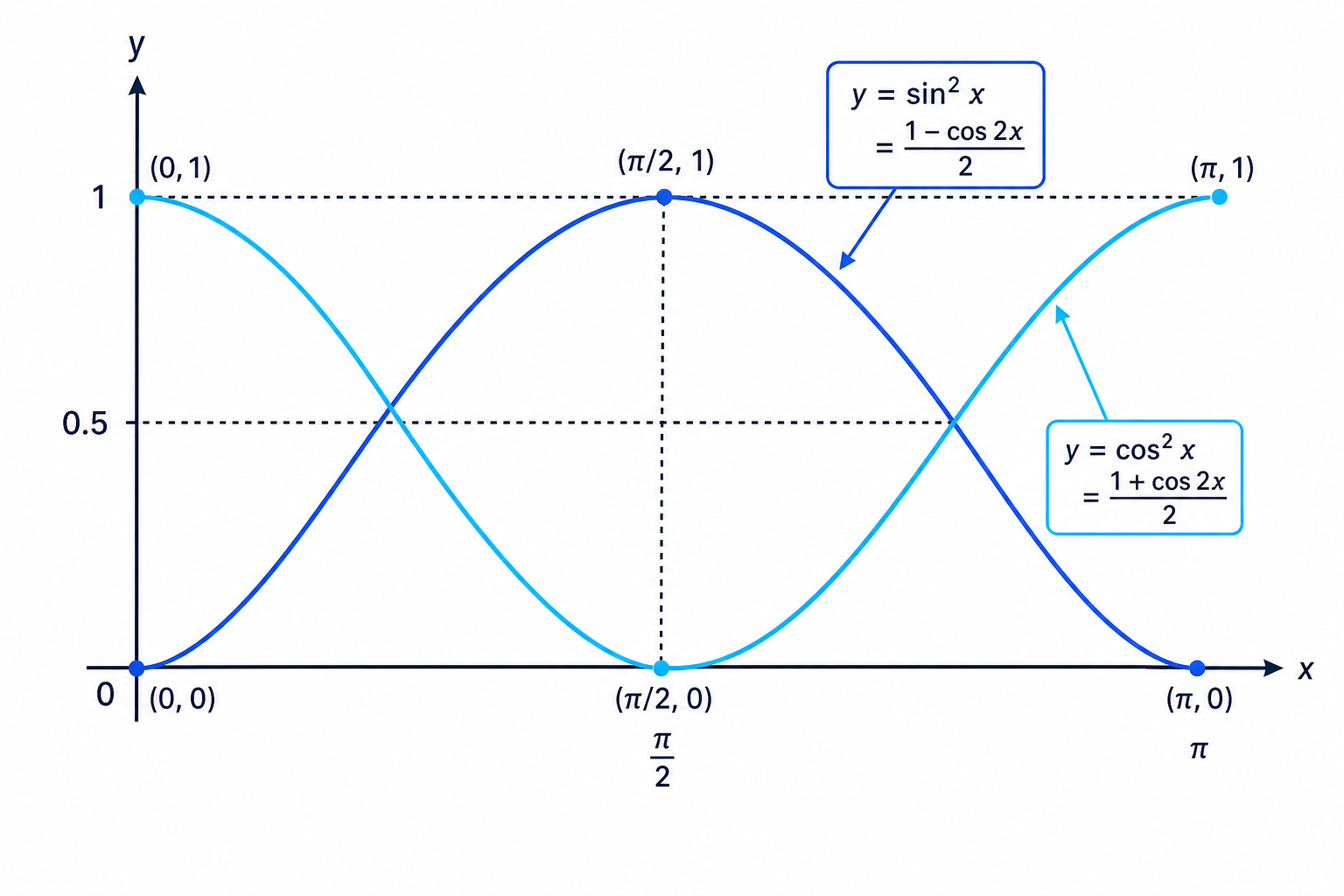
Differentiate to check
For trig integrals, a quick derivative check is very powerful. For example, differentiating tan(4x)\tan(4x)tan(4x) gives 4sec2(4x)4\sec^2(4x)4sec2(4x), so integrating sec2(4x)\sec^2(4x)sec2(4x) must introduce a factor of 14\frac{1}{4}41.
Trig functions and a squared integral
-
Find
I=∫(3sec2(2x)−4cosec(5x)cot(5x)) dxI=\int\left(3\sec^2(2x)-4\operatorname{cosec}(5x)\cot(5x)\right)\,dxI=∫(3sec2(2x)−4cosec(5x)cot(5x))dx -
Use ddxtan(2x)=2sec2(2x)\frac{d}{dx}\tan(2x)=2\sec^2(2x)dxdtan(2x)=2sec2(2x) and ddxcosec(5x)=−5cosec(5x)cot(5x)\frac{d}{dx}\operatorname{cosec}(5x)=-5\operatorname{cosec}(5x)\cot(5x)dxdcosec(5x)=−5cosec(5x)cot(5x):
I=32tan(2x)+45cosec(5x)+cI=\frac{3}{2}\tan(2x)+\frac{4}{5}\operatorname{cosec}(5x)+cI=23tan(2x)+54cosec(5x)+c -
Now find
J=∫0π2cos2x dxJ=\int_0^{\frac{\pi}{2}}\cos^2x\,dxJ=∫02πcos2xdx -
Replace cos2x\cos^2xcos2x using the double-angle identity, then integrate:
J=∫0π21+cos2x2 dx=[x2+sin2x4]0π2=π4\begin{aligned} J&=\int_0^{\frac{\pi}{2}}\frac{1+\cos2x}{2}\,dx \\ &=\left[\frac{x}{2}+\frac{\sin2x}{4}\right]_0^{\frac{\pi}{2}} \\ &=\frac{\pi}{4} \end{aligned}J=∫02π21+cos2xdx=[2x+4sin2x]02π=4π
3. Integration by substitution
Substitution
A substitution changes the variable in an integral, usually from xxx to uuu, so that a complicated expression becomes simpler. It is the reverse of the chain rule.
For definite integrals, you can either change back to xxx before substituting the limits, or change the limits into uuu-values straight away. Do not mix the two methods.
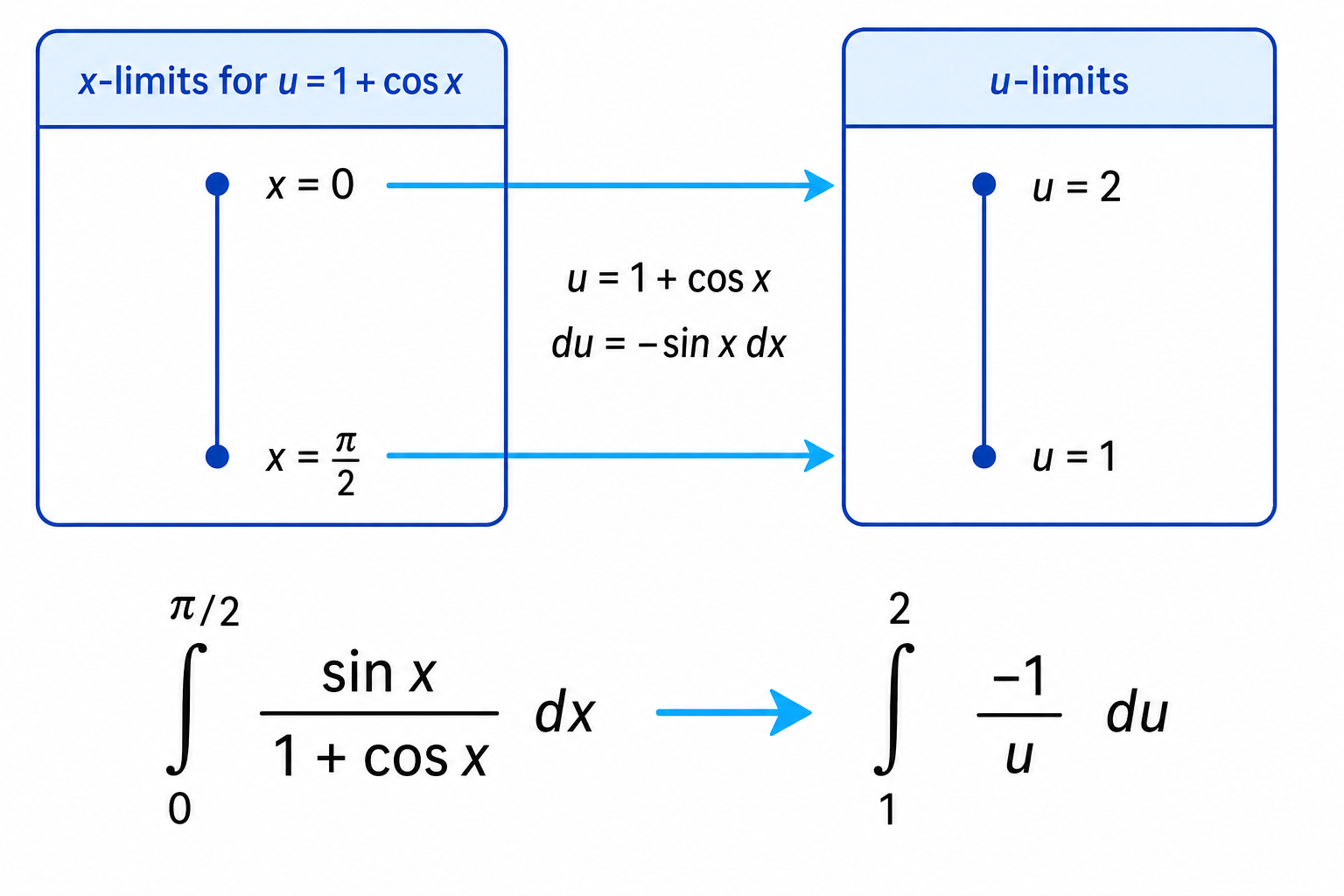
Changing limits with
-
Find
I=∫0π2sinx1+cosx dxI=\int_0^{\frac{\pi}{2}}\frac{\sin x}{1+\cos x}\,dxI=∫02π1+cosxsinxdx -
Let u=1+cosxu=1+\cos xu=1+cosx, so dudx=−sinx\frac{du}{dx}=-\sin xdxdu=−sinx and therefore sinx dx=−du\sin x\,dx=-dusinxdx=−du.
-
Change the limits: when x=0x=0x=0, u=2u=2u=2; when x=π2x=\frac{\pi}{2}x=2π, u=1u=1u=1.
-
Substitute carefully, including the minus sign:
I=∫21−1u du=∫121u du=[lnu]12=ln2\begin{aligned} I&=\int_2^1 -\frac{1}{u}\,du \\ &=\int_1^2 \frac{1}{u}\,du \\ &=\left[\ln u\right]_1^2=\ln2 \end{aligned}I=∫21−u1du=∫12u1du=[lnu]12=ln2
Mixing variables
If you change the limits into uuu-values, finish the integral in uuu. If you want to use the original xxx-limits, change your answer back to xxx first.
4. Integration by parts
Integration by parts is the product rule in reverse. Use it when your integrand is a product, especially involving xxx, lnx\ln xlnx, exponentials or trig functions.

A product like
-
Let
I=∫xsinx dxI=\int x\sin x\,dxI=∫xsinxdx -
Choose u=xu=xu=x and dvdx=sinx\frac{dv}{dx}=\sin xdxdv=sinx, so dudx=1\frac{du}{dx}=1dxdu=1 and v=−cosxv=-\cos xv=−cosx.
-
Substitute into the formula:
I=x(−cosx)−∫(−cosx)(1) dx=−xcosx+∫cosx dx=−xcosx+sinx+c\begin{aligned} I&=x(-\cos x)-\int(-\cos x)(1)\,dx \\ &=-x\cos x+\int\cos x\,dx \\ &=-x\cos x+\sin x+c \end{aligned}I=x(−cosx)−∫(−cosx)(1)dx=−xcosx+∫cosxdx=−xcosx+sinx+c -
A quick check is that differentiating −xcosx+sinx-x\cos x+\sin x−xcosx+sinx gives xsinxx\sin xxsinx.
5. Algebraic integration and partial fractions
Partial fractions
Partial fractions rewrite one complicated rational expression as a sum of simpler fractions. They are useful because terms like 1x+a\frac{1}{x+a}x+a1 integrate to logarithms.
If the numerator has degree greater than or equal to the denominator, use algebraic division first. For repeated factors, include every power of the factor.
Partial fractions before integrating
-
Decompose
3x(x+1)(x−2)\frac{3x}{(x+1)(x-2)}(x+1)(x−2)3x -
Write
3x(x+1)(x−2)=Ax+1+Bx−2\frac{3x}{(x+1)(x-2)}=\frac{A}{x+1}+\frac{B}{x-2}(x+1)(x−2)3x=x+1A+x−2B -
Multiply through by (x+1)(x−2)(x+1)(x-2)(x+1)(x−2) and compare coefficients:
3x=A(x−2)+B(x+1)3x=A(x-2)+B(x+1)3x=A(x−2)+B(x+1) -
Match coefficients of xxx and constants:
A+B=3,−2A+B=0⇒A=1, B=2A+B=3,\qquad -2A+B=0 \Rightarrow A=1,\ B=2A+B=3,−2A+B=0⇒A=1, B=2 -
Integrate the simpler form:
∫3x(x+1)(x−2) dx=ln∣x+1∣+2ln∣x−2∣+c\int\frac{3x}{(x+1)(x-2)}\,dx=\ln|x+1|+2\ln|x-2|+c∫(x+1)(x−2)3xdx=ln∣x+1∣+2ln∣x−2∣+c
Vertical asymptotes
For indefinite integrals, use modulus signs in ln∣x−a∣\ln|x-a|ln∣x−a∣. For definite integrals, check the interval does not cross a point where the denominator is zero.
6. Areas, including parametric curves
A definite integral gives signed area. If the curve is above the xxx-axis, the area is positive. If finding the area between two curves, integrate “upper curve minus lower curve”.
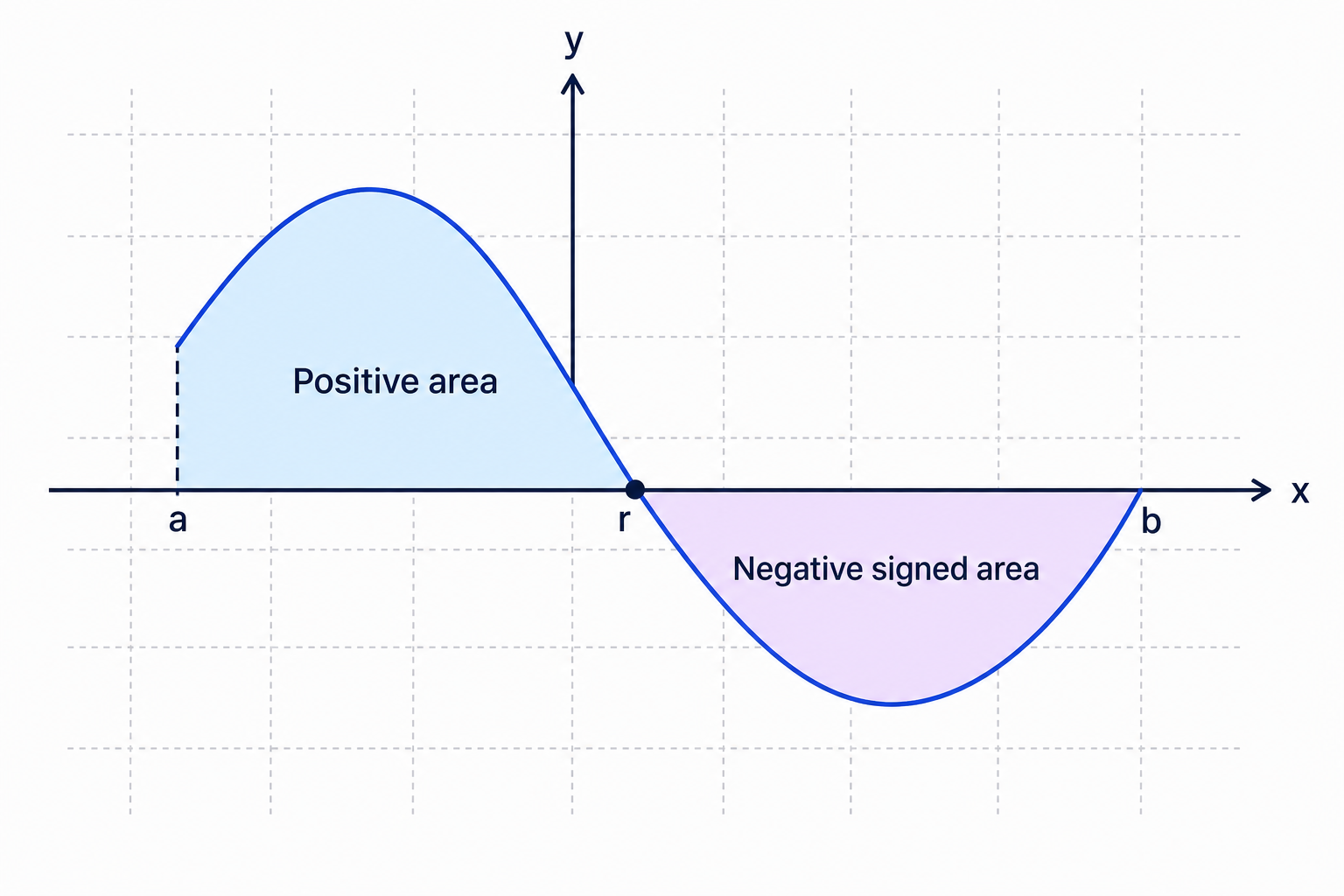
Parametric equations
Parametric equations describe xxx and yyy using a third variable, often ttt. For area under a parametric curve, use A=∫y dx=∫y(t)dxdt dtA=\int y\,dx=\int y(t)\frac{dx}{dt}\,dtA=∫ydx=∫y(t)dtdxdt.
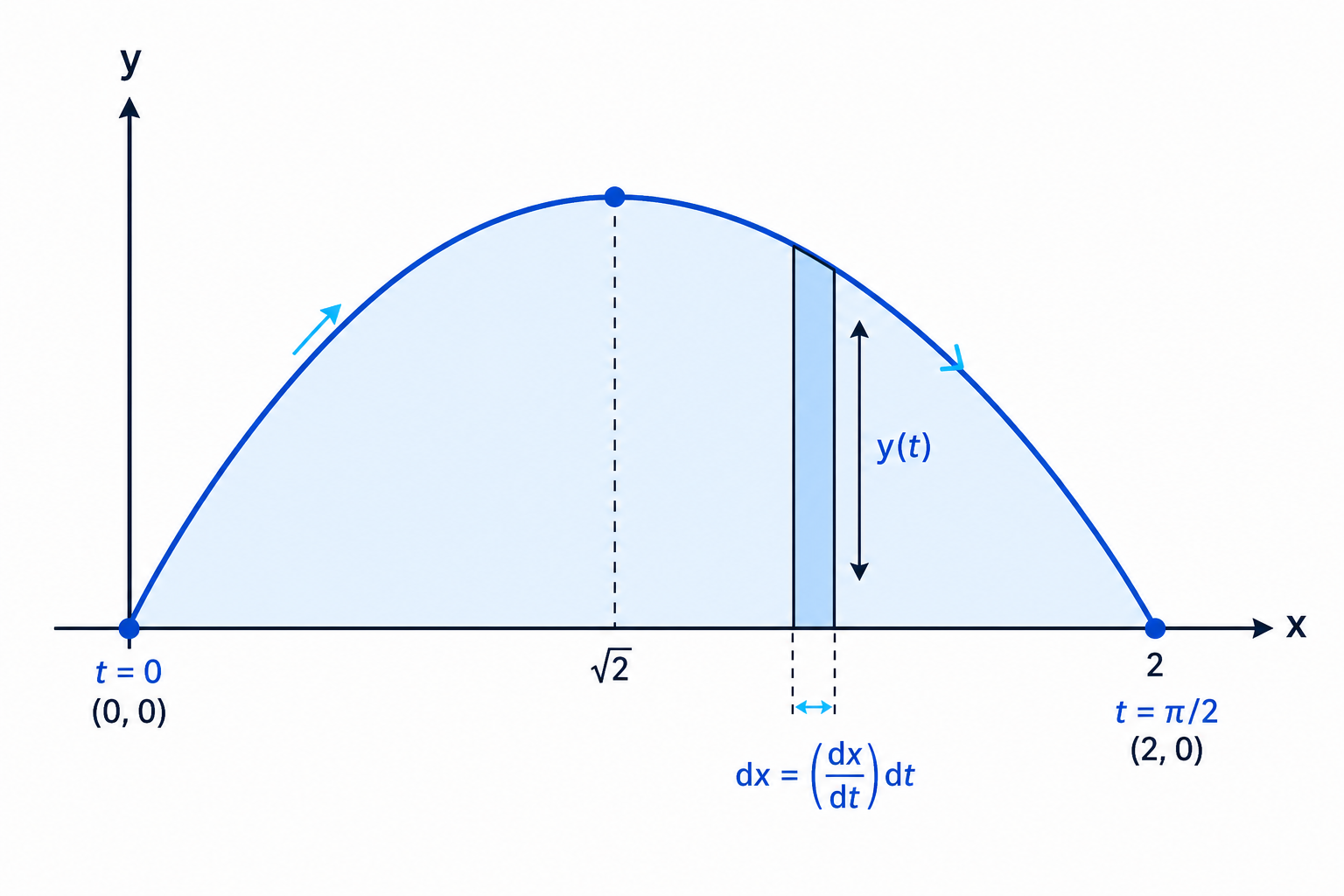
Area under a parametric curve
-
A curve is given by x=2sintx=2\sin tx=2sint, y=3sin2ty=3\sin2ty=3sin2t, where 0≤t≤π20\leq t\leq \frac{\pi}{2}0≤t≤2π. Since xxx increases from 0 to 2, use the area formula directly.
-
Differentiate xxx with respect to ttt:
dxdt=2cost\frac{dx}{dt}=2\cos tdtdx=2cost -
Substitute into A=∫ydxdt dtA=\int y\frac{dx}{dt}\,dtA=∫ydtdxdt:
A=∫0π23sin2t(2cost) dt=∫0π212sintcos2t dt\begin{aligned} A&=\int_0^{\frac{\pi}{2}}3\sin2t(2\cos t)\,dt \\ &=\int_0^{\frac{\pi}{2}}12\sin t\cos^2t\,dt \end{aligned}A=∫02π3sin2t(2cost)dt=∫02π12sintcos2tdt -
Use u=costu=\cos tu=cost, so du=−sint dtdu=-\sin t\,dtdu=−sintdt, with limits u=1u=1u=1 to u=0u=0u=0:
A=∫10−12u2 du=∫0112u2 du=4A=\int_1^0 -12u^2\,du=\int_0^1 12u^2\,du=4A=∫10−12u2du=∫0112u2du=4
Negative parametric area
If dxdt\frac{dx}{dt}dtdx is negative over the interval, ∫ydxdt dt\int y\frac{dx}{dt}\,dt∫ydtdxdt may give a negative signed area. Reverse the limits or take the positive area when the question asks for area.
7. Differential equations
Differential equation
A differential equation contains a derivative, such as dydx\frac{dy}{dx}dxdy. It is separable if you can rearrange it so all the yyy terms are with dydydy and all the xxx terms are with dxdxdx.
When a rate is directly proportional to the amount present, you often get an exponential model such as P=AektP=Ae^{kt}P=Aekt.
Solving a separable differential equation
-
Solve dydx=(y+2)2\frac{dy}{dx}=(y+2)^2dxdy=(y+2)2, given that y=−1y=-1y=−1 when x=0x=0x=0.
-
Separate the variables:
1(y+2)2 dy=dx\frac{1}{(y+2)^2}\,dy=dx(y+2)21dy=dx -
Integrate both sides:
−1y+2=x+c-\frac{1}{y+2}=x+c−y+21=x+c -
Use the initial condition:
−1=0+c⇒c=−1-1=0+c \Rightarrow c=-1−1=0+c⇒c=−1 -
Rearrange into the form y=f(x)y=f(x)y=f(x):
−1y+2=x−1⇒1y+2=1−x⇒y=11−x−2-\frac{1}{y+2}=x-1 \Rightarrow \frac{1}{y+2}=1-x \Rightarrow y=\frac{1}{1-x}-2−y+21=x−1⇒y+21=1−x⇒y=1−x1−2
8. The trapezium rule
The trapezium rule estimates an area by splitting it into trapezia. The vertical values used are called ordinates.
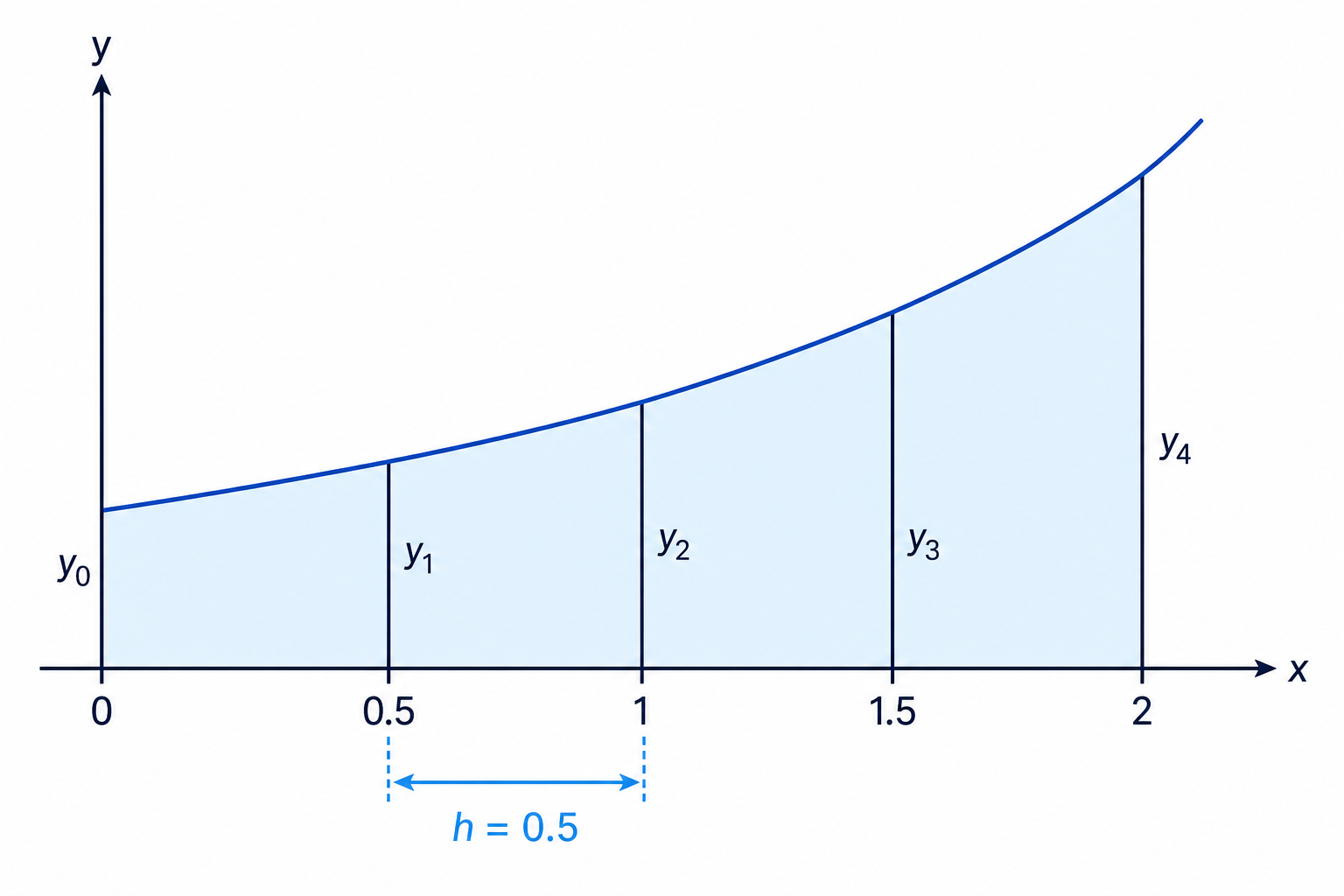
For width hhh and ordinates y0,y1,…,yny_0,y_1,\dots,y_ny0,y1,…,yn,
∫aby dx≈h2(y0+yn+2(y1+y2+⋯+yn−1))\int_a^b y\,dx\approx \frac{h}{2}\left(y_0+y_n+2(y_1+y_2+\cdots+y_{n-1})\right)∫abydx≈2h(y0+yn+2(y1+y2+⋯+yn−1))Using five ordinates
-
Estimate ∫02ex/2 dx\int_0^2 e^{x/2}\,dx∫02ex/2dx using ordinates at x=0,0.5,1,1.5,2x=0,0.5,1,1.5,2x=0,0.5,1,1.5,2. The corresponding values are 1.000, 1.284, 1.649, 2.117 and 2.718.
-
There are four strips, so the strip width is 0.5.
-
Substitute into the trapezium rule:
Estimate=0.52(1.000+2.718+2(1.284+1.649+2.117))=3.4545\begin{aligned} \text{Estimate} &=\frac{0.5}{2}\left(1.000+2.718+2(1.284+1.649+2.117)\right) \\ &=3.4545 \end{aligned}Estimate=20.5(1.000+2.718+2(1.284+1.649+2.117))=3.4545 -
To three significant figures, the estimate is 3.45.
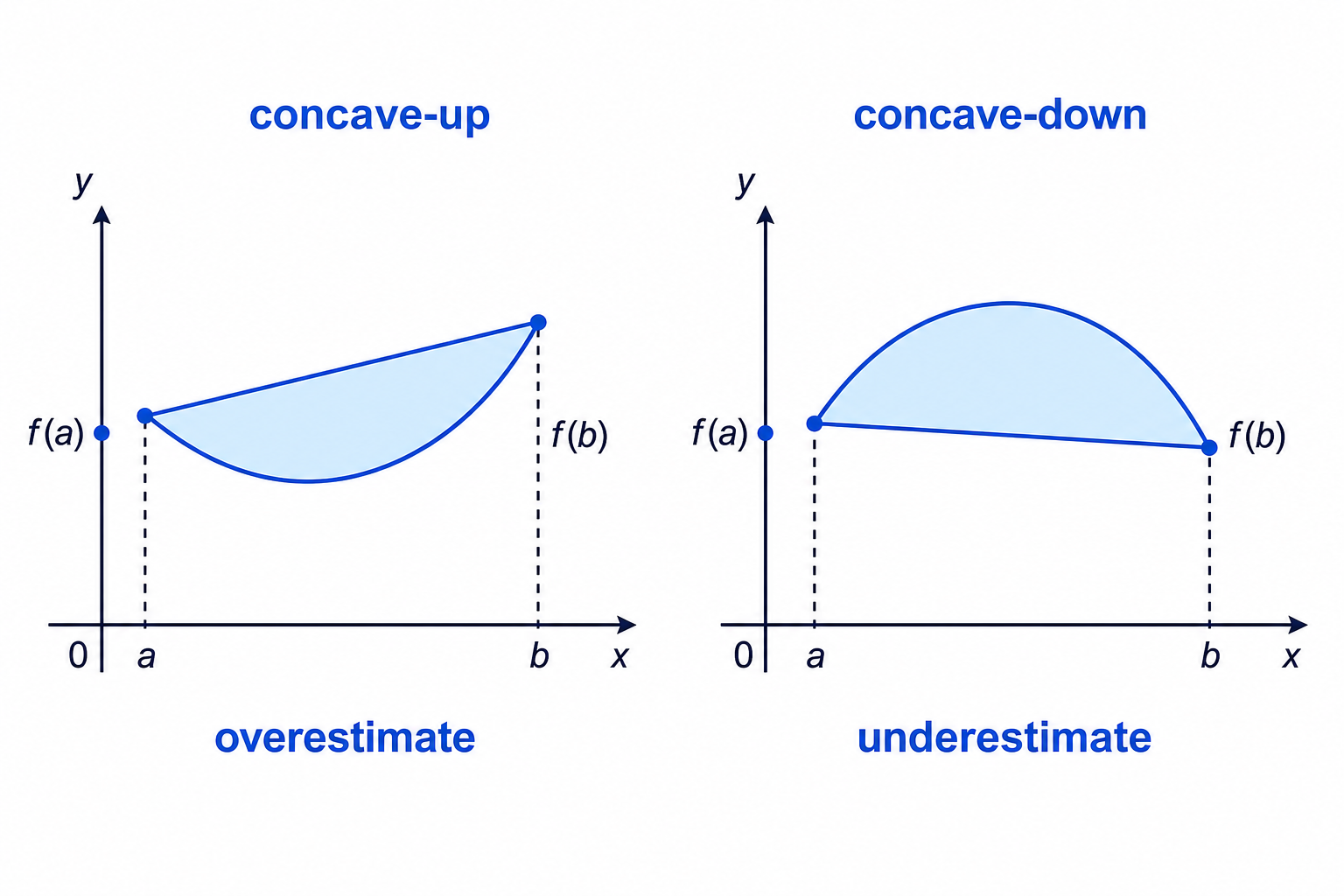
Overestimate or underestimate
Trapezia use straight chords. For a concave-up curve, the chords lie above the curve, so the estimate is an overestimate; for a concave-down curve, it is an underestimate.
In the exam
-
For every indefinite integral, include +c+c+c unless the question is definite.
-
Differentiate your answer quickly to check missing scale factors.
-
In substitution, change the limits or change back to the original variable, but do not mix methods.
-
For areas, decide whether you need signed area, positive area, or upper curve minus lower curve.
-
Keep exact answers exact: simplify logs using laws of logarithms only at the end.
Check yourself
-
Why does ∫(2x+1)5 dx\int(2x+1)^5\,dx∫(2x+1)5dx need a factor involving the derivative of 2x+12x+12x+1?
-
In the substitution u=1+cosxu=1+\cos xu=1+cosx, what happens to the limits x=0x=0x=0 and x=π2x=\frac{\pi}{2}x=2π?
-
Which technique would you try first for ∫xlnx dx\int x\ln x\,dx∫xlnxdx, and why?
