

What you'll learn
- How to calculate the weight of a body using W=mgW=mgW=mg.
- How mass and weight differ.
- How to include weight in a force diagram and apply Newton's second law.
- How to model straight-line motion under gravity, including free fall and vertical projection.
Mass, Weight and Gravity
Mass
The mass of a body measures the amount of matter in it. Its symbol is usually mmm, and its SI unit is the kilogram, kg.
Mass is a scalar quantity: it has magnitude but no direction. For a given body, its mass is treated as constant in A-Level mechanics problems.
Weight
Earth attracts objects towards its centre. This gravitational attraction produces a force called weight.
Weight
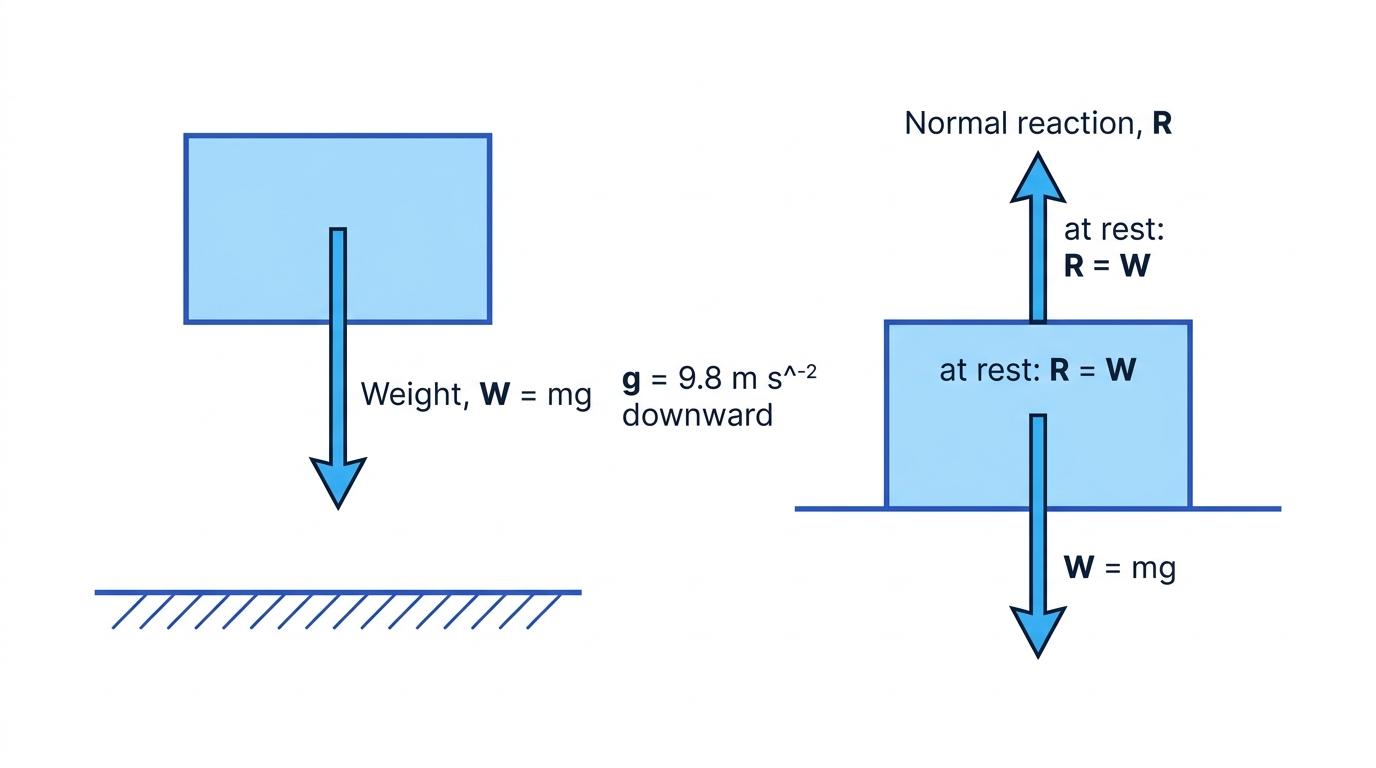
The weight of a body is the gravitational force acting on it. Near Earth's surface,
W=mgW=mgW=mgwhere WWW is weight in newtons, mmm is mass in kilograms, and ggg is the magnitude of the acceleration due to gravity.
Unless a question gives a different value, use
g=9.8 m s−2.g=9.8\text{ m s}^{-2}.g=9.8 m s−2.Weight is a vector quantity because it has both magnitude and direction. It acts vertically downwards, towards the centre of Earth.
Mass is not weight
Mass is measured in kilograms and describes the body itself. Weight is measured in newtons and is the force of gravity on that body.
Calculating weight
A suitcase has mass 18 kg. Find its weight.
-
Identify the mass as m=18 kgm=18\text{ kg}m=18 kg and use g=9.8 m s−2g=9.8\text{ m s}^{-2}g=9.8 m s−2.
-
Substitute into W=mgW=mgW=mg:
W=18×9.8.W=18\times 9.8.W=18×9.8. -
Calculate the force:
W=176.4 N.W=176.4\text{ N}.W=176.4 N.The suitcase's weight is 176.4 N, acting vertically downwards.
Giving weight in kilograms
Kilograms measure mass, not weight. Since weight is a force, its unit must be the newton, N.
Representing Weight in a Force Diagram
A force diagram shows the forces acting on one chosen body. Weight should be drawn as an arrow pointing vertically downwards and labelled WWW or mgmgmg.
Other forces may also act. For example:
- A surface can exert a normal reaction, perpendicular to the surface.
- A string can exert tension along the string.
- Air resistance or another resistive force acts against the direction of motion.
- A driving force or thrust acts in its stated direction.
Weight does not automatically equal the normal reaction. They are equal only when the resultant vertical force is zero and no other vertical forces act.
Finding the normal reaction
A box of mass 12 kg rests on a horizontal floor. Find the normal reaction RRR from the floor.
-
The box has no vertical acceleration, so its resultant vertical force is zero.
-
Its upward force is RRR, while its downward weight is
W=12×9.8=117.6 N.W=12\times 9.8=117.6\text{ N}.W=12×9.8=117.6 N. -
Balancing the vertical forces gives
R−117.6=0,R-117.6=0,R−117.6=0,so
R=117.6 N.R=117.6\text{ N}.R=117.6 N.
Using Weight with Newton's Second Law
Newton's second law states that the resultant force on a body equals its mass multiplied by its acceleration:
F=ma.F=ma.F=ma.The FFF in this equation is the resultant force, meaning the overall force after directions have been taken into account. It is not necessarily just the weight.
Before forming an equation, choose a positive direction. Forces in that direction are positive; forces in the opposite direction are negative.
Descending against resistance
A package of mass 5 kg is falling vertically. Air resistance of 14 N acts upwards. Find its acceleration.
-
Choose vertically downwards as positive. The weight is positive and the resistance is negative.
-
Calculate the weight:
W=5×9.8=49 N.W=5\times 9.8=49\text{ N}.W=5×9.8=49 N. -
Apply Newton's second law in the downward direction:
49−14=5a.49-14=5a.49−14=5a. -
Solve for aaa:
a=355=7 m s−2.a=\frac{35}{5}=7\text{ m s}^{-2}.a=535=7 m s−2.The acceleration is 7 m s−27\text{ m s}^{-2}7 m s−2 vertically downwards.
Use a direction statement
Write something such as “taking downwards as positive” before your force equation. This makes the signs in your working much easier to follow.
Using weight as the resultant force
If resistance, tension, reaction or thrust also acts vertically, you must combine all the forces before using F=maF=maF=ma.
Free Fall
A body is in free fall when gravity is the only force acting on it. Air resistance is therefore ignored in this model.
For a body of mass mmm, taking downwards as positive gives
mg=ma.mg=ma.mg=ma.Since m≠0m\neq 0m=0, dividing by mmm gives
a=g.a=g.a=g.This explains why, in the free-fall model, every body has the same downward acceleration regardless of its mass.
Free-fall acceleration
If weight is the only force acting, the acceleration is ggg vertically downwards. The body's mass cancels from Newton's second law.
Falling from rest
A stone is released from rest and falls freely for 3 seconds. Find its speed and the distance it falls.
-
Take downwards as positive. Since the stone is released, u=0u=0u=0, and free fall gives a=9.8 m s−2a=9.8\text{ m s}^{-2}a=9.8 m s−2.
-
Use v=u+atv=u+atv=u+at:
v=0+9.8×3=29.4 m s−1.v=0+9.8\times 3=29.4\text{ m s}^{-1}.v=0+9.8×3=29.4 m s−1. -
Use s=ut+12at2s=ut+\frac12at^2s=ut+21at2:
s=0+12×9.8×32=44.1 m.s=0+\frac12\times 9.8\times 3^2=44.1\text{ m}.s=0+21×9.8×32=44.1 m.Its speed is 29.4 m s⁻¹ and it falls 44.1 m.
Vertical Projection
A body may initially move upwards even though its weight acts downwards. While it rises, gravity reduces its upward velocity. At the highest point, its velocity is momentarily zero, but its acceleration is still vertically downwards.
If upwards is chosen as positive, then
a=−g=−9.8 m s−2.a=-g=-9.8\text{ m s}^{-2}.a=−g=−9.8 m s−2.If downwards is chosen as positive, then a=+ga=+ga=+g. Either convention works, provided you use it consistently for displacement, velocity, acceleration and forces.
Finding maximum height
A ball is projected vertically upwards at 19.6 m s−119.6\text{ m s}^{-1}19.6 m s−1. Find the greatest height it reaches above its starting point, ignoring air resistance.
-
Take upwards as positive. Then u=19.6 m s−1u=19.6\text{ m s}^{-1}u=19.6 m s−1 and a=−9.8 m s−2a=-9.8\text{ m s}^{-2}a=−9.8 m s−2.
-
At the greatest height, the instantaneous velocity is v=0v=0v=0. Use
v2=u2+2as.v^2=u^2+2as.v2=u2+2as. -
Substitute the known values:
0=19.62+2(−9.8)s.0=19.6^2+2(-9.8)s.0=19.62+2(−9.8)s. -
Rearrange:
s=19.6219.6=19.6 m.s=\frac{19.6^2}{19.6}=19.6\text{ m}.s=19.619.62=19.6 m.The greatest height above the point of projection is 19.6 m.
Zero velocity does not mean zero acceleration
At the highest point of a vertical flight, the velocity is zero for an instant, but weight still acts. The acceleration remains 9.8 m s−29.8\text{ m s}^{-2}9.8 m s−2 downwards.
The Constant-Gravity Model
Using a constant value of ggg is a mathematical model. It assumes that:
- The body remains close enough to Earth's surface for gravitational acceleration to be constant.
- Earth can be treated as fixed.
- Air resistance is ignored unless the question includes it.
- The body can usually be modelled as a particle, so its size and rotation are unimportant.
These assumptions make the acceleration constant, allowing you to use the constant-acceleration formulae.
When constant-acceleration formulae apply
You may use the standard SUVAT equations only over a period in which the acceleration is constant. If a resistive force changes with speed, the acceleration may not remain constant.
In the exam
- Draw a force diagram and include weight as mgmgmg vertically downwards.
- State your positive direction before applying F=maF=maF=ma or the constant-acceleration formulae.
- Use g=9.8 m s−2g=9.8\text{ m s}^{-2}g=9.8 m s−2 unless another value is given, and distinguish carefully between mass in kg and weight in N.
- Check whether gravity is the only force: if it is, the acceleration is ggg downwards; if it is not, find the resultant force first.
- At a greatest height, set the velocity to zero, not the acceleration.
Check yourself
- What is the weight of a body of mass 7.5 kg, and in which direction does it act?
- A falling body has weight 80 N and upward resistance 20 N. How would you form its equation of motion?
- Why does a vertically projected ball still have non-zero acceleration at its highest point?
