

What you'll learn
- Why some binomial expansions are infinite and only valid for certain values of xxx.
- How to rewrite (a+bx)n(a+bx)^n(a+bx)n in the standard form (1+u)n(1+u)^n(1+u)n.
- How to use ∣bxa∣<1\left|\frac{bx}{a}\right|<1abx<1 to find the interval of validity.
- How validity affects approximations made using the first few terms of an expansion.
Prerequisite: the general binomial expansion
For any real or rational power nnn, the general binomial expansion begins
(1+u)n=1+nu+n(n−1)2!u2+n(n−1)(n−2)3!u3+⋯(1+u)^n = 1+nu+\frac{n(n-1)}{2!}u^2 +\frac{n(n-1)(n-2)}{3!}u^3+\cdots(1+u)n=1+nu+2!n(n−1)u2+3!n(n−1)(n−2)u3+⋯Here, uuu is the expression being added to 1. The dots show that the expansion may continue indefinitely.
If nnn is a non-negative integer, such as 2 or 5, one of the factors in the coefficients eventually becomes zero. The expansion therefore terminates and is a finite polynomial.
If nnn is not a non-negative integer, for example −12-\frac12−21, 13\frac1331 or −2-2−2, the expansion generally continues forever.
Infinite binomial series
An infinite binomial series is the non-terminating expansion of (1+u)n(1+u)^n(1+u)n when the power nnn is not a non-negative integer.
Recognising a non-terminating expansion
Expand (1+u)−12(1+u)^{-\frac12}(1+u)−21 up to and including the term in u3u^3u3.
-
Substitute n=−12n=-\frac12n=−21 into the general expansion:
(1+u)−12=1−12u+(−12)(−32)2u2+(−12)(−32)(−52)6u3+⋯(1+u)^{-\frac12} = 1-\frac12u +\frac{\left(-\frac12\right)\left(-\frac32\right)}{2}u^2 +\frac{\left(-\frac12\right)\left(-\frac32\right)\left(-\frac52\right)}{6}u^3 +\cdots(1+u)−21=1−21u+2(−21)(−23)u2+6(−21)(−23)(−25)u3+⋯ -
Simplify each coefficient:
(−12)(−32)2=38,(−12)(−32)(−52)6=−516.\frac{\left(-\frac12\right)\left(-\frac32\right)}{2} =\frac38, \qquad \frac{\left(-\frac12\right)\left(-\frac32\right)\left(-\frac52\right)}{6} =-\frac5{16}.2(−21)(−23)=83,6(−21)(−23)(−25)=−165. -
Therefore,
(1+u)−12=1−12u+38u2−516u3+⋯(1+u)^{-\frac12} = 1-\frac12u+\frac38u^2-\frac5{16}u^3+\cdots(1+u)−21=1−21u+83u2−165u3+⋯This does not terminate, so its validity must be considered.
What does “valid” mean?
An infinite series does not necessarily approach a finite value for every value of its variable.
A series is convergent when the sum of its terms approaches a finite limit. It is divergent when its partial sums do not approach a finite limit.
For the general binomial series of (1+u)n(1+u)^n(1+u)n, the expansion is guaranteed to converge to the original expression when
∣u∣<1.|u|<1.∣u∣<1.The notation ∣u∣|u|∣u∣ means the absolute value or magnitude of uuu. Therefore, ∣u∣<1|u|<1∣u∣<1 is equivalent to
−1<u<1.-1<u<1.−1<u<1.Validity condition
The infinite binomial expansion of (1+u)n(1+u)^n(1+u)n is valid for ∣u∣<1|u|<1∣u∣<1. Before giving an interval of validity, identify the entire expression playing the role of uuu.
The inequality is strict, so the endpoints u=−1u=-1u=−1 and u=1u=1u=1 are not included in the standard interval of validity. Although some particular series may behave differently at an endpoint, OCR expects the condition ∣u∣<1|u|<1∣u∣<1 here.
Rewriting (a+bx)n(a+bx)^n(a+bx)n
The general formula applies directly to an expression beginning with 1. To expand (a+bx)n(a+bx)^n(a+bx)n, first factor out the constant aaa:
a+bx=a(1+bxa).a+bx=a\left(1+\frac{bx}{a}\right).a+bx=a(1+abx).Therefore,
(a+bx)n=an(1+bxa)n.(a+bx)^n = a^n\left(1+\frac{bx}{a}\right)^n.(a+bx)n=an(1+abx)n.The expression replacing uuu is
u=bxa.u=\frac{bx}{a}.u=abx.So the expansion is valid when
∣bxa∣<1.\left|\frac{bx}{a}\right|<1.abx<1.Provided a≠0a\neq0a=0 and b≠0b\neq0b=0, this can also be written as
∣x∣<∣ab∣.|x|<\left|\frac{a}{b}\right|.∣x∣<ba.Equivalently, the interval is
−∣ab∣<x<∣ab∣.-\left|\frac{a}{b}\right|<x<\left|\frac{a}{b}\right|.−ba<x<ba.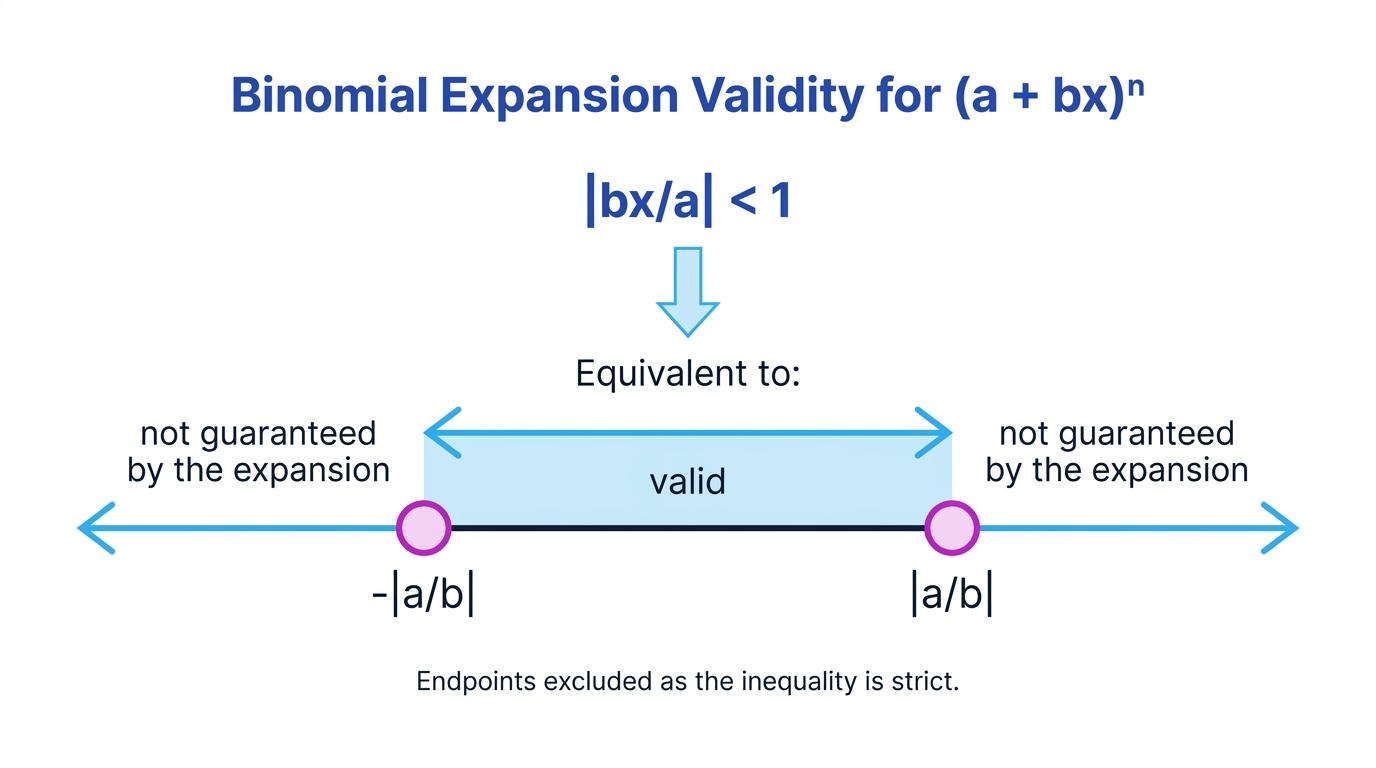
Using the unfactored term
For (a+bx)n(a+bx)^n(a+bx)n, the condition is not generally ∣bx∣<1|bx|<1∣bx∣<1. After factoring out aaa, the quantity replacing uuu is bxa\frac{bx}{a}abx, so the condition is ∣bxa∣<1\left|\frac{bx}{a}\right|<1abx<1.
Finding an interval of validity
Find the interval of validity of the binomial expansion of (2−3x)−12(2-3x)^{-\frac12}(2−3x)−21.
-
Factor out 2 so that the bracket begins with 1:
(2−3x)−12=2−12(1−32x)−12.(2-3x)^{-\frac12} = 2^{-\frac12}\left(1-\frac32x\right)^{-\frac12}.(2−3x)−21=2−21(1−23x)−21. -
Identify the expression replacing uuu:
u=−32x.u=-\frac32x.u=−23x. -
Apply the condition ∣u∣<1|u|<1∣u∣<1:
∣−32x∣<1.\left|-\frac32x\right|<1.−23x<1. -
Use ∣−32x∣=32∣x∣\left|-\frac32x\right|=\frac32|x|−23x=23∣x∣ and solve:
32∣x∣<1⇒∣x∣<23.\frac32|x|<1 \quad\Rightarrow\quad |x|<\frac23.23∣x∣<1⇒∣x∣<32. -
Hence the expansion is valid for
−23<x<23.-\frac23<x<\frac23.−32<x<32.
Expanding and stating validity together
A complete answer may require both the expansion and its interval of validity. The interval comes from the expression substituted for uuu, not from the number of terms you calculate.
Expanding with a validity condition
Expand (4+x)−1(4+x)^{-1}(4+x)−1 up to and including the term in x3x^3x3, and state the values of xxx for which the expansion is valid.
-
Factor out 4:
(4+x)−1=14(1+x4)−1.(4+x)^{-1} = \frac14\left(1+\frac{x}{4}\right)^{-1}.(4+x)−1=41(1+4x)−1. -
Use the expansion
(1+u)−1=1−u+u2−u3+⋯(1+u)^{-1}=1-u+u^2-u^3+\cdots(1+u)−1=1−u+u2−u3+⋯with u=x4u=\frac{x}{4}u=4x:
(4+x)−1=14(1−x4+x216−x364+⋯ ).(4+x)^{-1} = \frac14\left( 1-\frac{x}{4}+\frac{x^2}{16}-\frac{x^3}{64}+\cdots \right).(4+x)−1=41(1−4x+16x2−64x3+⋯). -
Multiply every term by 14\frac1441:
(4+x)−1=14−x16+x264−x3256+⋯(4+x)^{-1} = \frac14-\frac{x}{16}+\frac{x^2}{64}-\frac{x^3}{256}+\cdots(4+x)−1=41−16x+64x2−256x3+⋯ -
Apply the validity condition to u=x4u=\frac{x}{4}u=4x:
∣x4∣<1⇒∣x∣<4.\left|\frac{x}{4}\right|<1 \quad\Rightarrow\quad |x|<4.4x<1⇒∣x∣<4. -
Therefore, the stated expansion is valid for
−4<x<4.-4<x<4.−4<x<4.
A quick interval check
For an expansion centred at x=0x=0x=0, the interval obtained from ∣bxa∣<1\left|\frac{bx}{a}\right|<1abx<1 should be symmetric about zero.
Validity and approximation
Using only the first few terms of an infinite expansion gives a truncated series. This provides an approximation rather than an exact equality.
Values of xxx must lie inside the interval of validity. In general, the approximation is better when ∣bxa∣\left|\frac{bx}{a}\right|abx is small, because later powers then decrease rapidly.
Checking whether an approximation is valid
Suppose the expansion of (2−3x)−12(2-3x)^{-\frac12}(2−3x)−21 is used to estimate its value when x=12x=\frac12x=21.
-
The expansion is valid when
−23<x<23.-\frac23<x<\frac23.−32<x<32. -
Compare the proposed value with this interval:
−23<12<23.-\frac23<\frac12<\frac23.−32<21<32. -
Therefore, x=12x=\frac12x=21 lies inside the interval, so the infinite expansion is valid there. However,
∣−32⋅12∣=34,\left|-\frac32\cdot\frac12\right|=\frac34,−23⋅21=43,which is fairly close to 1. A short truncation may therefore converge less quickly than it would for a value of xxx nearer zero.
Inside the interval does not mean exact
The condition ∣bxa∣<1\left|\frac{bx}{a}\right|<1abx<1 guarantees convergence of the complete infinite series. If you retain only a few terms, your result is still an approximation.
In the exam
- Factor out the constant term so that the bracket is in the form (1+u)n(1+u)^n(1+u)n.
- Identify the whole expression corresponding to uuu, including its sign and any numerical factor.
- Apply ∣u∣<1|u|<1∣u∣<1, solve the inequality carefully, and exclude both endpoints.
- State the final answer as either an absolute-value inequality or an open interval.
- Check that the interval is symmetric about zero for an expression of the form (a+bx)n(a+bx)^n(a+bx)n.
Check yourself
- What expression replaces uuu when (5−2x)n(5-2x)^n(5−2x)n is written in the form 5n(1+u)n5^n(1+u)^n5n(1+u)n?
- For which values of xxx is the infinite binomial expansion of (3+4x)−12(3+4x)^{-\frac12}(3+4x)−21 valid?
- Why can a truncated binomial expansion be valid at a particular value of xxx but still give only an approximation?
