

What you'll learn
- What the natural logarithm lnx\ln xlnx means and how it is connected to exe^xex.
- How to recognise and sketch the graph of y=lnxy=\ln xy=lnx.
- How to use ln\lnln to evaluate expressions and solve exponential equations.
- How the logarithm laws apply to natural logarithms.
Prerequisite: logarithms as inverse operations
A logarithm tells you the power to which a base must be raised. For a positive base aaa, where a≠1a\neq 1a=1,
ay=x⟺logax=y.a^y=x \quad \Longleftrightarrow \quad \log_a x=y.ay=x⟺logax=y.For example, log28=3\log_2 8=3log28=3 because 23=82^3=823=8.
The word inverse means an operation or function that reverses another. Taking a logarithm to base aaa reverses raising aaa to a power.
Exponential and logarithmic forms
The statements ay=xa^y=xay=x and logax=y\log_a x=ylogax=y contain exactly the same information. You can switch between the two forms whenever it is useful.
Converting between logarithmic and exponential form
Express log5125=3\log_5 125=3log5125=3 in exponential form, and express e4=ke^4=ke4=k in logarithmic form.
- The equation log5125=3\log_5 125=3log5125=3 asks, “What power of 5 gives 125?” Therefore, its exponential form is 53=1255^3=12553=125.
- In e4=ke^4=ke4=k, the base is eee, the power is 4 and the result is kkk.
- Therefore, its logarithmic form is logek=4\log_e k=4logek=4, which is normally written as lnk=4\ln k=4lnk=4.
The number eee
The number eee is an important mathematical constant, approximately equal to 2.718. Like π\piπ, it is irrational, meaning that its decimal expansion continues forever without repeating.
The exponential function y=exy=e^xy=ex appears naturally in mathematical models involving continuous growth or decay. Its inverse function is the natural logarithm.
The natural logarithm
The natural logarithm of xxx, written lnx\ln xlnx, is the logarithm of xxx to base eee:
lnx=logex.\ln x=\log_e x.lnx=logex.Equivalently, lnx\ln xlnx is the power to which eee must be raised to obtain xxx.
For example:
ln1=0,lne=1,ln(e5)=5.\ln 1=0,\qquad \ln e=1,\qquad \ln(e^5)=5.ln1=0,lne=1,ln(e5)=5.These follow because e0=1e^0=1e0=1, e1=ee^1=ee1=e and e5=e5e^5=e^5e5=e5.
Reading the notation
The notation lnx\ln xlnx means “the natural logarithm of xxx”. It does not mean lll multiplied by nnn multiplied by xxx.
Inverse relationships
Because lnx\ln xlnx and exe^xex are inverse functions, each one reverses the other:
ln(ex)=x\ln(e^x)=xln(ex)=xfor every real value of xxx, and
elnx=xe^{\ln x}=xelnx=xfor x>0x>0x>0.
The condition x>0x>0x>0 is essential because lnx\ln xlnx is only defined for positive real inputs.
Using inverse functions
Simplify ln(e3t−2)\ln(e^{3t-2})ln(e3t−2) and eln7e^{\ln 7}eln7.
- In ln(e3t−2)\ln(e^{3t-2})ln(e3t−2), the natural logarithm directly reverses the exponential function.
- Therefore, ln(e3t−2)=3t−2\ln(e^{3t-2})=3t-2ln(e3t−2)=3t−2.
- Similarly, the exponential function reverses the natural logarithm, so eln7=7e^{\ln 7}=7eln7=7.
Order matters
The identity ln(ex)=x\ln(e^x)=xln(ex)=x does not mean that lnx=ex\ln x=e^xlnx=ex. The functions undo one another only when one is applied to the output of the other.
The graph of y=lnxy=\ln xy=lnx
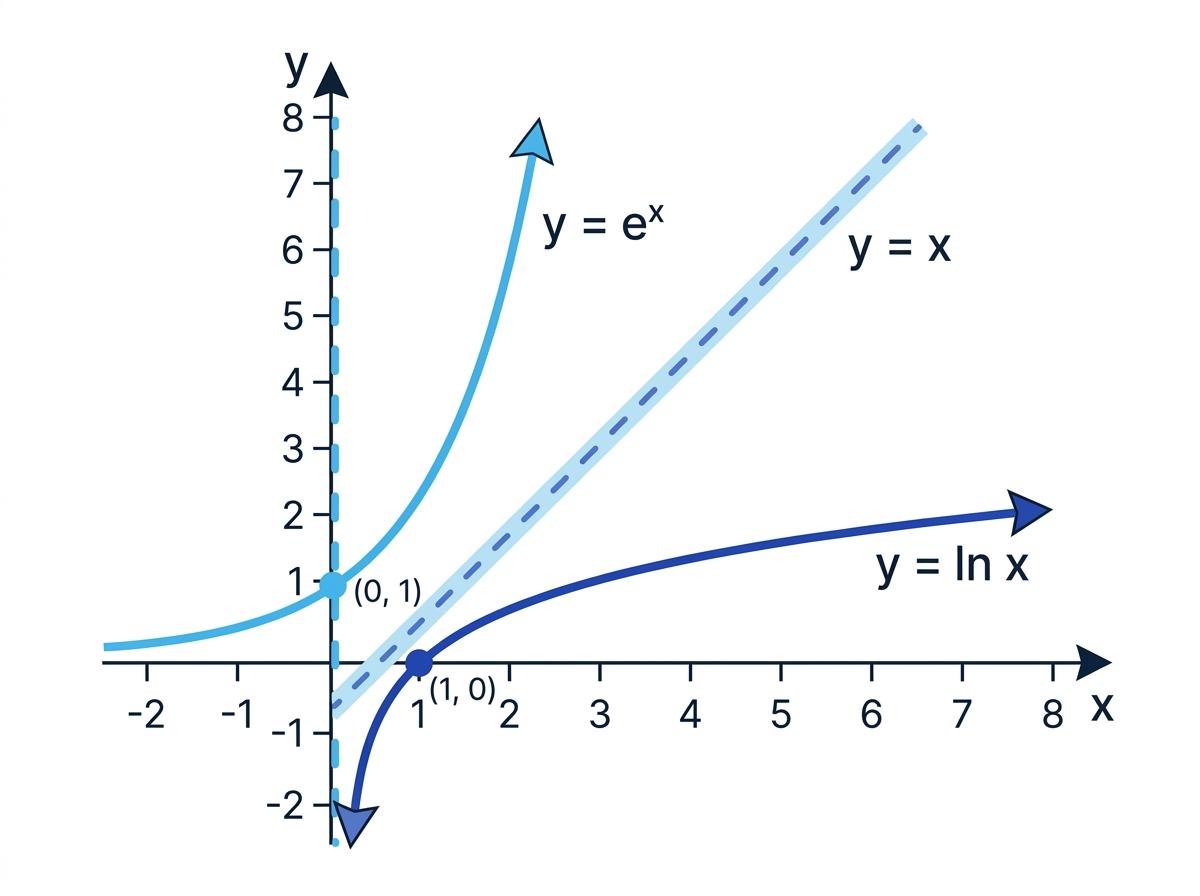
The graph of y=lnxy=\ln xy=lnx is the reflection of the graph of y=exy=e^xy=ex in the line y=xy=xy=x. This is a general property of the graphs of inverse functions: their input and output coordinates are exchanged.
For example, y=exy=e^xy=ex passes through (0,1)(0,1)(0,1), so y=lnxy=\ln xy=lnx passes through (1,0)(1,0)(1,0).
Domain and range
The domain of a function is the set of permitted input values. Since no real power of eee produces zero or a negative number, the domain of y=lnxy=\ln xy=lnx is
x>0.x>0.x>0.The range is the set of possible output values. Every real number can be an output of lnx\ln xlnx, so its range is
−∞<y<∞.-\infty<y<\infty.−∞<y<∞.Intercept and asymptote
The graph crosses the xxx-axis at (1,0)(1,0)(1,0) because ln1=0\ln 1=0ln1=0.
It has no yyy-intercept because x=0x=0x=0 is not in its domain.
The line x=0x=0x=0, which is the yyy-axis, is a vertical asymptote. An asymptote is a line that a curve approaches increasingly closely without meeting. In particular,
lnx→−∞as x→0+.\ln x\to-\infty \quad \text{as } x\to 0^+.lnx→−∞as x→0+.The notation x→0+x\to 0^+x→0+ means that xxx approaches zero through positive values.
Shape of the curve
The function lnx\ln xlnx is increasing throughout its domain: if xxx increases, then lnx\ln xlnx also increases. However, the graph becomes gradually less steep, so its rate of increase slows.
For large positive xxx, lnx\ln xlnx still increases, but very slowly. There is no horizontal asymptote.
Features of the logarithm graph
For y=lnxy=\ln xy=lnx:
- the domain is x>0x>0x>0;
- the range is all real numbers;
- the xxx-intercept is (1,0)(1,0)(1,0);
- there is no yyy-intercept;
- x=0x=0x=0 is a vertical asymptote;
- the curve is increasing but becomes less steep.
Sketching a natural logarithm graph
Sketch y=lnxy=\ln xy=lnx and mark its main features.
- Draw the vertical asymptote x=0x=0x=0 and keep the curve entirely to its right because the domain is x>0x>0x>0.
- Mark the exact point (1,0)(1,0)(1,0), where the graph crosses the xxx-axis.
- Draw an increasing curve that falls towards negative infinity as xxx approaches zero from the right, then rises increasingly slowly as xxx becomes large.
Evaluating natural logarithms
Some natural logarithms have exact values, especially when the input is a power of eee:
ln(ek)=k.\ln(e^k)=k.ln(ek)=k.For other positive inputs, use the ln\lnln button on your calculator. For example, ln10≈2.303\ln 10\approx 2.303ln10≈2.303 to three decimal places.
A calculator should be in the mode requested by the wider question, but degree or radian mode does not affect a direct logarithm calculation.
Evaluating a natural logarithm
Evaluate ln15\ln 15ln15 to three decimal places.
- Check that the input is positive, so the natural logarithm is defined.
- Enter ln(15)\ln(15)ln(15) into the calculator to obtain approximately 2.708050201.
- Round to three decimal places: ln15≈2.708\ln 15\approx 2.708ln15≈2.708.
Natural logarithm laws
Because lnx\ln xlnx is a logarithm, the standard logarithm laws apply. For positive aaa and bbb,
ln(ab)=lna+lnb,\ln(ab)=\ln a+\ln b,ln(ab)=lna+lnb, ln(ab)=lna−lnb,\ln\left(\frac{a}{b}\right)=\ln a-\ln b,ln(ba)=lna−lnb,and, for any real number kkk,
ln(ak)=klna.\ln(a^k)=k\ln a.ln(ak)=klna.Logarithms do not distribute over addition
In general, ln(a+b)≠lna+lnb\ln(a+b)\neq\ln a+\ln bln(a+b)=lna+lnb. The addition law applies when the arguments are multiplied: ln(ab)=lna+lnb\ln(ab)=\ln a+\ln bln(ab)=lna+lnb.
Simplifying a logarithmic expression
Simplify ln(3x2)−ln3\ln(3x^2)-\ln 3ln(3x2)−ln3, where x≠0x\neq 0x=0.
-
Apply the quotient law:
ln(3x2)−ln3=ln(3x23).\ln(3x^2)-\ln 3=\ln\left(\frac{3x^2}{3}\right).ln(3x2)−ln3=ln(33x2). -
Simplify the argument to obtain ln(x2)\ln(x^2)ln(x2).
-
Since x2>0x^2>0x2>0 when x≠0x\neq 0x=0, the logarithm is defined. The simplified expression is therefore ln(x2)\ln(x^2)ln(x2).
Solving equations using ln\lnln
Natural logarithms are especially useful when the unknown appears in the power of eee. Taking ln\lnln of both sides allows you to bring the exponent down.
Solving an exponential equation
Solve e2x−1=7e^{2x-1}=7e2x−1=7, giving your answer to three decimal places.
-
Take the natural logarithm of both sides:
ln(e2x−1)=ln7.\ln(e^{2x-1})=\ln 7.ln(e2x−1)=ln7. -
Use ln(eu)=u\ln(e^u)=uln(eu)=u to obtain 2x−1=ln72x-1=\ln 72x−1=ln7.
-
Rearrange:
x=1+ln72≈1.473.x=\frac{1+\ln 7}{2}\approx 1.473.x=21+ln7≈1.473.
Check solutions graphically
The solution of lnx=k\ln x=klnx=k is the xxx-coordinate where the horizontal line y=ky=ky=k meets y=lnxy=\ln xy=lnx. Since the logarithm graph is always increasing, there is exactly one such solution.
In the exam
- For a graph sketch, show the asymptote x=0x=0x=0, the intercept (1,0)(1,0)(1,0) and the correct increasing shape.
- Check that every input to ln\lnln is positive; reject values that make a logarithm’s argument zero or negative.
- Use exact forms such as ln7\ln 7ln7 unless the question asks for a decimal, and only round at the end.
Check yourself
- What are the domain, range, intercept and asymptote of y=lnxy=\ln xy=lnx?
- How would you solve e3x=11e^{3x}=11e3x=11 using natural logarithms?
- Why is ln(−2)\ln(-2)ln(−2) not defined as a real number?
