

What you'll learn
- What modulus notation means and how to evaluate expressions involving it.
- How to sketch modulus graphs using reflection and transformations.
- How to solve equations involving one or more modulus expressions.
- How to interpret and solve modulus inequalities using distance and algebra.
Modulus as distance
The modulus or absolute value of a real number is its distance from zero on the number line. Distance cannot be negative, so modulus always produces a non-negative answer.
For example, 5 and −5-5−5 are both 5 units from zero. Therefore:
∣5∣=5and∣−5∣=5|5|=5 \qquad\text{and}\qquad |-5|=5∣5∣=5and∣−5∣=5The vertical bars in ∣x∣|x|∣x∣ are modulus signs, not brackets.
The modulus function
For any real number xxx,
∣x∣={x,x≥0,−x,x<0.|x|= \begin{cases} x, & x\ge 0,\\ -x, & x<0. \end{cases}∣x∣={x,−x,x≥0,x<0.In particular, ∣x∣≥0|x|\ge 0∣x∣≥0 for every real value of xxx.
The second part of the definition can seem surprising. If xxx is negative, then −x-x−x is positive. For example, if x=−7x=-7x=−7, then −x=7-x=7−x=7.
Evaluating modulus expressions
Evaluate ∣3−8∣+∣−4∣|3-8|+|-4|∣3−8∣+∣−4∣.
- Calculate the expressions inside the modulus signs: 3−8=−53-8=-53−8=−5, while the second value is already −4-4−4.
- Take each distance from zero: ∣−5∣=5|-5|=5∣−5∣=5 and ∣−4∣=4|-4|=4∣−4∣=4.
- Add the resulting non-negative values to obtain 5+4=95+4=95+4=9.
Treating modulus signs as brackets
You cannot simply remove modulus signs. For instance, ∣−3∣=3|-3|=3∣−3∣=3, not −3-3−3. Evaluate the expression inside first, then apply the modulus.
The graph of the modulus function
The graph of y=∣x∣y=|x|y=∣x∣ is made from two straight-line pieces:
- when x≥0x\ge 0x≥0, it follows y=xy=xy=x;
- when x<0x<0x<0, it follows y=−xy=-xy=−x.
These pieces meet at the vertex, meaning the point where the graph changes direction, at (0,0)(0,0)(0,0). The result is a V-shaped graph.
You can obtain it from y=xy=xy=x by reflecting the part below the xxx-axis upwards. More generally, the graph of y=∣f(x)∣y=|f(x)|y=∣f(x)∣ is formed by keeping the parts of y=f(x)y=f(x)y=f(x) on or above the xxx-axis and reflecting every part below the xxx-axis in the xxx-axis.
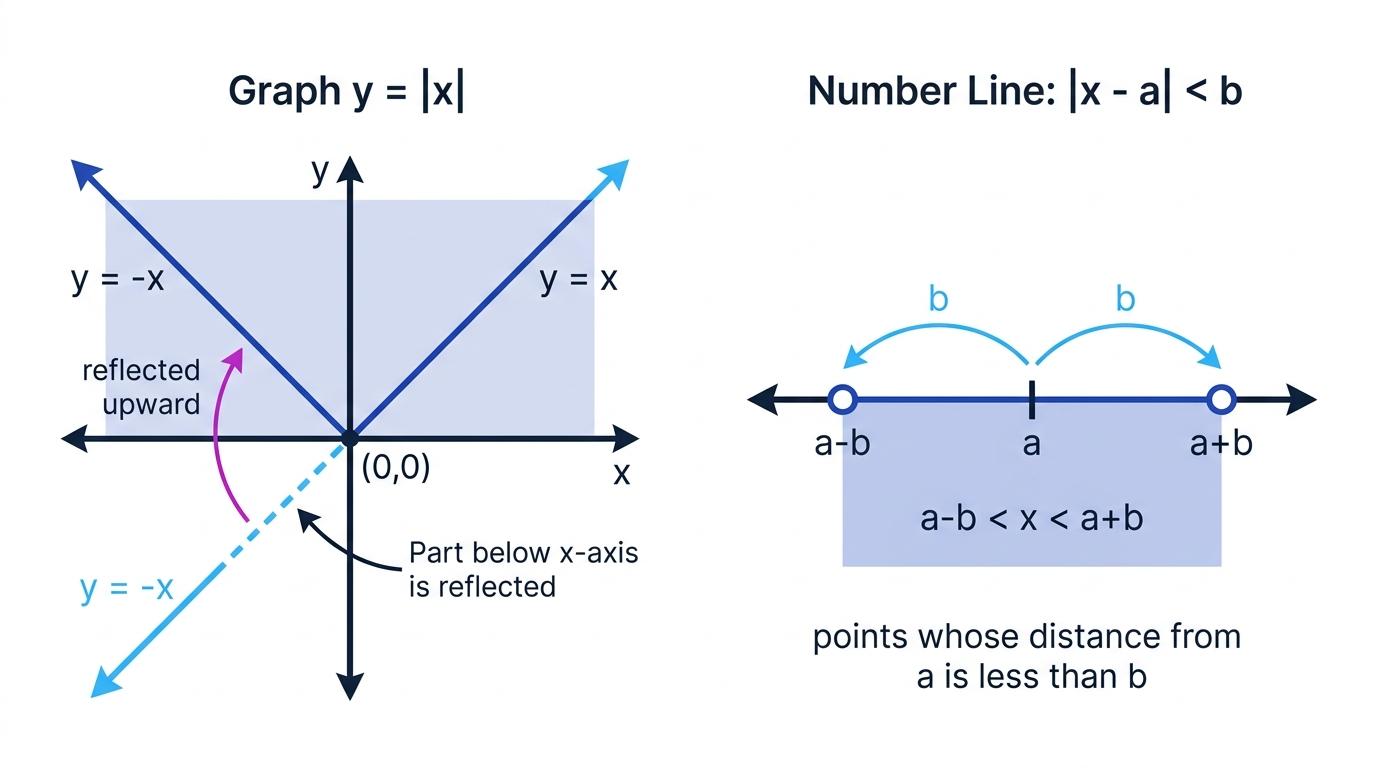
Modulus reflects negative outputs
To sketch y=∣f(x)∣y=|f(x)|y=∣f(x)∣, leave every point with f(x)≥0f(x)\ge 0f(x)≥0 unchanged and replace every negative output by its positive counterpart. The xxx-coordinates do not change.
Sketching a transformed modulus graph
Sketch y=∣x−2∣+1y=|x-2|+1y=∣x−2∣+1 and identify its vertex.
- Begin with y=∣x∣y=|x|y=∣x∣, whose vertex is (0,0)(0,0)(0,0).
- Replacing xxx by x−2x-2x−2 translates the graph 2 units to the right, moving the vertex to (2,0)(2,0)(2,0).
- Adding 1 translates the graph 1 unit upwards, so the final vertex is (2,1)(2,1)(2,1). The graph remains V-shaped, with gradients −1-1−1 and 1 on its two branches.
Check the vertex
For y=∣x−a∣+cy=|x-a|+cy=∣x−a∣+c, the expression inside the modulus is zero when x=ax=ax=a. The vertex is therefore (a,c)(a,c)(a,c).
Equations of the form ∣f(x)∣=k|f(x)|=k∣f(x)∣=k
If k>0k>0k>0, the equation ∣f(x)∣=k|f(x)|=k∣f(x)∣=k says that f(x)f(x)f(x) is a distance kkk from zero. There are therefore two possibilities:
f(x)=korf(x)=−kf(x)=k \qquad\text{or}\qquad f(x)=-kf(x)=korf(x)=−kIf k=0k=0k=0, there is only one condition: f(x)=0f(x)=0f(x)=0. If k<0k<0k<0, there are no real solutions because a modulus cannot be negative.
Solving a linear modulus equation
Solve ∣2x−3∣=7|2x-3|=7∣2x−3∣=7.
-
Split the equation into the two possible cases:
2x−3=7or2x−3=−72x-3=7 \qquad\text{or}\qquad 2x-3=-72x−3=7or2x−3=−7 -
Solve the first equation: 2x=102x=102x=10, so x=5x=5x=5.
-
Solve the second equation: 2x=−42x=-42x=−4, so x=−2x=-2x=−2. Both values satisfy the original equation, so the solution set is x=5x=5x=5 or x=−2x=-2x=−2.
The relation ∣a∣=∣b∣|a|=|b|∣a∣=∣b∣
Two numbers have equal modulus precisely when they have the same square:
∣a∣=∣b∣⟺a2=b2|a|=|b| \quad\Longleftrightarrow\quad a^2=b^2∣a∣=∣b∣⟺a2=b2The symbol ⟺\Longleftrightarrow⟺ means if and only if, often shortened to “iff”. It says that each statement implies the other.
This relation works because squaring, like modulus, removes the sign. Equivalently:
a2=b2⇒(a−b)(a+b)=0⇒a=b or a=−ba^2=b^2 \Rightarrow (a-b)(a+b)=0 \Rightarrow a=b\text{ or }a=-ba2=b2⇒(a−b)(a+b)=0⇒a=b or a=−bSolving an equation with modulus on both sides
Solve ∣2x−1∣=∣x+5∣|2x-1|=|x+5|∣2x−1∣=∣x+5∣.
-
Use ∣a∣=∣b∣|a|=|b|∣a∣=∣b∣ iff a2=b2a^2=b^2a2=b2:
(2x−1)2=(x+5)2(2x-1)^2=(x+5)^2(2x−1)2=(x+5)2 -
Use the difference of two squares:
((2x−1)−(x+5))((2x−1)+(x+5))=0\big((2x-1)-(x+5)\big)\big((2x-1)+(x+5)\big)=0((2x−1)−(x+5))((2x−1)+(x+5))=0This simplifies to (x−6)(3x+4)=0(x-6)(3x+4)=0(x−6)(3x+4)=0.
-
Set each factor equal to zero, giving x=6x=6x=6 or x=−43x=-\frac{4}{3}x=−34.
A quicker equivalent method
From ∣f(x)∣=∣g(x)∣|f(x)|=|g(x)|∣f(x)∣=∣g(x)∣, you may write f(x)=g(x)f(x)=g(x)f(x)=g(x) or f(x)=−g(x)f(x)=-g(x)f(x)=−g(x). This is equivalent to squaring both sides and often reduces the algebra.
Modulus inequalities as distances
The expression ∣x−a∣|x-a|∣x−a∣ is the distance between xxx and aaa on a number line.
Therefore, ∣x−a∣<b|x-a|<b∣x−a∣<b means that xxx is less than bbb units away from aaa. Provided b>0b>0b>0:
∣x−a∣<b⟺a−b<x<a+b|x-a|<b \quad\Longleftrightarrow\quad a-b<x<a+b∣x−a∣<b⟺a−b<x<a+bThe solution is the open interval centred at a‘,extendinga`, extending a‘,extendingb$ units in each direction. The endpoints are excluded because the inequality is strict.
Similarly:
∣x−a∣≤b⟺a−b≤x≤a+b|x-a|\le b \quad\Longleftrightarrow\quad a-b\le x\le a+b∣x−a∣≤b⟺a−b≤x≤a+bSolving a modulus inequality using distance
Solve ∣x−4∣<3|x-4|<3∣x−4∣<3.
- Interpret the expression as the distance between xxx and 4. This distance must be less than 3.
- Move 3 units to either side of the centre 4: the endpoints are 4−3=14-3=14−3=1 and 4+3=74+3=74+3=7.
- Since the inequality is strict, exclude both endpoints. The solution is 1<x<71<x<71<x<7.
You can also apply the standard result after rearranging a linear expression.
Rearranging a linear modulus inequality
Solve ∣2x−5∣≤7|2x-5|\le 7∣2x−5∣≤7.
-
Rewrite the modulus inequality as a compound inequality:
−7≤2x−5≤7-7\le 2x-5\le 7−7≤2x−5≤7 -
Add 5 to all three parts:
−2≤2x≤12-2\le 2x\le 12−2≤2x≤12 -
Divide all three parts by 2 to obtain −1≤x≤6-1\le x\le 6−1≤x≤6.
Inequalities outside an interval
If ∣x−a∣>b|x-a|>b∣x−a∣>b, then the distance between xxx and aaa is greater than bbb. The solutions lie outside the interval:
∣x−a∣>b⟺x<a−borx>a+b|x-a|>b \quad\Longleftrightarrow\quad x<a-b \quad\text{or}\quad x>a+b∣x−a∣>b⟺x<a−borx>a+bFor ≥\ge≥, include the endpoints.
Inside or outside
For positive bbb, “less than” gives values between a−ba-ba−b and $a+b`, while “greater than” gives values outside those boundaries.
Solving an outside-interval inequality
Solve ∣3x+1∣≥5|3x+1|\ge 5∣3x+1∣≥5.
-
A modulus is at least 5 when its contents are at least 5 or at most −5-5−5:
3x+1≥5or3x+1≤−53x+1\ge 5 \qquad\text{or}\qquad 3x+1\le -53x+1≥5or3x+1≤−5 -
Solve the first inequality: 3x≥43x\ge 43x≥4, so x≥43x\ge\frac{4}{3}x≥34.
-
Solve the second inequality: 3x≤−63x\le-63x≤−6, so x≤−2x\le-2x≤−2. Hence x≤−2x\le-2x≤−2 or x≥43x\ge\frac{4}{3}x≥34.
Check the right-hand side
The usual interval rules assume b>0b>0b>0. If the right-hand side is zero or negative, reason from ∣f(x)∣≥0|f(x)|\ge 0∣f(x)∣≥0 instead of applying the rule automatically.
Using and instead of or
A greater-than modulus inequality normally produces two separate regions, joined by or. A value cannot usually lie to the left and right of the interval at the same time.
In the exam
- Interpret modulus as distance, then decide whether the solution should lie inside an interval or outside it.
- For equations, include both sign possibilities and substitute solutions back when you have squared or performed non-reversible algebra.
- Show endpoint inclusion clearly: use <<< or >>> with open endpoints, and ≤\le≤ or ≥\ge≥ with included endpoints.
- Check that your answer is possible: a modulus can never equal or be less than a negative number.
Check yourself
- How would you sketch y=∣x+3∣−2y=|x+3|-2y=∣x+3∣−2, and where is its vertex?
- Can you solve ∣4x−1∣=∣x+8∣|4x-1|=|x+8|∣4x−1∣=∣x+8∣ using both the squaring method and the two-case method?
- What is the difference between the solution sets of ∣x−5∣<2|x-5|<2∣x−5∣<2 and ∣x−5∣>2|x-5|>2∣x−5∣>2?
