

What you'll learn
- How to solve quadratic equations by factorising, completing the square, and using the quadratic formula.
- How the discriminant tells you how many real roots a quadratic has.
- How to recognise and solve equations that are quadratic in a function of the unknown.
- How to check solutions and choose an efficient method.
Recognising a quadratic equation
A quadratic equation can be written in the form
ax2+bx+c=0,ax^2+bx+c=0,ax2+bx+c=0,where aaa, bbb, and ccc are constants and a≠0a\neq 0a=0.
The highest power of the unknown is 2. Before applying a standard solving method, rearrange the equation so that one side is zero.
Roots
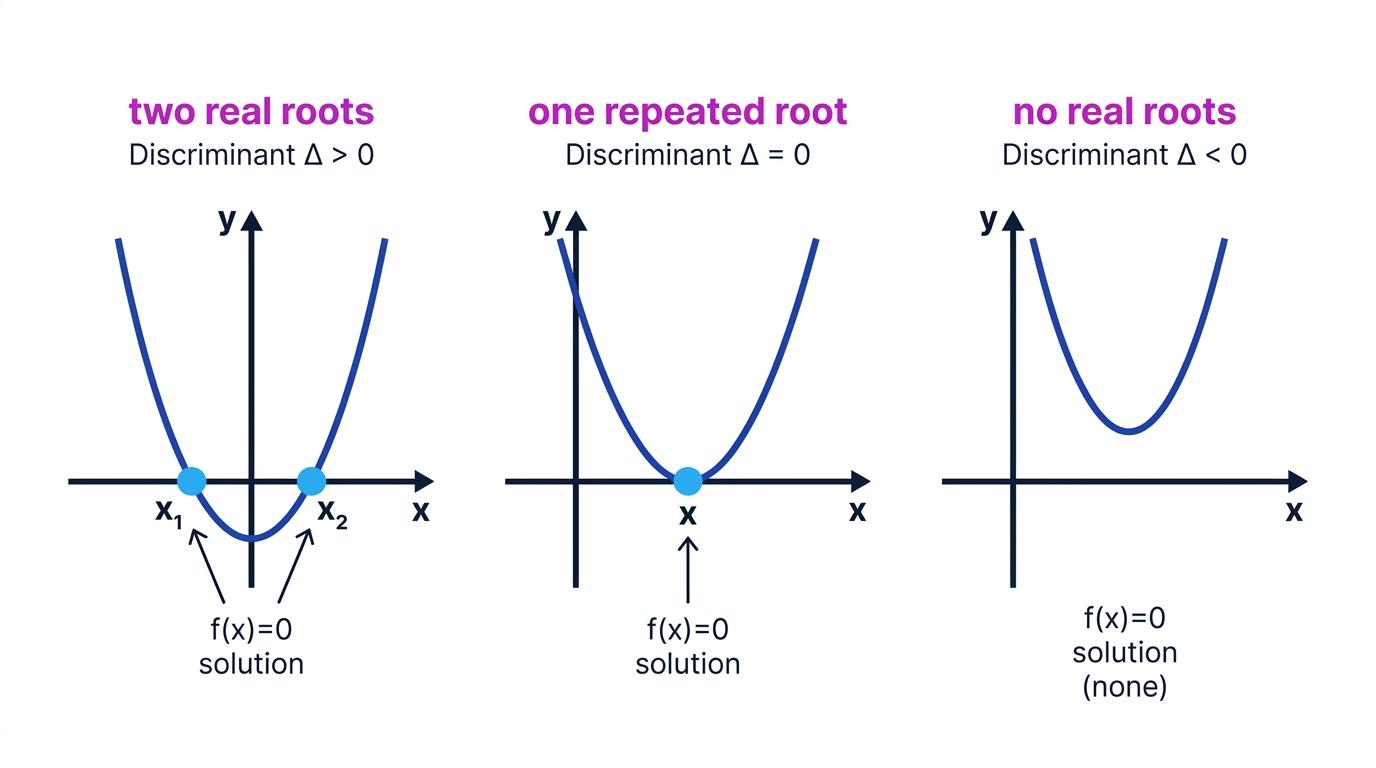
The roots, or solutions, of an equation are the values of the unknown that make the equation true. On the graph y=ax2+bx+cy=ax^2+bx+cy=ax2+bx+c, real roots are the xxx-coordinates where the curve meets the xxx-axis.
For example, x2=5x−6x^2=5x-6x2=5x−6 should first be rearranged to
x2−5x+6=0.x^2-5x+6=0.x2−5x+6=0.A quadratic may have two distinct real roots, one repeated real root, or no real roots.
Solving by factorising
Factorising is usually the quickest method when the quadratic splits into simple linear factors.
This method uses the zero-product property: if pq=0pq=0pq=0, then p=0p=0p=0 or q=0q=0q=0.
Factorise only when one side is zero
You can conclude that either factor is zero only when their product equals zero. Rearrange the equation before factorising.
Solving a quadratic by factorising
Solve 2x2−7x+3=02x^2-7x+3=02x2−7x+3=0.
-
To factorise, find two terms whose product is 2x2⋅3=6x22x^2\cdot 3=6x^22x2⋅3=6x2 and whose sum is −7x-7x−7x. These are −6x-6x−6x and −x-x−x:
2x2−6x−x+3=0.2x^2-6x-x+3=0.2x2−6x−x+3=0. -
Factorise by grouping:
2x(x−3)−1(x−3)=0,(2x−1)(x−3)=0.\begin{aligned} 2x(x-3)-1(x-3)&=0,\\ (2x-1)(x-3)&=0. \end{aligned}2x(x−3)−1(x−3)(2x−1)(x−3)=0,=0. -
Apply the zero-product property:
2x−1=0orx−3=0.2x-1=0 \quad \text{or} \quad x-3=0.2x−1=0orx−3=0. -
Solve each linear equation:
x=12orx=3.x=\frac12 \quad \text{or} \quad x=3.x=21orx=3.
Losing one of the roots
A quadratic can have two solutions. After factorising, set each linear factor equal to zero.
Solving by completing the square
To complete the square means rewriting a quadratic using a squared bracket. For a monic quadratic, whose coefficient of x2x^2x2 is 1,
x2+bx=(x+b2)2−(b2)2.x^2+bx=\left(x+\frac b2\right)^2-\left(\frac b2\right)^2.x2+bx=(x+2b)2−(2b)2.Completing the square is useful when factorisation is not obvious. It also reveals the turning point of the corresponding quadratic graph.
Solving by completing the square
Solve x2+6x+1=0x^2+6x+1=0x2+6x+1=0, giving exact answers.
-
Take half the coefficient of xxx, which is 3, and complete the square:
x2+6x+1=(x+3)2−9+1=(x+3)2−8.x^2+6x+1=(x+3)^2-9+1=(x+3)^2-8.x2+6x+1=(x+3)2−9+1=(x+3)2−8. -
Set the completed-square form equal to zero and isolate the square:
(x+3)2−8=0,(x+3)2=8.\begin{aligned} (x+3)^2-8&=0,\\ (x+3)^2&=8. \end{aligned}(x+3)2−8(x+3)2=0,=8. -
Take both the positive and negative square roots:
x+3=±8=±22.x+3=\pm\sqrt8=\pm 2\sqrt2.x+3=±8=±22. -
Subtract 3:
x=−3±22.x=-3\pm 2\sqrt2.x=−3±22.
Forgetting the negative square root
From u2=ku^2=ku2=k, you need u=±ku=\pm\sqrt{k}u=±k when k>0k>0k>0. Using only the positive square root loses a solution.
The quadratic formula
Every quadratic equation ax2+bx+c=0ax^2+bx+c=0ax2+bx+c=0, where a≠0a\neq 0a=0, can be solved using the quadratic formula:
x=−b±b2−4ac2a.x=\frac{-b\pm\sqrt{b^2-4ac}}{2a}.x=2a−b±b2−4ac.This is especially useful when the quadratic does not factorise easily.
Substitute coefficients with their signs
Write down aaa, bbb, and ccc before substituting. If a coefficient is negative, keep it in brackets during the calculation.
Using the quadratic formula
Solve 3x2+2x−7=03x^2+2x-7=03x2+2x−7=0, giving exact answers.
-
Identify the coefficients:
a=3,b=2,c=−7.a=3,\qquad b=2,\qquad c=-7.a=3,b=2,c=−7. -
Substitute them into the formula:
x=−2±22−4(3)(−7)2(3).x=\frac{-2\pm\sqrt{2^2-4(3)(-7)}}{2(3)}.x=2(3)−2±22−4(3)(−7). -
Simplify the expression under the square root:
22−4(3)(−7)=4+84=88.2^2-4(3)(-7)=4+84=88.22−4(3)(−7)=4+84=88. -
Simplify the surd and the resulting fraction:
x=−2±886=−2±2226=−1±223.\begin{aligned} x&=\frac{-2\pm\sqrt{88}}6\\ &=\frac{-2\pm 2\sqrt{22}}6\\ &=\frac{-1\pm\sqrt{22}}3. \end{aligned}x=6−2±88=6−2±222=3−1±22.
Unless a decimal answer is requested, leave irrational solutions in exact surd form.
The discriminant and the number of roots
The expression inside the square root in the quadratic formula is called the discriminant.
Discriminant
For ax2+bx+c=0ax^2+bx+c=0ax2+bx+c=0, the discriminant is
Δ=b2−4ac.\Delta=b^2-4ac.Δ=b2−4ac.Its sign determines the number of real roots.
- If Δ>0\Delta>0Δ>0, there are two distinct real roots.
- If Δ=0\Delta=0Δ=0, there is one repeated real root.
- If Δ<0\Delta<0Δ<0, there are no real roots.
A repeated root occurs when both solutions have the same value. Graphically, the parabola touches the xxx-axis at its turning point.
Determining the number of real roots
Determine the number of real roots of x2−4x+7=0x^2-4x+7=0x2−4x+7=0.
-
Identify a=1a=1a=1, b=−4b=-4b=−4, and c=7c=7c=7.
-
Calculate the discriminant:
Δ=(−4)2−4(1)(7)=16−28=−12.\begin{aligned} \Delta&=(-4)^2-4(1)(7)\\ &=16-28\\ &=-12. \end{aligned}Δ=(−4)2−4(1)(7)=16−28=−12. -
Since Δ<0\Delta<0Δ<0, the equation has no real roots. The corresponding graph does not meet the xxx-axis.
Squaring a negative coefficient
If b=−4b=-4b=−4, then b2=(−4)2=16b^2=(-4)^2=16b2=(−4)2=16, not −16-16−16. Use brackets when substituting a negative value.
Quadratics in a function of the unknown
Some equations do not initially look quadratic because the repeated expression is more complicated than xxx. They may still have the structure
A[f(x)]2+Bf(x)+C=0.A[f(x)]^2+Bf(x)+C=0.A[f(x)]2+Bf(x)+C=0.This is called an equation quadratic in a function of the unknown. Temporarily substitute u=f(x)u=f(x)u=f(x), solve the quadratic in uuu, and then return to the original unknown.
Common disguised quadratics include equations involving x4x^4x4 and x2x^2x2, or two powers such as 32x3^{2x}32x and 3x3^x3x.
Spot the repeated expression
Look for one expression and its square. For example, x4x^4x4 is the square of x2x^2x2, while (x+1)4(x+1)^4(x+1)4 is the square of (x+1)2(x+1)^2(x+1)2.
Solving a disguised quadratic
Solve
(x+1)4−5(x+1)2+4=0.(x+1)^4-5(x+1)^2+4=0.(x+1)4−5(x+1)2+4=0.-
The equation is quadratic in (x+1)2(x+1)^2(x+1)2. Let
u=(x+1)2.u=(x+1)^2.u=(x+1)2.Then (x+1)4=u2(x+1)^4=u^2(x+1)4=u2, so the equation becomes
u2−5u+4=0.u^2-5u+4=0.u2−5u+4=0. -
Factorise and solve the quadratic in uuu:
(u−1)(u−4)=0,u=1oru=4.\begin{aligned} (u-1)(u-4)&=0,\\ u&=1 \quad \text{or} \quad u=4. \end{aligned}(u−1)(u−4)u=0,=1oru=4. -
Replace uuu with (x+1)2(x+1)^2(x+1)2:
(x+1)2=1or(x+1)2=4.(x+1)^2=1 \quad \text{or} \quad (x+1)^2=4.(x+1)2=1or(x+1)2=4. -
Solve both resulting equations, including positive and negative square roots:
x+1=±1⇒x=0 or x=−2,x+1=±2⇒x=1 or x=−3.\begin{aligned} x+1&=\pm 1 &&\Rightarrow x=0\text{ or }x=-2,\\ x+1&=\pm 2 &&\Rightarrow x=1\text{ or }x=-3. \end{aligned}x+1x+1=±1=±2⇒x=0 or x=−2,⇒x=1 or x=−3. -
Therefore, the four solutions are
x=−3, −2, 0, 1.x=-3,\,-2,\,0,\,1.x=−3,−2,0,1.
Check the range of your substitution
A substituted variable may have restrictions. If u=x2u=x^2u=x2, then u≥0u\geq 0u≥0, so any negative solution for uuu must be rejected before returning to xxx.
Checking your solutions
You can check an exact solution by substituting it into the original equation. For decimal solutions, substitution may give a value close to zero because of rounding.
A graphing calculator can also provide a useful check: the calculated roots should match the xxx-intercepts. However, your written solution must still show the required algebra.
In the exam
- Rearrange the equation into the form ax2+bx+c=0ax^2+bx+c=0ax2+bx+c=0 before choosing a method.
- Try factorising first when integer factors look likely; otherwise use completing the square or the quadratic formula.
- For a disguised quadratic, state your substitution clearly and remember to solve back in terms of the original unknown.
- Keep exact values unless the question requests decimals, and check that you have included every possible root.
Check yourself
- Can you solve 6x2−x−2=06x^2-x-2=06x2−x−2=0 by factorising?
- What does b2−4ac=0b^2-4ac=0b2−4ac=0 tell you about the roots and the graph?
- How would you begin solving x6−7x3+12=0x^6-7x^3+12=0x6−7x3+12=0?
