

What you'll learn
- What it means to solve two equations simultaneously.
- How to solve two linear equations using elimination and substitution.
- How to solve a system containing one linear and one quadratic equation.
- How to check solutions and interpret them as intersections of graphs.
What are simultaneous equations?
A pair of simultaneous equations consists of two equations involving the same variables. You must find values of the variables that satisfy both equations at the same time.
For example,
x+y=7,x−y=1\begin{aligned} x+y&=7,\\ x-y&=1 \end{aligned}x+yx−y=7,=1has the solution x=4x=4x=4 and y=3y=3y=3, because these values make both equations true.
Solution of simultaneous equations
A solution is an ordered pair (x,y)(x,y)(x,y) that satisfies every equation in the system.
The graphical meaning
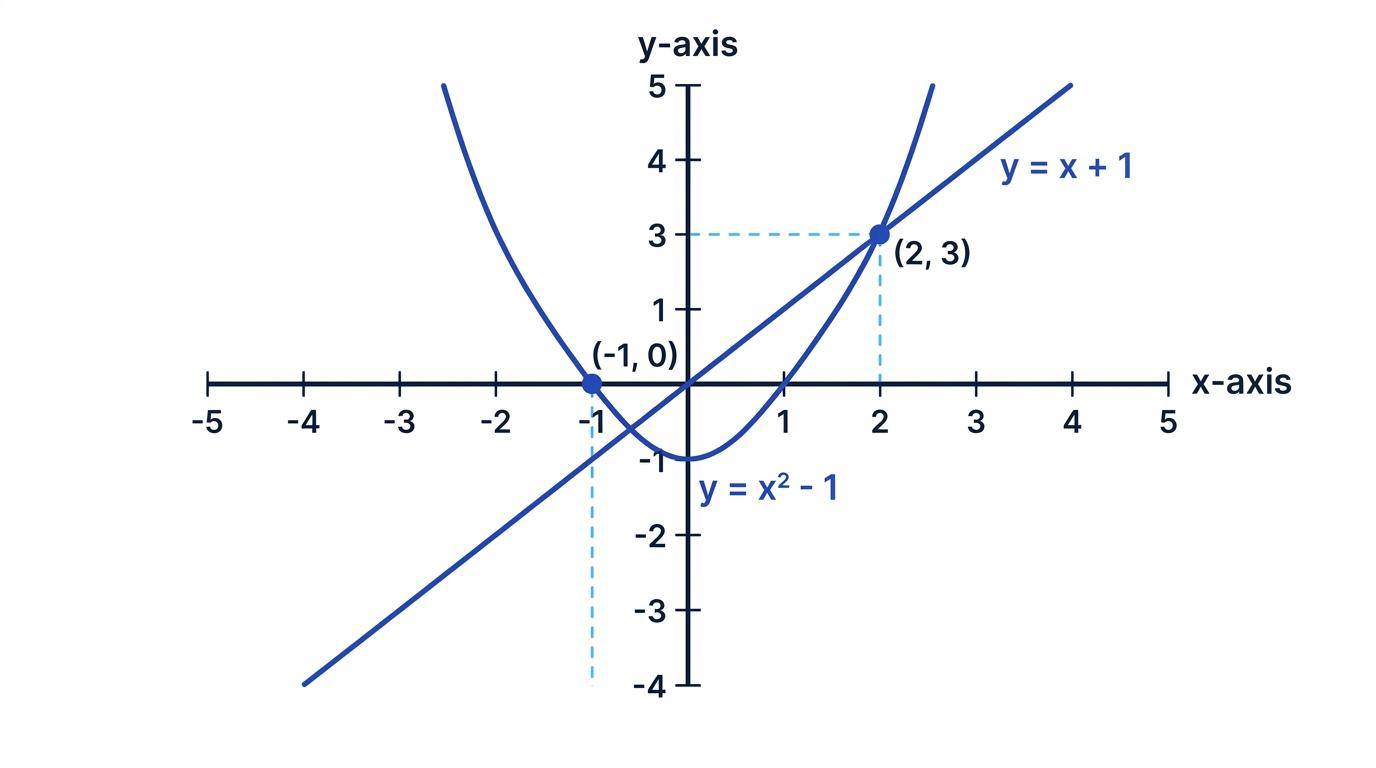
Each equation in two variables represents a graph. A simultaneous solution is therefore a point where the graphs intersect.
- Two distinct straight lines usually meet once, giving one solution.
- Parallel straight lines do not meet, giving no solutions.
- Identical straight lines have infinitely many points in common.
- A straight line and a quadratic curve can meet at zero, one or two points.
The graph below shows the line y=x+1y=x+1y=x+1 intersecting the parabola y=x2−1y=x^2-1y=x2−1 at (−1,0)(-1,0)(−1,0) and (2,3)(2,3)(2,3).
Equations as intersections
Solving simultaneous equations algebraically means finding the coordinates of every intersection of their graphs.
Prerequisite: rearranging equations
Before using substitution, you need to be able to make one variable the subject of an equation. The subject is the variable written alone on one side.
For example, rearranging 3x+2y=113x+2y=113x+2y=11 to make yyy the subject gives
y=11−3x2.y=\frac{11-3x}{2}.y=211−3x.Whatever operation you apply to one side of an equation must also be applied to the other side.
Making a variable the subject
Make xxx the subject of 4x−3y=104x-3y=104x−3y=10.
-
Add 3y3y3y to both sides to isolate the term containing xxx:
4x=10+3y.4x=10+3y.4x=10+3y. -
Divide every term by 4:
x=10+3y4.x=\frac{10+3y}{4}.x=410+3y.
Solving linear equations by elimination
A linear equation contains variables only to the first power. Its graph is a straight line.
The elimination method combines the equations so that one variable disappears. You can add or subtract equations, provided the eliminated variable has equal or opposite coefficients.
Coefficient
A coefficient is the numerical factor multiplying a variable. In 5x−2y=95x-2y=95x−2y=9, the coefficients of xxx and yyy are 5 and −2-2−2 respectively.
When the coefficients already match
If one variable has equal coefficients with the same sign, subtract the equations. If it has opposite coefficients, add the equations.
Eliminating a variable directly
Solve
3x+2y=16,x+2y=8.\begin{aligned} 3x+2y&=16,\\ x+2y&=8. \end{aligned}3x+2yx+2y=16,=8.-
The coefficients of yyy are equal, so subtract the second equation from the first:
(3x+2y)−(x+2y)=16−8,(3x+2y)-(x+2y)=16-8,(3x+2y)−(x+2y)=16−8,giving 2x=82x=82x=8, so x=4x=4x=4.
-
Substitute x=4x=4x=4 into one of the original equations:
4+2y=8.4+2y=8.4+2y=8.Hence 2y=42y=42y=4, so y=2y=2y=2.
-
Check both equations:
3(4)+2(2)=163(4)+2(2)=163(4)+2(2)=16and
4+2(2)=8.4+2(2)=8.4+2(2)=8.Therefore the solution is (4,2)(4,2)(4,2).
When the coefficients do not match
You may multiply one or both equations by a constant to create matching coefficients. You must multiply every term in the equation.
Creating equal coefficients
Solve
2x+3y=12,5x−2y=11.\begin{aligned} 2x+3y&=12,\\ 5x-2y&=11. \end{aligned}2x+3y5x−2y=12,=11.-
The lowest convenient matching coefficients of yyy are 6 and −6-6−6. Multiply the first equation by 2 and the second by 3:
4x+6y=24,15x−6y=33.\begin{aligned} 4x+6y&=24,\\ 15x-6y&=33. \end{aligned}4x+6y15x−6y=24,=33. -
Add the new equations. The yyy terms cancel:
19x=57,19x=57,19x=57,so x=3x=3x=3.
-
Substitute x=3x=3x=3 into 2x+3y=122x+3y=122x+3y=12:
6+3y=12,6+3y=12,6+3y=12,so y=2y=2y=2. The solution is (3,2)(3,2)(3,2).
Multiplying only part of an equation
When scaling an equation, multiply every term on both sides. For example, multiplying 2x+3y=122x+3y=122x+3y=12 by 2 gives 4x+6y=244x+6y=244x+6y=24, not 4x+3y=244x+3y=244x+3y=24.
Choose the easier variable
Look for coefficients that are already equal, opposite, or have a small common multiple. This reduces arithmetic and the chance of an error.
Solving linear equations by substitution
The substitution method involves expressing one variable in terms of the other, then replacing that variable in the second equation.
It is particularly efficient when a variable is already isolated, such as y=2x−5y=2x-5y=2x−5, or has coefficient 1 or −1-1−1.
Substituting a linear expression
Solve
y=3x−4,2x+y=11.\begin{aligned} y&=3x-4,\\ 2x+y&=11. \end{aligned}y2x+y=3x−4,=11.-
Replace yyy in the second equation with 3x−43x-43x−4:
2x+(3x−4)=11.2x+(3x-4)=11.2x+(3x−4)=11. -
Solve the resulting equation in xxx:
5x−4=11⇒5x=15⇒x=3.5x-4=11 \Rightarrow 5x=15 \Rightarrow x=3.5x−4=11⇒5x=15⇒x=3. -
Use y=3x−4y=3x-4y=3x−4 to find the other variable:
y=3(3)−4=5.y=3(3)-4=5.y=3(3)−4=5.Therefore the solution is (3,5)(3,5)(3,5).
Missing brackets during substitution
If you substitute a multi-term expression into an equation, put it in brackets first. For example, replacing yyy with 3x−43x-43x−4 in 2y2y2y gives 2(3x−4)2(3x-4)2(3x−4), so both terms are multiplied by 2.
Choosing between elimination and substitution
For two linear equations, either method can produce the same solution.
- Use elimination when coefficients match easily.
- Use substitution when one variable is already isolated or can be isolated simply.
- If fractions appear immediately under one method, consider whether the other will be cleaner.
Method choice
The best method is usually the one that keeps the algebra simple. You are not required to use the same method for every pair of equations.
One linear and one quadratic equation
A quadratic equation contains a squared variable, such as x2x^2x2. When one equation is linear and the other is quadratic, substitution is normally the most direct method.
The standard process is:
- Rearrange the linear equation to make one variable the subject.
- Substitute that expression into the quadratic equation.
- Solve the resulting quadratic.
- Substitute each possible value back to find the matching value of the other variable.
Because a line can intersect a quadratic curve twice, you must usually expect up to two solutions.
Finding two line–curve intersections
Solve
y=x+1,y=x2−1.\begin{aligned} y&=x+1,\\ y&=x^2-1. \end{aligned}yy=x+1,=x2−1.-
Both expressions equal yyy, so set them equal:
x+1=x2−1.x+1=x^2-1.x+1=x2−1. -
Rearrange into quadratic form:
x2−x−2=0.x^2-x-2=0.x2−x−2=0.Factorise:
(x−2)(x+1)=0.(x-2)(x+1)=0.(x−2)(x+1)=0.Therefore x=2x=2x=2 or x=−1x=-1x=−1.
-
Substitute each value into y=x+1y=x+1y=x+1:
x=2⇒y=3,x=2 \Rightarrow y=3,x=2⇒y=3,and
x=−1⇒y=0.x=-1 \Rightarrow y=0.x=−1⇒y=0. -
The two simultaneous solutions are (2,3)(2,3)(2,3) and (−1,0)(-1,0)(−1,0). These are the two intersections shown on the graph.
Substitution involving brackets
If the linear equation gives an expression such as y=5−xy=5-xy=5−x, then substituting into y2y^2y2 produces (5−x)2(5-x)^2(5−x)2. The brackets are essential.
Substituting into a squared variable
Solve
x+y=5,x+y2=11.\begin{aligned} x+y&=5,\\ x+y^2&=11. \end{aligned}x+yx+y2=5,=11.-
Rearrange the linear equation to obtain x=5−yx=5-yx=5−y, then substitute into the second equation:
(5−y)+y2=11.(5-y)+y^2=11.(5−y)+y2=11. -
Rearrange and factorise:
y2−y−6=0⇒(y−3)(y+2)=0.y^2-y-6=0 \Rightarrow (y-3)(y+2)=0.y2−y−6=0⇒(y−3)(y+2)=0.Hence y=3y=3y=3 or y=−2y=-2y=−2.
-
Use x=5−yx=5-yx=5−y for each value:
y=3⇒x=2,y=3 \Rightarrow x=2,y=3⇒x=2,and
y=−2⇒x=7.y=-2 \Rightarrow x=7.y=−2⇒x=7.The solutions are (2,3)(2,3)(2,3) and (7,−2)(7,-2)(7,−2).
Discarding the second quadratic root
A quadratic may give two valid values. Substitute both roots back into the linear equation and report both ordered pairs unless the question imposes a restriction.
How many solutions are possible?
After substitution, the resulting quadratic may have two, one or no real roots. This tells you how many times the line meets the quadratic curve.
For ax2+bx+c=0ax^2+bx+c=0ax2+bx+c=0, the discriminant is b2−4acb^2-4acb2−4ac.
- If b2−4ac>0b^2-4ac>0b2−4ac>0, there are two distinct real solutions.
- If b2−4ac=0b^2-4ac=0b2−4ac=0, there is one repeated real solution; the line is tangent to the curve.
- If b2−4ac<0b^2-4ac<0b2−4ac<0, there are no real solutions; the graphs do not meet.
Tangent
A tangent is a line that touches a curve at a point without crossing it locally. For a line and a quadratic, this corresponds to a repeated root.
Showing that no real intersection exists
Determine whether y=x+1y=x+1y=x+1 and y=x2+x+3y=x^2+x+3y=x2+x+3 have any real simultaneous solutions.
-
Set the two expressions for yyy equal:
x+1=x2+x+3.x+1=x^2+x+3.x+1=x2+x+3. -
Rearrange:
x2+2=0,x^2+2=0,x2+2=0,so x2=−2x^2=-2x2=−2.
-
No real number has a negative square, so there are no real solutions. Equivalently, the quadratic has negative discriminant, confirming that the graphs do not intersect.
In the exam
- Label equations or align them carefully so that signs and coefficients are easy to track.
- Choose elimination for convenient matching coefficients and substitution when a variable is already isolated.
- For a linear–quadratic system, solve the entire quadratic and find the corresponding second coordinate for every root.
- Check each ordered pair in both original equations, especially after squaring, expanding brackets or handling negative values.
Check yourself
- Can you solve two linear equations whose coefficients must first be multiplied?
- Why can a line and a quadratic curve have two simultaneous solutions?
- How would you recognise algebraically that two graphs have no real point of intersection?
