

What you'll learn
- How to recognise transformations of the graph y=f(x)y=f(x)y=f(x).
- How to sketch y=af(x)y=af(x)y=af(x), y=f(x)+ay=f(x)+ay=f(x)+a, y=f(x+a)y=f(x+a)y=f(x+a) and y=f(ax)y=f(ax)y=f(ax).
- How to describe transformations precisely using translations, stretches and reflections.
- How to track key points and find equations of transformed graphs.
Starting point: the graph of a function
The notation y=f(x)y=f(x)y=f(x) means that the function fff takes an input xxx and produces an output yyy.
A graph transformation changes the position or shape of a graph according to a rule. The main transformations are:
- a translation, which moves the graph without changing its shape;
- a stretch or compression, which changes distances in one direction;
- a reflection, which flips the graph in a line.
To sketch a transformed graph accurately, it helps to track important points such as intercepts, turning points and endpoints.
Point mapping
A point mapping describes where each point moves. If (p,q)(p,q)(p,q) lies on y=f(x)y=f(x)y=f(x), then q=f(p)q=f(p)q=f(p). A transformation changes (p,q)(p,q)(p,q) to a new point according to its rule.
Changes outside the function
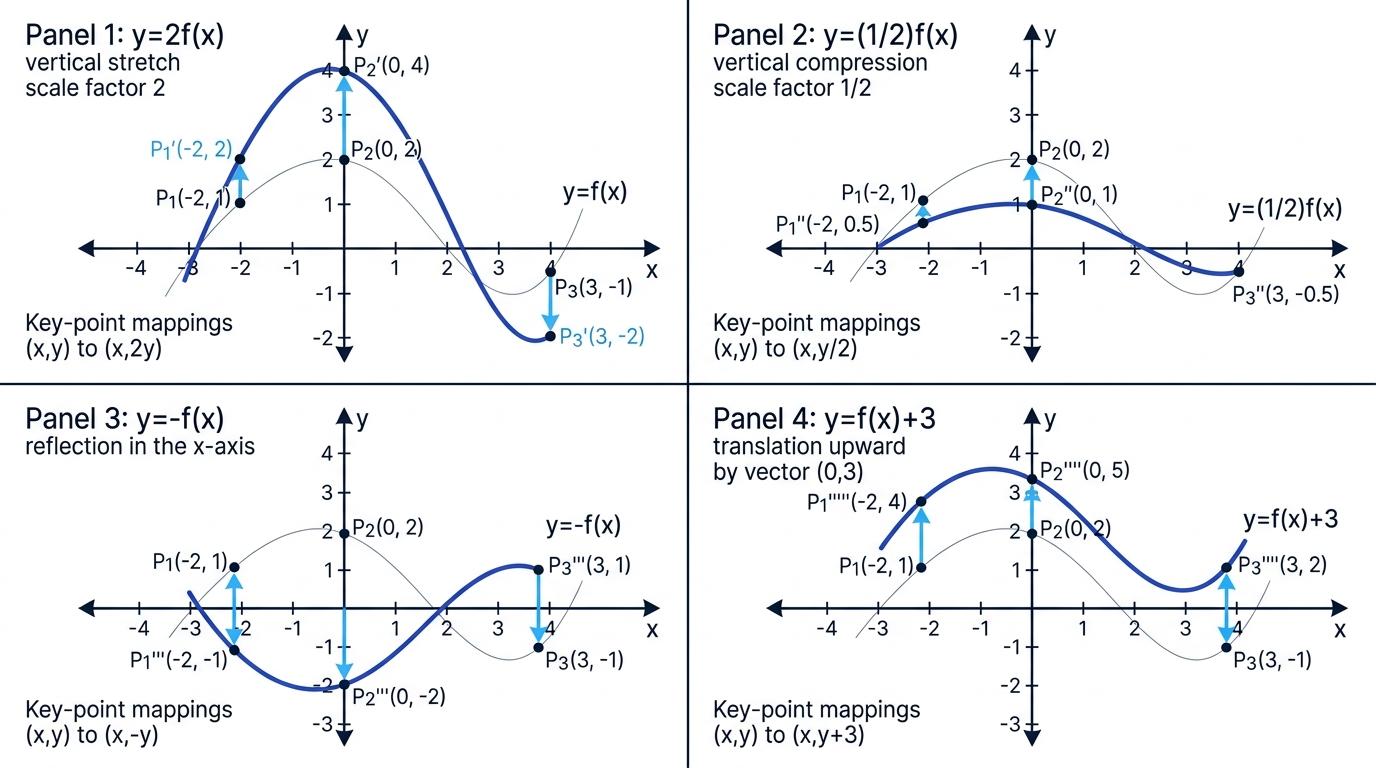
In y=af(x)y=af(x)y=af(x) and y=f(x)+ay=f(x)+ay=f(x)+a, the change is made outside the function. It therefore acts directly on the output, or yyy-coordinate.
Vertical translations: y=f(x)+ay=f(x)+ay=f(x)+a
Adding aaa to the output moves every point vertically:
(p,q)⟼(p,q+a).(p,q)\longmapsto(p,q+a).(p,q)⟼(p,q+a).Therefore, y=f(x)+ay=f(x)+ay=f(x)+a is a translation of y=f(x)y=f(x)y=f(x):
- upwards by aaa units if a>0a>0a>0;
- downwards by ∣a∣|a|∣a∣ units if a<0a<0a<0.
The translation vector is
(0a).\begin{pmatrix} 0\\ a \end{pmatrix}.(0a).Outside addition
Adding a number outside the function causes a vertical movement in the same direction as the sign: +a+a+a moves up when a>0a>0a>0.
Translating a quadratic vertically
Sketch y=x2−4y=x^2-4y=x2−4 from the graph of y=x2y=x^2y=x2.
- Write the equation as y=f(x)−4y=f(x)-4y=f(x)−4, where f(x)=x2f(x)=x^2f(x)=x2. This is an outside change, so it is vertical.
- Map every point using (p,q)↦(p,q−4)(p,q)\mapsto(p,q-4)(p,q)↦(p,q−4), which moves the graph down 4 units.
- The original turning point (0,0)(0,0)(0,0) moves to (0,−4)(0,-4)(0,−4), so the transformed parabola has turning point (0,−4)(0,-4)(0,−4) and the same shape as y=x2y=x^2y=x2.
Vertical scaling and reflection: y=af(x)y=af(x)y=af(x)
Multiplying the entire output by aaa changes every yyy-coordinate:
(p,q)⟼(p,aq).(p,q)\longmapsto(p,aq).(p,q)⟼(p,aq).For a≠0a\neq 0a=0, this is a stretch parallel to the yyy-axis with scale factor ∣a∣|a|∣a∣. In particular:
- if ∣a∣>1|a|>1∣a∣>1, the graph is stretched vertically;
- if 0<∣a∣<10<|a|<10<∣a∣<1, the graph is compressed vertically;
- if a<0a<0a<0, the graph is also reflected in the xxx-axis;
- if a=0a=0a=0, the equation becomes y=0y=0y=0, so the graph is the xxx-axis wherever the original function is defined.
Points on the xxx-axis do not move because multiplying a zero yyy-coordinate still gives zero. Therefore, the roots usually remain unchanged.
Stretching and reflecting a quadratic
Describe the transformation from y=x2−1y=x^2-1y=x2−1 to y=−3(x2−1)y=-3(x^2-1)y=−3(x2−1), and identify the new turning point.
- Let f(x)=x2−1f(x)=x^2-1f(x)=x2−1. The new equation is y=−3f(x)y=-3f(x)y=−3f(x), so every yyy-coordinate is multiplied by −3-3−3.
- Since ∣−3∣=3|-3|=3∣−3∣=3, there is a stretch parallel to the yyy-axis with scale factor 3. The negative sign also gives a reflection in the xxx-axis.
- The original turning point is (0,−1)(0,-1)(0,−1). Using (p,q)↦(p,−3q)(p,q)\mapsto(p,-3q)(p,q)↦(p,−3q) gives (0,−1)↦(0,3)(0,-1)\mapsto(0,3)(0,−1)↦(0,3).
Stretching both coordinates
For y=af(x)y=af(x)y=af(x), multiply only the yyy-coordinates by aaa. The xxx-coordinates do not change.
Changes inside the function
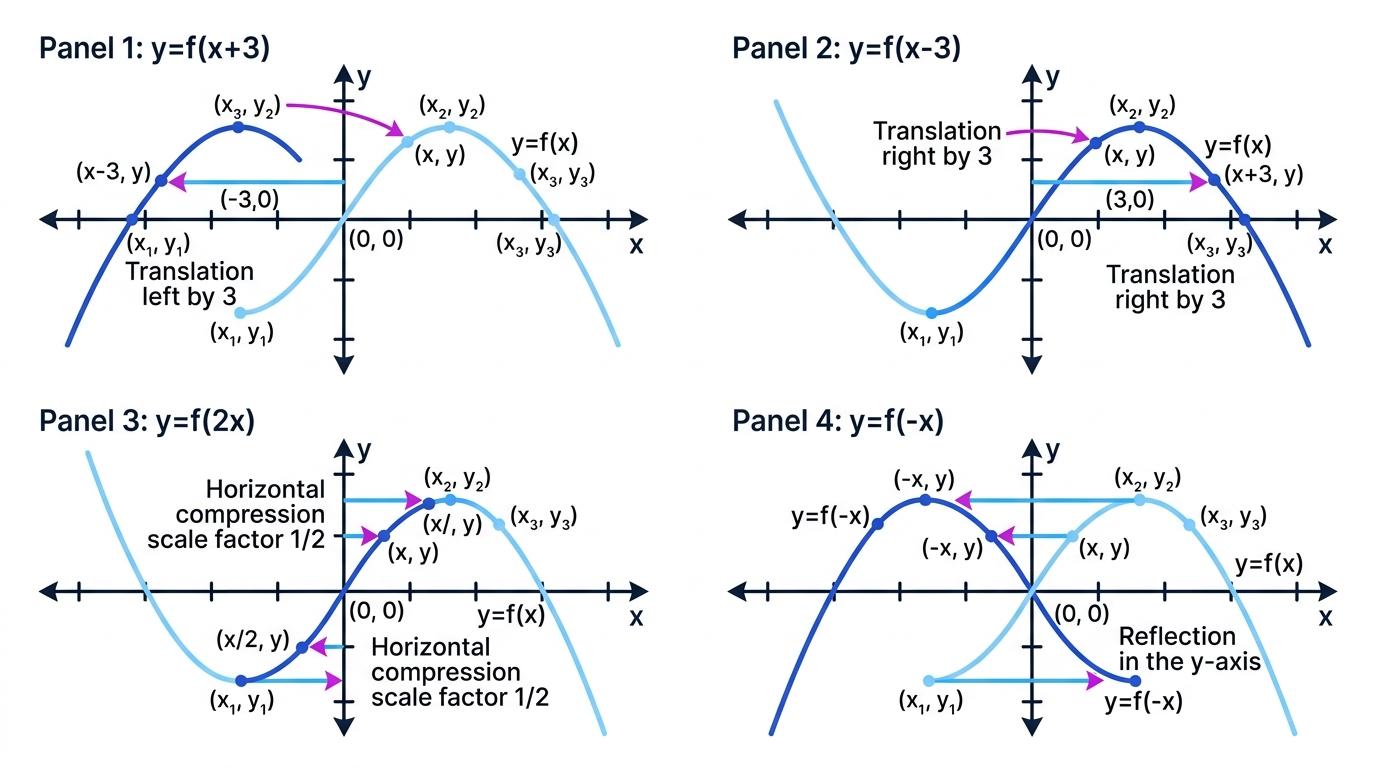
In y=f(x+a)y=f(x+a)y=f(x+a) and y=f(ax)y=f(ax)y=f(ax), the change is made to the input. It therefore affects the xxx-coordinates.
Inside transformations appear to work in the opposite direction because you must compensate for the altered input.
Horizontal translations: y=f(x+a)y=f(x+a)y=f(x+a)
Suppose (p,q)(p,q)(p,q) is on the original graph, so f(p)=qf(p)=qf(p)=q. On the new graph y=f(x+a)y=f(x+a)y=f(x+a), the same output occurs when
x+a=p,x+a=p,x+a=p,so x=p−ax=p-ax=p−a. Therefore,
(p,q)⟼(p−a,q).(p,q)\longmapsto(p-a,q).(p,q)⟼(p−a,q).Hence y=f(x+a)y=f(x+a)y=f(x+a) is a translation by the vector
(−a0).\begin{pmatrix} -a\\ 0 \end{pmatrix}.(−a0).For example, y=f(x+3)y=f(x+3)y=f(x+3) moves left 3 units, whereas y=f(x−3)y=f(x-3)y=f(x−3) moves right 3 units.
Inside addition is opposite
For horizontal translations, the direction is opposite to the sign inside the brackets: f(x+a)f(x+a)f(x+a) moves left when a>0a>0a>0.
Translating a square-root graph
Find the equation obtained by translating y=xy=\sqrt{x}y=x right by 5 units.
- A movement right by 5 changes each xxx-coordinate according to (p,q)↦(p+5,q)(p,q)\mapsto(p+5,q)(p,q)↦(p+5,q).
- An inside subtraction produces a movement to the right, so replace xxx with x−5x-5x−5.
- The transformed equation is y=x−5y=\sqrt{x-5}y=x−5. Its endpoint moves from (0,0)(0,0)(0,0) to (5,0)(5,0)(5,0).
Horizontal scaling and reflection: y=f(ax)y=f(ax)y=f(ax)
To obtain the same output q=f(p)q=f(p)q=f(p) from y=f(ax)y=f(ax)y=f(ax), the input must satisfy
ax=p.ax=p.ax=p.When a≠0a\neq 0a=0, this gives x=pax=\frac{p}{a}x=ap, so
(p,q)⟼(pa,q).(p,q)\longmapsto\left(\frac{p}{a},q\right).(p,q)⟼(ap,q).The graph undergoes a stretch parallel to the xxx-axis with scale factor 1∣a∣\frac{1}{|a|}∣a∣1:
- if ∣a∣>1|a|>1∣a∣>1, the graph is compressed horizontally;
- if 0<∣a∣<10<|a|<10<∣a∣<1, the graph is stretched horizontally;
- if a<0a<0a<0, the graph is also reflected in the yyy-axis.
Compressing a sine graph horizontally
Describe the transformation from y=sinxy=\sin xy=sinx to y=sin(2x)y=\sin(2x)y=sin(2x) and find where the point (π2,1)\left(\frac{\pi}{2},1\right)(2π,1) moves.
- The multiplier 2 is inside the function, so it acts on the xxx-coordinates.
- The horizontal scale factor is 12\frac{1}{2}21, meaning that all horizontal distances are halved.
- Apply the mapping (p,q)↦(p2,q)(p,q)\mapsto\left(\frac{p}{2},q\right)(p,q)↦(2p,q):
Using the visible multiplier
The graph of y=f(3x)y=f(3x)y=f(3x) has horizontal scale factor 13\frac{1}{3}31, not 3. Inside multipliers act reciprocally on xxx-coordinates.
The case a = 0
The reciprocal rule for y=f(ax)y=f(ax)y=f(ax) requires a≠0a\neq 0a=0. If a=0a=0a=0, then y=f(0)y=f(0)y=f(0) is a constant horizontal line, provided that f(0)f(0)f(0) is defined.
Finding equations from descriptions
Translate each verbal description into the part of the function that must change:
- vertical movement: add outside f(x)f(x)f(x);
- horizontal movement: add or subtract inside the input;
- vertical scaling: multiply outside f(x)f(x)f(x);
- horizontal scaling: multiply the input.
Combining a translation and a stretch
The graph y=f(x)y=f(x)y=f(x) is stretched parallel to the yyy-axis with scale factor 2, then translated left by 3 units. Find its new equation.
- The vertical stretch multiplies every output by 2, giving y=2f(x)y=2f(x)y=2f(x).
- Translating left by 3 requires replacing the input xxx with x+3x+3x+3.
- Applying both changes gives
A point (p,q)(p,q)(p,q) on the original graph moves to (p−3,2q)(p-3,2q)(p−3,2q).
Outside and inside
Changes outside fff affect height and therefore act on yyy-coordinates. Changes inside the brackets affect position across the page and therefore act reciprocally on xxx-coordinates.
Describing transformations precisely
State all of the following where relevant:
- the type of transformation;
- the direction or line of reflection;
- the scale factor or translation vector.
For example, describe y=f(−2x)y=f(-2x)y=f(−2x) as a reflection in the yyy-axis together with a stretch parallel to the xxx-axis with scale factor 12\frac{1}{2}21.
In the exam
- Decide whether the change is inside or outside the function before moving any points.
- Mark transformed intercepts, turning points and endpoints first, then join them with the correct general shape.
- Check the direction of horizontal translations and use reciprocal scale factors for horizontal stretches.
- When describing a transformation, include the axis direction, scale factor, reflection line or translation vector as appropriate.
Check yourself
- Where does the point (4,−2)(4,-2)(4,−2) move under the transformation y=3f(x)+1y=3f(x)+1y=3f(x)+1?
- How would you transform y=f(x)y=f(x)y=f(x) to obtain y=f(x−6)y=f(x-6)y=f(x−6)?
- Describe fully the transformation from y=f(x)y=f(x)y=f(x) to y=f(−12x)y=f(-\frac{1}{2}x)y=f(−21x).
