

What you'll learn
- How to translate geometric information into vector equations.
- How to prove that points are collinear and divide lines in a given ratio.
- How to find resultants and solve equilibrium problems involving forces.
- How to interpret your vector answer in the original context.
Vector foundations
A vector is a quantity with both magnitude and direction. Magnitude means size or length. Vectors can represent displacement, velocity, acceleration and force.
A vector is often written as a column vector:
a=(a1a2)\mathbf{a}=\begin{pmatrix}a_1\\a_2\end{pmatrix}a=(a1a2)The numbers a1a_1a1 and a2a_2a2 are the horizontal and vertical components of the vector.
By contrast, a scalar has magnitude but no direction. Mass, time and temperature are scalars.
Adding and subtracting vectors
Vectors are added and subtracted component by component:
(ab)+(cd)=(a+cb+d).\begin{pmatrix}a\\b\end{pmatrix} + \begin{pmatrix}c\\d\end{pmatrix} = \begin{pmatrix}a+c\\b+d\end{pmatrix}.(ab)+(cd)=(a+cb+d).Multiplying a vector by a scalar changes its magnitude and, if the scalar is negative, reverses its direction:
k(ab)=(kakb).k\begin{pmatrix}a\\b\end{pmatrix} = \begin{pmatrix}ka\\kb\end{pmatrix}.k(ab)=(kakb).Follow a route
If you travel from one point to another through intermediate points, add the vectors for each part of the journey. For example, AB→+BC→=AC→\overrightarrow{AB}+\overrightarrow{BC}=\overrightarrow{AC}AB+BC=AC.
Finding a missing displacement
A particle moves through displacements (5−2)\begin{pmatrix}5\\-2\end{pmatrix}(5−2) and (−17)\begin{pmatrix}-1\\7\end{pmatrix}(−17), measured in metres.
-
Add the corresponding components:
(5−2)+(−17)=(5−1−2+7).\begin{pmatrix}5\\-2\end{pmatrix} + \begin{pmatrix}-1\\7\end{pmatrix} = \begin{pmatrix}5-1\\-2+7\end{pmatrix}.(5−2)+(−17)=(5−1−2+7). -
Simplify to obtain the total displacement:
(45) m.\begin{pmatrix}4\\5\end{pmatrix}\text{ m}.(45) m. -
Interpret the components: the particle finishes 4 m to the right and 5 m above its starting point.
Position vectors and vectors between points
A position vector describes the position of a point relative to a fixed origin, usually called OOO. If OA→=a\overrightarrow{OA}=\mathbf{a}OA=a, then a\mathbf{a}a is the position vector of AAA.
To move from AAA to BBB, subtract the position vector of the starting point from that of the finishing point.
Vector between two points
If OA→=a\overrightarrow{OA}=\mathbf{a}OA=a and OB→=b\overrightarrow{OB}=\mathbf{b}OB=b, then
AB→=b−a.\overrightarrow{AB}=\mathbf{b}-\mathbf{a}.AB=b−a.The diagram shows both this subtraction rule and the related idea that balancing forces must be equal and opposite.
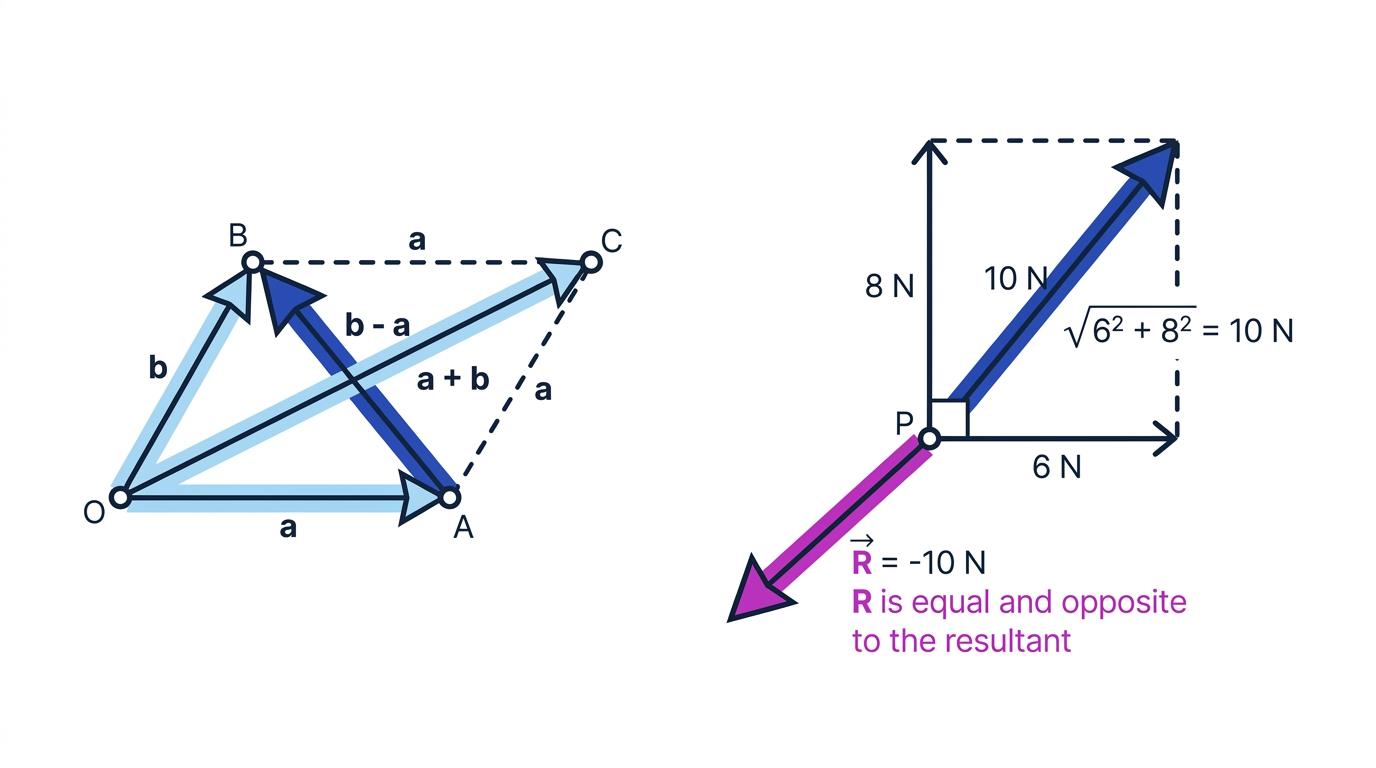
Using position vectors in a triangle
Points AAA and BBB have position vectors
a=(2−1),b=(85).\mathbf{a}=\begin{pmatrix}2\\-1\end{pmatrix}, \qquad \mathbf{b}=\begin{pmatrix}8\\5\end{pmatrix}.a=(2−1),b=(85).Find AB→\overrightarrow{AB}AB and the position vector of the midpoint MMM of ABABAB.
-
Subtract the position vector of AAA from that of BBB:
AB→=b−a=(85)−(2−1)=(66).\overrightarrow{AB} = \mathbf{b}-\mathbf{a} = \begin{pmatrix}8\\5\end{pmatrix} - \begin{pmatrix}2\\-1\end{pmatrix} = \begin{pmatrix}6\\6\end{pmatrix}.AB=b−a=(85)−(2−1)=(66). -
The midpoint is halfway from AAA to BBB, so
OM→=a+12AB→.\overrightarrow{OM} = \mathbf{a}+\frac12\overrightarrow{AB}.OM=a+21AB. -
Substitute the vectors:
OM→=(2−1)+12(66)=(52).\overrightarrow{OM} = \begin{pmatrix}2\\-1\end{pmatrix} + \frac12\begin{pmatrix}6\\6\end{pmatrix} = \begin{pmatrix}5\\2\end{pmatrix}.OM=(2−1)+21(66)=(52).
Subtracting in the wrong order
For AB→\overrightarrow{AB}AB, calculate “position of BBB minus position of AAA”. Reversing the subtraction gives BA→\overrightarrow{BA}BA, which points in the opposite direction.
Dividing a line in a ratio
Suppose PPP lies on the line segment from AAA to BBB and divides it in the ratio AP:PB=m:nAP:PB=m:nAP:PB=m:n. The fraction of the complete journey from AAA to BBB is then mm+n\frac{m}{m+n}m+nm.
Therefore,
OP→=a+mm+n(b−a).\overrightarrow{OP} = \mathbf{a} + \frac{m}{m+n}(\mathbf{b}-\mathbf{a}).OP=a+m+nm(b−a).This “start plus a fraction of the journey” approach is often easier to remember than a section formula.
Locating a point that divides a line
The position vectors of AAA and BBB are a\mathbf{a}a and b\mathbf{b}b. Point PPP divides ABABAB in the ratio AP:PB=2:3AP:PB=2:3AP:PB=2:3. Find OP→\overrightarrow{OP}OP.
-
The whole segment contains 2+3=52+3=52+3=5 equal parts, and APAPAP contains 2 of them. Hence
AP→=25AB→.\overrightarrow{AP}=\frac25\overrightarrow{AB}.AP=52AB. -
Replace AB→\overrightarrow{AB}AB with b−a\mathbf{b}-\mathbf{a}b−a:
OP→=a+25(b−a).\overrightarrow{OP} = \mathbf{a}+\frac25(\mathbf{b}-\mathbf{a}).OP=a+52(b−a). -
Collect the coefficients of a\mathbf{a}a and b\mathbf{b}b:
OP→=35a+25b.\overrightarrow{OP} = \frac35\mathbf{a}+\frac25\mathbf{b}.OP=53a+52b.
Proving collinearity
Points are collinear if they lie on the same straight line.
Two non-zero vectors are parallel when one is a scalar multiple of the other. Therefore, to prove that AAA, BBB and CCC are collinear, you can show that
AC→=kAB→\overrightarrow{AC}=k\overrightarrow{AB}AC=kABfor some scalar kkk.
If k>0k>0k>0, the vectors point in the same direction. If k<0k<0k<0, they point in opposite directions.
Proving three points are collinear
The points have position vectors
a=(12),b=(48),c=(714).\mathbf{a}=\begin{pmatrix}1\\2\end{pmatrix}, \quad \mathbf{b}=\begin{pmatrix}4\\8\end{pmatrix}, \quad \mathbf{c}=\begin{pmatrix}7\\14\end{pmatrix}.a=(12),b=(48),c=(714).-
Find two vectors beginning at the same point:
AB→=b−a=(36),AC→=c−a=(612).\overrightarrow{AB} = \mathbf{b}-\mathbf{a} = \begin{pmatrix}3\\6\end{pmatrix}, \qquad \overrightarrow{AC} = \mathbf{c}-\mathbf{a} = \begin{pmatrix}6\\12\end{pmatrix}.AB=b−a=(36),AC=c−a=(612). -
Compare the vectors:
AC→=2AB→.\overrightarrow{AC}=2\overrightarrow{AB}.AC=2AB. -
Since one vector is a scalar multiple of the other, the vectors are parallel and share point AAA. Therefore, AAA, BBB and CCC are collinear. Also, BBB lies between AAA and CCC because the scalar lies between 0 and 1 when AB→\overrightarrow{AB}AB is written as a multiple of AC→\overrightarrow{AC}AC.
Make the conclusion explicit
A scalar multiple proves that the relevant vectors are parallel. To complete a collinearity proof, also mention that the vectors pass through a common point.
Magnitude and direction
The magnitude of v=(xy)\mathbf{v}=\begin{pmatrix}x\\y\end{pmatrix}v=(xy) is its length:
∣v∣=x2+y2.|\mathbf{v}|=\sqrt{x^2+y^2}.∣v∣=x2+y2.Its direction can be found using trigonometry. If θ\thetaθ is measured anticlockwise from the positive horizontal direction, start with
tanθ=yx,\tan\theta=\frac{y}{x},tanθ=xy,then use the signs of the components to identify the correct quadrant.
Trusting inverse tangent without checking
A calculator value of tan−1(y/x)\tan^{-1}(y/x)tan−1(y/x) may not give the required quadrant. Sketch the components or inspect their signs before stating the direction.
Vectors and forces
A force is a vector measured in newtons, N. When several forces act on an object, their vector sum is called the resultant force.
If forces are given in component form, add their horizontal components and add their vertical components.
Equilibrium
An object is in equilibrium when the resultant force acting on it is the zero vector:
∑F=0.\sum\mathbf{F}=\mathbf{0}.∑F=0.Finding a force that maintains equilibrium
A particle is acted on by forces
F1=(60) N,F2=(08) N.\mathbf{F}_1=\begin{pmatrix}6\\0\end{pmatrix}\text{ N}, \qquad \mathbf{F}_2=\begin{pmatrix}0\\8\end{pmatrix}\text{ N}.F1=(60) N,F2=(08) N.Find the third force R\mathbf{R}R required for equilibrium, including its magnitude.
-
Add the two known forces:
F1+F2=(68) N.\mathbf{F}_1+\mathbf{F}_2 = \begin{pmatrix}6\\8\end{pmatrix}\text{ N}.F1+F2=(68) N. -
For equilibrium, the third force must cancel this resultant:
R=−(68)=(−6−8) N.\mathbf{R} = -\begin{pmatrix}6\\8\end{pmatrix} = \begin{pmatrix}-6\\-8\end{pmatrix}\text{ N}.R=−(68)=(−6−8) N. -
Calculate its magnitude:
∣R∣=(−6)2+(−8)2=100=10 N.|\mathbf{R}| = \sqrt{(-6)^2+(-8)^2} = \sqrt{100} = 10\text{ N}.∣R∣=(−6)2+(−8)2=100=10 N. -
Interpret the answer: the force has magnitude 10 N and acts downwards and to the left, exactly opposite to the resultant of the known forces.
Modelling a problem with vectors
In a context, you must decide what each vector represents and choose positive directions. A reliable process is to:
- draw a simple diagram;
- label known vectors and unknown components;
- translate routes, parallel lines or equilibrium into vector equations;
- compare components or coefficients;
- interpret the result in context.
A negative component is not automatically wrong. It means that the true direction is opposite to the positive direction you selected.
Translate, solve, interpret
Vector problem solving has three stages: turn the situation into vector equations, solve those equations, and then explain what the resulting numbers or vectors mean.
In the exam
- Define any vectors or positive directions that are not already specified, and keep the notation consistent.
- For a vector between points, use “finish minus start”; for equilibrium, set the sum of all forces equal to 0\mathbf{0}0.
- Compare components separately, keep exact values unless a decimal is requested, and finish by interpreting magnitude, direction, ratio or position in the context.
Check yourself
- If OA→=a\overrightarrow{OA}=\mathbf{a}OA=a and OB→=b\overrightarrow{OB}=\mathbf{b}OB=b, how would you express the point three-quarters of the way from AAA to BBB?
- What vector relationship could you use to prove that three points are collinear?
- Two known forces have resultant (pq)\begin{pmatrix}p\\q\end{pmatrix}(pq) N. What force is required for equilibrium, and how would you find its magnitude?
