

What you'll learn
- How a definite integral represents signed area.
- How to apply the trapezium rule using equally spaced ordinates.
- How to decide whether a trapezium-rule estimate is too large or too small.
- How to use upper and lower estimates to give limits for an area.
Before You Start
Definite integrals and area
A definite integral gives the signed area between a graph and the horizontal axis over a specified interval:
∫abf(x) dx\int_a^b f(x)\,dx∫abf(x)dxIf f(x)≥0f(x)\ge 0f(x)≥0 throughout the interval, this is the ordinary area under the curve y=f(x)y=f(x)y=f(x) from x=ax=ax=a to x=bx=bx=b.
If the graph lies below the horizontal axis, the integral counts that part negatively. Therefore, a definite integral and a total geometrical area are not always the same.
Numerical integration
Numerical integration means estimating a definite integral using numerical values of the function, rather than finding and integrating an exact algebraic expression.
Numerical integration is useful when:
- the function cannot easily be integrated;
- only a table of values is available;
- an approximate numerical answer is sufficient.
Interpreting a definite integral
Suppose f(x)≥0f(x)\ge 0f(x)≥0 for 1≤x≤51\le x\le 51≤x≤5 and
∫15f(x) dx≈12.7.\int_1^5 f(x)\,dx\approx 12.7.∫15f(x)dx≈12.7.- The limits 1 and 5 show that the region extends from x=1x=1x=1 to x=5x=5x=5.
- Because f(x)≥0f(x)\ge 0f(x)≥0, the graph does not go below the horizontal axis.
- The approximate area under the curve is therefore 12.7 square units.
Dividing the Interval
To estimate an area, you divide the interval into narrow vertical strips.
The vertical boundary lines of these strips are called ordinates. If the interval is divided into nnn equal strips, there are n+1n+1n+1 ordinates because both endpoints are included.
Let the equally spaced coordinates be
x0,x1,x2,…,xn,x_0,x_1,x_2,\ldots,x_n,x0,x1,x2,…,xn,with corresponding heights
y0,y1,y2,…,yn,y_0,y_1,y_2,\ldots,y_n,y0,y1,y2,…,yn,where yi=f(xi)y_i=f(x_i)yi=f(xi).
Strip width
If the interval from x=ax=ax=a to x=bx=bx=b is divided into nnn equal strips, the width of each strip is
h=b−an.h=\frac{b-a}{n}.h=nb−a.Confusing strips and ordinates
For nnn strips, you need n+1n+1n+1 function values. For example, 4 strips require 5 ordinates.
Finding the ordinates
Divide the interval from x=2x=2x=2 to x=5x=5x=5 into 6 equal strips.
-
Calculate the strip width:
h=5−26=12.h=\frac{5-2}{6}=\frac12.h=65−2=21. -
Begin at 2 and repeatedly add 12\frac1221:
2, 2.5, 3, 3.5, 4, 4.5, 5.2,\ 2.5,\ 3,\ 3.5,\ 4,\ 4.5,\ 5.2, 2.5, 3, 3.5, 4, 4.5, 5. -
There are 7 ordinates, confirming that 6 strips have been formed.
The Trapezium Rule
Instead of following the curve exactly, the trapezium rule joins consecutive points on the curve with straight lines. Each strip is then treated as a trapezium.
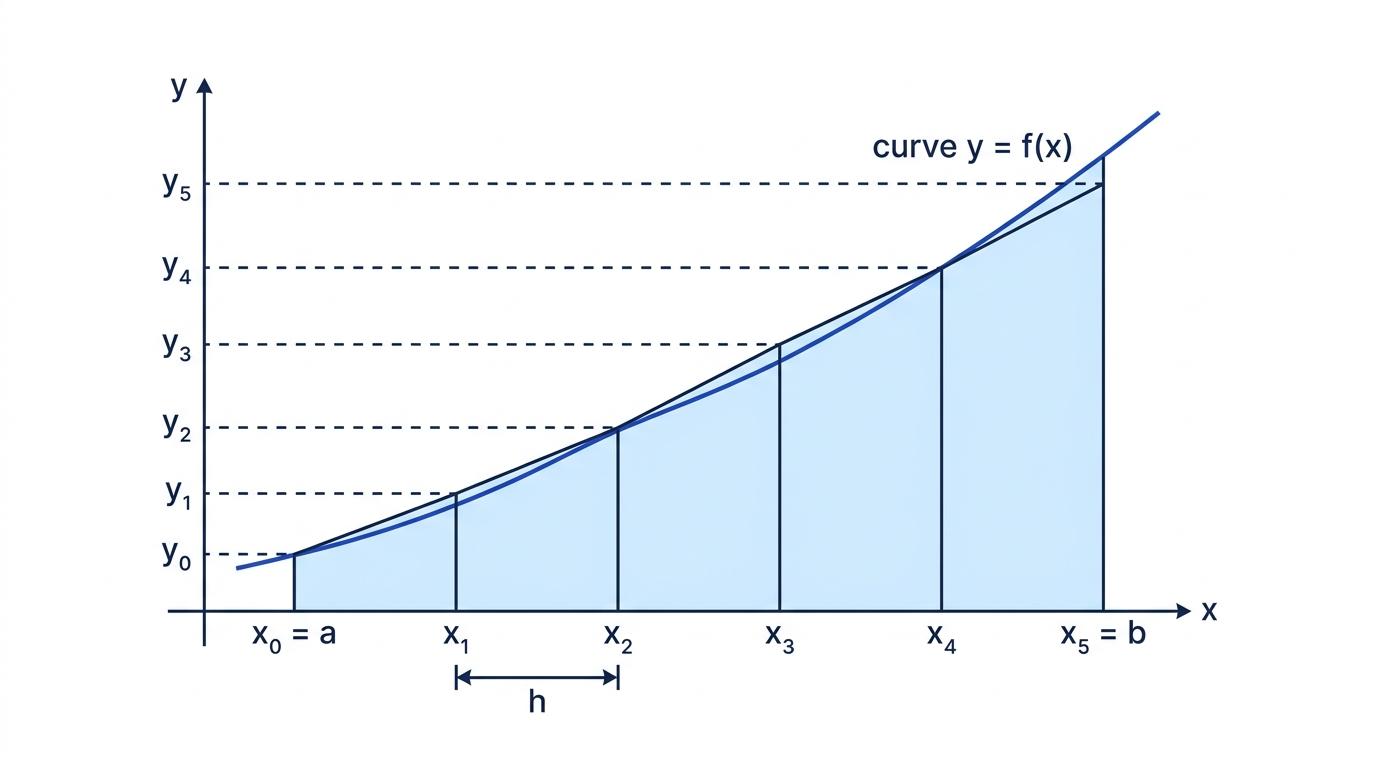
The area of one trapezium with parallel sides yiy_iyi and yi+1y_{i+1}yi+1 and width hhh is
12h(yi+yi+1).\frac12h(y_i+y_{i+1}).21h(yi+yi+1).Adding the areas of all the trapezia gives the full rule.
The trapezium rule formula
For nnn equal strips of width hhh,
∫abf(x) dx≈h2[y0+yn+2(y1+y2+⋯+yn−1)].\int_a^b f(x)\,dx \approx \frac{h}{2} \left[ y_0+y_n+2(y_1+y_2+\cdots+y_{n-1}) \right].∫abf(x)dx≈2h[y0+yn+2(y1+y2+⋯+yn−1)].The first and last ordinates appear once. Every interior ordinate appears twice.
A useful memory pattern is:
h2[first+last+2(all the middle values)].\frac{h}{2} \left[ \text{first}+\text{last}+2(\text{all the middle values}) \right].2h[first+last+2(all the middle values)].Estimating an integral from a table
Use the trapezium rule with 4 strips to estimate
∫0211+x2 dx.\int_0^2 \frac{1}{1+x^2}\,dx.∫021+x21dx.The relevant values are
x:0, 0.5, 1, 1.5, 2,y:1, 0.8, 0.5, 413, 0.2.\begin{aligned} x &: 0,\ 0.5,\ 1,\ 1.5,\ 2,\\ y &: 1,\ 0.8,\ 0.5,\ \frac{4}{13},\ 0.2. \end{aligned}xy:0, 0.5, 1, 1.5, 2,:1, 0.8, 0.5, 134, 0.2.-
Calculate the strip width:
h=2−04=0.5.h=\frac{2-0}{4}=0.5.h=42−0=0.5. -
Substitute the first and last heights once and the middle heights twice:
∫0211+x2 dx≈0.52[1+0.2+2(0.8+0.5+413)].\int_0^2 \frac{1}{1+x^2}\,dx \approx \frac{0.5}{2} \left[ 1+0.2+2\left(0.8+0.5+\frac{4}{13}\right) \right].∫021+x21dx≈20.5[1+0.2+2(0.8+0.5+134)]. -
Evaluate the expression:
∫0211+x2 dx≈1.103846…≈1.104.\int_0^2 \frac{1}{1+x^2}\,dx \approx 1.103846\ldots \approx 1.104.∫021+x21dx≈1.103846…≈1.104.
Organising your substitution
Write the first and last values before inserting the doubled bracket of middle values. This makes missing or doubling an endpoint less likely.
Using an incorrect strip width
Find hhh from the limits and the number of strips. Do not assume that h=1h=1h=1, and do not divide by the number of ordinates.
Accuracy of the Estimate
The straight top of each trapezium usually does not coincide exactly with the curve. The difference between the estimate and the true integral is called the error.
Using more, narrower strips usually makes the estimate more accurate because each straight segment follows a smaller portion of the curve.
Concavity and the direction of error
A curve is concave up when its gradient is increasing. It bends like a cup, and its second derivative is positive:
f′′(x)>0.f''(x)>0.f′′(x)>0.The chords joining points on a concave-up curve lie above the curve. The trapezium rule therefore gives an overestimate.
A curve is concave down when its gradient is decreasing, so
f′′(x)<0.f''(x)<0.f′′(x)<0.The chords lie below the curve, giving an underestimate.
Judging the error
- If f′′(x)>0f''(x)>0f′′(x)>0 throughout the interval, the trapezium estimate is an upper bound.
- If f′′(x)<0f''(x)<0f′′(x)<0 throughout the interval, the trapezium estimate is a lower bound.
Determining the direction of error
A trapezium-rule calculation estimates
∫13lnx dx.\int_1^3 \ln x\,dx.∫13lnxdx.-
Differentiate twice:
f′(x)=1x,f′′(x)=−1x2.f'(x)=\frac1x, \qquad f''(x)=-\frac{1}{x^2}.f′(x)=x1,f′′(x)=−x21. -
For 1≤x≤31\le x\le 31≤x≤3, the second derivative is negative, so the curve is concave down throughout the interval.
-
The straight chords lie below the curve, so the trapezium-rule result is an underestimate and forms a lower bound for the integral.
Changing concavity
If f′′(x)f''(x)f′′(x) changes sign within the interval, the curve changes concavity. You cannot use one simple statement to claim that the whole trapezium estimate is an upper or lower bound.
Giving Limits for an Area
A lower bound is a value known to be no greater than the true area. An upper bound is a value known to be no less than the true area.
If LLL is a lower estimate and UUU is an upper estimate, then the true area AAA satisfies
L≤A≤U.L\le A\le U.L≤A≤U.For a positive increasing function, rectangles using the left endpoint of each strip lie below the curve, while rectangles using the right endpoint lie above it.
Bounding an area with rectangles
Use 4 equal strips to bound the area under y=x2y=x^2y=x2 from x=0x=0x=0 to x=2x=2x=2.
-
The width is h=0.5h=0.5h=0.5, and the heights are
0, 0.25, 1, 2.25, 4.0,\ 0.25,\ 1,\ 2.25,\ 4.0, 0.25, 1, 2.25, 4. -
Since x2x^2x2 is increasing, use the four left-hand heights for a lower bound:
L=0.5(0+0.25+1+2.25)=1.75.L=0.5(0+0.25+1+2.25)=1.75.L=0.5(0+0.25+1+2.25)=1.75. -
Use the four right-hand heights for an upper bound:
U=0.5(0.25+1+2.25+4)=3.75.U=0.5(0.25+1+2.25+4)=3.75.U=0.5(0.25+1+2.25+4)=3.75. -
Therefore, if AAA is the true area,
1.75≤A≤3.75.1.75\le A\le 3.75.1.75≤A≤3.75.
In the exam
- Calculate h=b−anh=\frac{b-a}{n}h=nb−a before substituting any heights.
- Check that nnn strips correspond to n+1n+1n+1 ordinates.
- Use the pattern first + last + twice the middle values, keeping full calculator accuracy until the end.
- Sketch or examine f′′(x)f''(x)f′′(x) before claiming that an answer is an overestimate or underestimate.
- State bounds as a complete inequality such as L≤A≤UL\le A\le UL≤A≤U.
Check yourself
- How many ordinates are required when the interval is divided into 8 strips?
- Why are the interior ordinates doubled in the trapezium-rule formula?
- What does the sign of f′′(x)f''(x)f′′(x) tell you about whether the trapezium rule overestimates or underestimates?
