

What you'll learn
- How to represent forces and acceleration as two-dimensional vectors.
- How to find the resultant force by adding force vectors.
- How to apply Newton’s second law separately in two perpendicular directions.
- How to find an unknown force, acceleration, or mass from vector information.
Prerequisites: two-dimensional vectors
A two-dimensional vector has two components. These describe its effect in two perpendicular directions, usually horizontal and vertical.
For example,
F=(5−2) N\mathbf{F}= \begin{pmatrix} 5\\ -2 \end{pmatrix} \text{ N}F=(5−2) Nrepresents a force with:
- a horizontal component of 5 N in the positive direction;
- a vertical component of 2 N in the negative direction.
You may also see the same vector written as
F=5i−2j N,\mathbf{F}=5\mathbf{i}-2\mathbf{j}\text{ N},F=5i−2j N,where i\mathbf{i}i is a unit vector in the positive horizontal direction and j\mathbf{j}j is a unit vector in the positive vertical direction.
Vector component
A component is the part of a vector acting in one chosen direction. The signs of the components depend on the positive directions you choose.
Choosing positive directions
You must choose a positive direction for each axis. A common choice is:
- positive horizontally to the right;
- positive vertically upwards.
A component pointing in the opposite direction is then negative. The choice itself does not affect the physics, provided you use it consistently.
Losing negative signs
A negative component does not mean that the force is “negative”. It means that the force acts opposite to the chosen positive direction.
Resultant force
Several forces may act on the same particle. The resultant force is the single force that has the same overall effect as all those forces combined.
To find it, add the force vectors component by component:
R=∑F.\mathbf{R}=\sum \mathbf{F}.R=∑F.For example, if F1\mathbf{F}_1F1, F2\mathbf{F}_2F2 and F3\mathbf{F}_3F3 act on a particle, then
R=F1+F2+F3.\mathbf{R}=\mathbf{F}_1+\mathbf{F}_2+\mathbf{F}_3.R=F1+F2+F3.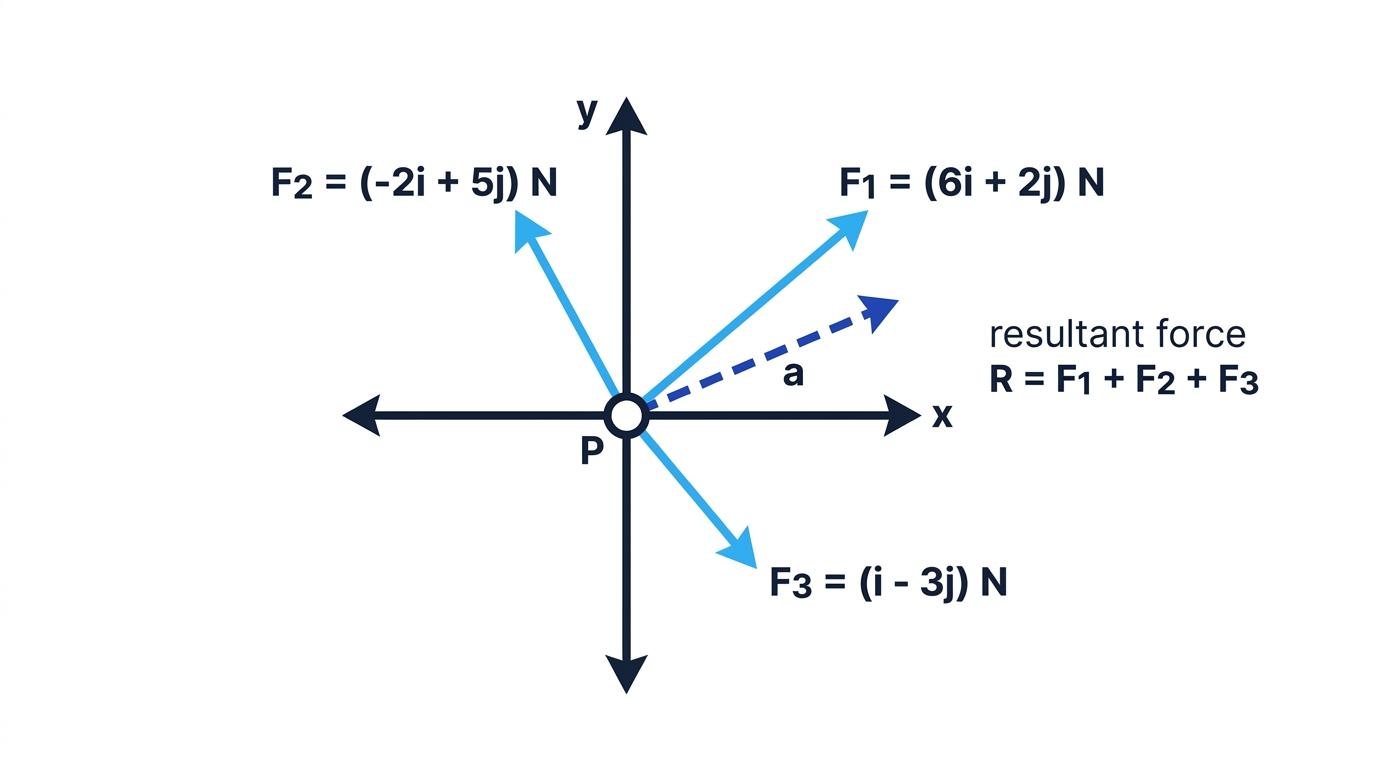
Finding a resultant force
Three forces acting on a particle are
F1=(62),F2=(−25),F3=(1−3) N.\mathbf{F}_1= \begin{pmatrix} 6\\ 2 \end{pmatrix}, \qquad \mathbf{F}_2= \begin{pmatrix} -2\\ 5 \end{pmatrix}, \qquad \mathbf{F}_3= \begin{pmatrix} 1\\ -3 \end{pmatrix} \text{ N}.F1=(62),F2=(−25),F3=(1−3) N.-
Add the horizontal components:
Rx=6−2+1=5 N.R_x=6-2+1=5\text{ N}.Rx=6−2+1=5 N. -
Add the vertical components:
Ry=2+5−3=4 N.R_y=2+5-3=4\text{ N}.Ry=2+5−3=4 N. -
Combine the components to give the resultant force:
R=(54) N.\mathbf{R}= \begin{pmatrix} 5\\ 4 \end{pmatrix} \text{ N}.R=(54) N.
Newton’s second law in vector form
Newton’s second law states that the resultant force on a particle equals its mass multiplied by its acceleration.
Newton's second law
For a particle of constant mass,
∑F=ma,\sum\mathbf{F}=m\mathbf{a},∑F=ma,where ∑F\sum\mathbf{F}∑F is the resultant force in N, mmm is the mass in kg, and a\mathbf{a}a is the acceleration in m s−2^{-2}−2.
Mass is a scalar, meaning that it has size but no direction. Multiplying the acceleration vector by the mass multiplies each of its components:
m(axay)=(maxmay).m \begin{pmatrix} a_x\\ a_y \end{pmatrix} = \begin{pmatrix} ma_x\\ ma_y \end{pmatrix}.m(axay)=(maxmay).Therefore, the vector equation is equivalent to two scalar equations:
∑Fx=max,∑Fy=may.\begin{aligned} \sum F_x&=ma_x,\\ \sum F_y&=ma_y. \end{aligned}∑Fx∑Fy=max,=may.These equations show that forces in the horizontal direction determine the horizontal acceleration, while forces in the vertical direction determine the vertical acceleration.
Force and acceleration point together
Because mass is positive, the acceleration vector is always in the same direction as the resultant force vector. It need not point in the direction of motion.
Finding acceleration from several forces
A particle of mass 2 kg is acted on by the forces
(7−1) N,(−35) N.\begin{pmatrix} 7\\ -1 \end{pmatrix} \text{ N}, \qquad \begin{pmatrix} -3\\ 5 \end{pmatrix} \text{ N}.(7−1) N,(−35) N.Find its acceleration.
-
Add the force vectors to find the resultant:
∑F=(7−1)+(−35)=(44) N.\sum\mathbf{F} = \begin{pmatrix} 7\\ -1 \end{pmatrix} + \begin{pmatrix} -3\\ 5 \end{pmatrix} = \begin{pmatrix} 4\\ 4 \end{pmatrix} \text{ N}.∑F=(7−1)+(−35)=(44) N. -
Apply ∑F=ma\sum\mathbf{F}=m\mathbf{a}∑F=ma:
(44)=2a.\begin{pmatrix} 4\\ 4 \end{pmatrix} = 2\mathbf{a}.(44)=2a. -
Divide both components by the mass:
a=12(44)=(22) m s−2.\mathbf{a} = \frac{1}{2} \begin{pmatrix} 4\\ 4 \end{pmatrix} = \begin{pmatrix} 2\\ 2 \end{pmatrix} \text{ m s}^{-2}.a=21(44)=(22) m s−2.
Writing separate component equations
You do not always need to add the forces into one vector first. You can resolve Newton’s second law directly along each axis.
Suppose a particle of mass mmm has acceleration
a=(axay).\mathbf{a}= \begin{pmatrix} a_x\\ a_y \end{pmatrix}.a=(axay).Then write one equation for each direction:
horizontal:∑Fx=max,vertical:∑Fy=may.\begin{aligned} \text{horizontal:}\quad &\sum F_x=ma_x,\\ \text{vertical:}\quad &\sum F_y=ma_y. \end{aligned}horizontal:vertical:∑Fx=max,∑Fy=may.This is particularly useful when a question contains an unknown force component.
Organise by direction
Before forming equations, sort every force into its horizontal and vertical components. This makes sign errors much easier to spot.
Finding an unknown force vector
A particle of mass 3 kg accelerates at
a=(2−1) m s−2.\mathbf{a}= \begin{pmatrix} 2\\ -1 \end{pmatrix} \text{ m s}^{-2}.a=(2−1) m s−2.Two forces act on it. One is
P=(45) N,\mathbf{P}= \begin{pmatrix} 4\\ 5 \end{pmatrix} \text{ N},P=(45) N,and the other is Q\mathbf{Q}Q. Find Q\mathbf{Q}Q.
-
Use Newton’s second law to calculate the resultant force required:
∑F=ma=3(2−1)=(6−3) N.\sum\mathbf{F} =m\mathbf{a} =3 \begin{pmatrix} 2\\ -1 \end{pmatrix} = \begin{pmatrix} 6\\ -3 \end{pmatrix} \text{ N}.∑F=ma=3(2−1)=(6−3) N. -
Form the vector equation using the two forces:
P+Q=(6−3).\mathbf{P}+\mathbf{Q} = \begin{pmatrix} 6\\ -3 \end{pmatrix}.P+Q=(6−3). -
Subtract P\mathbf{P}P component by component:
Q=(6−3)−(45)=(2−8) N.\begin{aligned} \mathbf{Q} &= \begin{pmatrix} 6\\ -3 \end{pmatrix} - \begin{pmatrix} 4\\ 5 \end{pmatrix}\\ &= \begin{pmatrix} 2\\ -8 \end{pmatrix} \text{ N}. \end{aligned}Q=(6−3)−(45)=(2−8) N.
Magnitude and direction of acceleration
If an acceleration is given by
a=(axay),\mathbf{a}= \begin{pmatrix} a_x\\ a_y \end{pmatrix},a=(axay),its magnitude is
∣a∣=ax2+ay2.|\mathbf{a}|=\sqrt{a_x^2+a_y^2}.∣a∣=ax2+ay2.Its direction can be found using trigonometry. An initial reference angle may satisfy
tanθ=∣ayax∣,\tan\theta=\left|\frac{a_y}{a_x}\right|,tanθ=axay,but you must use the signs of both components to identify the correct quadrant.
Finding the size and direction of acceleration
A particle has acceleration
a=(−34) m s−2.\mathbf{a}= \begin{pmatrix} -3\\ 4 \end{pmatrix} \text{ m s}^{-2}.a=(−34) m s−2.-
Calculate its magnitude:
∣a∣=(−3)2+42=5 m s−2.|\mathbf{a}|=\sqrt{(-3)^2+4^2}=5\text{ m s}^{-2}.∣a∣=(−3)2+42=5 m s−2. -
Find the acute angle between the acceleration and the horizontal:
θ=tan−1(43)≈53.1∘.\theta=\tan^{-1}\left(\frac{4}{3}\right)\approx 53.1^\circ.θ=tan−1(34)≈53.1∘. -
Since the horizontal component is negative and the vertical component is positive, the acceleration points upwards and to the left. It is therefore 53.1∘53.1^\circ53.1∘ above the negative horizontal direction.
Using only the inverse tangent value
A calculator gives a reference angle, but the component signs determine the actual direction. Always identify the quadrant before stating your answer.
Zero resultant force
If the forces sum to the zero vector, then
∑F=(00).\sum\mathbf{F}= \begin{pmatrix} 0\\ 0 \end{pmatrix}.∑F=(00).Newton’s second law then gives
a=(00).\mathbf{a}= \begin{pmatrix} 0\\ 0 \end{pmatrix}.a=(00).The particle is in equilibrium. It is either at rest or moving with constant velocity.
Zero acceleration does not mean stationary
A particle with zero resultant force can still be moving. Its velocity remains constant because its acceleration is zero.
Modelling assumptions
In these questions, an object is often modelled as a particle. This means its size and shape are ignored, and all forces are treated as acting at one point.
Newton’s second law uses the resultant external force. You must include every force specified by the model, such as weight, tension, thrust or resistance, with the correct direction.
If weight is involved, use
W=mg,\mathbf{W}=m\mathbf{g},W=mg,with gravitational acceleration of magnitude 9.8 m s−2^{-2}−2 vertically downwards, unless the question states otherwise.
In the exam
- Choose and state positive horizontal and vertical directions, then attach the correct sign to every component.
- Add all forces or write ∑Fx=max\sum F_x=ma_x∑Fx=max and ∑Fy=may\sum F_y=ma_y∑Fy=may separately.
- Check that force is measured in N, mass in kg and acceleration in m s−2^{-2}−2, and that the acceleration points in the same direction as the resultant force.
- If a direction is required, use the component signs to choose the correct quadrant after calculating the reference angle.
Check yourself
- How would you find the acceleration of a particle when several two-dimensional force vectors and its mass are given?
- If the resultant force is zero, what can you conclude about the particle’s acceleration and velocity?
- Why is an acceleration with components (−23)\begin{pmatrix}-2\\3\end{pmatrix}(−23) not directed simply at tan−1(3/2)\tan^{-1}(3/2)tan−1(3/2) from the positive horizontal?
